The 1931 Sullivan Goblin N10694 c/n SC-1 was a two-place open cockpit monoplane powered by a 38hp Continental.
Sold and resold many times around the Bay Area and Santa Rosa. Officers in the Sullivan company were J W Robb and J J Schmidt, who also show up later as principals in the Ful-Vue Fixtures Co Ltd, one of the plane’s buyers (24 June 1932).
Universal Engine & Propeller Co, Berkeley (SF Bay Airdrome, Alameda 1937), acquired it on 29 January 1934 and installed their 50hp Universal Indian with variable-pitch prop.
After several more changes of owners, and a 60hp LeBlond in 1937, the reg was cancelled on 15 April 1940 Its registration expired in 1940 and was cancelled.
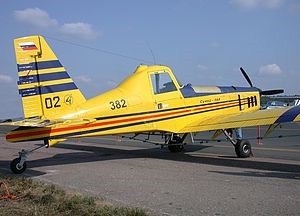
The Su-38L is a Russian agricultural aircraft, the first aircraft of this type to be designed and built by the Sukhoi Design Bureau civil aircraft section (Sukhoi Civil Aircraft (CJSC)). Design originally began in 1993 as a development of the Sukhoi Su-29 aerobatic aircraft. Development was suspended due to economic problems, and when restarted in 1998, the aircraft was redesigned, reducing the aircraft’s size and replacing the originally planned M-14 radial engine with a LOM Praha 337S inline engine. The first prototype made its maiden flight on 27 July 2001, with a second flying by June 2002. As no users had yet expressed interest in the aircraft, the project was proceeding at a low pace.
Su-38L
Engine: 1 × LOM Praha 337S, 184 kW (247 hp)
Max takeoff weight: 1,200 kg (2,646 lb)
Capacity: 500L (132 US Gallon) chemical hopper
Maximum speed: 150–180km/h (81–97 knots, 93–112 mph)
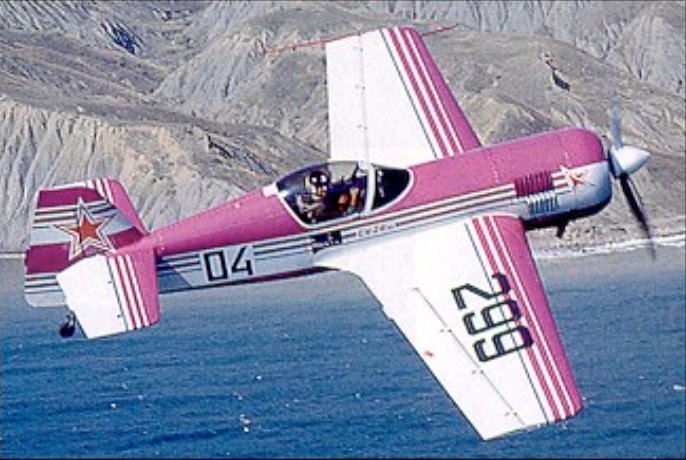
A further development of the Su-29, it has an even more impressive performance, and has sales success in the UK, Australia, the USA and elsewhere. The new wing is 70 per cent by weight composite materials. The pilot’s seat is inclined at 35 degrees, allowing an expert flyer to fully exploit the Su-31’s g tolerance of +12/-10. The first prototype flew in June 1992. In production since 1994.
Su-31 Engine: 1 x M-14PF, 300kW Max take-off weight: 968 kg / 2134 lb Empty weight: 670 kg / 1477 lb Wingspan: 7.80 m / 26 ft 7 in Length: 6.90 m / 23 ft 8 in Height: 2.76 m / 9 ft 1 in Wing area: 11.80 sq.m / 127.01 sq ft Max. speed: 330 km/h / 205 mph Ceiling: 4000 m / 13100 ft Range: 290 km / 180 miles Range w/max.fuel: 740-1200 km / 460 – 746 miles Roll rate: 400 deg/sec Max ROC: 4725 fpm
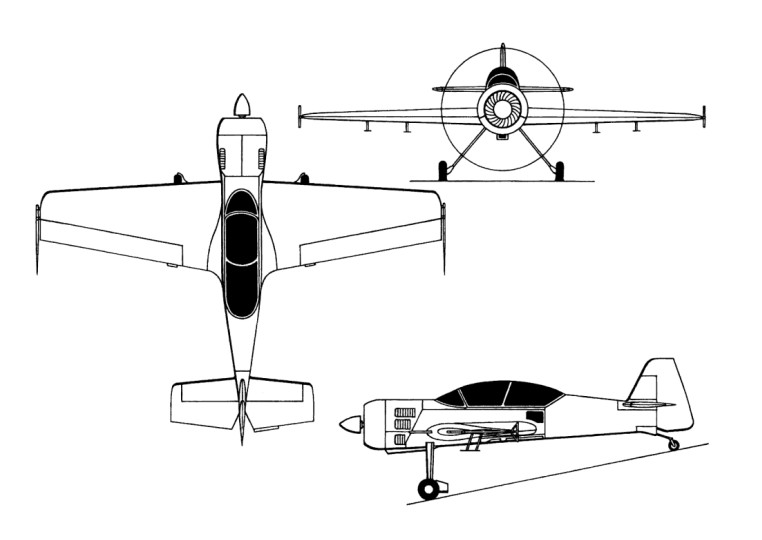
With the political changes that have occurred, the former Soviets have found an increasing desire to attract, sales abroad. The former Soviet pilots soon came to the conclusion that there was a requirement for a two seat aircraft with the same performance as the single seat Su-26, principally for training purposes, and Sukhoi developed the SU29.
The two-seat Su-29 is just 50 kg heavier than the single seat Su-26/31 models. It features a high proportion of composites in the structure including the wings and parts of the fuselage.
The two-seater is flown from the rear seat.
The Su-29 is placarded to +12/-10g but factory test demonstrated a minimum fail load at no less than 23.5g. It is impossible to achieve more than 18g in flight but the +12g limit allows a 50% safety margin.
The cockpit includes an anthropometric seat reclined at 35 degrees to increase pilot ‘g’ tolerance.
Fuel endurance is limited to about 30 minutes of aerobatic flying with a reserve, but filling up the wing tanks will give you four hours in the air at 157 knots ( 65 per cent ) plus reserve. It is stressed to plus and minus 23 g at the factory although the brochure states plus 9 and minus 7 with two persons on board and plus 11 and minus 9 solo. The engine life is 2250 hours at normal operation but restricted to 500 hours of “UNLIMITED” aerobatics. The propeller is a three bladed MT composite prop from Germany.
Su-29M is equipped with ejection seats, the lightest aircraft in the world with such a facility.
Su-29 Engine: 1 x M-14PT, 270kW Max take-off weight: 860-1204 kg / 1896 – 2654 lb Empty weight: 735 kg / 1620 lb Wingspan: 8.20 m / 27 ft 11 in Length: 7.29 m / 24 ft 11 in Height: 2.89 m / 10 ft 6 in Wing area: 12.20 sq.m / 131.32 sq ft Max. speed: 325 km/h / 202 mph Ceiling: 4000 m / 13100 ft Range w/max.fuel: 1200 km / 746 miles Crew: 1-2
SU-29 Engine: Vedeneyev M14P radial 9-cylinder, 360 hp Empty Weight: 1738 lb Gross Weight: 2684 lb Max Load: 946 lb Fuel Capacity: 71.6 Usgal / 451 lb Wing Area: 131.95 sq. ft Wingspan: 27 ft Length: 24 ft Height: 9.5 ft Vne: 273 mph Vs: 71 mph Rate of Climb: 3150 fpm Max Range: 890 sm High Speed Cruise: 183 mph Roll Rate: 360 deg/sec Takeoff Distance: 495 ft Landing Distance: 1247 ft
Su-29KS Engine: M-14P, 360 hp Max speed: 325 kph ROC: 16m/sec Range: 1200 km Loading: +10/-9 Height: 2.49 m Length: 7.22 m Wing span: 8.20 m
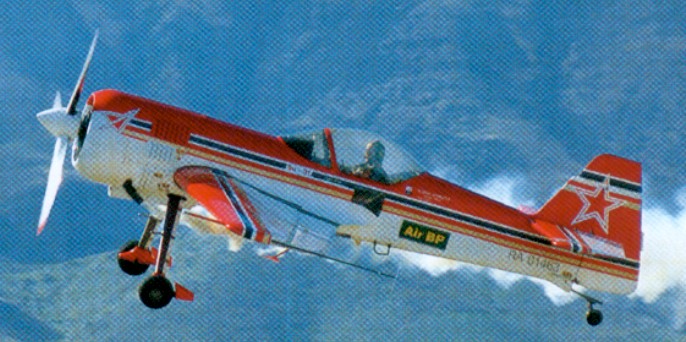
The first prototype flew on June 30, 1984, and at the World Aerobatic Competitions in Hungary 1984 western pilots saw, for the first time, the replacement for the very competitive Yak 50 and Yak 55; the standard competition aircraft of the Soviet pilots. This was the Sukhoi Su26 (originally called the Su42). The two new aircraft were prototypes with wings and tail made of foam covered plywood and apparently not well finished. They weren’t highly placed and did little to impress. It wasn’t until 1986 at the world championships in England that the western world saw for the first time the redeveloped Su26M when three aircraft arrived in tight formation. The Su26M had carbon fibre and keviar technology with extensive use of titanium in the spar and landing gear, as well as a longer wing. It was to become the standard aircraft for the Soviet team and very quickly impressed all who saw it in action. The engine never changed and is the same nine cylinder Vedenyev M 14P 360HP engine as in the Yak 55.
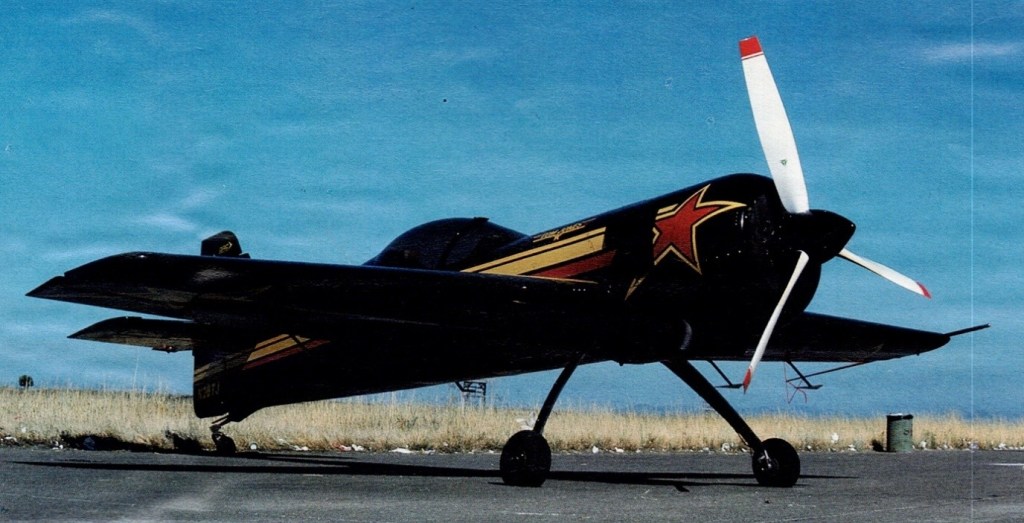
Su-26 N26TJ
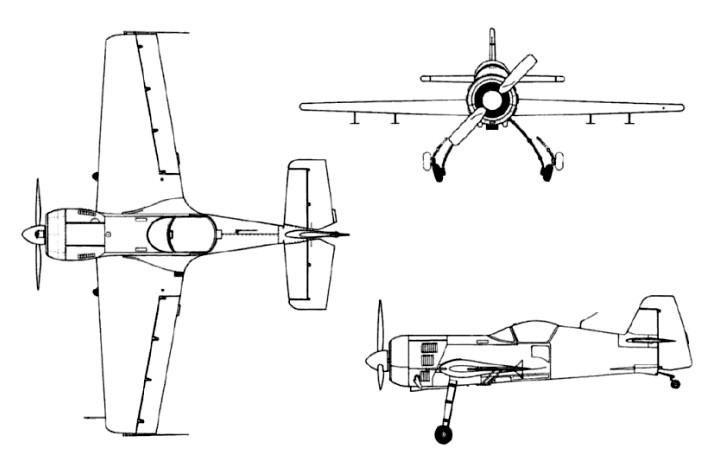
A mid-wing, aerobatic taildragger, the fuselage is made of stainless steel tube and kevlar, the wings are composite and the landing gear is titanium. The main spars are a combination of carbon fibre covered with kevlar (ultimate strength +- 28g).
With the political changes that have occurred, the former Soviets have found an increasing desire to attract, sales abroad. The former Soviet pilots soon came to the conclusion that there was a requirement for a two seat aircraft with the same performance as the single seat, principally for training purposes; a point not lost on the Sukhoi design team. Hence the development of the two seat Su29.
Su-26 Engine: 1 x M-14P piston engine, 270kW Max take-off weight: 835 kg / 1841 lb Wingspan: 7.80 m / 26 ft 7 in Length: 6.83 m / 22 ft 5 in Wing area: 11.83 sq.m / 127.34 sq ft Max. speed: 450 km/h / 280 mph Range w/max.fuel: 800 km / 497 miles Seats: 1
Su-26MX Engine: Ivchenko, 360 hp Cruise: 190 mph Stall: 60 mph Roll rate: 400 deg/sec
In 1965, the Soviet government instructed the Sukhoi design bureau to begin design studies of a new variable-geometry strike aircraft in the same class as the General Dynamics F- 111. One criteria was that the new aircraft must be able to fly at very low level in order to penetrate increasingly effective air defence systems. Conceived as a replacement for the Su-17/20/22 Fitter series fighter-bomber, the Su-24 Fencer was the first Soviet aircraft to incorporate an integrated combat avionics system combining a computer bombsight, weapons control system and anavigation/terrain avoidance system. In order to survive on the modern SAM infested battlefield, bombers would need to be capable of high speed (Mach 1 plus) low level penetrations in all weather conditions, depending on terrain masking, electronic jamming and precision weapons delivery to accomplish their mission. Lastly, in order to meet Soviet multi mission capabilities, the new aircraft would have to be adaptable to tactical reconnaissance and air interceptor missions.
An early test aircraft incorporating a delta wing VTOL (Vertical Take Off and Landing) design with separate lift and cruising engines was abandoned because of poor low level handling characteristics. Successes with the variable geometry wings of the MiG-23 Flogger interceptor and Su-17 Fitter offered another option; variable geometry allowed for acceptable performance at all altitudes and airspeeds. The first successful flight test of the Fencer-A occurred in 1970.
Initial Fencer-A production aircraft were equipped with variable aperture intakes on the engines, which allowed for a high altitude maximum speed above Mach 2, but since the Su-24 wouldn’t be spending much of it’s life at high altitude, and such speeds were not possible at low altitude, the actuators were later dropped to save weight and reduce maintenance requirements. Deliveries of the first production version, the ‘Fencer-A’, began in 1974.
Several variants were produced, culminating in the Su-24M ‘Fencer-D’, which entered service in 1986. This variant has in-flight refuelling equipment, upgraded nav/attack systems, and laser/TV designators. The Su-24MR is a tactical reconnaissance version. The Su-24 is known to NATO by the reporting name ‘Fencer’.
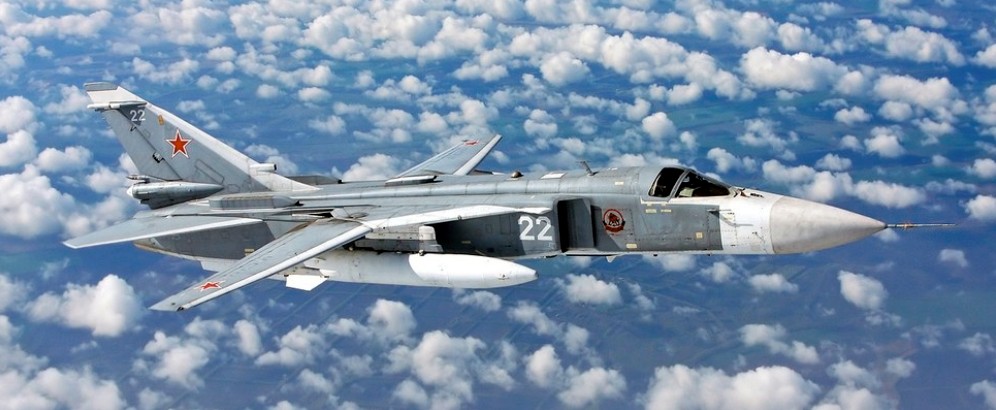
Su-24SR
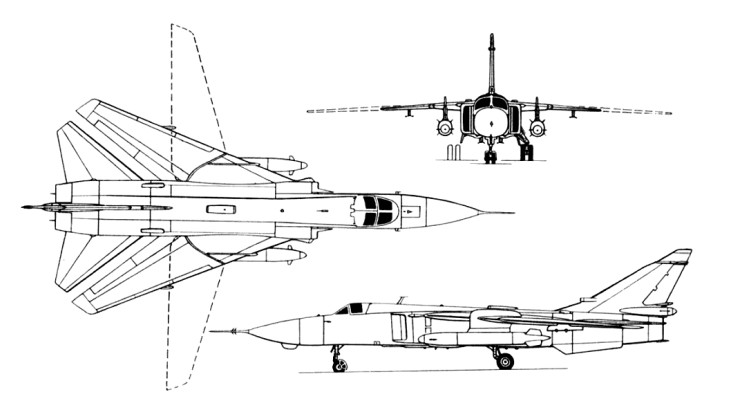
The Sukhoi Su-24 ‘Fencer’ is a Russian frontline bomber. It is capable of delivering nuclear and conventional weapons in all-weather conditions day and night. The two powerful AL-21F turbojets combined with the variable-geometry wing and a terrain avoidance system or TFR enables the Su-24 to fly low-level at supersonic speeds. The variable-geometry wing has the following settings: 16 degrees (take-off and landing), 35 degrees (cruise), 45 degrees (high speed manouvering), 60 degrees (supersonic flight). Its crew consists of a pilot and a navigator/weapons station officer which are seated side by side in the cockpit cabin (pilot port-side). Apart from the nav/attack system radar and the TFR the nose also contains a second radar scanner for ranging airborne targets.
Early production variants of the Su-24 were limited to a weapon load of 7000 kg with six hardpoints. But design changes during production soon introduced two additional under-wing pylons and another one on the centre-line under the fuselage. Now with a total of nine hardpoints the Su-24 is able to carry up to 8000 kg (17,637 lb). Two R-60 AAMs can be carried for self-defense.
The most important bomber variant of the Su-24 was the Su-24M. Also known as Fencer-D by NATO designation, this upgraded Su-24 is equipped with more advanced systems. It features an advanced nav/attack targeting system which combined with the Kaira-24 laser ranger/designator enables the use of laser-guided and TV-guided weapons. Navigation and radio communication systems were also upgraded. The addition of an in-flight refuelling system greatly improved the aircraft’s range and flexibility.
The Su-24MR is a dedicated tactical reconnaissance version of the Su-24M. All weapon systems were removed to make space for the recce equipment. The Su-24MR is equipped with a complex system of sensors and cameras. It has radar-tracking equipment, infra red and television cameras, panoramic and perspective photo cameras, but also laser and radiation detection systems. The systems can be operated manually or automatically. The Su-24MP is another variant based on the Su-24M upgrade. The Su-24MP is a electronic warfare (EW) platform. The jamming equipment is situated in a container on the centre-line below the fuselage. Just like the Su-24MR it has lost its Air-to-Ground capability, but can be equipped with 2 or 4 R-60 IR-guided missiles for self defense.
Su-24MK is the export variant of the Su-24M which was developed for friendly Arabian nations. There are almost no differences between the Su-24MK and the original Su-24M. Reportedly 20 aircraft were exported to Syria, 15 to Libya, and 24 (some say 25) to Iraq. During 1990 Russia delivered 12 Su-24MK Fencers to the the Islamic Republic of Iran Air Force (IRIAF). The IRIAF has modified these aircraft to use Western weapons, such as the C-802 Noor anti-ship cruise missile. After Operation Desert Storm began, Saddam sent 24 Iraqi Su-24MKs to Iran. These have since been integrated in the IRIAF Su-24 fleet. In 2002 all Iranian Su-24s were modified with inflight refuelling probes to receive fuel from the IRIAF KC-707 tankers.
Su-24M2 is an upgrade of the baseline Su-24M model by Russia’s Gefest company. The Su-24M2 is equipped with a new advanced SVP-24 computer plus the latest software, which improves navigational accuracy and non-guided weapon delivery precision. The 4th Combat and Conversion Training Centre (CCTC) based at Lipetsk has been running the operational evaluation program for the new upgrade since a few years. At least five Russian Air Force aircraft have been upgraded to Su-24M2 standard and reportedly also seven Su-24MK aircraft delivered to Algeria have been upgraded.
The Fencer entered service in 1974. Four versions have been identified, the latest in 1983. Fencer B differs from Fencer A in having a brake parachute bullet fairing at the base of the fin. Fencer C, introduced in 1981, has this feature as well as radar homing and warning receiver antennas on the fin and intakes. Fencer D has detail differences, including an under-fuselage reconnaissance sensor and in-flight refuelling capability.
There are some 835 Su-24 Fencer variable-geometry interdictor/strike aircraft in Soviet service in 1987, and production continued until 1992. The aircraft equipping Soviet strategic, tactical, and naval air forces.
Su-24 (Fencer-A) Engine: 2 x turbojet. Installed thrust (dry / reheat): 150 / 215 kN Span: 17.5 m / 10.5 m Length: 21.3 m Wing area: 42 sq.m Empty wt: 19,000 kg MTOW: 41,000 kg Warload: 11,000 kg Max speed: 1.2 Mach Ceiling: 17,500 m Combat radius: 950 km
Su-24 (Fencer-C) Engine: 2 x turbojet. Installed thrust (dry / reheat): 150 / 215 kN Span: 17.5 m / 10.5 m Length: 21.3 m Wing area: 42 sq.m Empty wt: 19,000 kg MTOW: 41,000 kg Warload: 11,000 kg Max speed: 1.2 Mach Ceiling: 17,500 m Combat radius: 950 km
Su-24M (Fencer-D) Powerplant: two 109.8 kN (24,690 lb st) Saturn/Lyulka AL-21F-3A afterburning turbofans Length 24.59m (80 ft 8.25 in) Height 6.19m (20 ft 3.75 in) Wing span fully swept 10.36m (34 ft 0 in) Wingspan fully spread 17.64m (57 ft 10.5 in) Wing area: 51.0-55.2 sq.m / 548.96594.17 sq ft Take-off (‘clean’) 19.000 kg (41,885 lb) Max Take-Off Weight 39,700 kg (87,520 lb) Max level speed at 11,000m (36,090 ft) Mach 2.2 / 2.320 km/h / 1,441 mph Ceiling 17,500m (57,415 ft) Range w/max.fuel: 2500 km / 1553 miles Range w/max.payload: 560 km / 348 miles Armament: one 23 mm GSh-6-23 six barrel gun or one 30 mm GSh-6N-30 six barrel cannon in later versions Bombload: 8000 kg (17,637 lb) Hardpoints: 8 Crew: 2
In second quarter of 1960 Sukhoi proposed the Su-15-40 interception system, consisting of the Su-15 aircraft, Vikhr-P radar (reduced version of the Smerch radar of the Tu-128) and K-40 (AA-6 ‘Acrid’) missiles. Compared to the Su-11-8M complex, the new system offered better range, maximum launch distance and could launch from any direction including head-on. Construction of five Su-15 (designated T-58) prototypes began in mid-1960, equipped with a single AL-7F2 engine and rectangular side air intakes, based on experience with the P-1 and T-49.
On 5 February 1962, the resolution approving the Su-15 construction passed, but required it to be a modernised Su-11. The ‘first stage’ Su-15 aircraft were to be equipped with modernised armament system from the Su-11, consisting of the Oryol-D58 radar and K-8M1 missiles. ‘Second stage’ aircraft were to be equipped with the new Smerch-AS (Taifun) radar and K-8M2 (R-98) missiles.
Development of a single-seat interceptor fighter providing better supersonic performance while (initially) preserving a fundamentally similar wing was begun as the T-5 in the late ‘fifties. This was a larger aircraft than the preceding T-43 and was powered by paired Tumansky R-11 turbojets with lateral air intakes. Retaining the tailed-delta configuration and 57 degree sweepback at wing quarter chord, the interceptor was built as the T-58 prototype and flown on 30 May 1962
Sukhoi failed to retain its place in the work schedule of the Novosibirsk factory. Yakovlev’s Yak-28P ‘Firebar’ replaced the Su-11 on the production line at Novosibirsk. 443 aircraft were built between 1962 and 1967. The Su-15 needed to be largely superior to the Yak-28P in order to have it enter series production. The Su-15 proved much better with the exception of its range. The Yak-28’s configuration of engines in underwing nacelles limited its performance and flight handling. In 1964 Yakovlev introduced the Yak-28-64 with a configuration similar to the Su-15, but to no avail.
State acceptance tests of the T-58-8M1 interception complex started in August 1963, later the K-8M1 missiles were followed by the K-8M2. On 3 April 1965 the T-58-8M2 was officially commissioned and designated Su-15-98 consisting of the Su-15, RP-15 (Oryol-D58) radar and R-98 (K-8M2) missiles. In 1966 series production at Novosibirsk began, the first pre-series Su-15 made its first flight from Novosibirsk on 6 March 1966. The superiority of the Su-15 over the Yak-28P was obvious and the production line was cleared.
As the Su-15, 10 examples participated in the July 1967 air display at Domodedovo. Flagon B was an experimental derivative exhibited at Domodedovo in 1967, but not seen since. Three lift jets mounted in the centre fuselage conferred STOL (short take¬off and landing) performance, and the outer 40% of each wing was of reduced sweep, thereby increasing area without extending the tips.
The initial version, effectively confined to a large pre-series for service evaluation, possessed a wing similar to that of the Su-9 and Su-11, with some 30cm removed adjacent to the fuselage each side. The Oryol-D Al radar and two R-8 AAMs were fitted, and power was provided by two R-11F2S-300 turbojets each rated at 3900kg and 6200kg with max afterburning. The virtually pure delta wing gave place on the next version, the Su-15T (the suffix signifying introduction of Taifun radar), to a cranked leading edge with outboard sweepback reduced to 47 degrees, overall span remaining unchanged. Su-15T production was limited to 10 aircraft delivered during 1969.
The Su-15 Flagon A has a classic mid-wing monoplane layout with a highly swept 57 degree delta-shaped wing and tailplane. This layout is very similar to that of its predeccessors Su-9 and Su-11 as well as the contemporary MiG-21. The Su-15 different from these designs by having two engines and lateral air intakes. This arrangement of the air intakes was needed to enable the use of a larger antenna for the radar, needed to increase the detection range of the radar. The Lyulka AL 21F 3 turbojets, each producing 7800 kg (17200 lb) of dry thrust and 11200 kg (24700 lb) with afterburning were arranged side-by-side, being fed from ram¬type intakes with splitter plates mounted on the fuselage sides. Variable area nozzles are used.. The tricycle landing gear consisted of a front leg with a single wheel retractable into the fuselage and main carriage consisting of single wheels, which retract inwards into the wing compartments.
Late production series Su-15 received a number of aerodynamic changes to improve handling characteristics during take-off and landing. The new wing features a greater surface area and the other sweep angle was decreased to 45 degrees, resulting in the so called ‘cranked-delta’. The new wing reduced the landing and take-off speeds as well as the induced drag in flight. NATO recognised the rewinged aircraft as ‘Flagon-D’.
The aircraft also received a UPS boundary layer control system and R-11F2SU-300 engines adapted to the UPS. The UPS system blowns air from the engine compressor to the surface flaps, enabling higher deflection angles of the flaps, 45 for landing and 20 degrees for take-off. However the engine compressors delivered insufficient power, and deflection remained limited to 25 and 15 degrees respectively.
Apart from new weapons and avionics, the ‘second stage’ Su-15T/TM received also the new R-13-300 turbojects. The R-13-300 was more poweful and slightly improved acceleration and range. It also enabled full use of the UPS system. The air intakes were slightly bigger to accodomate the greater airflow required for the R-13s. The aircraft also received a longer front undercarriage leg to improve wing incidence at take-off and reduce the danger of foreign objects damage (FOD).
Late production Su-15TM received ogive shaped radome (bullet shaped) replacing the more aerodynamic cone design. The cone shape caused the more powerful Taifun-M radar to produce inner reflections of the radar pulse in the nose.
The basic Su-15 was fitted with the RP-15M Oryol-D58M radar (NATO ‘Skip Spin’), a modernised variant of the Oryol-D58 radar with better resistance to jamming. The Oryol-D58 was developed from the Oryol radar of the Su-11 and was fitted with a larger antenna. ‘Second Stage’ Su-15T aircraft were equipped with the more powerful Taifun radar, based on the Smerch-A radar of the MiG-25P. It was only fitted to 10 Su-15T aircraft, all subsequent Su-15 production aircraft (Su-15TM) features the improved Taifun-M (NATO ‘Twin Scan’). The Taifun-M was the last of the first generation of Russian fighter radars.
The Su-15 was equipped with the Lazur-S (ARL-S) command datalink, the onboard component of the Ground Controlled Intercept (GCI) system. The ground based operator could transmit commands via UHF radio or via the encoded datalink. In case of the datalink, the Lazur-S would receive, decode and transmit the commands to the pilot in the form of course, speed and altitude indicators as well as single message as ‘afterburner on’, ‘radar on’ etcetera. After having been guided to the target by GCI commands, the target could then be engaged using the Su-15’s onboard radar.
The Su-15TM was equipped with the Lazur-SM and SAU-58 automatic control system enabling fully automatic mode in which the modernised Vozdukh-1M GCI system directly transmitted commands to the aircraft’s control, without pilot intervention. The automatic system could guide the interceptor to the target, engage the radar, launch the missiles at the target, exit from the attack, return to base and enter landing approach to an altitude of 50-60 meters.
Late production Su-15TM were fitted with the modified SAU-58-2, which was able to read low-altitude radio altimeter data. The Vokdukh-1M GCI system could now guide the Su-15TM at low altitude (200 meters) and intercept low-flying targets, which could not be tracked by the Taifun radar because it could not distinguish targets against the ground background. But pilots refused these low level flights with the Su-15TM. By now the MiG-23 with Doppler radar had become available and developement ceased.
Other avionics included IFF, Sirena-2 (Sirena-3 on Su-15TM) Radar Warning Receiver (RWR), and navigation equipment.
The cockpit is fitted with the KS-4 ejection seat designed by Sukhoi. In the top center of the instrument panel a single hooded display is located for the radar. A simple K-10T sight is installed to aim the R-69 missiles and cannons.
The Su-15UT and Su-15UM are two trainer variants, with the cockpits placed in tandem, although with seperate canopies. For communication between the cockpits an intercom is used. The instructor cockpit also features a retractable periscope providing forward vision for the instructor during landing.
The Su-15 carried two medium range air-to-air missiles of the K-8 (AA-3 ‘Anab’) family on underwing PU-1-8 (later PU-2-8) launchers. The K-8 range of missiles were developed as part of the interception system aimed at destroying enemy bombers. Although the Su-15 as part of the Su-15-98 was originally intended to carry the R-98 (K-8M2) missile, initially the R-8M1 (K-8M1) was also used. With the Taifun-M radar, the Su-15TM was equipped with the improved R-98M (K-8M3). All of these missiles were available with IR or semi-active radar seeker, normally the Su-15 is seen carrying one of each variant.
Later the IR-guided R-60 short-range missile was added to the Su-15s inventory by adding two small innerwing pylons. The underfuselage pylons were replaced by the BD3-59FK type, enabling carriage of the UPK-23-250 gun containers as well as a number of unguided air-to-ground weapons. The new PU-2-8 pylons could also carry unguided air-to-ground weapons. However the Su-15 lacked the fire control systems needed for effective delivery of these against ground targets.
In 1967 the first Su-15 entered service with the 148th Pilot Combat Training Centre of the Soviet Air Defence Forces ( Protivo Vozdushnaya Oborona – PVO) at at Savasleyka. 611th IAP at Dorokhovo, near Moscow, was the first operational unit to receive the Su-15 and began military operational tests in September 1967 with 10 series production aircraft which continued until July 1969. The Su-15 gradually replaced the Sukhoi Su-9 and Su-11 and Yakovlev Yak-25M and Yak-28Ps.
While the Su-15 was in series production, a number of improved design features were developed, tested and subsequently introduced with a new production series. The most important change in the basic Su-15 variant was the new cranked wing design, and later the addition of short range weapons. Another improvement was the new ogival radome on late production Su-15TMs, as discussed earlier as well. Unlike the West, the Soviets did not perceive these improved production series aircraft as new variants.
Development of a two-seat training version of the Su-15 began in 1965 as soon as the Su-15 was approved for serial production. In 1965 the PVO preferred a combat capable trainer, and in October that year the committee approved the U-58 design which only differed in having a two-seat cockpit. A U-58 prototype was planned to be built in 1967, but the choice of radar delayed the production. The U-58 had originally be planned with the Korshun-58, a development of the Oryol radar. However in 1967, the Taifun radar was favoured.
A two-seat trainer was desperately needed, since the single-seat Su-15s were rolling of the production line. Development of the trainer was divided in a simple U-58T training version without radar and reduced avionics and a fully capable U-58B. Flagon C is a two seat trainer with secondary combat capability.
The U-58T featured a lengthened fuselage, two-seat cockpit, slightly reduced internal fuel capacity, and lacked the radar and weapons. The U-58T prototype made its first flight on 26 August 1968 and completed state acceptance tests on 3 July 1970 receiving the Su-15UT designation. Series production was started in the same year and continued until 1972.
The definitive wing appeared on the Su-15TM (Taifun modifikatsiya) which became the major production version in 1972 and achieved operational status in the second half of 1973. This introduced a further variation of the cranked planform with a span extension of 60cm, the improved Taifun-M radar, and Gavrilov-developed R-13F-300 turbojets rated at 4237kg and 6600kg with afterburning. Armament, too, was upgraded, two additional wing pylons being introduced inboard and a pair of IR-homing R-23TE and two radar-guided R-23RE AAMs normally being carried. Twin pods each containing a twin-barrel 23mm cannon could be carried side-by-side on fuselage pylons. From 1975, the conical radome was replaced by one of ogival shape, production of the Su-15TM ending in the late ‘seventies after manufacture of some 1,500 interceptors of this type.
The U-58B prototype with Taifun radar made its first flight on 24 June 1970, but tests were stopped soon because of the forward shift in gravity caused by the radar.
Since the second half of 1973, the Flagon-D has been joined in the ranks of the IAP-VO Strany by an appreciably more effective model, the Flagon-F, with uprated avionics signified by an appreciably larger radome and more powerful turbojets indicated by enlarged intakes and intake ducting. It would seem probable that, whereas the Flagon-C and -D are powered by a pair of Lyulka AL-7F engines, the Flagon-F has two Lyulka AL-2lFs. Flagon D and E have compound sweep wings similar to those adopted for Flagon 13, and Flagon E which has been in service since the second half of 1973 additionally has more powerful engines and uprated avionics. The larger radar dish results in an original nose radome.
The Su-15-98 system was named the first stage of the Su-15 interceptor programme. With the new Taifun radar and R-98M missile, the new Su-15TM would create the Su-15-98M interception system to operate with the modernised Vozdukh-1M CGI system. On 31 Janary 1969 the first T-58T modernised interceptor with Taifun radar started its test programme. Before testing had been finished, series production began and 10 Su-15T aircraft were produced in 1970-1971, before it switched to the T-58M with Taifun-M radar, designated Su-15TM for service. This new version of the Taifun corrected some problems encountered during testing. The Taifun-M was far more powerful than the Oryol radar which resulted in a longer range, but also neccessary adjustments to the radome shape.
The last variant to enter series production was the Su-15UM trainer. This new combat capable trainer was based on the Su-15TM. This time the fuselage length and internal fuel tanks remained unchanged from the Su-15TM and only the radar and some avionics were removed to accomodate the instructor cockpit. Although just like the Su-15UT, it did not carry the radar, it was combat capable using the heat-seeking R-98MT and R-60 missiles as well as the gun pods. The last two were introduced to all Su-15s versions by now. The U-58TM prototype was first flown on 23 April 1976 and state acceptance tests had been completed by 25 November 1976. A small number of Su-15UM were produced between 1976 and 1979.
Standard armament is a pair of AA 3 Anab air to air missiles, one fitted with an infrared seeker and the other employing semi active radar guidance; the missile pylons are mounted beneath each outer wing panel. Twin side by side fuselage pylons are pro¬vided for 600 litres (132 Imp gal) auxiliary fuel tanks and some aircraft carry twin 23¬mm (0.90 in) GSh 23 cannon forward of these pylons. Fire control and illumination for the radar guided A A 3 are provided by an X¬band Skip Spin radar, with an effective range of 40 km (25 miles), mounted in the Su 15’s nose. Later versions may be fitted with the AA 6 Acrid or AA 7 Apex air to air missiles, possibly in conjunction with a derivative of the MiG 25’s Fox Fire radar.
The introduction of transistors meant the end of the Su-15 development as well as the production of armed variants. Production stopped in 1975 with only the Su-15UM trainer being produced until 1979. In the 1970s the Sapfir-23 radar had been developed for the MiG-23 ‘Flogger’ using transistor technology and Doppler effect. The MiG-23 radar could distinguish low flying targets against the ground, such a look-down/shoot-down capability was impossible for the Su-15TM. Sukhoi attempted to make the Su-15TM more capable against low flying targets by introducing the SAU-58-2 flight control system, enabling very low-level flight. However the MiG-23 also proved to have much better performance. From the MiG-23ML the MiG-23P interceptor version was developed for the PVO by integrating it systems with the Vozdukh-1M CGI system.
The Su-15 aircraft combined with its Oryol-D58 radar and R-98 missiles formed the Su-15-98 interception complex and was operated within the Vozdukh-1 ground controlled incept (GCI) system of the Soviet Air Defence forces (PVO). Entering service in the 1970s the modernised Su-15TM version was equipped with the Taifun-M radar and R-98M missiles, forming the Su-15-98M complex. The Su-15 together with its bigger brother the MiG-25 guarded the Soviet airspace throughout the 1970s and 1980s until gradually replaced by the more capable Su-15TM and later the MiG-23P, which also meant the end of further Su-15 developments. By the end of the 1980s all older Su-15 and Su-15UT versions had been withdrawn from service, by then also the MiG-31 and Su-27 advanced interceptors had entered service. However most of the Su-15TM fleet were not replaced but scrapped in the early 1990s as required by the Conventional Forces in Europe (CFE) treaty.
A total of 1290 aircraft were produced between 1966 and 1979 at the state aircraft production plant in Novosibirsk, a small number continued service in the Ukrainian Air Force until 1996.
The aircraft was liked by its pilots for its safety, resulting from its two engines, automatic landing approach system and light handling. However it became also infamous because of its involvement in dubious shoot-downs of several civil airliners, in particular KAL007 which killed 269 civilians.
Events: 10 Jan 1960 – First flight of T-49 experimental prototype, by Anatoliy Koznov Spring 1960 – Su-15 name first appears in Su-15-40 interception system proposals 5 Feb 1962 – Resolution on building the Su-15 (T-58) passed 30 May 1962 – First flight T-58D-1 prototype from Zhukovskiy field, by Vladimir Ilyushin 4 May 1963 – First flight T-58D-2 prototype, by Vladimir Ilyushin Aug 1963 – State acceptance trials for T-58-8M1 interception complex started 2 Oct 1963 – First flight T-58D-3 prototype 3 Apr 1965 – T-58-8M2 interception complex commissioned, designated Su-15-98 6 Sept 1965 – First flight T-58L (converted from T-58D-2) with skids, by Vladimir Ilyushin 1966 – Start Su-15 Series production at Novosibirsk factory 1966 – T-58D-1 and pre-series Su-15 test new cranked wing design. 6 June 1966 – First flight T-58VD (converted from T-58D-1) STOL prototype, by Yevgeniy Solovyov 1967 – Service entry Su-15 with PVO Sept 1967 – Start military operational tests with 10 series aircraft from 611th IAP 26 Aug 1968 – First flight U-58T (Su-15UT) trainer, by Yevgeniy Kukushev 31 Jan 1969 – First flight T-58T (Su-15T) with Taifun radar, by Vladimir Krechetov Jul 1969 – End military operational tests 1969 – From 11th series onwards, production aircraft receive new wing and UPS system. NATO ‘Flagon-D’ 24 June 1970 – First flight U-58B combat trainer, by A. Gribaschev 3 July 1970 – U-58T completes state acceptance tests and is designated Su-15UT. NATO ‘Flagon-C’ 18 Aug 1970 – Start of state acceptance tests for T-58TM (Su-15TM) with Taifun-M radar. 1970 – Start of series production Su-15T and Su-15UT at Novosibirsk Dec 1971 – Su-15T production switched to Su-15TM. May 1972 – First flight experimental T-58R with TFR. 3 July 1972 – First flight Su-15bis (converted series Su-15TM) at Novosibirsk 20 Dec 1972 – Su-15bis completes tests successfully. 1973 – Start of fitting new-build and existing Su-15 aircraft with small inner-wing pylons for R-60 5 Apr 1973 – End of state acceptance tests Su-15TM. NATO ‘Flagon-E/F’ 22 Jan 1974 – T-58D-2 on display at the Monino Museum 21 Jan 1975 – Government resolution for commissioning of the Su-15-98M interception complex finally passed. 15 Feb 1975 – Military tests of Su-15TM start at 148th PVO Pilot Combat Training Centre at Savasleyka. 1975 – End of Su-15TM serial production. 2 Apr 1976 – Su-15 intercepted a Japanese P-2V Neptune patrol aircraft when it penetrated Soviet airspace near Sakhalin Island. The Su-15 fired two missiles, but missed the target. 23 Apr 1976 – First Flight U-58TM combat trainer at Novosibirsk, piloted by Vladimir Vylomov and V. Belanin 25 Nov 1976 – State acceptance tests for U-58TM completed, designation Su-15UM assigned. NATO ‘Flagon-G’ 1976 – Peak year, Su-15s account for 98.700 flying hours this year 20 Apr 1978 – Two Su-15TM (431st IAP, Afrikanda) piloted by Captain A. Bosov and Captain Gromov intercept Korean Air Lines (KAL) Boeing 707 when it entered Soviet airspace near Murmansk, flying from Paris to Canada. After signalling failed, Bosov was ordered to shoot it down. He fired a R-60 missile, destroying the left outer engine and wingtip. The 707 made a forced landing on frozen Lake Korpiyarvi, 30km from the border with Finland. Among 110 passengers and crew, two had been killed. 20 Jul 1978 – Military tests of Su-15TM completed. 1979 – End of Su-15UM series production, last Su-15 made, a total of 1290 Su-15 aircraft were produced. 18 Jul 1981 – Su-15TM (166th IAP, Sandar) piloted by Captain V. Kuliapin intercepts Argentine Canadair CL-44 transport coming from Iran over Georgia. Kuliapin rammed the target crashing both aircraft. Kuliapin ejected and survived. (also reported to have been Su-15T) 8 Aug 1981 – According to ACIG.org, Su-15TM piloted by Captain O. Terbanov shoots down Argentinian DC-8 using R-98 missile. 31 Aug 1983 – Su-15TM ‘Red 17’ (41st IAP, Sakhalin) piloted by Major G. Osipovich intercepted Korean Air Lines flight KAL-007 en route from Canada to Korea, having strayed from its route several hundred kilometres entering Soviet airspace. The Boeing 747-200 was shot down by two R-98 missiles killing all 269 passengers and crew. 1990 – According to official CFE data, the PVO had 230 Su-15s based in the European and 90 more in the Asian part of the USSR. 2 Sept 1990 – Last known combat action. Su-15TM, piloted by Captain I. Zdatchenko, shoot down a reconnaissance balloon at 12000m (39,140ft) over the Kola Peninsula. 19 Nov 1990 – CFE treaty signed, Soviet combat aircraft in Europe had to be reduced to 5150, 1461 aircraft had to be withdrawn. 17 July 1992 – CFE treaty goes into force, remaining Su-15s are scrapped 17 Mar 1993 – At Samara AB, the first four Su-15s are scrapped in the presence of Western representatives for the CFE treaty 1996 – Remaining Ukrainian Su-15TM of the 62nd Air Defence Fighter Regiment, based at Belbek, are mothballed.
Variant Overview
Development/Pre-Production Prototypes:
T-58 (1) Original Su-15 (T-58) aircraft for the Su-15-40 interception system powered by a single Lyul’ka AL-7F2 turbojet. The aircraft was based on the Su-11, but had rectangular side intakes, drawing on experience with the experimental P-1 and T-49. The front air intake of the Su-11 design was not suitable because of the large Oryol radar. Construction of prototypes not completed, but airframes used for T-58D.
T-58 (2) Alternative T-58 design with two Metskhvarishvili R-21F-300 turbojet engines, uprated version of the R-11F-300 engine (MiG-21).
T-58D-1 First prototype adapted for two engined layout. Received less powerful R-11F2S-300 engines, since R-21 engine was not ready yet. Air intakes were increased in size for greater air flow required by the R-11 engines, giving the aircraft a slim waist. It was not yet equipped with radar and thus had a shorter nose. First flight 30 May 1962. Several improvements were introduced in 1963-64. In January 1965 the T-58D-1 received new cranked wings and eventually transformed into the T-58VD STOL testbed.
T-58D-2 Second prototype. First flight on 4 May 1963. It was equipped with the Oryol-D58 radar resulting in a longer and wider nose than on the T-58D-1. Later, the T-58D-2 was used as testbed, T-58L.
T-58D-3 Third prototype, first flown on 2 October 1963. Revised fuselage shape. Central part (waist) of the aircraft was straightened adding space for additional fuel tanks. In 1965-1967, the T-58D-3 was used for testing the modernised Oryol-D58M radar and SAU-58 flight control system.
T-59 Parallel development for an interceptor fighter configuration. T-59 has the TsP radar and engine intake similar to that of the T-49.
T-60 Another development similar to the twin-engined T-58 but with oblique rectangular air intakes similar to those of the MiG-25.
Basic Su-15:
Su-15 (T-58D) T-58D was the first version to enter series production. Being designated Su-15 it entered service in April 1965, ASCC NATO designation Flagon-A. Full-scale production began in 1966 and continued until the end of 1970. Initially operated with R-8M1 missiles. It was equipped with the RP-15M Oryol-D58M radar and Tumanskiy R-11F2S-300 turbojets.
T-58M Project based on the modification of the Su-15 into a tactical bomber with vertical lift engines. The design extensively changed the fuselage design with additional air intakes on top and exhausts under the fuselage. The project ultimately resulted in the Su-24.
T-58VD T-58VD (vertikal’nye dvigateli, or vertical engines), NATO Flagon-B, was a testbed for the vertical engine configuration for the T-58M. Converted from T-58D-1 prototype, three small 2350kg Koliesov RD36-35 engines were placed vertically inside the fuselage for short take off and landing. First flight 6 June 1966 by Yevgeniy Solovyov. Tests ran until June 1967. Demonstrated at Domodedovo in July 1967, because of reduced room for fuel in the fuselage because of the engines, range was unsufficient for further development.
Su-15UT (U-58T) Trainer resulting from the U-58 project for a two-seat training version of the Su-15. To speed up development of a trainer, it was decided to remove radar, datalink and RWR. The prototype maiden flight took place on 26 August 1968. Series production started in 1970 and continued until 1972. The fuselage was lenghtened by 45cm and the front fuel tank was reduced by 900 litres, to make room for the instructor cockpit behind the front cockpit. This was somewhat compensated with an additional 190 litre tank in the rear fuselage. A retractable periscope provided forward vision for the instructor. Often Su-15UT can be seen fitted with dummy R-98 missile. NATO ‘Flagon-C’.
U-58B Designation for the armed version of the U-58 trainer, as requested by the PVO back in 1965. One prototype of the two-seat combat trainer was built, fitted with Taifun radar. First flight 24 June 1970 by A. Gribachev. Tests stopped because of unacceptable forward shifted centre of gravity caused by the radar.
Su-15 1969 onwards From the 11th production series in 1969, the Su-15 was fitted with a new wing to reduce take-off and landing speeds and inflight induced drag. The cranked wing with the outer panel swept at 45 degrees was tested on the T-58D-1 prototype in 1966. The aircraft was also fitted with a UPS system, which uses blown air from the engine compressor to enable higher flap deflection. Engines adapted for UPS were designated R-11FSU-300. However the compressors delivered insufficient airflow to make the system effective. NATO designation for rewinged aircraft was ‘Flagon-D’, Soviet designation remained Su-15.
Su-15 1973 onwards From 1973/1974 all new-build and existing aircraft were fitted with K-10T sight and small inner-wing pylons to enable armament of R-60 missiles.
Su-15-30 (T-58D-30) Project in 1966-67 proposing fitting the Su-15 with Smerch-A radar and K-40 missiles of the MiG-25P. The aircraft would also be fitted with two D-30 turbofan engines.
Su-15Sh (T-58Sh) Design proposal for a supersonic ground-attack aircraft in 1969-1970 based on the Su-15. The MiG-27 won the competition.
T-58N Designation used for the proposal of a modernised Su-15 capable of deploying nuclear tactical weapons.
Second Stage Su-15:
Su-15T (T-58T) Su-15 fitted with the Taifun (Typhoon) radar, a variant of the Smerch-A radar from the MiG-25P modified for the reduced space and electrical power of the Su-15. The Su-15T was also fitted with more powerful R-13-300 engines, adjusted air intakes, a longer front leg, SAU-58 automatic flight control system, and some new and upgraded navigation, communication, datalink and RWR. The new engine resulted in slight improvement of acceleration, range, and enabled proper operation of the UPS system. First flight 31 January 1969 by Vladimir Krechetov. Ten Su-15T were built in 1970-71 when defects in the Taifun were revealed.
Su-15U (T-58U) Alternative proposal to Su-15T, fitting the aircraft with the Korshun-58 radar. Work started in 1965 but was cancelled in favour of the Su-15T in 1967.
Su-15TM (T-58TM) (early) Fitted with the modernised RP-26 Taifun-M radar, series production of the Su-15TM was started in Late 1971. The Su-15TM was part of the modernised interception complex designated Su-15-98M, together with the R-98M (K-98M) missiles. The Su-15TM also had the modifications of the Su-15T and late production Su-15 aircraft, including provision for underbelly gun pods and the additional wing pylons for R-60 missiles. NATO ‘Flagon-E’.
Su-15TM (T-58TM) (late) The cone shaped radome was unsuitable for the more powerful Taifun-M radar and resulted in unwelcome radar pulse reflections inside the aircraft nose. Late production models, starting with the 8th series, were therefor fitted with an ogival shaped radome. The underfuselage pylons were replaced with a type capable of the UPK-23-250 gun pods as well as boms, rockets, or tanks. Also the underwing pylons were replaced and made capable of these weapons. Late production aircraft fitted with the SAU-58-2 flight control system and Vozdukh to intercept low-attitude targets. NATO recognised the Su-15TM with ogival nose, as a new variant, and designated it ‘Flagon-F’. Also western sources reported the designation Su-21 for this variant, but this was never used by Russian sources. Production ceased in 1975.
Su-15UM (U-58TM) Two-seat combat trainer developed from the late production Su-15TM. Length of the fuselage and internal fuel tank capacity remained the same this time. Although the Su-15UM has no radar, it was fitted with the ogival shaped radome anyway. But it lacked the SAU-58, datalink, RWR and navigiation system of the Su-15TM. It could be armed with R-98MT and R-60 IR-guided missiles as well as gun pods. First flight U-58TM prototype 23 April 1976 by Vladimir Vylomov and V. Belanin. Small number produced between 1976 and 1979, last series produced Su-15. NATO reporting name ‘Flagon-G’.
Su-15bis (T-58bis) Converted Su-15TM aircraft with R-25-300 engines. The additional thrust resulted in improved acceleration and speed at low altitude. Also ceiling and range were improved. Testing took place from 3 July until 20 December 1972. The Su-15bis passed the tests, but never entered series production because of an insufficient rate of production of the R-25-300 engine for both Su-15bis and MiG-21bis, the latter was considered more important.
Su-15 Flying Testbeds:
T-58L L stands for Lyzhnyi = skid. T-58D-2 with lubricated skid landing gear and longer front leg installed. First flight 6 September 1965, tests continued until 1973. Landing skids were abandoned but the longer front leg entered production on Su-15T produced since 1969.
T-58R Designation used for a series produced Su-15 with Relyef terrain-following radar installed in the nose instead of the radar. First flight in May 1972. Relyef was destined for the Su-24.
LLSu-15 Su-15 with bort number 16 used by the Flight Research Institute at Zhukovsky for testing Soviet chaff and flare dispensers for self defence of aircraft of various classes. Later also used for electronic warfare devices. In 1981-82 the LLSu-15 tested changeable inflight stability and steerability, and a side control stick.
Su-15 IFR First pre-series aircraft (c/n 0015301) was used in 1974 for testing an inflight refuelling system for tactical aircraft within the Sakhalin-6A programme carried out for the Su-24 (T-6). The aircraft carried a refuelling UPAZ pod suspended under the fuselage. Su-15TM (c/n 0215306) was equipped with a fixed refuelling probe on the right of the nose. The Sakhalin system is now common on Russian aircraft, although it was not used by the Su-15.
Notes:
Su-15 designation was also used for Sukhoi’s earlier twin-engines swept-wing interceptor design, which was designated ‘P’ internally. The prototype first flew on 11 January 1949 and was lost on 3 June 1949. A second prototype was never finished.
Su-21 is an incorrect designation for late production Su-15TM, given by Western press.
Specifications:
Su-15 (early) Overall length: 21.44 m Length excl probe: 20.54 m Wing span: 8.616 m Height: 5.00 m Wing area: 34.56 sq.m Empty weight: 10,220 kg Internal fuel: 5,600 kg Normal take-off weight: 16,520 kg Max take-off weight: 17,350 kg Max speed high alt: 2,230 km/h Max speed SL: 1,200 km/h Max cruise speed: 1,550 km/h Service ceiling: 18,500 m Range without aux. tanks:1,260 km Range maximum range: 1,540 km Range intercept radius: 560 km Take-off speed: 395 km/h Landing speed: 315-320 km/h Take-off run: 1,150-1,200 m Landing roll: 1,000-1,100 m G-limit with missiles: 5.0
Su-15UT Length excl probe: 20.99 m Wing span: 8.616 m Height: 5.00 m Wing area: 34.56 sq.m Empty weight: 10,740 kg Internal fuel: 5,010 kg Normal take-off weight: 16,690 kg Max take-off weight: 17,200 kg Max speed high alt: 1,850 km/h Max speed SL: 1,200 km/h Max cruise speed: 1,290 km/h Service ceiling: 16,700 m Range maximum range: 1,700 km Landing speed: 330-340 km/h Take-off run: 1,200 m Landing roll: 1,150-1,200 m G-limit with missiles: 5.0
Su-15 (late) Overall length: 21.44 m Length excl probe: 20.54 m Wing span: 9.340 m Height: 5.00 m Wing area: 36.60 sq.m Empty weight: 10,350 kg Internal fuel: 5,600 kg Normal take-off weight: 16,650 kg Max speed high alt: 2,230 km/h Max speed SL: 1,200 km/h Service ceiling: 18,500 m Range without aux. tanks:1,305 km Range maximum range: 1,600 km Range intercept radius: 560 km Landing speed: 285 km/h Take-off run: 1,100-1,150 m G-limit with missiles: 5.0
Su-15TM ‘Flagon-E’ Length excl probe: 19.56 m Length overall: 21.41 m / 70 ft 3 in Wing span: 9.340 m / 31 ft 8 in Height: 4.843 m Wing area: 36.60 sq.m / 393.96 sq ft Empty weight: 10,874 kg Internal fuel: 5,550 kg Normal take-off weight: 17,200 kg / 37920 lb Max take-off weight: 17,900 kg Max speed high alt: 2,230 km/h Max speed SL: 1,300 km/h Max cruise speed: 1,700 km/h Service ceiling: 18,100 m – 18500m (60,965 ft) Range without aux. tanks:1,380 km Range maximum range: 1,780 km Range intercept radius: 590 km Take-off speed: 370 km/h Landing speed: 285-290 km/h Take-off run: 1,000-1,100 m Landing roll: 850-950 m G-limit with missiles: 5.0
Su-15UM Length excl probe: 19.56 m Wing span: 9.340 m Height: 4.843 m Wing area: 36.60 sq.m Empty weight: 10,635 kg Internal fuel: 5,550 kg Normal take-off weight: 17,200 kg Max take-off weight: 17,900 kg Max speed high alt: 1,875 km/h Max speed SL: 1,250 km/h Max cruise speed: 1,700 km/h Service ceiling: 15,500 m Range maximum range: 1,150 km Take-off speed: 340-350 km/h Landing speed: 260-280 km/h Take-off run: 1,160 m Landing roll: 1,120 m G-limit with missiles: 5.0
The 1946 UTB-2 was a trainer derivative of the Tu-2. The UTB-2 was structurally similar, but because of the elimination of combat equipment it was much lighter, and this allowed the use of less powerful engines. The front fuselage was widened to make room for a trainee and instructor side-by-side.
Engine: 2 x ASh-21, 515kW Max take-off weight: 6546 kg / 14432 lb Wingspan: 18.9 m / 62 ft 0 in Length: 14.0 m / 46 ft 11 in Height: 4.8 m / 16 ft 9 in Wing area: 48.8 sq.m / 525.28 sq ft Max. speed: 380 km/h / 236 mph Cruise speed: 340 km/h / 211 mph Ceiling: 6000 m / 19700 ft Armament: 1 x 12.7mm machine-guns, bombs Crew: 3
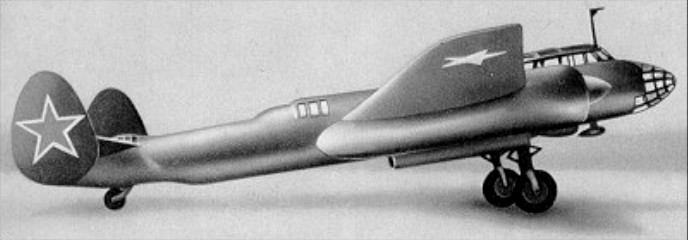
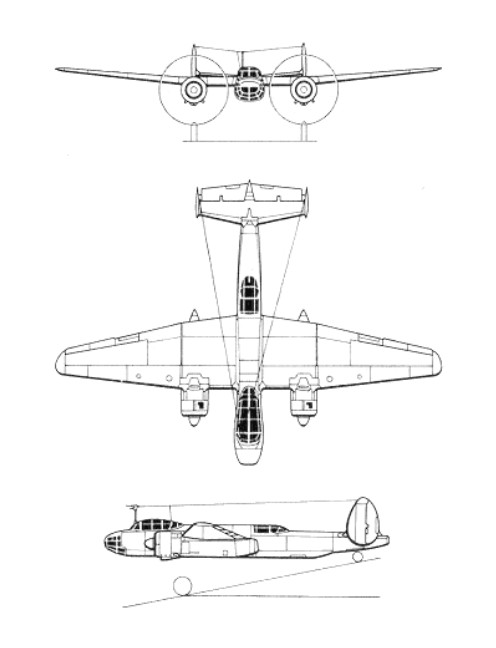
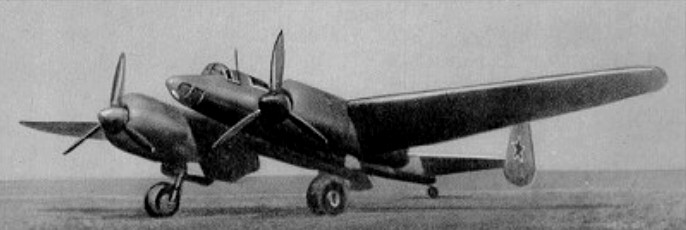
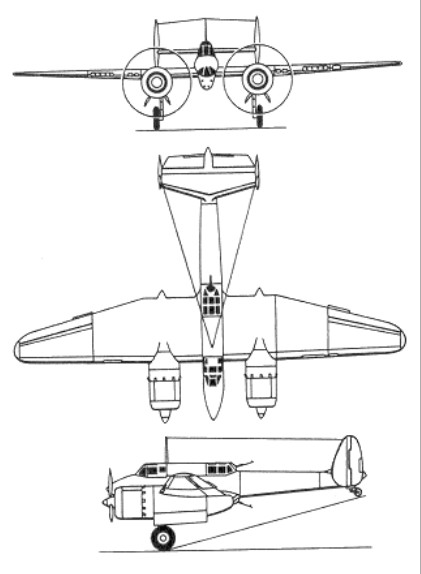
A 1943 twin-engined long-range attack aircraft. No production.
Engines: 2 x ASh-71F, 1620kW Max take-off weight: 12425 kg / 27393 lb Empty weight: 9180 kg / 20239 lb Wingspan: 20.5 m / 67 ft 3 in Length: 13.6 m / 45 ft 7 in Wing area: 60.0 sq.m / 645.83 sq ft Max. speed: 550 km/h / 342 mph Ceiling: 9000 m / 29550 ft Range w/max.fuel: 1100 km / 684 miles Armament: 4 x 45mm cannons, 9 x 7.62mm machine-guns, 1 x 12.7mm machine-guns Crew: 2
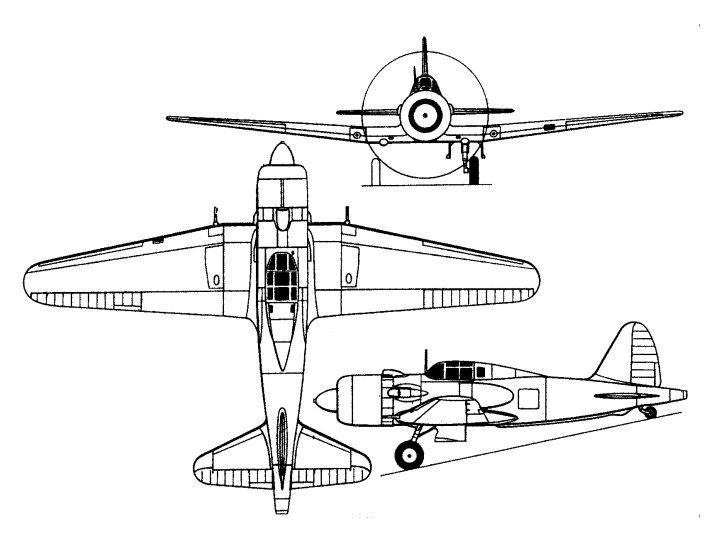
Chronologically, the Su-7 mixed-power high-altitude interceptor preceded the Su-5, being based broadly on the single-seat Su-6(A) assault aircraft. Intended to fulfil a 1943 requirement, the Su-7 retained the single-spar metal wing of the experimental shturmovik, mated to a new all-metal semi-monocoque fuselage. It was proposed that the fighter be powered by the 2,200hp Shvetsov M-7118-cylinder two-row radial engine with paired TK-3 turbo-superchargers, but non-availability of this power plant led to the decision to install a 14-cylinder two-row Shvetsov M-82FN radial engine rated at 1,850hp and supplemented by a Korolyov-Glushko RD-1KhZ bi-fuel rocket motor developing 300kg thrust with a burn time of four minutes.
Flight testing of the Su-7 with the rocket motor commenced in the late summer of 1944. Although the unstable nature of the rocket power plant motivated against adoption of the Su-7, flight testing revealed that it boosted maximum speed by 83km/h at 7,500m and by 195km/h at 13,000m. Armament comprised two wing-mounted 20mm cannon, and the sole rocket-powered Su-7 prototype was being prepared for the first post-World War II air display over Moscow in 1945 when the rocket motor exploded, killing the pilot and destroying the aircraft.
Engine: Shvetsov M-82FN radial, 1,850hp and 1 x Korolyov-Glushko RD-1KhZ bi-fuel rocket motor, 300kg thrust Max take-off weight: 4340 kg / 9568 lb Wingspan: 13.50 m / 44 ft 3 in Length: 9.60 m / 32 ft 6 in Wing area: 26.00 sq.m / 279.86 sq ft Max. speed: 680 km/h / 423 mph Range: 1240 km / 771 miles







 All Aero