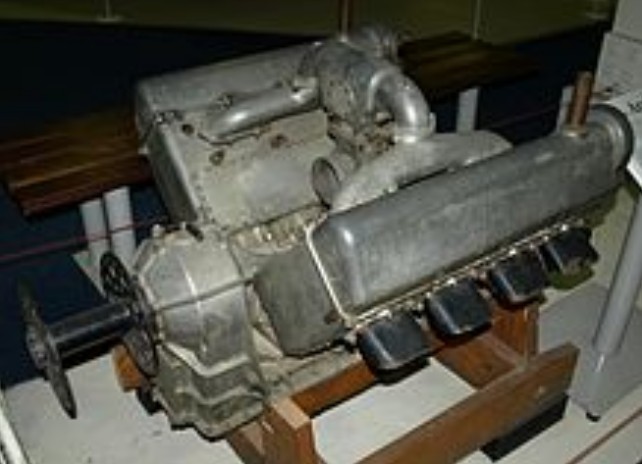
The Sunbeam Manitou was a further development of the V-12 Maori Mk.III; work on it began by Louis Coatalen in 1917, using aluminium alloy rather than cast iron blocks, cast in blocks of three cylinders, a typical Sunbeam feature. Bore was increased to 110 mm (4.33 in), but stroke remained at 135 mm (5.31 in). The cylinder bank were at a 60° vee, with twin overhead camshafts on each bank operating four valves per cylinder. Two Claudel-Hobson carburettors and two BTH magnetos delivered mixture to the cylinders and ignited it. Fitted with a reduction gear for aircraft the engine developed 300 hp (224 kW)at 2,000rpm., later increased to 325 hp (242 kW). Unsuccessful as an aero-engine, it is best known for having powered the Sunbeam 350HP racing car.
Despite large orders for 840 Manitous, only 13 were built before production stopped. Those that were built found favour as motor-boat power-plants and only one flew trials in a Short 184 seaplane. Four were fitted to the ‘Maple Leaf V’ and a specially built Manitou was fitted to the 350hp Sunbeam racing car.
A direct development of the Afridi, the Sunbeam Maori was far more successful. In similar fashion to Coatalens development of Sunbeam’s side-valve engines he increased the bore to 100 mm (3.94 in) retaining the stroke of 135 mm (5.31 in), displacing 12.27 l (748.8 cu in) for a power output of 260 hp (194 kW) at 2,000rpm driving a geared propeller.
Production of the Maori began in April 1917, including 100 Afridis which were converted to Maoris on the production line as the Maori Mk.I, with new-build Maoris designated as Maori Mk.II. Converted Afridis, (Maori Mk.I), were rated at 250 hp (186 kW) at 2,000rpm, whilst new-build Maori Mk.IIs were rated at 260 hp (194 kW) at 2,000rpm.
Maoris found favour with Short and Fairey seaplanes as well as Handley Page O/400 bombers, with development continuing to give the Maori Mk.III and Maori Mk.IV. The Maori Mk.III introduced cylinder banks with exhaust ports on the outside rather than the inside of the Vee and the carburettors on the inside. The Mk.III was rated at 275 hp (205 kW).
The final Maori version was designed specifically for use in airships as the Maori Mk.IV, with controls mounted directly on the rear of the engine, flywheel, enlarged cooling system and water-cooled exhaust pipes. Fitted to R33 and R34, five Maori Mk.IVs were fitted to each airship in gondolas, allowing the engines to be tended by on-board mechanics.
Applications: Avro 529 Silver King Curtiss H.12 Fairey F.2a Patrol Fairey F.22 Campania Fairey III Grahame-White E.IV Ganymede Handley Page O/100 Handley Page O/400 HM Airship R.33 HM Airship R.34 Parnall Zeppelin-Strafer Royal Aircraft Factory CE.1 Royal Aircraft Factory RE.9 Short N.2B Short Type 184 Vickers FB.27 Vimy Wight Tractor seaplane
Specifications: Maori II Type: V-12 Water-cooled 60 degree piston engine Bore: 100 mm (3.94 in) Stroke: 135 mm (5.31 in) Displacement: 12.27 l (748.8 cu in) Length: 1,612.9 mm (63.50 in) Width: 850.9 mm (33.50 in) Height: 873.76 mm (34.40 in) Dry weight: 490 kg (1,080.27 lb) Designer: Louis Coatalen Valvetrain: Twin overhead camshafts, four valves per cylinder Fuel system: Gravity feed to four Claudel Hobson CZS 38 mm (1.50 in) carburettors Fuel type: Gasoline Oil system: Dry sump pressure feed Cooling system: Water-cooled by radiator Power output: 260 hp (194 kW)at 2,000rpm Compression ratio: 5.3:1
Conceived to replace the Crusader/Zulu on the production lines, Louis Coatalen designed a companion engine for the V-12 Cossack, giving it the name Afridi. The Afridi was a much smaller engine than the Cossack and also spawned a whole family of derivative engines.
The major attributes of the Afridi were a bore of 92 mm (3.62 in) and stroke of 135 mm (5.31 in) displacing 11.476 l (700.3 cu in) for a power output of 200 hp (149 kW)at 2,000rpm. The twin overhead camshafts were driven by gears, directly operating two inlet and two exhaust valves per cylinder. Two Claudel-Hobson carburettors on the outsides of the blocks fed mixture to the cylinders, where it was ignited by the dual ignition system energised by four 6-cyl magnetos.
Three hundred Afridis were ordered, of which 299 were delivered and 100 converted to Sunbeam Maoris. Service use was mainly in Curtiss R.2 tractor biplanes and various Short seaplanes.
Applications: Armstrong-Whitworth FK.10 Avro 519 Curtiss R.2 Short Improved Navyplane Short N.2A Scout
By 1916 the demand for aero-engines was placing huge demands on the manufacturing industry. To help ease the pressure the War Office standardised on engines of about 200 hp (149 kW), one of these was a 90 degree V-8 water-cooled engine from Sunbeam known as the Arab. Using cast Aluminium alloy cylinder blocks and heads with die-cast Aluminium alloy pistons, the V-8 Arab had a bore of 120 mm (5 in), and stroke of 130 mm (5 in) for a capacity of 11.76 l (718 cu in) litres, developing 208–212 hp (155–158 kW) at 2,000 rpm.
First bench-run in 1916, the Arab was obviously inspired by the Hispano-Suiza V-8 engines but with very little in common when examined in detail. After submission to the Internal Combustion Engine Committee of the National Advisory Committee Sunbeam received an order for 1,000 in March 1917, increased to 2,000 in June 1917 as well as another 2,160 to be built by Austin Motors (1,000), Lanchester Motor Company (300), Napier & Son (300) and Willys Overland (560) in the United States of America. Bench testing revealed defects which required rectification, delaying completion of production drawings. Despite the delays one of the first flight-ready Arab flew in a Martinsyde F.2 two-seat fighter/reconnaissance aircraft in mid 1917.
Service use of the Arab was coloured by poor reliability and persistent vibration problems, causing some 2,350 orders to be cancelled and remaining orders ‘settled’, compensating manufacturers for costs incurred. 1,311 were built1917–1918.
Developed from the Arab were the inverted V-8 Sunbeam Bedouin, straight six Sunbeam Dyak, W-12 Sunbeam Kaffir and 20 cylinder radial Sunbeam Malay.
Variants Arab The production engine loosely based on the Hispano-Suiza 8 V-8 engines.
Bedouin In common with many other contemporary engine manufacturers the Arab was re-designed to run inverted and given the name Sunbeam Bedouin. Intended to provide better forward visibility for single-engined aircraft there is no evidence that the Bedouoin was fitted to an aircraft or flew.
Kaffir A W-12 broad arrow engine using blocks, heads and valve-gear from the Arab, giving 300 hp (224 kW). Bore remained the same at 120 mm (5 in), but with a stroke of 135 mm (5 in).
Dyak A straight six extrapolation of the Arab retaining the 120 mm (5 in) stroke and 130 mm (5 in) bore of the Arab, but with only two valves per cylinder as opposed to the three valves on the Arab.
Applications: Armstrong-Whitworth F.K.10 Avro 530 Bristol F.2b Fighter Bristol Scout F Fairey F.2a Fairey N.2a Grain Griffin Martinsyde F.2 Norman Thompson N.2c Norman Thompson NT.2b Royal Aircraft Factory AE.3 Ram Royal Aircraft Factory SE.5a Sage 4B Seaplane Trainer Short Improved Navyplane Sopwith Cuckoo Sunbeam 1917 Bomber Supermarine Baby
Specifications: Arab I Type: 8-cylinder, upright, 90 degree Vee engine Bore: 4.72 in (120 mm) Stroke: 5.12 in (130 mm) Displacement: 717.65 cu in (11.76 l) Length: 43.5 in (1,100 mm) Width: 31.9 in (810 mm) Height: 35.5 in (900 mm) Dry weight: 530 lb (240 kg) Valvetrain: single overhead camshaft, three poppet valves/cylinder (one inlet, two exhaust) Fuel system: Single Claudel-Hobson carburettor Cooling system: Liquid-cooled Reduction gear: 0.6:1, Left-hand tractor/Right Hand pusher Power output: 208 hp (155 kW) at 2,000 rpm (takeoff power) Compression ratio: 5.3:1
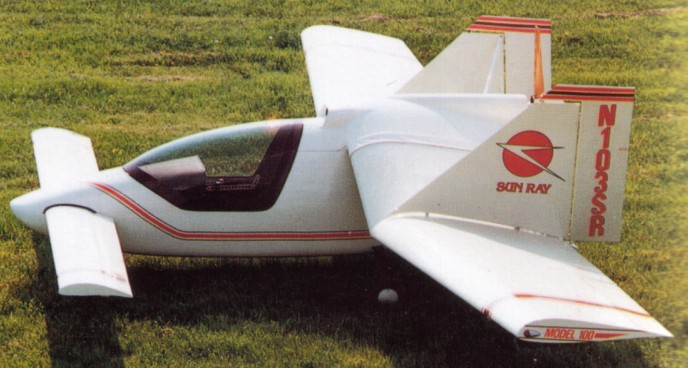
One of a steadily increasing number of American companies catering for the burgeoning homebuilder’s market, Sun Aerospace is a comparatively small concern based at Nappanee, Indiana. Sun Aerospace’s main product is the Sun Ray 100, a canard type that first flew in prototype form during September 1983 and is one of many sporting lightplanes clearly derived from the pioneering canard work of Burt Rutan.
The type is available in kit form, and it is estimated that some 500 man-hours are required for assembly of such a kit. The result is a trim single-seater with enclosed accommodation and non-retractable tricycle landing gear, but the overall appearance is perhaps marred by the size of its twin vertical surfaces, located above the main wing to the sides of the engine and its pusher propeller.
The construction of the Sun Ray 100 is typical of many current aircraft for the homebuilt market, and is centred on a fuselage that uses a primary structure of welded aluminium alloy tubes covered with three pre-moulded glassfibre shells. The main wing is attached to the top of the rear fuselage, and is sharply anhedralled to the locations of the vertical surfaces, and is flat outboard of that point: the wing structure has extensive reinforcement of spruce and comprises a pre-moulded glassfibre leading edge, an aluminium alloy trailing edge and glassfibre-wrapped ribs all covered with Ceconite or Stits Poly-Fiber. The canard foreplanes use pre-moulded glassfibre skins, and all the control surfaces (twin rudders, two wing-mounted ailerons and two canard-mounted elevators) are made of aluminium tubing.
Companies such as Sun Aerospace are keen to capitalize on all the possibilities of a successful basic design, and it is thought that under development are an amphibious version of the Sun Ray 10 and a two-seater known as the Sun Ray 200.
First flying on 13 January 1987, N222SR, another showed up at the 1987 Paris Air Show, N103SR c/n 100-103
Sun Ray 100 N103SR
Type: sport lightplane Powerplant: one 38.8-hp (52-kW) Rotax 503 Maximum cruising speed 100 mph (161 km/h) Initial climb rate 800 ft (244 m) per minute Service ceiling 13,500 ft (4115 m) Range 425 miles (684 km) Empty weight 550 lb (249 kg) Maximum take-off 850 lb (386 kg) Wingspan 32 ft (9.75 m) Length 13 ft (3.96 m) Height 6 ft (1.83 m) Wing area 157 sq.ft (14.59 sq.m) including canard foreplanes Accommodation: one
Single seat single engined monoplane with conventional three axis control. Wing has swept back leading and trailing edges, and tapering chord; no tail, canard wing. Pitch control by elevator on canard; yaw control by fin mounted rudders; control inputs through stick for pitch/roll and pedals for yaw. Retractable undercarriage has three wheels in tricycle formation. Ground steering by differential braking; (limited castoring nosewheel optional). Composite construction fuselage, partially enclosed (totally enclosed optional). Engine mounted level with centre part of wing driving pusher propeller.
Russ Mcdonald of Sun Aerospace announced that the test flights on the prototype, which is radical both in terms of its aerodynamics and the technology used, were under way from the end of March 1983 and the aircraft was scheduled to he shown in August at Oshkosh, where the Sun Ray will be in the running for the $10,000 prize offered by DuPont to promote the use of advanced materials and design concepts in lightweight aircraft construction.
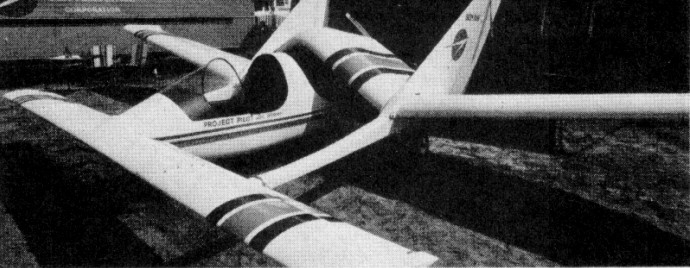
The Sun Ray is a conventional control aircraft with a side mounted control stick. Its wing has a laminar profile and is made up of two outer half wings with a large dihedral and a central inverse V wing forming the engine housing and carrying the pusher propeller. Below the joints between the centre section and the outer wings are twin parallel booms, which ensure the structural rigidity of the assembly by running forward to carry a canard at the nose of the fuselage, while above each joint is a fin and rudder assembly, inclined slightly outwards. The fuselage forms the hull and has a float attached, adding to the buoyancy of the parallel twin booms, which act as under wing floats. The single hull float and the outboard sponsons are detachable to take advantage of US law, which dictates that removable floats are not included in the empty weight of an ultralight. For ease of transportation, the outer wing and canard sections are removable, leaving a structure 8ft (2.4m) wide.
The Sunray makes extensive use of the Dupont fibre Kevlar, which is lighter and stronger than glass fibre and which allows more elaborate shapes while giving an impeccable surface finish.
In 1984 the Sun Ray kits started at $7595.
Engine: Kawasaki TA 440, 30 hp Power per unit area 0.24hp/sq.ft, 2.6 hp/sq.m Length overall 13.3 ft, 4.06 m Height overall 6.0ft, 1.83m Wing span 32.0ft, 9.75m Canard span 8.0ft, 2.44 m Total wing area 126 sq.ft, 11.7 sq.m Empty weight 250 lb, 113kg Max take off weight 510 lb, 231kg Payload 260 lb, 118kg Max wing loading 4.05 lb/sq.ft, 19.7 kg/sq.m Max power loading 17.0 lb/hp, 7.7kg/hp Max level speed 63 mph, 101 kph Never exceed speed 85 mph, 137 kph Max cruising speed 56 mph, 90 kph Economic cruising speed 43 mph, 69 kph Stalling speed 27 mph, 43 kph Max climb rate at sea level 600 ft/min, 3.1 m/s Service ceiling 13,500ft, 4100m Range at average cruising speed 145 mile, 233 km
In 1999 ASAP designed the Summit Powered Parachute. The SUMMIT II, the very first SLSA registered powered parachute in North America.
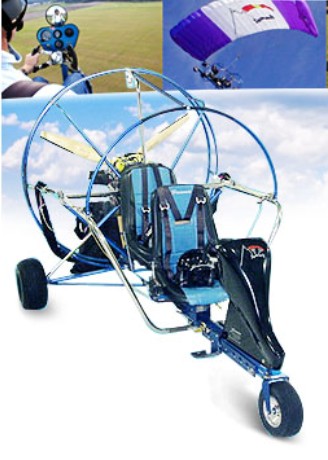
The Summit Powered Parachute has the 4 point canopy pick up to eliminate the pendulum effect, the tire placement to protect the propeller cage from damaging the prop, the true 2 seat placement for very comfortable seating and the innovative fuel seat tank. The Summit II also has foot steering and the anodized airframe, inside and out. The Summit is a bolt together kit that affords customers choice of both 2 stroke or 4 stroke engine including Rotax 503, Rotax 582, Rotax 912 and the HKS 700E. Each Summit II comes complete with the engine choice, engine accessories, GSC 3 blade GA propeller, Taskem EIS unit, Azusa tires and rims, full suspension with front brake and the S-Series Mustang square canopy. Options include canopy color choices, engine choices, and airframe color choices.
The kit include the airframe with 4” fuselage, ground steering Dyno-Focal engine mount, parts pre-cut, pre-measured, pre-drilled for ease of assembly, and no welding required.
Summit II
Price 2009: 15950 USD
Summit II Powered Parachute Cruise: 28 kt / 32 mph / 51 kmh Empty Weight: 141 kg / 310 lbs MTOW Weight: 431 kg / 950 lbs Glide Ratio: 5:1 Take-off distance (50ft obstacle): 100 ft / 30 m Landing distance (50ft obstacle): 75 ft / 23 m
In 1999, at the Sun n Fun airshow in Florida, the Summit II made its debut.
The two seat placement has separate seats and a single fuselage tube had every attach point triangulated. A slider foot control system is for canopy steering, and stainless steel rails around the pilot and passenger provide protection. A four point pick up system for the risers provides control against any pendulum affect. All the kits were anodized.
The landing gear was designed to be back under the engine so that in the event of a hard landing, the wheels would touch first, not the protective propeller guard.
Summit SS (single seat) Cruise: 30 kt / 35 mph / 56 kmh Empty Weight: 106 kg / 233 lbs MTOW Weight: 249 kg / 550 lbs Take-off distance (50ft obstacle): 200 ft / 61 m Landing distance (50ft obstacle): 100 ft / 30 m
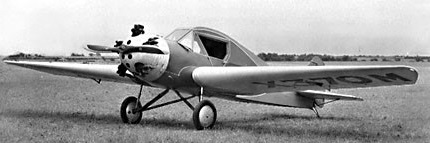
In 1941 Summit Aeronautical Corp was testing and developing HM-5 two-seat cabin monoplane designed by Howell Miller and built by Vidal process (molding under fluid pressure), for which company held license from Aircraft Research Corporation. War production of other items then supervened.
Only one was built, NX25332, the design evolving into 1940 Westfield.
In 1930 Sullivan Aircraft Manufacturing Co built a low-wing cabin monoplane which was developed as the K-3 Crested Harpy. Laird Co’s Jake Moellendick reportedly was involved to some extent.
A three-place cabin monoplane, it is known that two were built, NR127V and X370M, and perhaps more.





 All Aero