Thalman T-3

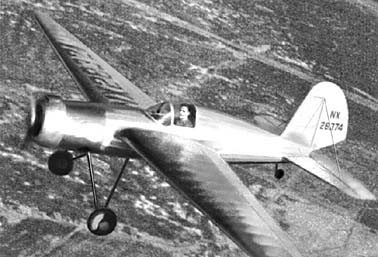
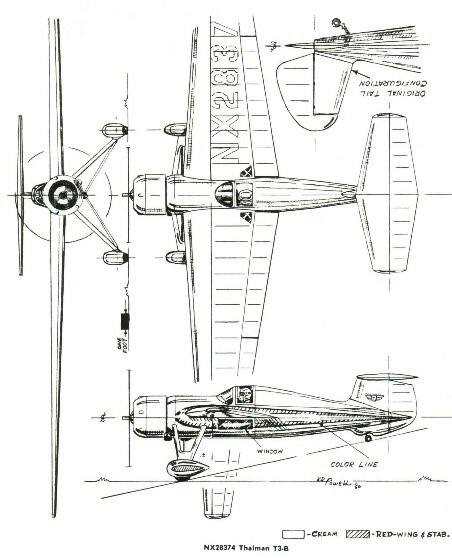
Thalman T-3B NX28374

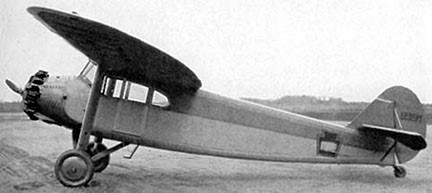
The 1941 T-3B was a single-place cabin monoplane of fabric-covered wood geodetic construction by Harry J. Thalman. One was built, registered NX28374.

The T-3B was a revised airframe with a T-tail and spats fitted to main wheels.

Engine: Velie M-5, 55hp
Wingspan: 41’0″
Max speed: 130 mph
Cruise: 120 mph
Stall: 38 mph
Seats: 1

Thalman-T-3B

Thalhofer Bronco

Single seat single engined high wing mono¬plane with conventional three axis control. Wing has unswept leading and trailing edges, and constant chord; conventional tail. Pitch control by elevator on tail; yaw control by fin mounted rudder; roll control by half span ailerons; control inputs through stick for pitch/roll and pedals for yaw. Wing braced from below by struts; wing profile Worth¬mann FX63 137; double surface. Undercar¬riage has three wheels in tricycle formation with additional tailskid; suspension on all wheels. Push right go right nose¬wheel steering connected to yaw control. No brakes. Aluminium tube framework, without pod. Engine mounted below wing driving pusher propeller.

An important manufactur¬er of hang gliders, producing around 300 of these aircraft per year, Thalhofer produced its first microlight in 1976. Two prototypes of the Bronco were built and flew for the first time at the end of March 1983. Production got under way in 1983, after the certification of the model.

Length overall 18.7ft, 5.70m
Wing span 28.5 ft, 8.70 m
Constant chord 3.9 ft, 1.20 m
Sweepback 0 deg
Tailplane span 5.2ft, 1.60 m
Total wing area 114 sq.ft, 10.6 sq.m
Total aileron area 6.9 sq.ft, 0. 64 sq.m
Total fin and rudder area 16.4 sq.ft, 1.52 sq.m
Total tailplane and elevator area 17.2 sq.ft, 1.60 sq.m
Wing aspect ratio 7.1/1
Wheel track 5.9 ft, 1.80 m
Engine: Konig SC430, 25hp at 4200rpm
Propeller diameter 55 inch, 1.40 m
Belt reduction, ratio 1.8/1
Max static thrust 132 lb, 60 kg
Power per unit area 0.22 hp/sq.ft, 2.4 hp/sq.m
Fuel capacity 5.3 US gal, 4.4 Imp gal, 20.0 litre
Empty weight 221 lb, 100 kg
Max take off weight 486 lb, 220 kg
Payload 265 lb, 120 kg
Max wing loading 4.24 lb/sq.ft, 20.7 kg/sq.m
Max power loading 19.4 lb/hp, 8.8 kg/hp
Load factors; +6.0, 3.0 ultimate
Max cruising speed 59 mph, 95 kph
Economic cruising speed 40mph, 65kph
Stalling speed 24mph, 40 kph
Max climb rate at sea level 400 ft/min, 2.0 m/s
Take off distance 165 ft, 50 m
Land¬ing distance 100 ft, 30 m
Thaden T-1 / Argonaut

Thaden T-1 NX3902

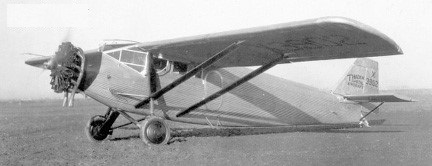
The 1928 Thaden T-1, or Argonaut, (ATC 2-29) was designed by Herbert von Thaden, registered NX3902, and first flew on 15 January 1928, piloted by George R Pond. The only one built crash-landed on 30 March 1933 in Chitkina AK., was recovered in 1988 and restored by an EAA group.

Engine: P&W Wasp A, 400-420hp
Wingspan: 53’0″
Length: 35’3″
Useful load: 2200 lb
Max speed: 135 mph
Cruise speed: 105 mph
Stall: 52 mph
Seats: 6-8

Texas-Temple Trimotor

A 1929 Trimotor designed by Carroll was noted as being test flown by Williams on 5 October 1929. It was to be powered by three 60 hp Velie and used as a photographic survey plane.

On 6 October 1929 the plane was flown to San Antonio for use by West Texas oilman Joe Palmer of the Texas Pacific Coal and Oil Company of Fort Worth.

Texas-Temple Sport / Sportsman

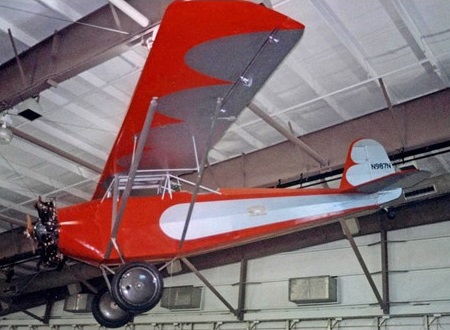
Temple Sportsman N987N on display at the Frontiers of Flight Museum at Dallas, Texas

Designed by George W Williams and George Carroll, the Sportsman was a parasol winged monoplane, equipped with two seats arranged in tandem. The cockpit had an open layout. A fixed tail-wheel undercarriage was fitted. The tailplane was set low on the fin. A 100 h.p. Cirrus III was initially fitted.

Three examples of the Sportsman were completed: NC480 manufacturers number 1; NC852H and N987N manufacturers number 107. There was no N987N registered in FAA records at the time, so it is likely to be from a later registration. There was an NC987H, but that was the registration for a different make of aircraft, a Smith S-1 with a Velie engine. The Sportsman was suitable for operation by individual sporting pilots. Williams was killed during 1930 in the crash while flying with a trainee pilot. The company folded after the accident.

One Texas-Temple Sportsman still exists. It had been found in bits by an airplane restorer, Jerry D Ferrell, who reconstructed it. The plane undertook its airworthiness test on July 26, 1990. Ferrel donated the plane for display at the Frontiers of Flight Museum, Love Field, Dallas, Texas. The plane is fitted with a Clyde Cessna modified engine, the Anzani.

The Texas-Temple Sportsman on display at the Frontiers of Flight Museum