The Butterfly Aurora Butterfly

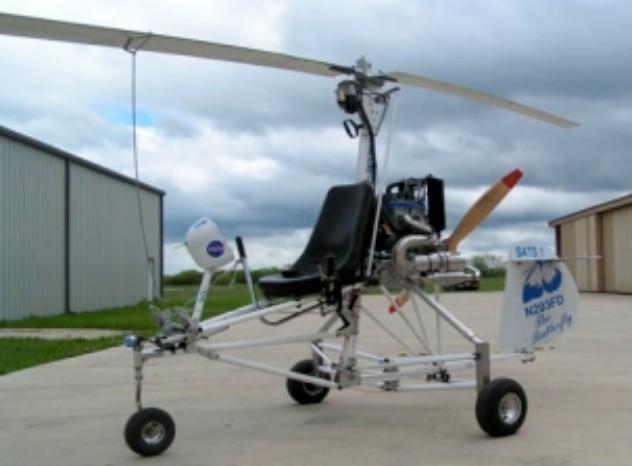
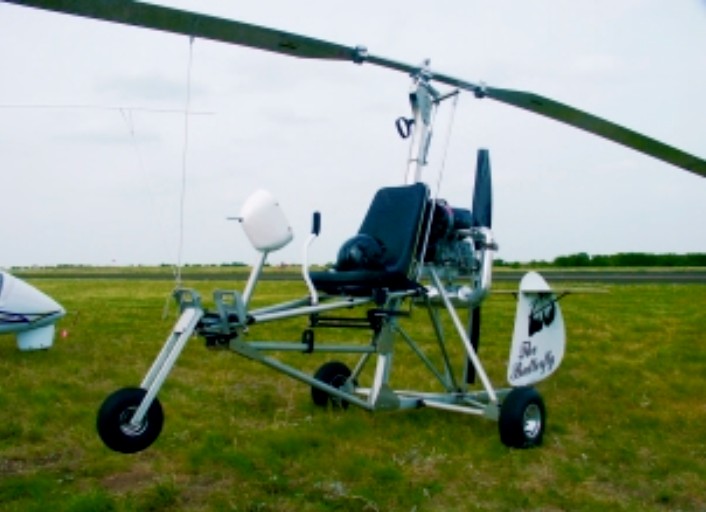
The Aurora Butterfly is centerline thrust and has a huge horizontal stabilizer.

The airframe materials kit has pre drilled locator holes that will have to be re drilled to size and some of the tubes will have to be cut to length. The kit is intended for the experimental category where you as the builder fabricate at least 51% of the kit for recreation and education. The cheek plates and various other parts are cut to shape and have undersized locator holes.

The front landing gear, landing gear support, joystick, and rotor head washer are made from 4130 Chrome Molly steel and they are heat-treated. All the parts are either powder coated or anodized in this kit. The tail is made using Kevlar.

The G-Force Magnum All Terrain Landing Gear has 16″ of stroke and has been tested to absorb up to 500’/minute vertical descent without failure.

Components – Standard Aurora
The engine is a Rotax 912ULS with 100 HP.
Three blade Warp Drive propeller.
Inst: ASI, ALT & Engine Monitor (Stratomaster).
The seat tank holds 7.4 gallons of fuel.
The 912 Metro Launch System is included.
The G-Force All Terrain Magnum landing gear (7’ wide) is included.
The MLS Rotor Brake is included.
The Rotor Tachometer is included.
The Aerodynamic Step is included.
The Large Instrument Pod is included.

Options:
Pointed nose pod/step/windscreen
Front Wheel Pant
Rear wheel pants (set)
10 Gallon Reserve Fuel Tank
Smoke System
Airfoil strut fairings kit
Gyro Recovery System (parachute)
GFLG Extension Selector
Oil Cooler
Twin (5 gallon each) Aerodynamic Reserve Fuel Tanks
Heavy Duty front tire (6” wheel with 13” tall tire) and strut
Spring Damper System (on the pushrods)
Optional Engines
Rotax 115 hp Turbocharged/Inter cooled engine.

Top Speed: >80 mph
Climb Rate: >1,000 ft/minute
Recommended pilot weight: Up to 275 lbs
Height: 8′ 6 “
Length: 11′ 2 “
Width: 84 “
Weight: 480 lbs. (standard kit)
The Butterfly Golden Butterfly

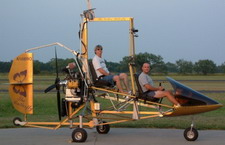
The “center line thrust” Golden Butterfly trainer is a two-place tandem gyroplane. Climb out with a 200 lb. pilot is a whopping 1,500 ft./minute and with two 200 lb. people it still climbs at 800 ft./per minute. With a 300 lb. pilot The Golden Butterfly still climes out at an amazing 900 ft./minute.

By removing one bolt the mast can be folded from 11′ high to 7’10”. The same bolt can be used to give 4 different pilot Center Of Gravity setting for a 150 lb., 200 lb., 250 lb., or a 300 lb. pilot with superb handling qualities.
What a ride.

The G-Force Landing Gear is a long stroke shock mounted parallelogram. The mast has a unique shock absorption and spring loaded dampening system that has removed most of the vibration out of the airframe. There is practically no stick shake due to isolation dampeners in the push pull tubes.

The Subaru 2.5 engine with a cam grind puts out 180 hp and drives a 74″ propeller. The Stratomaster glass cockpit display includes a rotor tachometer. The all flying 60″ tall tail with a 50″ wide horizontal stabilizer that centers the propeller blast is a true airfoil combination that gives The Golden Butterfly yaw control to easily overcome a large crosswind component.

The instructor in the rear seat also has an instrument panel with airspeed and altitude gauges included.

The Golden Butterfly is specifically designed to train students how to fly The Butterfly and Monarch gyroplanes but can also be used for a thousand other tasks, one of which is just pure fun flying in a huge, open frame, gyroplane with a friend. Set up with a climb prop the top speed is 95 mph with a fuel capacity of 15 US gallons.

The airframe materials kit has pre drilled locator holes that will have to be re drilled to size and some of the tubes will have to be cut to length. The kit is intended for the experimental category where you as the builder fabricate at least 51% of the kit for recreation and education. The cheek plates and various other parts are cut to shape and have undersized locator holes.

The front landing gear, landing gear support, joystick, and rotor head washer are made from 4130 Chrome Molly steel and they are heat-treated. All the parts are either powder coated or anodized in this kit. The tail is made using Kevlar.

Digital EIS which in addition to all engine functions includes, ASI, VSI, OAT, ALT, and others. Hydraulic Disk brakes are included. An electric pre-rotator is included.

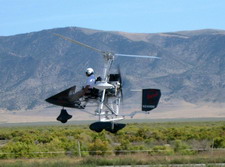
This gyrocopter was a failure. The only customer went through 8 engines before accumulating even 100 hours on the airframe, and everyone who flew it declared it a terrible machine. It never maintained sustained flight at an airshow and was finally abandoned.
Greg Mills

Engine: 2.5L EFI Subaru 180 hp
Propeller: 74″
Height: 11′
Folded Height 7′ 10″
Length: 17′ 5 “
Width: 7′ 7″
Top Speed: 95 mph

The Butterfly Emperor Butterfly

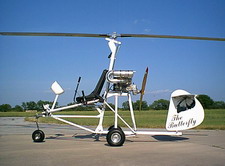
It fits in the back of a standard sized pick-up. An optional 72″ landing gear was available at no extra charge.

The Butterfly is centerline thrust with a huge horizontal stabilizer. The seat tank holds 7.5 USgallons of fuel. An electric pre rotator is fitted.

The airframe materials kit has pre drilled locator holes that will have to be re drilled to size and some of the tubes will have to be cut to length. The kit is intended for the experimental category where you as the builder fabricate at least 51% of the kit for recreation and education. The cheek plates and various other parts are cut to shape and have undersized locator holes.

The front landing gear, landing gear support, joystick, and rotor head washer are made from 4130 Chrome Molly steel and they are heat-treated. All the parts are either powder coated or anodized in the kit. The tail is made using Kevlar.

Options:
Rear wheel pants (set)
G-Force Landing Gear (A)(6’)
Rotor Tachometer

Engine: Rotax 503 50 hp
Propeller:Tennessee wood
Height: 7′ 4″
Length: 11′ 2″
Width: 57″
Weight: 280 lbs.
Recommended pilot weight: Up to 200 lbs
Top Speed: 63 mph
Instruments: ASI, ALT, Engine RPM, EGT and CHT.

The Butterfly Monarch

A single-seat open frame centerline thrust gyroplane with an adequate horizontal stabilizer. Powder coated square and round tube aluminum airframe. Electric or belt drive pre rotator with rotor brake. GRS Parachute available. Fits in the back of a pickup with the 58″ wide gear.

Engine: 66hp Rotax 582
Propeller: 60″ Powerfin
Rotor Blades: 23′ aluminum
Min Speed 20 mph
Cruise 63 mph
Top Speed 70 mph
Empty Weight 302 lbs
Useful Load 582 lbs
Width 58′ or 70″
Height 7’2″
Length 10’6′

The Butterfly Butterfly

Single-seat legal Part 103 Ultralight gyroplane
A Centerline Thrust gyroplane with an adequate horizontal stabilizer. Powder coated square and round-tube aluminum air frame. Fits in the back of a pick-up.
Available in 2009: Complete kit form or fully assembled and test flown.

Engine: 50 hp Rotax 503
Propeller: 60″ Tennessee Prop
Rotor Blades: 23′ aluminum
Min Speed 20 mph
Cruise 55 mph
Top Speed 63 mph
Empty Weight 254 lbs
Useful Load 254 lbs
Gross Weight 508 lbs
Width 4’10”
Height 7’2″
Length 10’6″

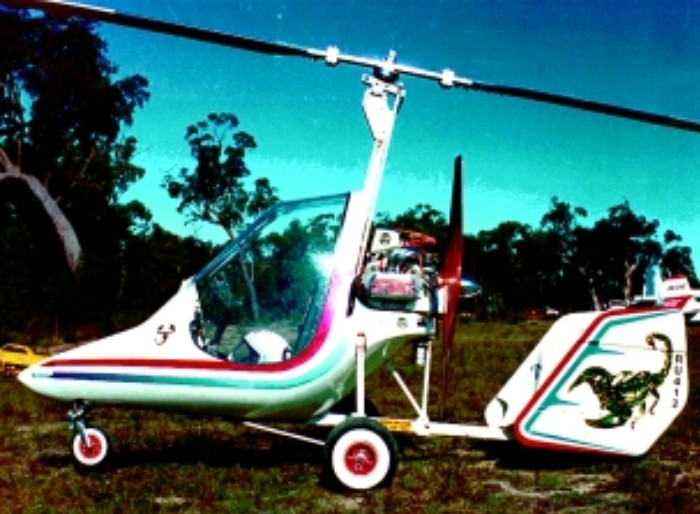
The Australian Autogyro Co Skyhook

A single seat open frame or partially enclosed autogyro. Airframe is 2×2 aluminium tube with shock absorbing landing gear, dual rudder. Rotor blades: 23’ Skyhook aluminium riveted.

Available in three versions. Open-frame model is the Mk I, with partial enclosure it’s the Mk II, fully enclosed is the Mk III. Airframe is 2 x 2 aluminum tube with shock-absorbing landing gear. Dual rudder. Information package was $10 (Aus)

Cost: Mk I $7,600 (U.S.) Fully assembled, and Mk III $15,200 (U.S.) in 2009.

Mk.1
Open frame
Engine: Rotax 503
Prop: IvoProp 54” x 32” 2 blade wood.
Rotor Blades: 23′ Skyhook aluminum riveted

Mk.2
Partially enclosed frame.
Engine: 1916cc 80 hp VW
Prop: Invincible 52” x 27”
Rotor Blades: 23′ Skyhook aluminum riveted

Mk.3
Fully enclosed frame
Engine: 1916cc 80 hp VW
Prop: Invincible 52” x 27” 2 blade wood
Rotor Blades: 23′ Skyhook aluminum riveted
Min speed: 15 mph
Cruise: 55-60 mph
Top speed: 100 mph
Empty wt: 380 lb
Useful load: 280 lb
Gross wt: 660 lb
Width: 5’6”
Height: 6’10”
Length: 10’

Mk III
Empty Weight 380 lbs
Useful Load 280 lbs
Gross Weight 660 lbs
Width 5’6″
Height 6’10”
Length 10′

The Airplane Factory Eindecker

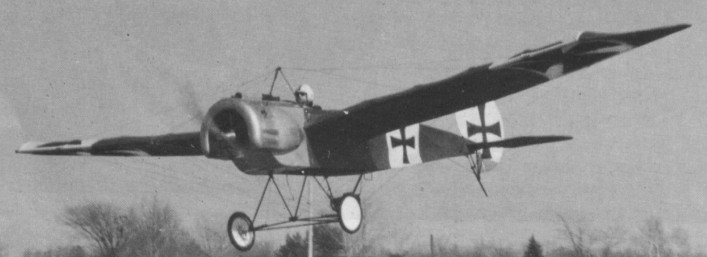
One aircraft that lends itself admirably to replication by virtue of its design is the Fokker Eindecker. This 1914 design has been reproduced in scale by the Aeroplane Factory, Dayton, Ohio; its original flying and landing wire concept adapting readily to modern microlight construction methods. Powered by a Rotax 277 developing 27 hp, this 36 foot wing span replica has a cruise speed of 45 mph and comes in kit form. Centre mounted joy stick, rudder pedals, tail wheel steerable through rudder pedals.

Empty wt: 251 lb
Wing span: 36’
Wing area: 154 sq.ft
Height: 8’
Length: 20’6”
Fuel cap; 4.4 USG
Construction: Aluminium, Dacron, Steel
Engine: Rotax 277 (268 cc) 28 hp
Static thrust: 275 lb
Max wt: 500 lb
Stall: 23 mph
Max speed: 63 mph
Vne: 70 mph
Climb rate: 500 fpm @ 30 mph
Design limit: +4, -2g
Glide ratio: 7.8-1
Wing loading: 3.25 lbs/sq.ft
Power loading: 17.26 lbs/hp

Thatcher CX4

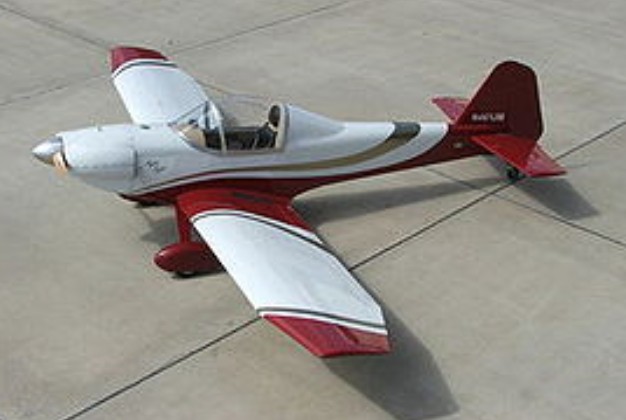
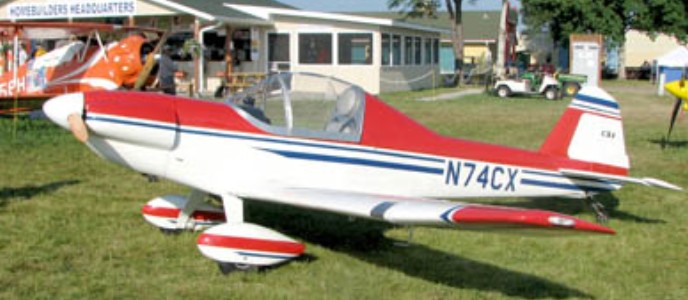
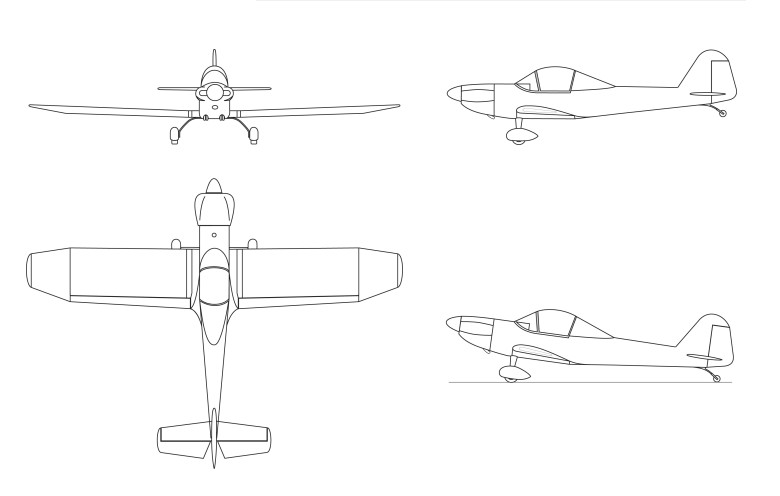
The CX4 is a low wing, single-seat aircraft designed to be simple to build and safe to fly. The name of the plane, CX4, is taken from an old radio show featuring Hop Harrigan, whose plane was called CX4.

The aircraft is all metal, 6061-T6 aluminium, except the cowling. It has hydraulic disc toe brakes and a heater and ventilation system for all season flying. The aircraft can be built with an optional 3 gal aux fuel tank. The CX4’s standard specified powerplant is a Volkswagen air cooled engine. The design load factor is 3.8 g, with an ultimate load of 5.7 g

The CX4 first flew in 2004. At the end of 2010, there were eighteen flying CX4s in the United States and South Africa. Parts and kits are currently supplied by Peter Beck.

Gallery

Powerplant: 1 × Volkswagen
Length: 18 ft 3 in (5.56 m)
Wingspan: 24 ft (7.3 m)
Height: 4 ft 8 in (1.42 m)
Wing area: 48 sq ft (4.5 sq.m)
Empty weight: 520 lb (236 kg)
Gross weight: 850 lb (386 kg)
Cruise speed: 109 kn; 201 km/h (125 mph)
Stall speed: 35 kph 64 km/h (40 mph)
Never exceed speed: 135 kn; 249 km/h (155 mph)
Service ceiling: 10,000 ft (3,000 m)
Rate of climb: 825 ft/min (4.19 m/s)
Crew: 1

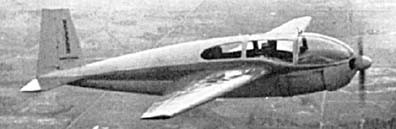
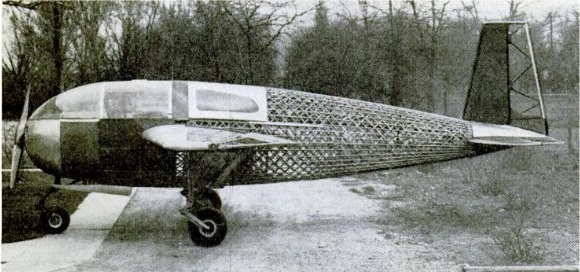
Thalman T-4

Thalman T-4 N53389

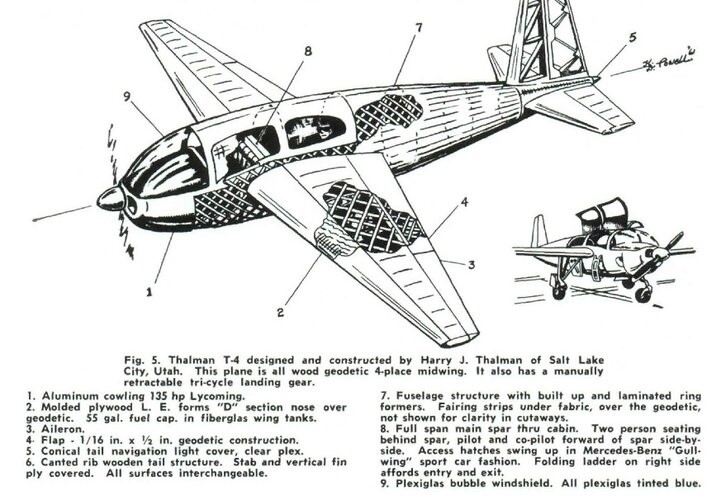
In 1949, Harry formed Thalman Aircraft Inc. at Salt Lake City. In the same year, he designed the Talman T-4 which, flew in 1951. The 1953 Thalman T-4 was a four-pace mid-wing cabin monoplane of all-wood geodetic construction. The T-4 followed the same wooden geodetic construction employed by Harry J. Thalman and William Earl Player when they helped form Plxweve Aircraft. (Construction techniques followed those of Thalman’s Oregonian mentor, George Yates – bending strips of cedar around heated former moulds.) In general construction technique, the T-3 and T-4 were similar – the T-3 being fabric-covered, the T-4 having a fibreglass covering.

Designed by Harry J. Thalman, the one built, N53389, had manually retracting undercarriage. Initially powered by a 135hp Lycoming O-290, it was later converted to T-tail with a 170hp O-340.

Convinced that serial wooden geodetic construction would be less expensive than by-then conventional metal construction, Thalman spent the next decade trying to get the T-4 into production. At one point, Thalman approached the Cache Chamber of Commerce in Utah for start-up funds of $50,000 (and a suitable workspace) to launch T-4 production – presumably near Logan, UT. The Chamber passed.

By 1960, Thalman Aircraft Corp. was doing business as Thalman Industries (sometimes given as Thalman Aircraft Industries). However, the firm was now planning to relocate to Roseburg, OR – 900 miles to the west. Roseburg businessman Lynn Andreas had become president and it was Andreas who was announcing the construction of a new factory on 5 acres of leased land at the Roseburg municipal airport. Early reports said that site ground preparation work had begun and that a “plywood plane” would be built. Harry Thalman is quoted, saying that his aircraft will sell for less than $14,000.

By 1963, Harry Thalman was working as a mechanic for Kelsey-Ellis Air Service at Salt Lake City Airport. The T-4 was in storage (and possibly disassembled by then) but Harry was still flying the T-3B. On 15 March 1963, Harry was doing flying cross-country when he flew into a blinding snowstorm. Harry Thalman died instantly when he crashed his T-3B monoplane in a gully outside of Grantsville, UT.

Engine: 135hp Lycoming O-290, later 170 hp Lycoming O-340
Wingspan: 40 ft 2.5 in
Length: 21 ft 6 in
Height: 6 ft 0 in
Empty weight: 1050 lb
MTOW: 2000 lb
Useful load: 1050 lb
Max speed: 175 mph
Cruise: 155 mph
Stall: 45 mph
Range: 700 mi
Seats: 4
Undercarriage: manual retractable