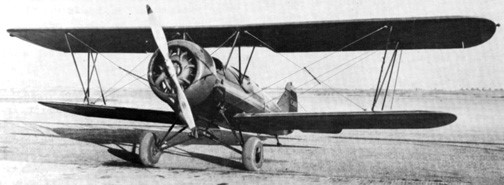
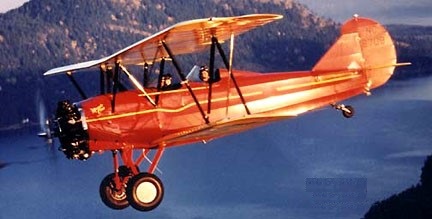
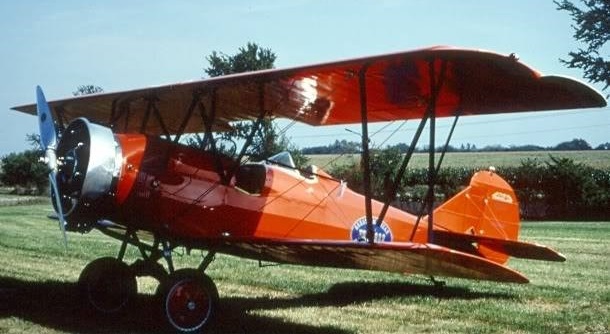
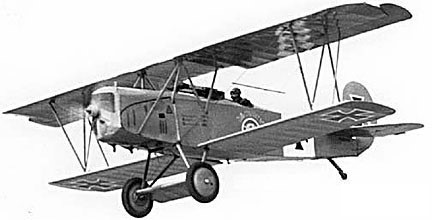
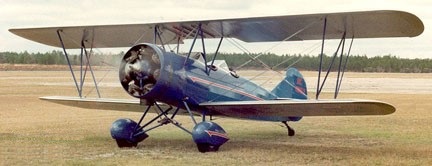
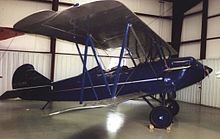
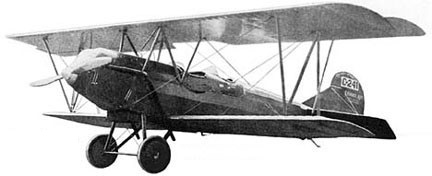
The original Travel Air Model A was engineered chiefly by Lloyd Stearman—with input from Travel Air co-founders Walter Beech, Clyde Cessna, and Bill Snook—largely as a metal-framed improvement of his immediately previous design of the wood-framed, metal-cowled Swallow New Swallow biplane, with elements of the best fighter aircraft of World War I, the metal-framed German Fokker D-VII. Most subsequent Travel Air biplanes were derived, directly or indirectly, from the original Model A.
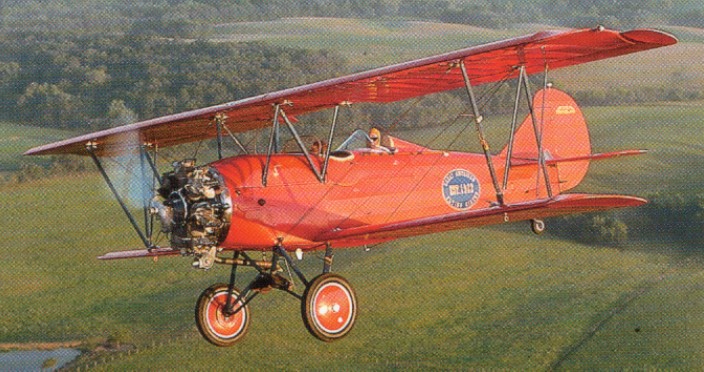
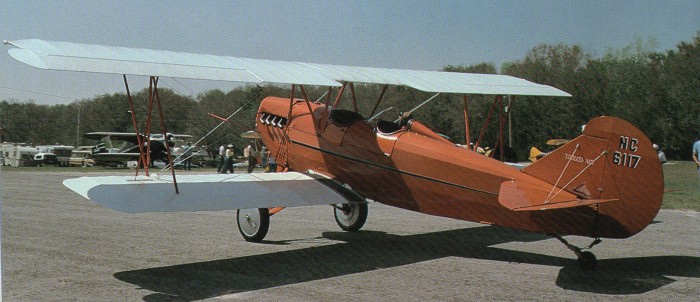
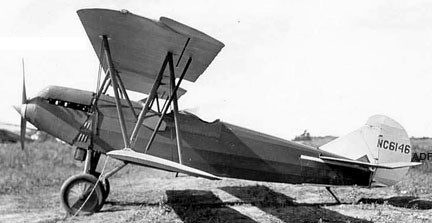
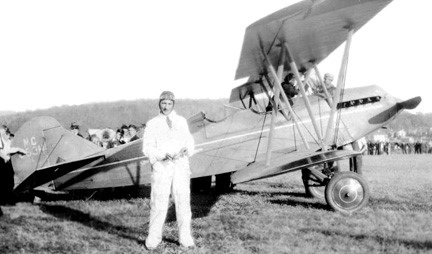
The types shared a common structure of a conventional single-bay biplane with staggered wings braced by N-struts. The fuselage was of fabric-covered steel tube and included two open cockpits in tandem, the forward of which could carry two passengers side-by-side.
Like other aircraft in the Travel Air line, it was available with a variety of different, interchangeable wings, including a wing shorter and thinner than the rest known as the “Speedwing” designed, as the name suggests, for increased cruise speed.
The 1926 Model B was a Travel Air Model A fitted with a Wright J-6 piston engine and divided axle.A three – four seat open cockpit biplane, it became the model 2000. The B-2000 of 1927 was the 2000 redesignated.
Production figures of the 1925 Model A were lumped together with B and subsequent 2000 models and the number built is undetermined.
The 1926 BH N11509 was the same as B, but with 150hp/180hp Hisso A/E engine.
The 1926 BW was the same as the Model B but with a 200hp Wright J-4. The Model BW was the winner of the 1926 Ford Reliability Tour piloted by Walter Beech. The BW became the CW-4000 series.
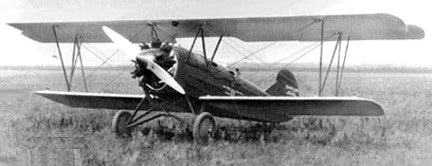
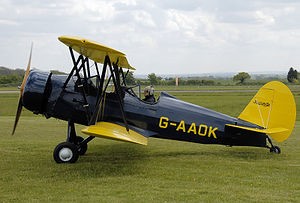
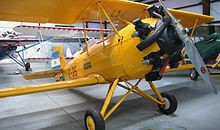
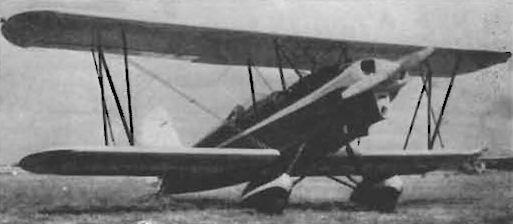
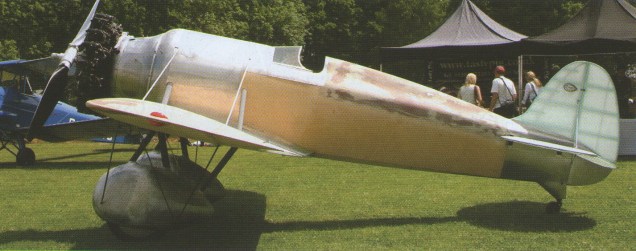
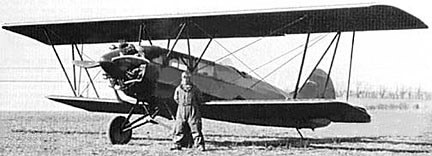
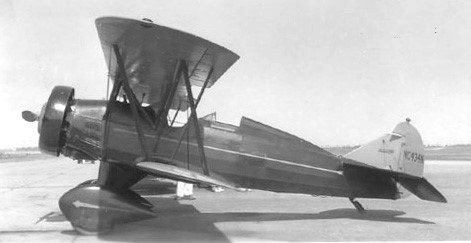
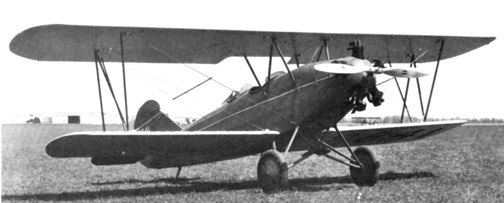
First flying in 1931, the Curtiss-Wright CW-12 Sport Trainer and CW-16 Light Sport (also marketed under the Travel Air brand that Curtiss-Wright had recently acquired) were high-performance training aircraft designed by Herbert Rawdon and Ted Wells and built in the United States in the early 1930s.
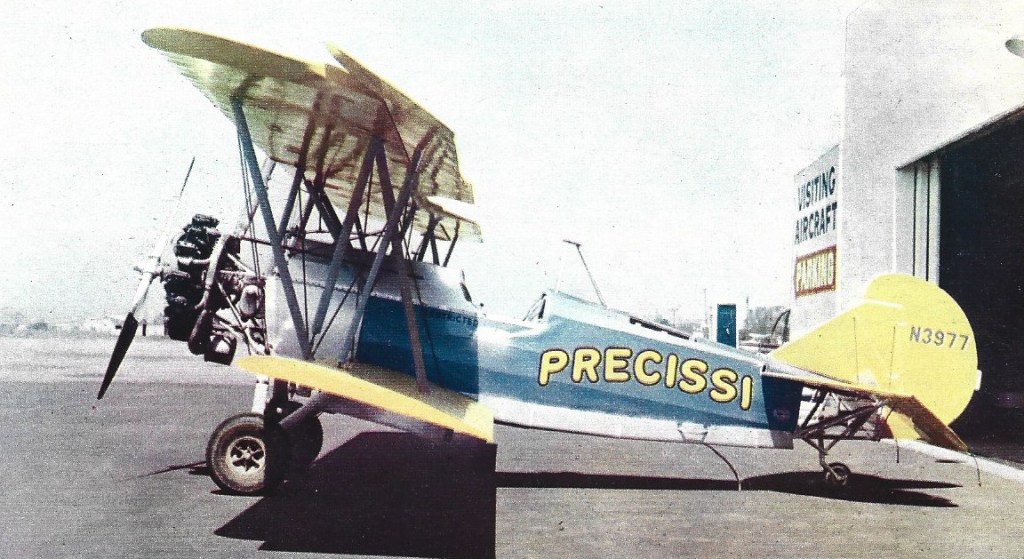
Curtiss Travel Air 16E
The CW-12 and CW-16 shared the same basic design as conventional single-bay biplanes with staggered wings braced with N-struts. The pilot and instructor sat in tandem, open cockpits, the forward cockpit of the CW-12 having a single seat, while the CW-16’s forward cockpit could seat two passengers side-by-side. Both versions of the aircraft were available in a variety of engine choices, and some CW-16s were exported as trainers to the air forces of Bolivia and Ecuador. Civil owners were in the USA and United Kingdom.
63 were built.
The Argentine Navy purchased 15 CW-16Es in 1935, with 13 more possibly being built from 1938. The type remained in use until 1949. The Bolivian Air Force purchased three CW-16s in 1934, with the type in use until 1943. The Brazilian Air Force received 15 CW-16Ws, with 125 hp (93 kW) Warner Scarab engines in 1935, the type remaining in service until 1940. The Colombian Air Force received six CW-16s in 1933. The Ecuadorian Air Force purchased six CW-16Es in 1935, with three more CW-16s following in 1936. Three remained in use until 1944.
Travel Air 16 Sport-Modified
Variants:
CW-12K Engine: Kinner K-5 2 built
CW-12Q Engine: Wright-built de Havilland Gipsy, 90 hp (67 kW) Propeller: 2-bladed fixed-pitch Wingspan: 28 ft 10 in (8.79 m) Wing area: 206 sq ft (19.1 sq.m) Airfoil: Clark Y (15%) Length: 21 ft 5 in (6.53 m) Height: 8 ft 10 in (2.69 m) Empty weight: 1,071 lb (486 kg) Gross weight: 1,725 lb (782 kg) Maximum speed: 105 mph (169 km/h; 91 kn) Cruise speed: 88 mph (142 km/h; 76 kn) Range: 390 mi (339 nmi; 628 km) Service ceiling: 12,000 ft (3,700 m) Rate of climb: 600 ft/min (3.0 m/s) Seats: 2 26 built
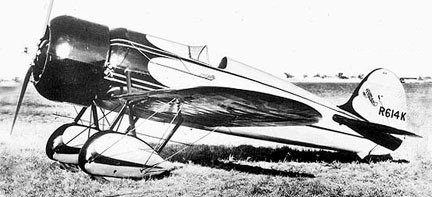
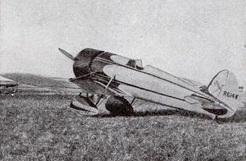
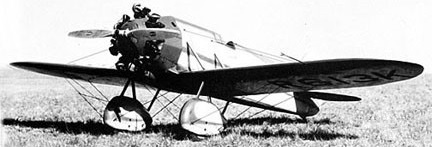
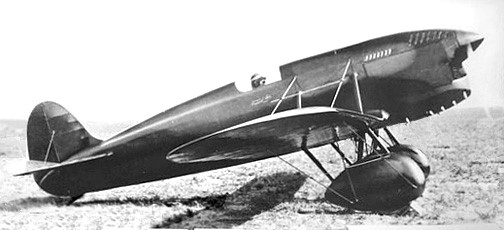
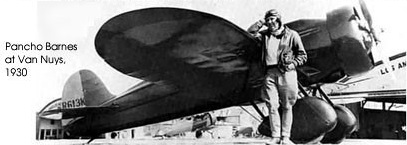
The 1929 Travel Air R Mystery Ship was designed by Walter Burnham and Herb Rawdon. The R became S through a newspaper’s abbreviation of “Mystery Ship” to “Mystery S”.
Five were built, of which 3 were racers; NR614K, NR482N, NR1313. One plane, N11717, with a 300hp Wright, was bought by the Italian government in 1931 “for study”.
The Mystery Ship held an official record at 236 mph. As Texaco 13 and piloted by Frank Hawks, NR1313 set transcontinental speed record 1929 and was at the time faster than any existant military plane, continued in 1930-32 to establish numerous new intercity speed records in the US and Europe.
Travel Air R-613 NX613K
Mystery Ship NR482N, piloted by Jim Haizlip, reached second place in the 1930 Thompson races.
Travel Air R Chevrolair NR613K
The 1929 R-613 Mystery Ship NX613K was fitted with a 250hp Chevrolair D-6 engine. As NR613K it raced in the 1929 Thompson Trophy piloted by Doug Davis.
Travel Air R-613 NX613K
It was later refitted with a 330hp Wright R-975 for Florence “Pancho” Barnes. At the 1968 Tallmantz auction, word got around that 67-year-old Pancho was there, hoping to buy her plane to restore. When the auctioneer announced a low starting bid, Pancho waved her bid paddle. That was followed by silence. The auctioneer got the message, so he nodded and pointed at her, “Sold!” and the audience applauded.
Mystery Ship sister
Frank Hawks flew to glory in 1930 in a Travel Air Mystery Ship.
Replica: Aero-Antiques Travel Air R
R Engine: 400hp Wright supercharged Cyclone Wingspan: 29’2″ Length: 20’2″ Useful load: 456 lb Max speed: 235 mph Cruise speed: 150 mph Stall: 70 mph Range: 525 mi Seats: 1
R-613 Mystery Ship Engine: 250hp Chevrolair D-6, later refitted with 330hp Wright R-975 Wingspan: 29’2″ Length: 21’0″
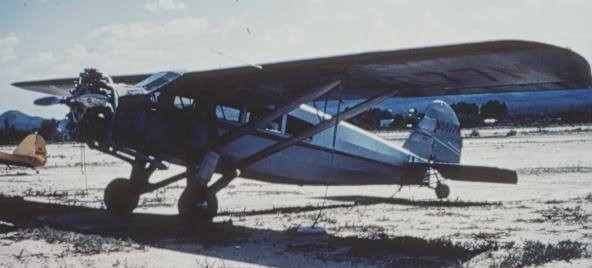
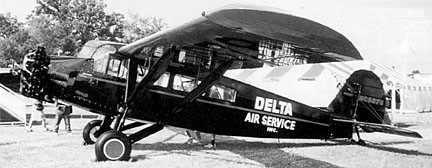
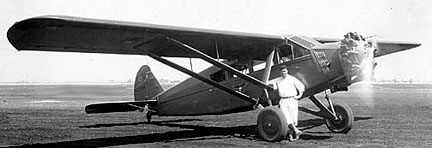
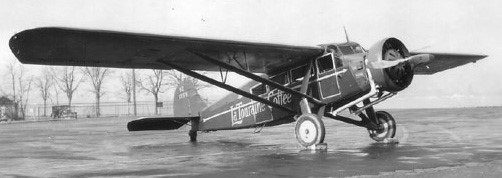
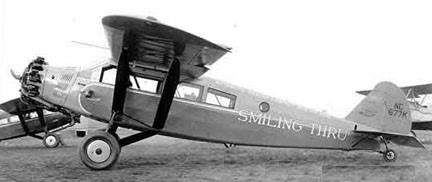
In 1929, the Travel Air Company under Walter Beech’s direction developed the 6000 (ATC 100, 2-28, 2-167, 2-234, 2-296). An improved version of the 5000, it sold for $12,000.
The Travel 6000 six place cabin monoplane was equipped with a Wright J-5 220 hp engine.
Travel Air 6000B NC8878
The prototype was NX4765 (2-28, superseded by 100).
Travel Air S-6000B NC9914
25 of the 1929 A-6000 were built (ATC 116), priced at $18,000.
Travel Air A-6000A
ATC 2-76 was for eight 7-place conversions, and ATC 2-308 for a 420hp P&W Wasp C version as A-6000-A Special.
Almost all were eventually converted under (2-167, 2-234 and 2-296) to 300hp Wright J-6 as S-6000B.
The 1929 S-6000B, or B-6000 (ATC 130) were six-place with a 300hp Wright J-6 engine. Priced at $13,000 fifty-five were built, including modifications of model 6000. The model evolved into the 6-B and ATC 2-138 was issued for seven-place conversions. ATC 2-153 was for the five-place 6000-B Special, and ATC 2-294 for four-place conversions, with ATC 2-302 for weight adjustments.
The one Model B-6, built in 1925, was a B-2000 with a 160hp Curtiss C-6 engine, and 31’6″ modified wing, without elephant-ears.
In 1930 eight Model 6-B were built which were the 6000-B with a 330hp Wright J-6 engine.
Travel Air 6-B
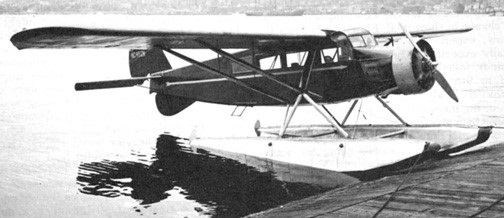
The 1929 SA-6000A (ATC 175) was a six-place pontoon version of the A-6000, priced at $20,000. At least two were built.
Selling for $7,960, nineteen of the 1929 Travelair 4-D were built (ATC 254) of which two were converted to E-4000. Performance was higher with cowl and wheel pants. Powered by a 220hp Wright J-5, they were also approved for a 240hp Wright J-6 under ATC 2-169 for NC9961 and ATC 2-300 for NC467N.
Travel Air 4-D
One model 4-P / 4-PT was built in 1929, NC419N (ATC 280, 2-160), powered by a 140hp ACE La-1 (Jacobs) engine, it was priced at $6,240.
Travel Air 4-P NC419N
The model 4-S NX469N of 1929 was a 4000 with an experimental Powell motor. Only one was built.
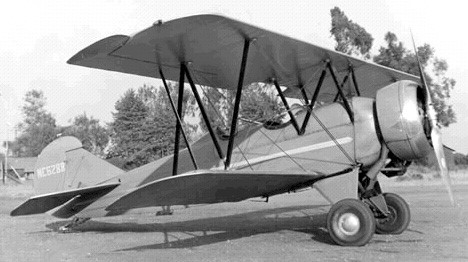
The model 4-U of 1930 (ATC 2-432) were conversions of models 2000 and 4000 to 130-160hp Comet engines by O W Timm Aircraft Co of Glendale CA. Sixteen were converted.
Travel Air 4-U NC5288
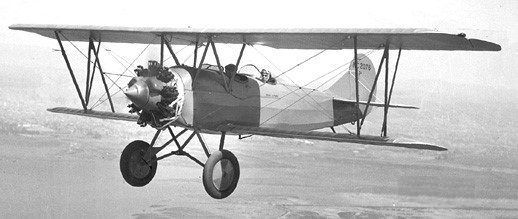
Ninety-nine of the 1926 Travel Air 4000 (ATC 32) were built at $9,800, many of which were conversions of older models. Ring cowls and balloon tires marked later versions.
Travel Air 4000 NC2078
Travel Air S-2000 converted to 4000 NC8708
About 25 of the 1920 B-4000 (ATC 146) were built, price at $8,500. They featured a tripodal pneumatic landing gear.
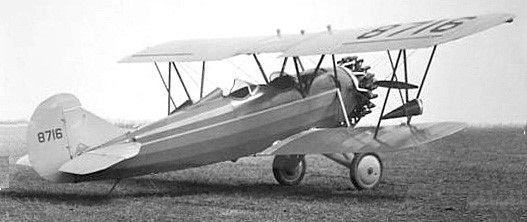
Travel Air B-4000 N8716
The B9-4000 of 1929 (ATC 2-381) was a three seater with a 300hp Wright J-6. Tt least 6, of which some were conversions of earlier 200hp J-5 models, were built.
Travel Air B9-4000
The 1929 BA-4000 was a Model 4000 with a 150hp Axelson engine.
The 1929 BC-4000 (ATC 189) was similar to the C-4000 but with tri-gear. Priced at $6,500, one was built and later mounted on floates as the SBC-4000 NC9821 (ATC 2-154).
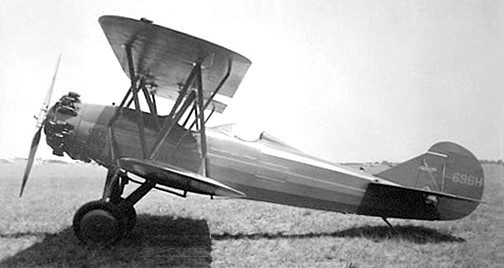
The 1929 BE-4000 was the same as the E-4000 but with tripod-braced landing gear, and unbalanced ailerons. Twelve were built.
Travel Air BE-4000 NC696H
In 1930, BF-4000 was the initial designation of the Model 4-D.
Seven of the 1929 BM-4000 (ATC 147) were built. They were the B-4000 with a Wright J-5 engine modified as single place mail carriers.
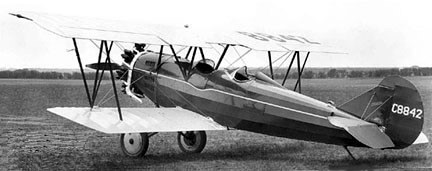
The 1928 C-4000 (ATC 149) was priced at $6,275. Twenty-two were built, plus seven converted from 2000, and 2 from E-2000. Some were the first of the “Speed Wing” models without elephant-ears. They were powered by a 185hp Curtiss Challenger.
Travel Air C-4000 from A-4000 NC8842
One Model CH, or CH-4000, was built in 1926 as a five place biplane. Four were in the cabin and the pilot sat in an open cockpit. It began the 7000 series.
The SC-4000 could be one of the modified Z-4-D dusters, NR375M.
The 1928 W-4000 (ATC 2-35) was a three-place with a 125hp Warner Scarab engine. The initial production (ATC 2-35) was superseded by ATC 112. Twenty-seven were built, priced at $5,575.
Three Travel Air CW, or CW-4000, were built in 1927. Two with the 200hp Wright J-4 engine, and one with 220hp J-5.
Travel Air CH
The 1930 D-4-D (ATC 2-222) was approval for “Speed Wing” conversions of models 2000, 3000, and 4000 to 240hp Wright R-760 engines. About 10 were converted.
Travel Air D-4-D
The D-2000 of 1929 were single place 2000 with narrower-fuselage competition modification for Art Goebel, named Chaparral. Five were built, later rebuilt as Model 11.
The 1928 D-3000 was a 3000 with a straight wing used for competition.
Travel Air D-4000 NC9040
The 1929 D-4000 (ATC 2-84) were 1-3 place “Speed Wing” versions of the J-5 powered 4000. Seventeen were built.
The D-4000 had split axle type landing gear with rubber cord shock absorbers. The wings were all wood spars and ribs, fabric covered. The fuselage, tail surfaces and rudder were welded steel tube, fabric covered. The ailerons were aerodynamically balanced and of wood and metal construction.
The 4000-CAM became the model 8000.
The 1929 D9-4000 was a single place D-4000 with a 300hp Wright J-6 powered competition model for Art Goebel, registered NR481N.
One DC-4000 was built, in 1929, N8843, a “Speed Wing” version of the C-4000.
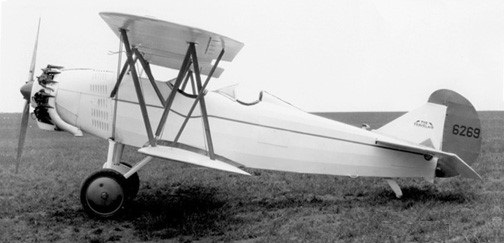
The 1929 built DW-4000 N6269 was a prototype”Speed Wing” version of the W-4000.
Travel Air DW-4000 N6269
Fifty-nine of the 1929 Travel Air E-4000 (ATC 2-156, later superseded by 188) were built. A few with elephant-ear ailerons on conversions of older models. They sold for $6,425 in 1929 and $5,850 in 1930.
Six of the Model 2000 and 4000 were modified to J4-4000 (ATC 2-243) in 1930, powered by a 200hp Wright J-4.
The K-4000 (205) was built in 1929. Of the seven built, one was converted to model 4-U (NC9963), and one (N8841) was fitted with a “Speed Wing” as model DK-4000. They had sold for $5,000±.
Travel Air K-4000
The Parks Air College repowered at least two of the two place model 4000 225hp Lycoming R-680 engines as flight school planes. Upgraded in 1941, they were designated L-4000 (ATC 2-560).
The 4000-SH became the model 9000.
Travelair 4000
Travel Air entered a specially-modified Model 4000 (designated 4000-T) in the Guggenheim Safe Aircraft Competition of 1930, but it was disqualified. The one converted, NX165V, was equipped with a 300hp Wright J-6 engine, Curtiss-built wings, and floating ailerons. It was later converted to model D-4-D.
One Travel Air 4000 was modified with a Ranger engine as Frank Tallman’s “Wichita Fokker” for film work.
Frank Tallman’s Travel Air 4000 modified with Ranger engine.
The 1930 V-4000 was a model 4000 with a 180-200hp Velie engine.
One D-4000 was competition-modified in 1930 as the single-place W-4-B NR6129. Designed by Ted Wells, it was fully cowled and featured flaps and wing slots and I-struts. Refered to as the Ted Wells Special, it was destroyed in a crash on 10 September 1930.
Two Z-4-D were built in 1930, N410N and NR375M, based on the 4-D, as crop dusters with 300hp Wright J-6 engines. One was possibly exported.
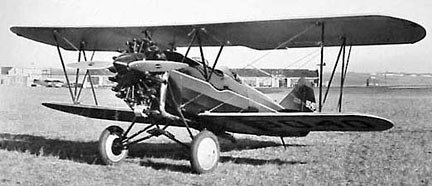
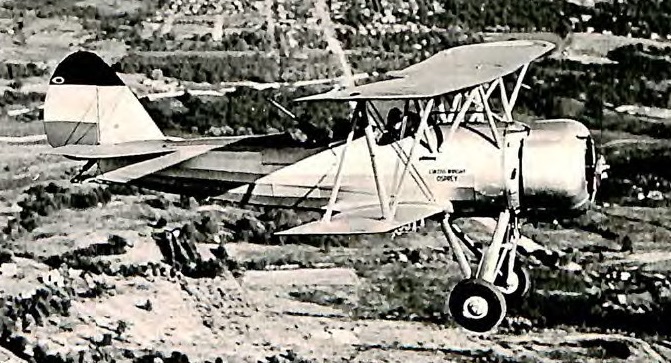
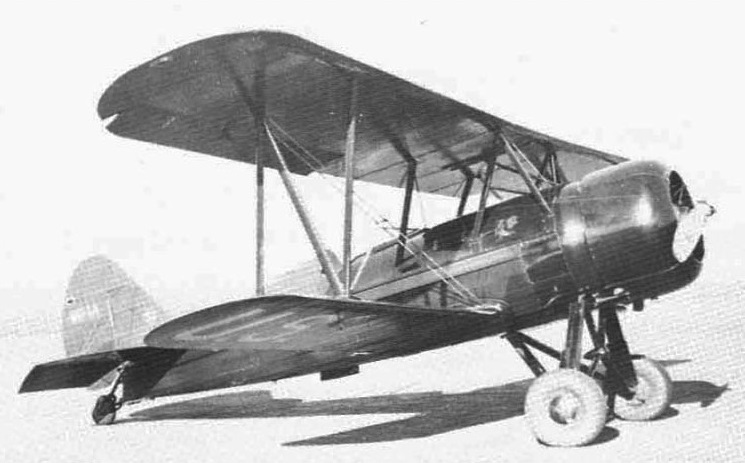
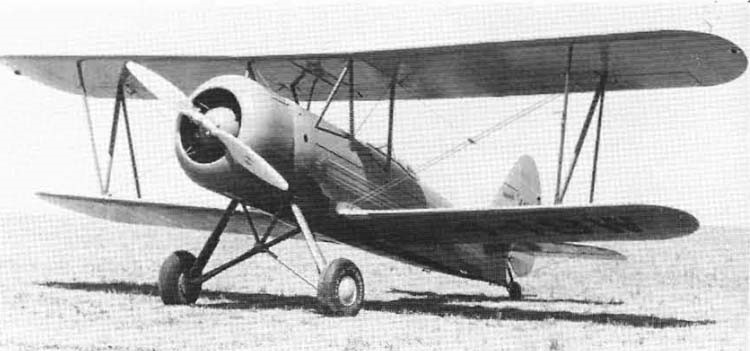
Following Travel Air Manufacturing Company purchase in August 1929 by Curtiss-Wright, the Model 4000 continued in production into the early 1930s as the CW-14, and the range was expanded to include a military derivative dubbed the Osprey.
Curtiss-Wright Osprey Whirlwind engine
The Curtiss-Wright CW-13 designation was not used and the next was the CW-14, developed on the basis of Travel Air 4000/4 – it was first designated Speedwing, but later renamed Sportsman. The name Osprey was given a two-seater military model designed for export.
CW-B14B
The CW-B14B Speedwing Deluxe (2 manufactured) had a 300hp Whirlwind J-6-9 (R-975E) engine (224 kW), and the single CW-B14R Special Speedwing Deluxe was powered with a 420-hp turbocharged SR-975E engine (313 kW).
CW-A14D
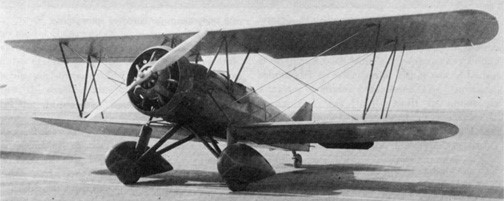
The military CW-C14B Osprey was powered with a 300 hp R-975E engine (224 kW). This was fitted with bomb racks, a fixed, forward-firing machine gun, and a trainable tail gun. These aircraft were supplied to Bolivia and used during the 1933 Gran Chaco War with Paraguay, which eventually led to Curtiss-Wright’s successful prosecution for supplying these aircraft in violation of a U.S. arms embargo. The rugged, reliable Ospreys were the preferred mounts of the Bolivian pilots—of several competing aircraft supplied. The resulting heavy use led to high losses—half of the original 12 units being lost in accidents or action, another five or so were employed, though precise outcomes are unclear, owing in part to repairs on some of the “lost” aircraft, which were returned to service. However, the action brought favorable publicity and credibility to Curtiss-Wright aircraft.
The only CW-14C prototype was powered by a 185 hp Curtiss Challenger engine (138 kW), followed by the CW-A14D (5 produced) with a Wright Whirlwind J-6-7 (R-760E) engine of 240 hp (179 kW).
The CW-C14R was similar to the CW-C14B, but with the J-6-9 engine. Colombia operated three CW-C14R Osprey from 1932, Ecuador purchased two CW-14Rs in 1931, and Venezuela purchased three CW-14Rs in 1932.
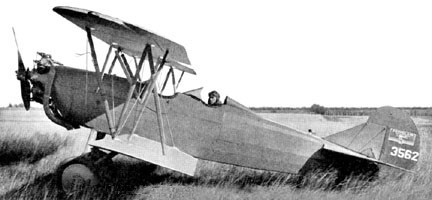
Three 1928 Travel Air 8000 (ATC 37) were built, including N3562 (later converted to Model B) and NC5091. Price at $5,000 an alternate designation was 4000-CAM.
Travel Air 8000 N3562
Four or five 1928 Travel Air 9000 (ATC 38) were built, priced at $5,000, converted from model 3000 and model 4000. An alternate designation was 4000-SH.
CW-14C Sportsman Engine: Curtiss Challenger, 185 hp (138 kW) 1 built
CW-A14D Deluxe Sportsman Engine: Wright J-6-7 (R-760), 240 hp (180 kW) Wing span: 9.44 m / 30 ft 12 in Wing Area: 23,0 m² / 248 ft² Length: 7.17 m / 23 ft 6 in Height: 2.78 m / 9 ft 1 in Empty Weight: 804 kg / 1773 lb MTOW: 1302 kg / 2870 lb Maximum speed: 249 km / h Cruising speed: 208 km / h Range: 966 km / 522 nm / 601 mi. Ceiling: 4877 m / 16.010 ft Seats: 3 5 built NACA cowling
CW-B14B Speedwing Deluxe Engine: Wright J-6-9, 300 hp (220 kW) 2 built
CW-B14R Special Speedwing Deluxe Single-seat racer built for Casey Lambert Engine: supercharged Wright R-975 1 built
CW-C14B Osprey militarized version Engine: Wright R-975E
CW-C14R Osprey militarized version Engine: Wright J-6-9
CW-17R Pursuit Osprey CW-B14B with uprated engine; possibly not built
The S-2000 of 1927 was a floatplane version of the 2000 with a 102hp Curtiss OXX-6. A few were modified as landplanes.
Travel Air S-2000 NC663H
The 1928 SD-2000 NX6416 was the same as the 2000 model, but with a 150hp Aeromarine B engine. It was later converted to a 4000 model.
The 1929 SC-2000 model (ATC 111) were the same as the 2000 model, but with a 160hp Curtiss C-6 engine. Priced at $4,000, two (NC7574 and NC8110), were built, and possibly one more.
The improved B model sold for $2,950, and $3,677 in 1929. ATC 2-25 was a 120hp Anzani installation and ATC 2-42 for twin EDO floats.
The 1931 model 2000-T (ATC 2-368) was powered by a 115hp Milwaukee-Tank engine. Fifteen were built.
Curtiss-Wright-Travel Air 2000 C-W wing, Continental W-670 NC4952
About 600 were built overall.
Travel Air 2000 with Curtiss OX-5 engine
In 1933 a Travel Air 2000 was modified by George and William Besler where the usual inline or radial gasoline piston engine was replaced by an oil-fired, reversible 90° angle V-twin angle-compound engine of their own design, which became the first fixed-wing airplane to successful fly using a steam engine of any type. The Beslers are thought to have sold the plane to the Japanese in 1937.
Travel Air 2000 Engine: Curtiss OX-5, 90 hp Wingspan: 34’8″ Length: 24’2″ Useful load: 845 lb Max speed: 100 mph Cruise speed: 85 mph Stall: 40 mph Seats: 3
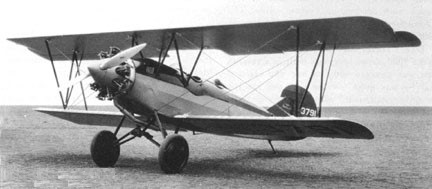
First of the Travel Air line, officially introduced in March 1926 as the Maiden Wichita. First flying on 13 March 1925 piloted by Walter Beech, it was priced at $3,500, rising to $2,195 in 1930.
A full-page company ad in Aero Digest of Aug 1928 featured “Old Number One” as being built in 1924 (the company was formed on 1/26/25), bought by O E Scott of St Louis, with a photo showing a tail number NC241 c/n 1. Since licensing came in 1927, it was obviously licensed and the photo made about that time.
Presently it is in the EAA collection, on display at the Beechcraft Heritage Museum.
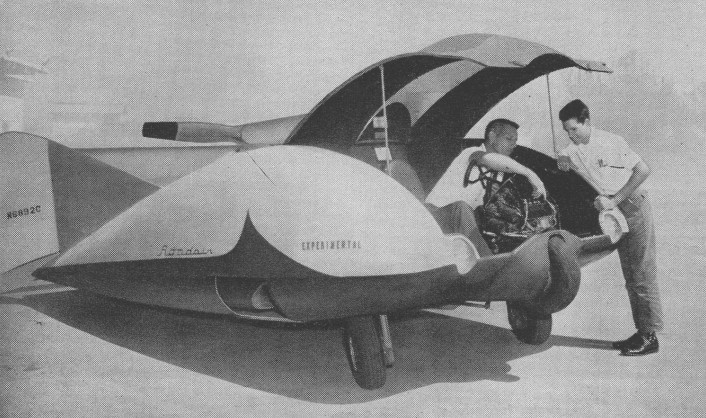
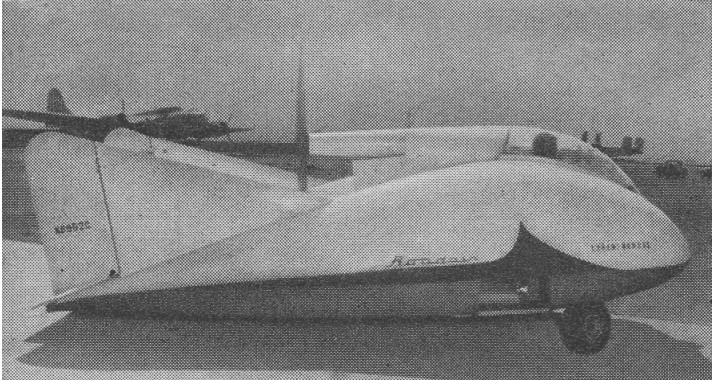
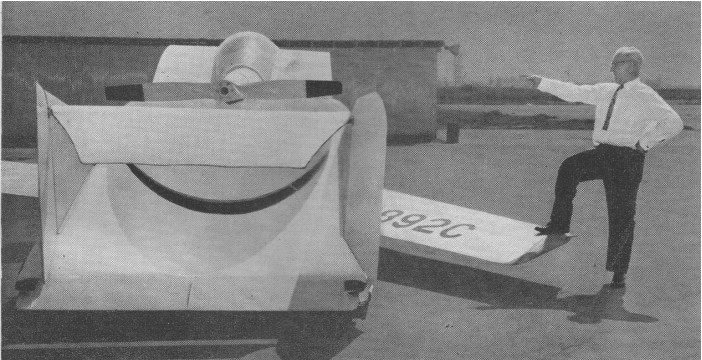
This Road Air was the first prototype, and last production model built by Herbert Trautman. The idea of making a car that could fly had always been a fascination for Herb. The idea for a plane/car combination was first conceived of in the aviation pioneer days prior to World War I but technical limitations of the time prevented any serious progress to be made. Interest was rekindled in the late 1920’s when ideas and activity flourished. It first flew in 1946. By 1950, Herb Trautmann had begun construction of the Road Airand, Herb continued to build his dream car until it was completed in 1959.
After finishing his dream flying car, Herb was ready for his maiden flight. Herb climbed in, locked the hatch, started the Road Air and began to taxi. Feeling comfortable he began to get the feel of the Road Air on faster and faster runs. Finally, he lined up into the wind, applied full power and headed down the runway. At about 90 mph the Road Air lifted off the ground to about 3 feet. As Herb soon began to loose control, he set the Road Air back on the runway averting disaster. He put it in storage, never to be flown again.
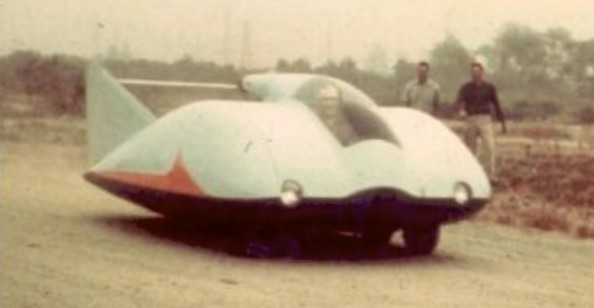
Called the Roadair, the car has a body 15 feet long and 7 feet 10 inches wide. As an auto, it rides on a tricycle gear, the single rear wheel driven by a small gasoline motor. As an airplane, the wings fold out from the body to a 25 foot wingspread. A 75-horsepower airplane engine drives the single pusher propeller. Twin rudders and elevator are located in the rear. Expected retail price was approximately $10,000. Estimated cruising speeds are 90 miles per hour in air and up to 75 on ground. FAA experimental license has been issued. Roadair operates us auto or plane from same controls. Same action moves rudders and wheels. Wings fold up inside body.
When Kermit purchased the Tallmantz Collection in 1985 the Road Air was on loan for display by Mr. Trautmann. When packing the collection for shipment to Florida, Herb, in his eighties, came out for a visit to decide what to do with his aircraft. He had no place to store it and when Kermit offered to take it back to Florida, Mr. Trautman signed over a Bill of Sale and gave it to him on the spot.
In 1996 the Road Air was restored to run-able condition. It is sometimes taken by trailer to trade shows and events as an attention getter to help promote Fantasy of Flight. On one promotional outing, the Road Air was taken down to the local U.S.A. Speedway and driven around the track for a quick demonstration.
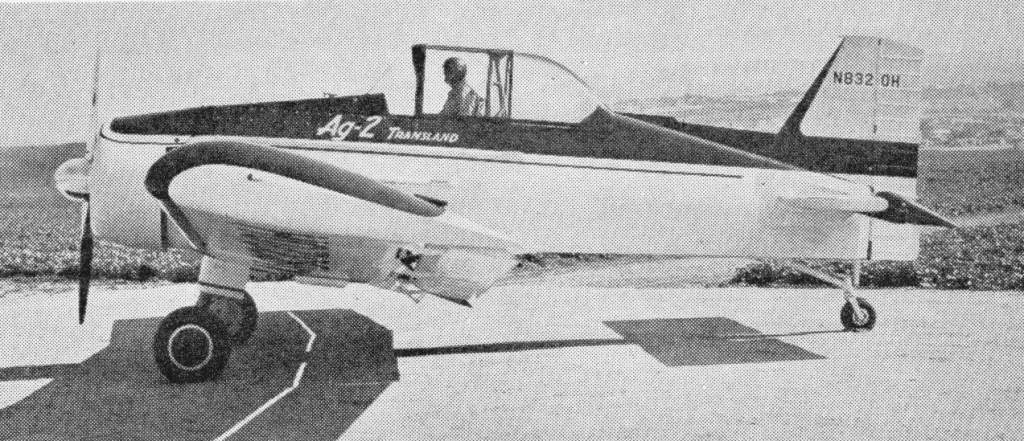
The idea of an agricultural aircraft followed a meeting between George Wing, Lloyd Stearman, Tom Watson (from Aerial Agriculture in Sydney, Australia) and George Roth (of Murryair of Hawaii and later owner/producer of Eniroth). George Roth had been instrumental in the building of the Ag-1, and he was an obvious influence in the Ag-2 design by George Wing’s team.
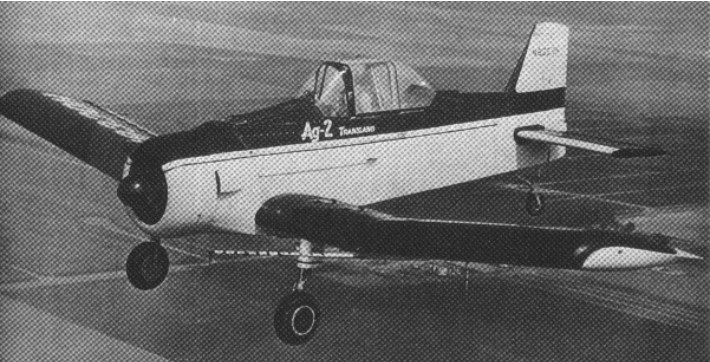
Construction of the first aircraft began in 1954 and the Transland Ag-2 made its first flight from Torrance as N8330H on 11 October 1956. At that stage, it was a single-seat aircraft powered by a 450-hp Pratt & Whitney R-985. Between the engine and the cockpit was housed an integral hopper of 53 cubic feet intended for solid materials and carrying a load of 3,000 lbs in the restricted category. The length of the cropduster was 28 ft, 5 inches and its height 9 ft. 8 inches.
The centre wing was built in two sections fastened to the fuselage either side of the hopper. Each section incorporated two 62.5 US gallon tanks which were intended as spray tanks totalling 250 US gallons. The wing was extremely thick – some eighteen inches deep – which gave high lift but also high drag. The aerofoil, a modified NACA 64021 section, had an aspect ratio of around 21%. A single flap extended under the fuselage between both sections. The outer wing panels also incorporated a 62.5 US gallon tank intended for aircraft fuel. The ailerons ran the full length of these panels with a top side lifting flap, which presumably kept a clean airflow over the wing and ailerons. Aluminium wing tips gave a wing span of 42 ft and a wing area of 321.6 sq.ft.
While the test flying was done on the first aircraft, a second, N8331H, was built and fitted with a 600-hp P&W R-1340. The payload was increased from 2,000 lbs to 3,000 lbs, giving an all-up weight in the agricultural category of 7,700 lbs. The empty weight of the aircraft was 3468 lbs.
N8331H first flew from Torrance in June 1958. The first aircraft was also retrofitted with an R-1340 and the rear cockpit modified to carry a passenger. The then Civil Aero¬nautics Administration awarded Type Certificate #4A20 to Transland Aircraft for the Ag-2 on 24 June 1958.
In 1959, a third and final aircraft, N8232H, was built and operated in Panama.
The monocoque design of the Ag-2 didn’t fail, it was twenty years ahead of its time. In the 1950s and ‘60s, the Stearmans and the Naval Aircraft N3Ns were still the “big planes” of an operator’s fleet and were able to be obtained cheaply for US$5,000, as opposed to the Ag-2’s price tag of US$25,000.
With 577 hours on the clock, N8330H was sold to Charles Chalking in Uruguay in 1962. The aircraft was flown to the South American country, where it was registered CX-AYC in May 1962. Under the name of Azucarera del Litorial SA of Paysandu, it flew some 224 hours on sugar fertilizing until 31 December 1963, when it was placed in storage. The aircraft spent 28 years in storage before being sold to an operator at Triente y Tres. Flown again on 25 September 1991, the Ag-2 had clocked up another 290 hours by 23 February 1993 before it was parked up at the airfield at Triente y Tres for seven years. Around 2000 the wings were removed and stored in a shed, while the fuselage was pushed to the edge of the airfield where weeds began to incarcerate it. In April 2003 the aircraft arrived in New Zealand for restoration, with 1091.2 flying hours. At some early stage the inside of the hopper was lined with fibreglass.
Engine: Pratt & Whitney R-985, 450-hp Seats: 1 Length: 28 ft 5 in Height: 9 ft. 8 in Hopper cap: 53 cubic feet Load cap: 2,000 lbs Spary tank cap: 250 USG Fuel cap: 62.5 USG Wing span: 42 ft Wing area: 321.6 sq.ft
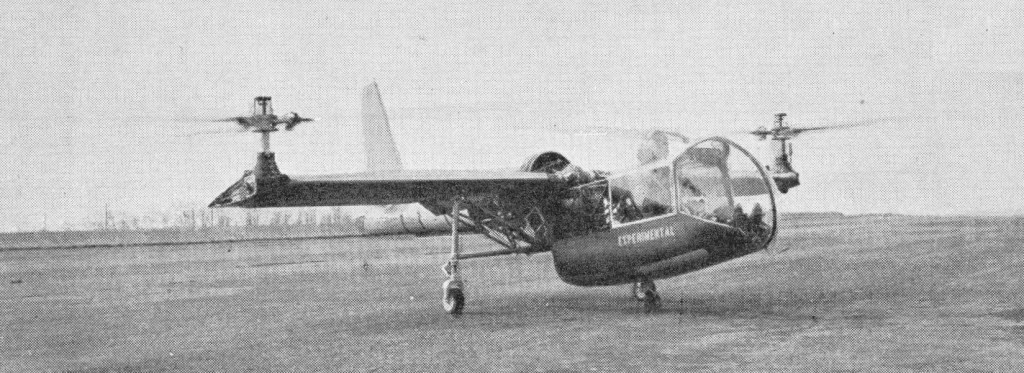
The Transcendental Aircraft Corporation of Glen Riddle, Pennsylvania, was the first company to claim flying a successful Tilt Rotor aircraft. The Model 1-G was a small, high-wing experimental aircraft with a fuselage-mounted engine and fixed tricycle landing gear designed and built by Mario A. Guerierri. The single pilot sat forward of the wing in a semi-enclosed fuselage. The clear plastic nose gave the pilot helicopter-like visibility. A single Lycoming 0-290-A six cylinder engine produced 160 horsepower. The fuselage measured 7.9m long, and the aluminum wing measured 6.4m. The ailerons were fabric covered. Empty weight was 655kg and take-off weight was 790kg. The projected maximum speed in helicopter mode was 190km/h, and 260km/h in airplane mode.
A 5.2-meter diameter, three-bladed, fully articulated rotor was mounted at each wing tip. The rotor shafts tilted from pointing vertically for hover down to 6 degrees up from horizontal for forward flight. Electric motors controlled the tilt of the rotor shafts.
Interconnecting shafts ensured that both rotors maintained the same tilt angle. Each rotor was driven through a two-speed gearbox. This allowed the pilot to lower the rotor rotation speed for more efficient cruise in forward flight.
Although the Model 1-G was a private development, the Wright Air Development Center at Wright-Patterson AFB issued contracts to study many of the Tilt Rotor’s unique peculiarities.
The first was awarded in 1952 to investigate the dynamics and structural characteristics of the rotor system. The Air Force awarded a second contract in 1953 to investigate mechanical instability problems associated with tilting the rotors.
The first hover flight was either on June 15 or July 6, 1954 (references vary). The first forward flight in hover mode occurred on December 13, 1954, and the first forward flight with rotors tilted occurred only four days later. By April 1955, conversions with the rotors tilted up to 35 degrees from vertical were completed. Eventually, the Model 1-G completed numerous transitions up to 70 degrees of tilt with the wings sustaining over 90 percent of the weight.
The engine reduction was been replaced by a two-gear reduction box, at the exit of which a gearing system has been attached which enables the rotors to be put into auto-rotation. At the engine’s maximum output of 3000 r.p.m. the rotors rotate at 633 r.p.m. as airscrews, and at 240 r.p.m. as helicopter rotors.
Three concentric tubes start from the swivelling device, the first of which moves the rotor, the second controls cyclic variation and the third variation of collective pitch. The time needed to move from the helicopter to the aircraft position is roughly three minutes. In this change-over, the rotors swivel through an angle of 82 degrees.
The Model 1-G was destroyed during a test flight on July 20, 1955. After performing a virtually complete conversion, the friction lock on the collective pitch controller slipped, throwing the aircraft into an abrupt, steep dive. The pilot initiated a recovery, but there was not enough altitude to complete the pull-up before contacting the Delaware River. The aircraft flipped on its back, resulting in irreparable damage.
During the Model 1-G’s brief career, it made over 100 flights, achieved 90% conversion (about 70 degrees forward rotor tilt), and flew 60 hours. It demonstrated excellent controllability without vibration, and reached an altitude of 1060m and an airspeed of 185km/h in helicopter mode.
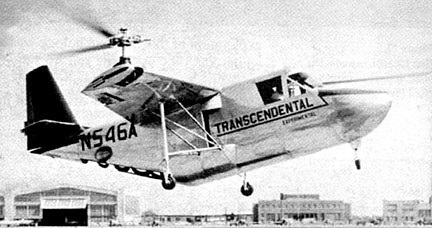
A second aircraft, called the Model 2, N546A, was to fly in late 1956. Transcendental received an Air Force contract in March 1956 and completed the Model 2 in October. Compared to the Model 1-G, it was stronger and more aerodynamic, but had the same basic configuration. The enclosed cockpit had side-by-side seating. Power was by one 250 horsepower Lycoming O-435-23 six cylinder engine. The wing was a 0.3m longer, but the fuselage was 1.2m shorter. Empty and gross weights were 708kg and 1015kg. Development ended when funding from Wright Air Development Center stopped. It could not be determined if the aircraft ever flew, and eventually it was dismantled.
Transcendental 2 N546A
The Model 3 of 1957 was also a convertible, and an extrapolation of Model 1G, it is intended to be powered by two gas turbines, and to accommodate a crew of two and also six passengers or alternatively four stretchers. It is expected that this model will have a cruising speed comparable to that of a traditional aircraft and also the special take-off and landing properties of a helicopter.
Model 1G Engine: 1 x Lycoming G0-290-A, 160hp Rotor diameter: 5.18m / 17 ft Width (rotor tip to rotor tip): 11.58m Rotors: 2 x 3-blade on outriggers Max rotor speed: 633rpm Wing span: 21 ft Length: 7.93m / 26′ 0″ Height: 2.13m Weight fully loaded: 794kg / 1,640 lb Empty weight: 658kg Maximum speed (as helicopter): 196km/h Maximum speed (as aircraft): 256km/h / 150 mph Absolute ceiling (as aircraft): 1525m Endurance: 90 minutes Seats: 1


 All Aero