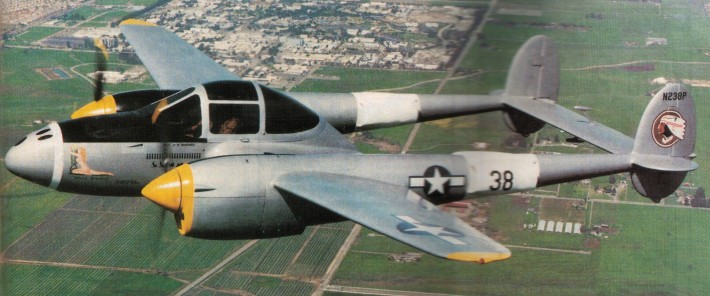
Walter Treadwell decided to design and build his own P-38 as a 55% scale replica. Treadwells is a P-38J.
Cooling the engines are four custon built copper radiators installed in the tail booms, made to form fit within the contours. Designed by Treadwell, the cores were fabricated by a Livermore radiator shop, and a friend, Norm Daniel braied the copper. Small, bullet shaped intakes provide airflow, where the supercharger air intake was on the original.
Contra-rotating was not feasible and each engine uses a 2.37-1 cogbelt PSRU reduction gearbox designed by Reductions Inc, and turns a 3 blade 66 in Warp Drive ground adjustable prop. Exhaust is through a single stack that exits below each engine nacelle.
Each part of the undercarriage was independently machined from solid stock. That included oleos, linkages and wheel forks, attachment fittings and retraction mechanism.
Although the replica is mostly composite construction, plywood was used to establish the cross sections, then stripped with foam that was then sanded into shape. Over this, fibreglass was laid, and when finished, the plywood formers removed, then replaced with bulkheads of honeycomb/glass that were glassed into the shell.
The twin booms are built the same way, but they are connected to wood stringers, then formed with foam, then wrapped with fibreglass.
The main spar is a box type built of Douglas fir in three sections. A centre section that connects the fuselage pod to each boom and the outer panels. All are covered, cap-stripped with carbon fibre, wrapped with fibreglass, then vacuum bagged. Ribs are traced from a CAD program onto full size templates, then each is individually cut from Bluefoam using hot wire. Each is then finished with ply cap strips. The aerofoil begins as an NACA 23015 at the root, then tapers into an NACA with washout at the tip of the entire wing, then covered with 1/16 inch plywood over which fibreglass cavering is applied. The control surfaces are statically balanced.
Primary controls are operated through a complex system of cables, pushrods and fittings that run from the fuselage and wings through the booms to move the ailerons, flaps, elevators, rudders and trimtabs. All this requires 34 sheaves out to the booms to accomplish this. The ailerons are controlled buy a series of bell cranks activated by cables and pushrods, and the same for the elevator. The rudders are cable controlled.
The landing gear is hydraulically operated.
The result is an airplane stressed to 9.9G. The landing gear has been drop tested for a 2000 lb landing weight.
The canopy frame is identical to the original P-38, complete with a flat forward panel, while the sides are molded. The canopy slides fore and aft to facilitate entry into the cockpit for two, and the top panel swings up and rearward.
Unlike the real P-38, Treadwell’s has a stick (topped off with an F-4 Phantom grip) to simplify linkages.
A major problem has been the engine/propeller combination with only 70% of the engine output being achived. Treadwell made the decision to ground the P-38 and replace the Suzuki engines with a pair of Walter Loms.
Engines: 2 x Suzuki 1.3 lt 4-cyl, 100 hp at 6400 rpm
Wingspan: 30.6 ft
Length: 21.9 ft
Wing area: 110 sq.ft
Empty weight: 1500 lb
Gross weight: 2000 lb
Cruise: 150 mph TAS
Top speed: 200 mph TAS
Service ceiling: 12,000 ft
Range: 525 sm




 All Aero