Turbay SA was formed in January 1961 to build the proposed T-3B production version and a lengthened fuselage development, the T-4, but no production was achieved.
Piston
Turbay T-3
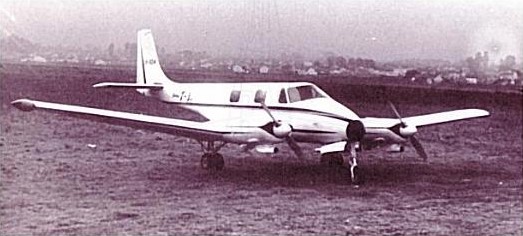
In 1957, the Argentine aircraft designer Alfredo Turbay began work on a twin-engined STOL light transport, the Turbay T-3A, with Turbay S.A. formed at Buenos Aires in January 1961 to build the new design. The T-3A was a low-wing cantilever monoplane of all metal construction. It was powered by two 130 kW (180 hp) Lycoming O-360-A1D engines driving two-bladed propellers, and was fitted with a retractable nosewheel undercarriage.
Alfredo Turbay piloted the T-3A on its first flight on 8 December 1964. Production was planned of the T-3B, which was to be fitted with 190–260 kW (250–350 hp) Lycoming or Continental engines, giving improved performance. These plans did not come to fruition, with the prototype T-3B never completed, and no production occurring.
Powerplants: 2 × Lycoming O-360-A1D, 130 kW (180 hp) each
Propellers: 2-blade Hartzell HC-92 zk-2b/8447-12A metal
Wingspan: 13.52 m (44 ft 4 in)
Wing area: 24.08 m2 (259.2 sq ft)
Aspect ratio: 7.5:1
Airfoil: NACA 23024 at root, NACA 4412 at tip
Length: 9.40 m (30 ft 10 in)
Height: 3.60 m (11 ft 10 in)
Empty weight: 1,034 kg (2,280 lb) equipped
Max. zero-fuel weight: 1,725 kg (3,803 lb)
Max takeoff weight: 1,860 kg (4,101 lb) (MTOW and MLW)
Fuel capacity: 360 L (95 US gal; 79 imp gal) in four wing tanks, with provision for 2x 80 L (21 US gal; 18 imp gal) external tanks; 24 L (6 US gal; 5 imp gal) oil
Wing loading: 77 kg/m2 (16 lb/sq ft)
Power/mass: 0.1442 kW/kg (0.0877 hp/lb)
Maximum speed: 318 km/h (198 mph, 172 kn)
Econ. Cruise: 230 km/h (140 mph, 120 kn)
Max cruise: 255 km/h (158 mph; 138 kn)
Stall speed: 85.4 km/h (53.1 mph, 46.1 kn)
Never exceed speed: 342 km/h (213 mph, 185 kn)
Range: 1,380 km (860 mi, 750 nmi) with maximum payload, zero wind
Range: 1,840 km (1,143 mi; 994 nmi) with maximum fuel, zero wind
Service ceiling: 7,600 m (24,900 ft)
SE Service ceiling: 3,500 m (11,483 ft)
Rate of climb: 6.6 m/s (1,300 ft/min)
Take-off run: 118 m (387 ft)
Take-off distance to 15.25 m (50 ft): 225 m (738 ft)
Landing run: 100 m (328 ft)
Landing distance from 15 m (49 ft): 180 m (591 ft)
Crew: 1
Capacity: 6 passengers / 522 kg (1,151 lb) max. payload / tanks for 800 L (211 US gal; 176 imp gal) chemicals
Turbay T-2
The T-2 five-seat twin-engined monoplane was destroyed by fire in early 1949 before it had flown.
Turbay T-1 Tucan
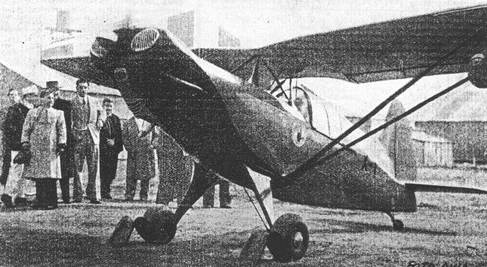
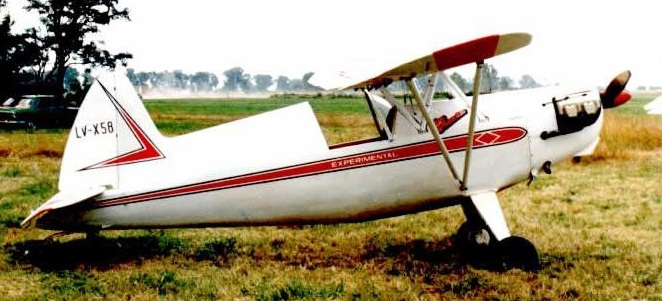
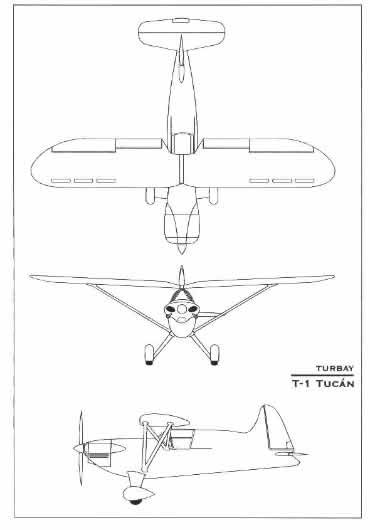
Designed by Alfredo Turbay and built by Sociedad Anonima Sfreddo & Paolini, the Tucán is a parasol-wing braced monoplane with a fixed cantilever type landing gear, tailwheel and powered by a 65 hp (48 kW) Continental A65 air-cooled piston engine. The design of the T-1 toucan started it in 1937, reaching its final form in 1939.
It had an enclosed cockpit just aft of the wing trailing-edge with a sliding canopy.
The first of January 1941 began with the construction of this prototype at the Technical Institute of the National University of Tucuman in the Popular Aviation Center founded by Los Tucanes Turbay himself and his colleagues a couple years earlier.
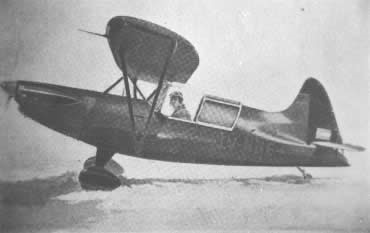
Construction was finished in April 1943 and between 2 and 5 February was statically tested and approved by the Directorate General of Civil Aviation granting the first experimental enrolment of registration, LV-X1.
The first flight was made on April 5, 1943 with an excellent performance, which made Turbay interested in taking it to Buenos Aires to get potential customers and try to manufacture in series. The plane arrived at Airfield San Fernando in Buenos Aires in May 1943 and on May 16 before national, military and aerospace Argentina and higher authorities. This made the Sfreddo and Paolini SA hire him as technical manager of the company. They planned to sell the aircraft at $10,000 National Currency each, which made it very accessible for the time. Turbay made some tweaks to the model and officially presented to the press and public at the airport on August 22 of that year.
Series production under license by Sfreddo and Paolini for the construction of 6 units were scheduled and minor modifications began with the works. The series aircraft would be equipped with the same engine as the prototype, the Continental A65 65 hp, but the Directorate General of Civil Aviation cancelled its commitment because of World War II for which production was suspended. Sfreddo & Paolini was seized and nationalized by the government.
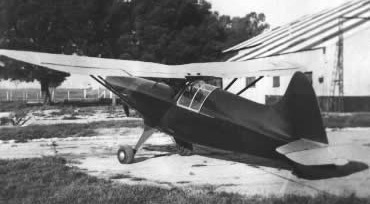
While there were several attempts to build the plane in series, political and economic problems of the country prevented this. Plans to revive production in 1963 were thwarted. The prototype, once approved, was re-registered LV-NBE on September 13, 1944. On January 23, 1945 Turbay sold the aircraft to Bruno Zantini and to Orlando Harriet on September 25 of that year. On 22 November 1956 the record was transferred to Roberto Velazquez who completely destroyed it in an accident on April 18, 1957 in Bell Ville, province of Cordoba.
In 1975 Luis Fernandez finished building a second aircraft with planes bought in 1969 at the AVEX institution that Turbay. This aircraft was registered as LV-X58 and first flew on October 9, 1975.
Engine: 1 × Continental A65, 48 kW (65 hp)
Length: 5.55 m (18 ft 2 in)
Wingspan: 7.22 m (23 ft 8 in)
Height: 1.90 m (6 ft 2½ in)
Wing area: 7.20 m2 (77.5 ft2)
Empty weight: 285 kg (627 lb)
Gross weight: 450 kg (990 lb)
Maximum speed: 205 km/h (127 mph)
Range: 1100 km (680 miles)
Endurance: 6 hours
Service ceiling: 4200 m (13780 ft)
Crew: 1
Tupolev-Myasishchec Type 31

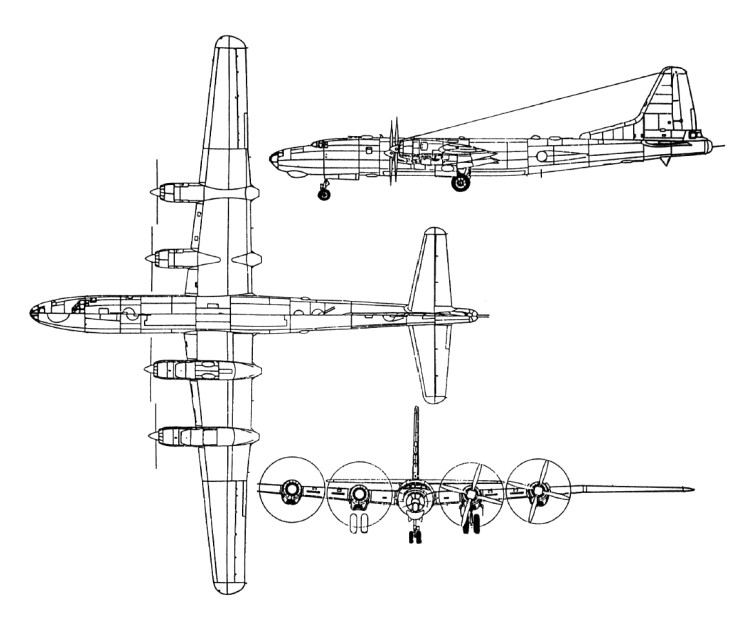
The Tupolev-Myasishchec Type 31 was believed to be an interim bomber design built only in pre-production quantities and used to test the turboprop power plants later employed by the type 40 Bear. The type 31 Barge originally employed diesel engines believed to be 4300 hp M-224, but these were later replaced by four turbines of about 4500 shp, plus 1200 lb residual thrust.
Est.
Wingspan: 185 ft
Length: 145 ft
Height: 38 ft
Loaded weight: 210,000 lb
Max speed: 380 mph
Cruise: 340 mph
Max range: 7500 mi
Tupolev Tu-75

Next in the extended B-29/Tu-4 family was a military transport, basically a version of the Tu-70. Its design was very similar to its civilian counterpart. Again Dmitri Markov had gone for a low-wing, four-engined transport, with the wings, undercarriage and tailplane virtually identical to those of the B-29/Tu-4; only the wing’s centre section had any major differences in order to fit a low- rather than a mid-wing arrangement. The fuselage was also almost a direct copy of the Tu-70 in length, cockpit and cross-section, but its military purpose resulted in some differences. These included the interior: rather than a luxury passenger cabin, the Tu-75 had a pressurised cargo hold with an underbody loading ramp which swung downwards on hinges to allow ramp access for its planned military cargoes. These could include vehicles such as jeeps or small tracked armoured personnel carriers. General cargo could be loaded or unloaded using a hoist which was mounted in the aircraft beside the loading ramp. Ahead of its time, even aero engines could be carried in the hold. Alternatively, 100 fully equipped paratroops could be carried, and could exit the aircraft while in flight.
Like the Tu-70, powerplants were those of the B-29, but this time Shvetsov’s copy, the ASh-73K, was used, with each engine giving 2,300hp. It was armed with three pairs of machine-guns, one on the upper fuselage, one below and one in the tail.
Work began on the Tu-75 in 1947, and the prototype was built at factory N 156. Its first flight was made on 22 January 1950. Although the aircraft was not put into production, it was another step on the road to the VVS building up its strategic transport and bomber capability.

Tupolev Tu-70

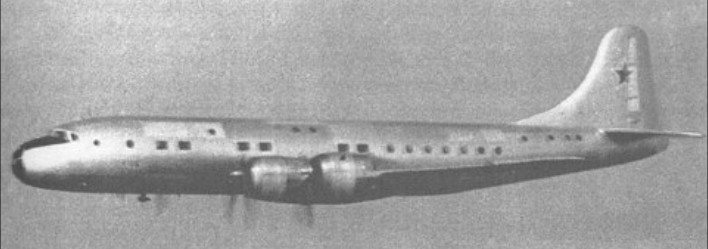
The Tu-70, NATO code name ‘Cart’, was a one-off long range airliner development from the Boeing B-29/Tupolev Tu-4. The prototype, incorporating a B-29 landing gear, tail unit and engines, first flew on 27 November 1946, designed for crew of eight and 48 VIP passengers, but used with crew of six and 72 passengers as staff transport for air force. A new nose with conventional cockpit/flight deck instead of low-drag Superfortress-style nose was built.
Engines: 4 x ASh-73TK, 1770hp
Max take-off weight: 51400 kg / 113318 lb
Empty weight: 38290 kg / 84415 lb
Wingspan: 43.05 m / 141 ft 3 in
Length: 35.61 m / 117 ft 10 in
Height: 9.75 m / 32 ft 0 in
Wing area: 161.7 sq.m / 1740.52 sq ft
Max. speed: 560 km/h / 348 mph
Range: 4900 km / 3045 miles
Crew: 6
Passengers: 48

Tupolev Tu-85

At the end of the 1940s, Vladimir Dobrynin’s engine design bureau had developed a new air-cooled, twenty-four cylinder in-line piston engine, the VD-4K, which offered a 4,300hp supercharged power output. Dmitri Markov set about designing a very long-range strategic bomber with these engines. Starting from the Tu-80 he began by designing a high-aspect wing with increased span – now it was 55.94m compared to the 43.83m of the Tu-75 and Tu-80, and wing area was 273.6sq.m, compared to 162.7sq.m. Wing aspect ratio was 11.4:1.
This allowed the new aircraft to carry forty-four tonnes of fuel which would give it a range of 12,000km. He streamlined the fuselage, and provided accommodation for a second crew which would be needed with the aircraft’s twenty-six hour endurance capability. Normal crew was eight so the Tu-85 carried sixteen in a pressurised cabin. The Tu-85 was fitted with large four-blade propellers, and it was armed with five turrets each fitted with a pair of NR-23 cannons which could be remotely controlled by a gunner, who had a screen to show the arc of fire from each position a development of the B-29/Tu-4 system.
The Tu-85 was constructed at factory N 156 in 1949 and 1950. When completed, it was brought to Zhukovski aerodrome, reassembled and readied for flight. On 9 January 1951, Aleksei Pereliot was in command as it took off for the first time.
In factory and state tests, it gave excellent results. Although its empty weight was 55.4 tonnes and its normal take-off weight seventy-five tonnes, it could take off at 107 tonnes when necessary, allowing it to carry the enormous fuel load needed to achieve its 12,300km range with a five-tonne payload, or to increase its normal five-tonne bomb load to twenty tonnes. Cruising speed for maximum range was established at 450km/h, but maximum speed was much higher. At low level, it was measured at 563km/h, and at a level of 10,000m it reached 665km/h.
By now, turbine engines were establishing themselves and offering higher speeds with lower fuel burns. The Tu-85 was the end of the line for Tupolev’s piston-engined, and also for Soviet aircraft. Limited flight trials were undertaken but further development was later cancelled. Only one Tu-85, the prototype was built. It was the last large Tupolev aircraft without swept wings.
Engines: 4 x VD-4K piston engines, 3160hp
Max take-off weight: 107000 kg / 235896 lb
Empty weight: 55400 kg / 122137 lb
Wingspan: 55.94 m / 184 ft 6 in
Length: 39.31 m / 129 ft 12 in
Height: 11.36 m / 37 ft 3 in
Wing area: 273.6 sq.m / 2945.00 sq ft
Max. speed: 665 km/h / 413 mph
Cruise speed: 563 km/h / 350 mph
Ceiling: 13000 m / 42650 ft
Range: 13000 km / 8078 miles
Crew: 11-16

Tupolev Tu-80

At the end of 1948, just as production Tu-4s were beginning to be delivered to the VVS, Tupolev and Markov began work on a replacement. In a sense, it was an improved B-29 design, with a major programme to trim weight and thus to improve performance.
A new wing with better aerodynamic qualities and with a lighter but stronger spar was developed with integral wing tankage. The fuselage was lightened and the round Tu-4 nose of the same chord as the fuselage was replaced with one in which the cockpit was raised above the nose for improved visibility. A new, more angular tail was also built, with a distinctive dorsal fin. Its engines were four of Shvetsov’s ASh-73TKFNs, a Soviet-built turbocharged version of the original B-29 engines.
All these changes resulted in the Tu-80 being substantially lighter than the Tu-4, and this allowed it to carry more fuel. Its first flight was made on 1 December 1949 from Zhukovski. In state tests, its maximum speed was established as 640km/h. But the Tu-80 was just another step on the way to the Soviet Union achieving a long-range strategic bomber. With the coming of age of turbines, it was not developed beyond its test programme.
Engines: 4 x ASh-73FN, 1770hp
Max take-off weight: 67200 kg / 148151 lb
Empty weight: 41030 kg / 90456 lb
Wingspan: 44.3 m / 145 ft 4 in
Length: 36.6 m / 120 ft 1 in
Height: 8.91 m / 29 ft 3 in
Wing area: 173.1 sq.m / 1863.23 sq ft
Max. speed: 650 km/h / 404 mph
Ceiling: 11180 m / 36700 ft
Range: 7000-8000 km / 4350 – 4971 miles
Crew: 11
Tupolev Tu-10
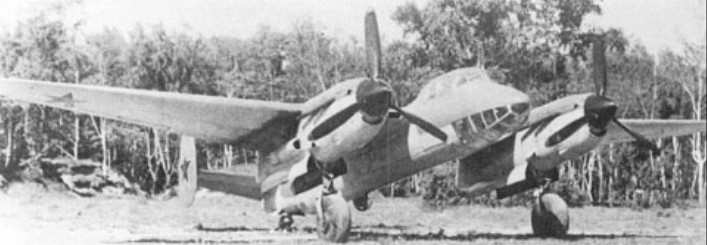
Another Tu-2 variant was the Tu-10. This was a four-crew aircraft fitted with inline Mikulin AM-39FNVs of 1850hp. Its first flight took place on 19 May 1945, and it proved to have perhaps the best performance of any Tu-2. At 8600m it attained a speed of 641km/h. Ceiling was 10,450m but range fell to 1,740km. A small batch was produced in Omsk between 1945 and 1947.
 All Aero