1998:
Via Isonzo 8
I 20048 Carate Brianz
Milan
Italy
Produce LSA aero engines
1998:
Via Isonzo 8
I 20048 Carate Brianz
Milan
Italy
Produce LSA aero engines
Construction of FVA25 (ultralight canard aircraft) began in 1983.
The FVA-19 was a study of the efficiency and design of an efficient towplane. With the following consideration: Scale is the generally accepted winch launch operation, economy would be better with aerotow if the total expenses are equal to or less at the same efficiency. Capturing all the factors that make up the term economy as a whole, was by evaluating all the statistical material possible.
Statistical considerations included a comparison of the cost of the tow plane towing to height, which incurred expenses such as overhauls, usual minor repairs. et al and depreciation are included.
After extensive calculations, it was clear that the power requirement of the optimum towing aircraft must be well above 175 hp. For a comparison, the costs and benefits achievable in the winch towing operation had to be known. For this purpose , the fixed costs of a glider per year were collected , as well as that of the wind, and from the Annual Report of the National Association of North Rhine-Westphalia DAeC the years 1959 – 1961 taken from the middle tee times . This was followed by a gliding hourly rate of 90, – DM at 60 hours per glider and year down to 70, – DM at 80 hours per glider and year. The last statement (80 h / year) seemed the performance of the winds to be exhausted. Assuming a flight time of 25 minutes per start a drag start at the same annual total flight time of 80h year and the same hour flight price could cost 4.75 DM . That was the cost of the winch to let the glider fly 25 minutes. For this purpose, on average just over two winch launches were necessary). With sufficient utilization of the towing aircraft such start-up costs are possible.
This can be reached by aerotow, with more than 80h / year per glider, so even higher towing rates may still be economical. The glider hour is the same price for both types of launch when the glider has reached 60hr per year by winch, and 95hr year by aerotow, and this with a towing price of 15 , – DM (again, for an average flight time per launch 25 minutes according to a towing height of n = 750m) .
A summary of this study was published in the trade press which great interest in gliding circles. Since the construction and flight testing of the ” Crow ” the FVA still aero-towed until the end of the 60s and in 1963, a Piper Super Cub was purchased as a tow plane. Construction of FVA-19 began in 1965, but acquisition of the Super Cub made construction superfluous.
With the help of some old masters of the FVA this study went to Bremen where it was constructed by the flight Scientific Working Group Bremen, This single-seat aircraft was equipped with a 180 hp engine, and with the type designation ESS 641 was first flown on September 17, 1971.

At the end of the fifties the FVA wanted each aviation student, after completing his studies, to have also private pilot’s license. It was decided to develop an inexpensive powered airplane, easy to fly, for training.
American engines were too expensive, so a Pollmann flight engine that was developed from the VW and gave a continuous output of 30PS at 3200 rpm was obtained. By selection of the propeller, it was possible to bring the propeller efficiency to 0.78%. It was necessary to give the propeller a comparatively large diameter of 2.15m.
It was necessary to reduce the speed of the engine to 1100 rev min. This was to be done by a V-belt reduction provided by the Pollmann, but this proved to be unusable. A transmission was developed by the FVA, with a reduction of 2.85 : l delivered by a helical spur.
Construction of the FVA18 “Primitive Krähe” (Primitive Crow, later Silver Crow) began in 1960. In the conventionally designed steel tube fuselage and one-piece wing was an extreme lightweight construction. It had a 250 kg empty weight for a two-seater powered aircraft with a wingspan of 10.50 m and a length of 6.70 m. The power plant took the flying weight to 430 kg. The plan was to only 400 kg.
The wings stems were examined at the Institute for Building Research on buckling strength.
The fuselage width of the FVA-18 was only 0.67 m. It turned out later that with this hull width a passenger, in tandem behind the pilot came in contact with the rudder pedals.
Aileron and elevator loading tests and suspension drop tests completed the test series.
The FVA-18 was built to CAR Part 3 Normal category. First flown in 1965, the flight tests were conducted under the provisions of “Civil Aeronaurics Manual (CAM)” and after “Flight Test Report Guide”. Here, every attitude and flight situation were subjected clearly defined requirements.
The self-designed gear had to be disassembled at fixed intervals to determine wear or replace bearings and oil seals leaking.
It soon became apparent that the propeller pitch was set too low. A new propeller was added at Hoffmann.
The first flights were destined to determine the normal behavior of the FVA-18. After a few minutes of flight, the oil temperature rose above the permissible level. Moreover, it was splashed on the front panel through the vent of the transmission oil.

The transmission made loud noises was at engine speeds below 1,800 rev / min, which, as it turned out, were also due to engine misfire. Metal shavings were found in the oil thrown out and the gearbox was disassembled after 20 minutes of flight time. The helical involute gears were shifting by 4 mm and beat against each other on a spacer. A newly designed additional spacer ring then prevented migration of the gears against each other, and the transmission was much quieter. Additional baffles enhanced oil cooling for level flight at a constant temperature of 90°C.
With a weight of 380 kg following flight performance were flown:
Cruising speed:
100 km / h at 3200 rev / min
90 km / h at 3000 rev / min
Lift-off distance:
40 m
Take-off distance 15m:
approximately 120 m
Rate of climb:
2.10 m / s
Altitude reached:
2500 m
Fuel consumption:
9 l / h
Range:
380 km
The first spin tests at medium gravity position could be recovered by normal control deflections and discharged again. The FVA -18 turned 1/4 to 1/2 turn. The spin was hardly different from a steep circle with minimum speed.
Flight testing was Dr. Mr. Professor. AW Quick performed the framework of the thesis of Freddy Schliewa at the Institute of Aerospace.
In 1971, she was presented in flight at the meeting of the Oskar Ursinus Vereinigung (OUV) in Egelsbach. where a lot of attention:
“The next day the representatives of the FVA Aachen presented their” primitive crow. “- Before FVA-18 from the flight characteristics of this bird that bears his name because of its simple construction with a right to all interested parties were able to convince themselves by relying on the stick translated and with the Crow Conclusion went into the air the idea of the aircraft from Aachen:… Everybody talks about the club aircraft to reproduction – we are only interested in (still) not sure “
(556 from German Aerokurier, Issue 8 71, p report on OUV-Meeting)
In particular, the low minimum speed of 55 km h and the harmless stall characteristics impressed. The simple construction aroused the interest of amateur aircraft builder. In the following years, numerous requests were answered and ten sets of drawings were delivered to interested parties.
At the end of 1971, a crashed Rf 5 Limbach engine was left. After some weighing, measuring and sketching it became clear that a transplant of the power plant was possible. Then the reconstruction was done in around 600 working hours in winter 1972/73 by Max Schörner and Erhard Schneider. The engine system and propeller had the first run-ups in April 1972.
The Crow flew for the first time on 17 May 1972. The old authorization expired, and now FVA-18b called Crow got a provisional airworthiness certification for testing. Acceleration at the start improved and short take-off run was now around 80 – 100 yards.
The following improvements and flight performance were achieved :
The FVA fully met the technical target with an intermediate stage. Through the development of the two-seater motor glider and the procurement of one for the FVA saw no further need for a powered aircraft. The Crow was sold to an OUV member.

In 1954, the FVA took a research commissioned by the Federal Ministry of Transport for the purpose of operating the type certification of the Horten Ho-33 V1 flying wing powered aircraft.
The aircraft was already designed with a view to later use it as powered aircraft.
Since the VI had first flown as a glider, the proposed engine weight was installed as ballast.
Design approval for the tailless Ho33-V1 powered aircraft was achieved in 1955.
The first two test samples of Ho 33 were built by Alfons Pützer KG in Bonn. The first calculation of the data used were the following:
Wingspan: 19.20 m
Chord at the root: 3.25m
Wing area: 35,60sq.m
Net weight: 430kg
Flying weight: approx 650kg
Wing loading: 18kg / sq.m
The hull was like the wings, made of wood construction with two seats in tandem. In the rear fuselage space for the engine was provided.
Tandem undercarriage with a steerable tail wheel and two retractable support wheels, about in the inner third of the half span were fitted.

The fuselage was transferred by Pützer to Aachen in the FVA workshop, where work was started for the engine installation. The powerplant was a Zündapp “Z 9-092”.
Power: 50 hp at 2300 rev / min
Consumption: 210285 g / hp-hr
Weight: approx 65 kg
This work took about four months to complete. The fuselage was returned to Bonn and transferred to Aachen after some trial launchs at Bonn again. While at the same weight for the purpose of determining the center of gravity, it turned out that the weights were far exceeded. With an empty weight of 620 kg the flying weight was about 850 kg.
It was prepared the launch in Merzbrück some difficulties. The Horten was transported for further testing in flight 33 at Noervenich. The entire aircraft was re-measured in almost all parts. The sparse drawings not agree with the construction.
The test flights at Noervenich proved, among other things, that behavior and the start was not satisfactory.

The regulations and guidelines of CAR Part 3 were applied and the new flight weight of about 900 kg; the geometrical data remained unchanged. As might be expected, the air loads were significantly higher than the original. The loads were set up as part of a student research project at the Department of Aviation.
The strength analysis was performed on the basis of newly data obtained during the survey of the aircraft resulting in air loads for the main components. The aircraft was undersized for the stresses occurring in some parts.
In particular, the suspension was of insufficient dimensions. More flights did not appear advisable because of the lack of strength. The changes required meant such an effort would exceed the financial resources so the job could not be continued. The aircraft was returned to Bonn leading to the abandonment of the project.
Later converted with a 75 hp Porsche engine.
Pützer-Horten Ho 33 V2 (001) D-EGOL suffered damage taxying at Bonn in June 1957 (owner and operator being LSV Bonn at the time). It had received a Permit to fly on 6 July 1956. The wings went to Fa.Frosch at Lutherbeck near Unna, the central fuselage to Rüdiger von Elm. The remaining parts were used to rebuild D-EJUS as engineless hybrid in the museum at Wasserkuppe.

After re-authorization of powered flight, in 1926 Ilse and Theodor Kober designed the FVA-6, a two-seater biplane. The FVA-6 was a biplane had two seats in tadem, and was powered by an English ABC engine with 30hp. The FVA-6 was built in the workshop of the former “Aachener Segelflugzeugbau GmbH”, which was acquired by Junkers.
For the test-flying the FVA-6 Ludwig Pfitzner had been chosen. He was one of the few new FVA – generation and just made his pilot’s license.
The two-seater biplane was completed before the end of 1926 and has done test flights to Dusseldorf – Lohausen because Aachen was still occupied by the Belgians. The FVA-6 totally destroyed during the first flight when entering Dusseldorf. The designers of the FVA-6 were no longer in Aachen, as the aircraft was completed. The new students who could fly hardly knew what to do with a new untried design.
Informal beginnings caused the formation of groups of engineers at universities with the aim of scientific and practical education. Aachen built a small series of trainers during 1917-18.
The first groups were formed in 1920 in Aachen, Darmstadt and Berlin-Charlottenburg, but others soon followed.
In 1920 Aachen Flugzeugbau was successful with gliders built to the designs of Prof Klemperer. In 1921 the name was changed to Aachener Segelflugzeugbau GmbH and in 1923 the K. F. glider-related light airplane (also a Klemperer design) was in production. In 1924 a two-seat low-wing monoplane was also flown.
2008: Flugwissenschaftliche Vereinigung Aachen
Templergraben 55
52062 Aachen
Germany
Flugwissenschaftliche Vereinigung Aachen e.V. are a group of students from the RWTH Aachen and the FH who devoted themselves to the research, building and flying of gliders. The Flight Research Association was founded in 1920 and is a club at the RWTH Aachen.
In return for the 300 per year paid flying itself is free for everyone. Aachen trains glider and motor glider pilots, as well as tow pilots.
They organize and support various courses to flight instructors, provide flying training, the training of workshop leaders and parachute packers.
With ties to many institutes of the University and the University of Applied Sciences, there is the opportunity to publish scientific work in the form of Theses. In addition, the activity in the FVA is recognized both at the FH and at RWTH as an internship.
The members can learn a lot about designing and implementing their own ideas and suggestions into action.
Working on a project is with Airbus, which deals with the testing and construction of mini-flaps, an alternative surface flap system for flight control.
With a very diverse fleet of aircraft, members perform all necessary work.
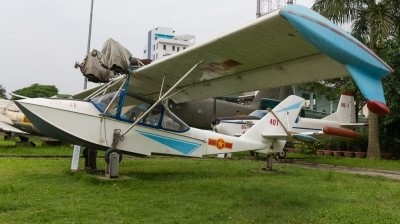
The VNS-41 is the first amphibious microlight aircraft made in Vietnam. The A41 Factory (officially Aircraft Repair Company A-41) under the Air Force and Air Defense Department (Ministry of Defense) manufactured the aircraft based on the Russian Che-22 Korvet design by Boris Chernov and E.Yungerov. A Che-22 was acquired by Vietnam in the late 1990s from the Philippines. Technicians began developing the VNS-41 in June 2003. Its entire hull, tail and middle wing are made of high-quality composite materials. The proportion of locally-made parts in the hydroplanes is 70 percent.
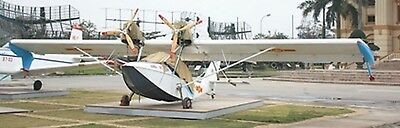
On September 12, 2005, the prototype took off for its testing before being produced for the market. The selling price was to be less than 2 billion Vietnamese dong (some 126,000 US dollar) per unit.
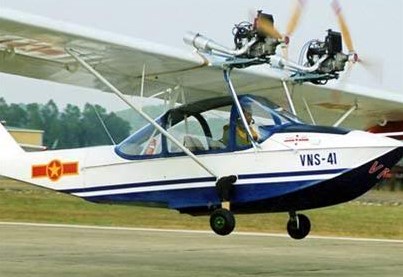
The A41 Factory under the Air force and Air Defense Department has just produced three hydroplanes. The VNS-41 was to be initially be used in forestry (forest patrol) and agriculture but will also be marketed for sport, travel and commercial applications. The first amphibious microlight aircraft made in Vietnam is preserved at the “Bao Tang Phong Khong – Khong Quan”, the Vietnam Air Force Museum.

Engines: 2 x Rotax 582, 65 hp
Wingspan: 11.65 m (38 ft 3 in)
Length: 6.98 m (22 ft 11 in)
Height: 2.535 m (8 ft 3.8 in)
MTOW: 780 kg (1,720 lb)
Fuel capacity: 80-litre (21-gallon)
Speed: 120–135 km/h (75–84 mph)
Endurance: 4 hr
Max range: 300 km (190 mi)
Ceiling: 3,000 m (9,800 ft)
TO run land: 50–70 m (160–230 ft)
TO run water: 200–300 m (660–980 ft)
Fuel burn: 38-44 lt/hr
Seats: 2-3
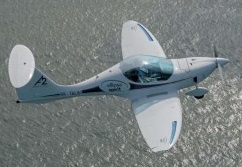
The Czech A2 CZ Ellipse Spirit was designed to comply with the Fédération Aéronautique Internationale ultralight aircraft rules. It features a cantilever low wing, a two seats in side-by-side configuration cockpit, tricycle landing gear and a single engine in tractor configuration.
The aircraft of all-composite construction. Its 8.0 m (26.2 ft) span elliptical wing employs rounded wingtips and fixed slots in the outer portion of the wing and dive brakes. Optional fuel capacity is 100 litres (22 imp gal; 26 US gal) giving a range of 1,730 km (1,075 mi). The standard engine is the ULPower 260iS four-cylinder, four-stroke aircraft engine of 107 hp (80 kW) and other engines available include the 100 hp (75 kW) Rotax 912S and 912iS, plus the 100 hp (75 kW) Lycoming IO-233.
Designed and produced by A2 CZ and first flown in July 2011, the aircraft was introduced at the Aero show in 2011 and was supplied complete and ready to fly or as a kit for amateur construction. The unt cost was € 75,000 in 2011.
The basic fixed gear Ellipse was undergoing development in 2011 into a retractable gear version as well as versions for the US light-sport aircraft category.
Ellipse Spirit
Engine: 1 × ULPower 260iS, 80 kW (107 hp)
Wingspan: 8.00 m (26 ft 3 in)
Wing area: 8.48 sq.m (91.3 sq ft)
Empty weight: 272.5 kg (601 lb)
Gross weight: 472.5 kg (1,042 lb)
Fuel capacity: 100 litres (22 imp gal; 26 US gal)
Maximum speed: 280 km/h (170 mph, 150 kn)
Cruise speed: 250 km/h (160 mph, 130 kn)
Stall speed: 60 km/h (37 mph, 32 kn)
Rate of climb: 7.5 m/s (1,480 ft/min)
Crew: one
Capacity: one passenger
1996: 3604 Galley Rd, Colorado Springs, CO 80909, USA.

