Angel Aircraft Corporation Angel / King’s Engineering Fellowship Model 44 Angel

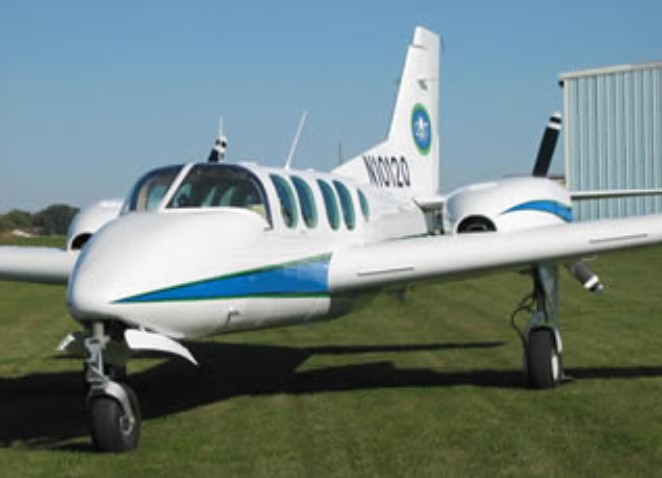
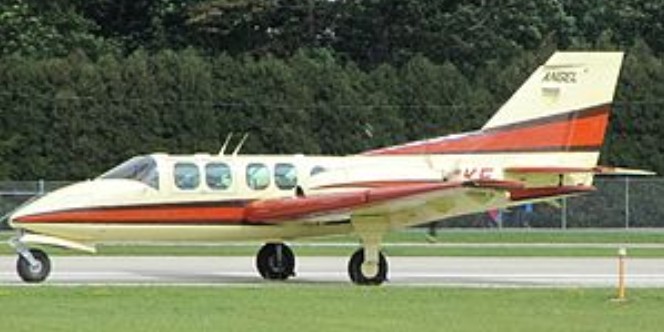
The eight-seat Model 44 Angel STOL missionary, executive and utility aircraft was certificated in 1992, featuring twin piston engines with pusher propellers. Originally The King’s Engineering Fellowship Model 44 Angel, developed by donations for missionary duties and designed by Carl Mortenson.

Design work began at the home of designer Carl Mortenson in 1972, with work on the prototype beginning in 1977, also from the designer’s home. In 1980 the project was moved to the municipal airport in Orange City, Iowa.

The Angel, with fully retractable landing gear and seating for eight offers STOL-capability. With easy seat removal, the Angel can economically carry one or two medical stretcher patients and one or two paramedics.

The Angel’s metal construction is simple, with the capability to use the short rough airstrips. The Angel comes equipped with large, low-pressure main tires for soft ground and rugged main gear. The cabin has been designed and tested for overturn loads, the engine mounts designed to contain the engines for loads up to 20g’s, and the seats crash-tested to absorb energy and restrain occupants to 26g’s.
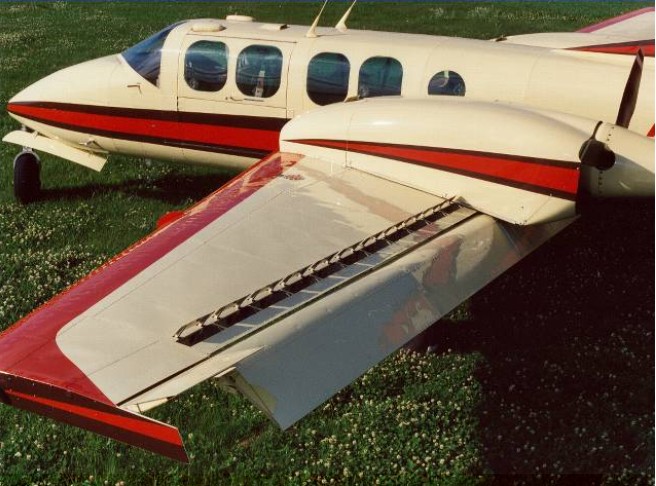
First flown on 13 January 1984, the Angel was certified to FAR 23 in the USA by the Federal Aviation Administration (FAA) in late 1992.

Engines: Lycoming IO-540-M1C5 300HP(224 kW) @2700 RPM
TBO: 2,000 hours
Fuel Grade: 100 LL (minimum grade)
Propeller: 2 Hartzell HC-E3YR – 2 ALTF/FLC-7458, 76″ dia (75 In min) CS, 3-blade, feathering
Wing Span: 39 ft 11.5 in (12.18 m)
Wing Area: 225.40 sq ft (20.94 sq.m)
Aspect Ratio: 7.08
Length: 33 ft 3 in
Height: 11 ft 6 in (3.51 m)
Max takeoff weight; 5,800 lbs (2,631 kg)
Standard Empty Weight: 3,880 lb (1,760 kg)
Standard Useful Load: 1,920 lbs
Fuel Capacity: 222 U.S. Gallons usable fuel (1,332 LBS)
Cabin Cargo (w/o seats): 84 cu ft, 1,400 lbs
Baggage Compartment : 10 cu ft, 200 lbs
Minimum takeoff roll: 658 ft
Take-off Over 50 ft obstacle: 1,404 ft
Take-off Maximum effort: 1,270 ft
Landing Distance: 568 ft
Landing Distance 50 ft obstacle: 1,046 ft
Standard Climb: 1,345 fpm
SE Rate of Climb: 196 fpm
Service Ceiling (100 fpm): 19,015 ft
Single Enging Ceiling (50 fpm): 3,868 ft
Maximum Level Speed: 180 kt IAS
Cruise @75% pwr (30 min res): 175 kt; Range: 1,137 nm; Endurance: 6.5 hr
Cruise @65% pwr (30 min res): 169 kt; Range: 1,266 nm; Endurance: 7.5 hr
Cruise @55% pwr (30 min res): 158 kt; Range: 1,406 nm; Endurance: 8.9 hr
Cruise @45% pwr (30 min res): 145 kt; Range: 1,493 nm; Endurance: 10.3 hr
Cruise @35% pwr (30 min res): 131 kt; Range: 1,720 nm; Endurance: 13.1 hr
Vne Never exceed speed: 209 kias
Vno Max structural cruising: 174 kias
Va Maneuvering speed at 5,800 lb: 139 kias
Va Maneuvering speed at 4,200 lb: 121 kias
Vle Max landing gear extension speed: 130 kias
Vlo Max landing gear operating speed: 130 kias
Vfe Max flaps extended speed: 104 kias
Vmc Minimum control speed: 65 kias
Vy Best rate of climb: 101 kias
Vs1 Power off stall, flaps up: 71 kias
Vs0 Power off stall, flaps down: 57 kias
Crew: One, pilot
Capacity: 7 passengers
ANEC II

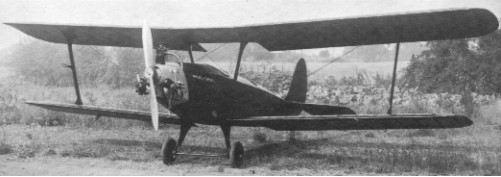
Built in 1924 by the Air Navigation and Engineering Company at Addlestone, Surrey, for the Air Ministry’s light aeroplane competition for two-seaters fitted with engines of up to 1,100 cc, the ANEC was eliminated from the trials owing to problems with the valve springs in its Anzani engine. Entered in the 1925 King’s Cup by Maj J.C. Savage, it did not take part, again owing to engine maladies. After being fitted with a 32 h,p, Bristol Cherub III engine and a strutted undercarriage, the machine finally came into its own, winning the Air League Challenge Cup Race, a 11 6 mile round trip from Castle Bromwich to Woodford, on July 16, 1927. Subsequently operated from Heston aerodrome by Air Commodore Alien Wheeler, the ANEC was withdrawn from use at West Mailing in 1937 before being moved to Old Warden for storage. The fuselage of G EBJO was restored over a three year period in the mid 1990s by Don Cashmore at Radcliffe on Trent in Nottinghamshire, and delivered back to Old Warden in October 1997 for completion by Shuttleworth engineer Andy Preslent. The fuselage and wings were reunited in October 2000. The ANEC then flew with an ABC Scorpion 2 engine restored by two of Shuttleworth’s engine specialists, Phil Norris and Bryan Avery.

ANEC I

Intent on encouraging British aviation progress, the Daily Mail offered a prize of £1,000 in 1923 for a ‘motor glider’ competition. The Duke of Sutherland offered £500 for the longest flight on one gallon of petrol in an aeroplane with an engine of not more than 750cc capacity. So the Royal Aero Club organised a Light Aeroplane Competition at Lympne in Kent.
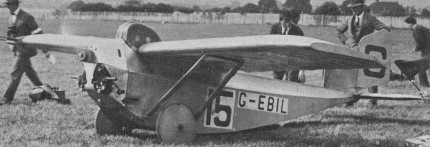
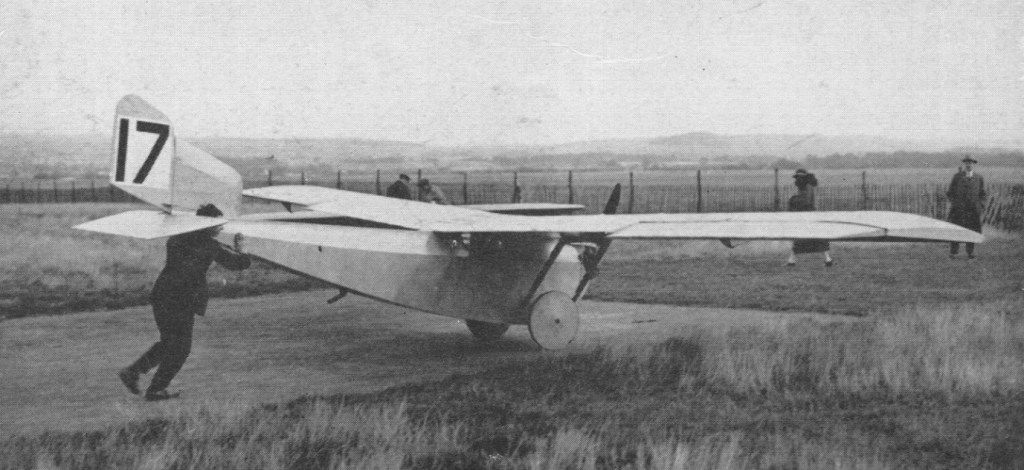
The ANEC l, G EBIL, was designed by W. S. Shackleton and was one of Britain’s first ultra light aircraft. It was entered in the 1923 Lympne Trials, and in the hands of J. H. James reached a height of 14,000ft after earlier flying 87.5 miles on a single gallon of petrol, powered with the 698cc Blackburne Tomtit.
Later it went to Martlesham for testing and acquired service number J7506. It was re engined with a 1000cc Anzani, becoming the ANEC 1A, and was returned for civilian use. With shortened wings it won the high-speed prize at the 1925 Lympne Trials at 83.76 mph. Registration marks were cancelled on January 22, 1926

Andrews A.1 Special

The idea was for an aircraft of low initial cost and low operating cost to enable the many young people of the day to follow up their Private Pilot Licence with a modestly priced 200 hours needed for their Commercial Licence. That was the original concept of the Andrews A.1 and the whole philosophy of its design. The structural design of the A.1 was heavily influenced by the limitations of small production lines and the need to be built in workshops which normally catered for maintenance with the addition of some simple tooling.
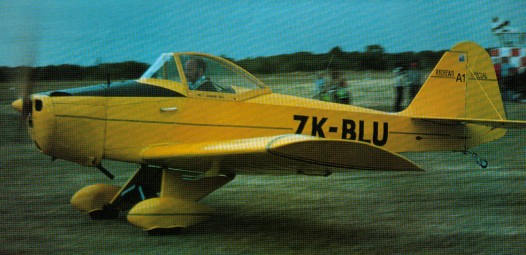
This aircraft, of which there is only one in existence (ZK-BLU), was the pioneer post-war homebuilt in New Zealand. It was built to Certificate of Airworthiness standard during the 1950’s by a CAD aeronautical engineer, Mr Cliff Andrews, although it later flew under a Permit to Fly. It first flew in 1957 but was largely inactive until 1973 when it was restored by Mr Andrews and sold to Alan Rowe of Lower Hutt. The aircraft’s construction employs a welded tube fuselage and tailgroup, and wings constructed of two wooden spars with a Warren-girder metal truss structure between. The whole airframe is fabric-covered.

Engine: Continental A65, 65 hp.
Span: 24 ft 0 in
Wing area: 115.5 sq.ft
Length: l9 ft 0 in
Height: 5 ft 7 in
Empty weight: 700 lb
MAUW: 950lb
Max speed: 102 mph at SL
Cruise: 94 mph.
ROC: 450 fpm.
Range: 270 miles.

Anderson, Greenwood & Co AG-14 / AND-51

Anderson, Greenwood & Company was organized in 1945 to design and manufacture airplanes. Its first model, the AG 14, was ready five years later. An all-metal pusher, the cabin seats two side-by-side with dual controls.

First flying on 1 October 1947, the AG 14 was certificated on 21 September 1950, but the Korean War came along and only 5 AG14’s were ever produced during 1950-1953.

One AG-14 prototype was built in 1947, NX80828, which received the Approved Type Certificate 4A1. It was later re-designated as AND-51.

The five AG-14 production examples built in 1950 were N9300K to N9304K, c/ns 1 to 5), later redesignated AND-51-A, with the same Approved Type Certificate 4A1. C/n 2 later became N4254M and c/n 3 later became N314AG.

One plane modified in 1962 as Mississippi State Univ XAZ-1. Advertised c.1964 by Space Enterprises as Space Coupe AG-14 with 100hp Continental O-220, but no record of production.

Gallery

Engine: Continental C90, 90 hp
Wing span: 34 feet 7 in
Wing area: 120 sq.ft
Length: 22 feet
Height: 7 ft 9 in
Empty weight: 850 lb
Loaded weight: 1400 lb
Top Speed: over 120 mph
Landing Speed: 49 mph
Cruising range: 4 hours
Service Ceiling: 16,500
Rate of Climb: over 700 f.p.m.

Anderson EA-1 Kingfisher             

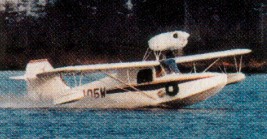
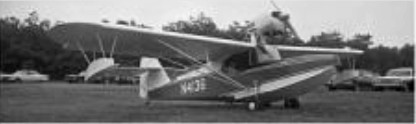
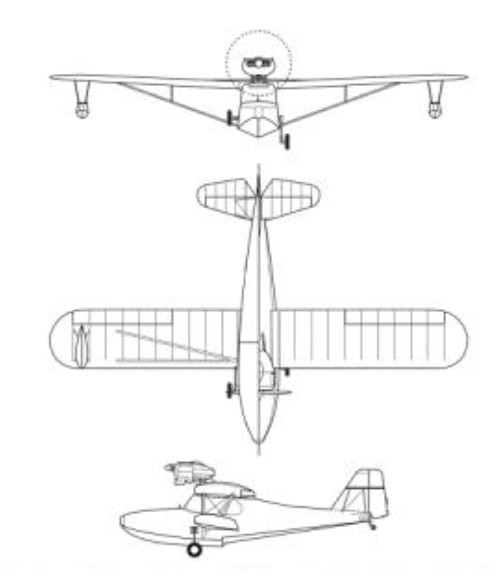
Earl Anderson, a Boeing 747 Captain, spent nine years developing the EA-1 Kingfisher at a cost of $5,500, and first flew it on 24 April 1969. At that time, it used a 100-hp Continental 0-200, similar to the Volmer VJ-22 Sportsman, which served as a design inspiration. Later, Anderson switched to a 115-hp Lycoming 0-235-C1, and by January 1975 had logged more than 600 hours on the amphibian. Seating two people side-by-side in an enclosed cabin, the Kingfisher uses standard Piper J-3 Cub wings, with tip floats of mahogany and plywood covered with fiberglass. The fuselage also is wooden, the framework covered with plywood and fiberglass. The landing gear is retractable.

200 sets of plans had been sold by 1978.

Gallery

Engine: 100 hp Continental O-200
Prop: 2 blade fixed pitch, wood
Max speed: 96 mph
Cruise speed: 85 mph
Range: 322 miles
Empty weight: 1032 lb
MTOW: 1540 lb
Wingspan: 36 ft 2 in
Length: 23 ft 6 in
Wing area: 178.5 sq.ft

Engine: Lycoming O-235, 115 hp.
Span 37 ft l in.
Wing Area 185 sq.ft.
Height 8 ft 4 in.
Length 23 ft 7 in.
Gross Weight 1600 lb.
Empty Weight 1092 lb.
Fuel 20-26 USgal.
Vmax 113 mph.
Cruise 90 mph.
Climb 650 fpm.
Stall 42 mph.
Ceiling 13,500 ft
Range 330 sm.
Seats 2.
Landing gear:
Retractable tail wheel.

Engine: Continental O-200A, 100 hp.
Span 37 ft l in.
Wing Area 185 sq.ft.
Height 8 ft 4 in.
Length 23 ft 7 in.
Gross Weight 1600 lb.
Weight empty: 1050 lbs.
Fuel cap: 20 USG.
Speed max: 95 mph.
Cruise: 85 mph.
Range: 280 sm.
Stall: 42 mph.
ROC: 700 fpm.
Take-off dist: 1000 ft (land), 2000 ft (water).
Seats 2.
Landing gear: Retractable tail wheel.

Anders Kiev / Russian Empire Airship Kiev

Russian non-rigid dirigible “Kiev” «Киев» was designed and constructed by Fedor Ferdinandovich Anders [Федор Фердинандович АНДЕРС].

The first flight is given as August 6, 1911 in the city of Kiev. It is claimed that the non-rigid “Kiev” was the first Russian dirigible built with private funds that carried passengers commercially.

Engine: 1 x 50 hp
Envelope: 1000 cu.m
Length: 35.5 m
Diameter: 7 m

Andreasson BA-6

Designed by Björn Andreasson and first flown in 1955, the BA-5 single-seat aerobatic sports monoplane was developed primarily for amateur construction.

The BA-6 is of all-wood construction and, with the exception of the fabric-covered control surfaces, has plywood covering. Fully aerobatic, The BA-6 has a Cessna-type spring-steel cantilever landing gear. Landing flaps are fitted.

SE-BXX and SE-BXY

The first two built were fitted with Continental A65 65hp engines and the airframe will take the Continental C85.

Engine: Continental A65, 65 hp
Wingspan: 23 ft
Length: 16 ft 5 in
Height: 5 ft
Max speed: 145 mph
Landing speed: 34 mph
Time to 20,000ft: 6 min
Range: 1200 mi