The Arrow V-8 was a Ford auto-engine conversion. Water cooled and producing 82hp, it received ATC 151 and ATC 161.
Piston
Arrow Model F / Sport M
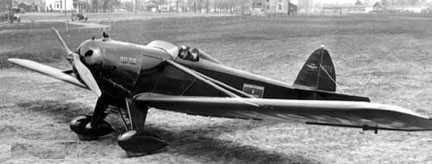
The 1934 Sport F prototype NC12581 was powered by a 82hp Arrow (dextrorotatory Ford V-8 conversion).

Seventeen production models were built in 1936 under ATC 601, and 87 under ATC 613 and 2-531 with a redesigned wing root and optional cockpit canopy in 1938, including one Sport M.
The original price was $1,500. Other motors used were Detroit Air Cat, Anzani, Genet, Kinner, and Velie.
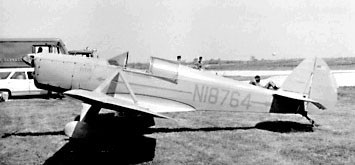
One Sport M prototype was built in 1938, NX/N18764, priced at $2,330, raised to $3,750. The series was discontinued.
Sport F
Wingspan: 36’7″
Length: 21’4″
Useful load: 503 lb
Max speed: 100 mph
Cruise: 90 mph
Stall: 45 mph
Range: 300 mi
Seats: 2
Sport M
Engine: 125hp Menasco C-4
Useful load: 603 lb
Max speed: 120 mph
Cruise: 105 mph
Stall: 48 mph
Range: 300 mi
Seats: 2
Arrow Sport / Sport Pursuit / Sport K

In late 1920s three models of two-seat sport or training biplane (the Arrow Sport and Arrow Sport Pursuit) were being made with steel-tube airframe and wooden wings. The wings were fully cantilever, but have interplane struts to comply with FAA regulations.
Designed by Swen Swanson in 1926, the two-seater had a side-by-side cockpit and no interplane struts. The wing was attached directly to the top of the fuselage, but cosmetic struts were later added to allay the concern of pilots.
The 1928 model offered 60hp Detroit Air Cat and Anzani engines.
About 100 of the Arrow A-2-160 Sport were built, powered by a 60 hp Le Blond engine. The original price was $3485.
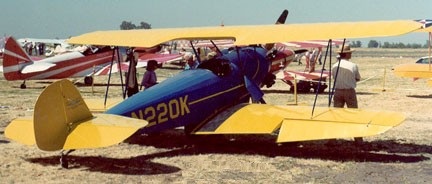
The only 1929 Sport Pursuit (ATC 2-110) built, N853H, was priced at $3,485 and renamed Sport K in 1935.
Sport
Engine: 35hp Anzani
Wingspan: 25’6″
Length: 19’3″
Seats: 2
Arrow A-2-160 Sport
Engine: 60 hp Le Blond
Prop: Hartzelll 6 ft 10 in / 12.08 m dia.
Wingspan: 25 ft 10 in / 7.87 m
Length: 19 ft 4 in / 5.89 m
Empty weight: 900 lb / 408 kg
Max weight: 1260 lb / 572 kg
Cruise: 75 mph
Seats: 2
Sport K
Engine: 100hp Kinner K-5
Wingspan: 25’10”
Length: 19’6″
Useful load: 596 lb
Max speed: 110 mph
Cruise: 95 mph
Stall: 35 mph
Seats: 2
Arrow Active
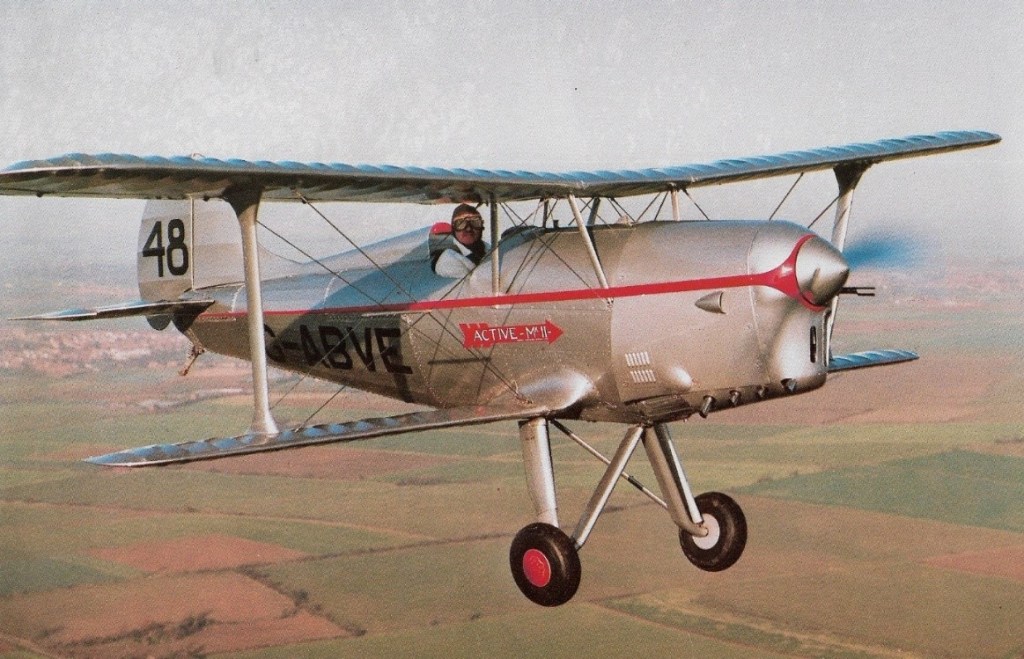
Designed by A.C. Thornton at Leeds, the Arrow Active I G-ABIX, a single-seat all metal biplane, was first flown in 1931. Powered by a 115 hp Cirrus Hermes IIB engine it had a top speed of 140 mph.
The second aircraft G-ABVE had a 120 hp Gipsy III engine and flew for the first time early in 1932. It was distinguished by a raised top wing and taller undercarriage. G-ABIX caught fire and was destroyed on 20 September 1935, the pilot parachuting to safety.
No other examples were built.
Active II
Engine: 120 hp Gipsy III
Wingspan: 24 ft
AUW: 1325 lb
144 mph
Arrow 1000
The Arrow 1000 is a four-cylinder, horizontally opposed, two-stroke, single- or dual-ignition, aircraft engine that was designed for float-equipped ultralight aircraft by Arrow SNC of Italy.
The Arrow family of engines are modular in design and share the same pistons, cylinders and gearboxes assembled around different crankcase designs, giving one-, two- or four-cylinder engines.
The 1000 is a conventional four-cylinder engine that weighs 145 lb (66 kg). The engine features single or optional dual ignition, reed valve induction, free air cooling, tuned exhaust system, slide venturi-type Bing carburetors, fuel pump, Nikasil cylinder coatings. The engine was offered with a gearbox reduction system that included a one-way clutch. Starting is electric starter with no provision for a recoil starter.
The 1000 produces 100 hp (75 kW), runs on premium unleaded auto fuel and has a recommended time between overhaul of 300 hours.
The tuned exhaust supplied with the engine has been criticized as “cumbersome” and needing modification to fit most aircraft.
Arrow engines are no longer in production.
Specifications:
Arrow 1000
Type: Four-cylinder, horizontally opposed two-stroke aircraft engine
Displacement: 1000 cc (61.02 cu in)
Dry weight: 145 lb (66 kg)
Valvetrain: reed valve
Oil system: premixed oil and fuel
Cooling system: air-cooled
Reduction gear: gearbox
Power output: 100 hp (75 kW)
Arrow 500
The Arrow 500 is a twin-cylinder, horizontally opposed, two-stroke, single or dual ignition, aircraft engine that was designed for ultralight aircraft by Arrow SNC of Italy.
The Arrow family of engines are modular in design and share the same pistons, cylinders and gearboxes assembled around different crankcase designs, giving one-, two- or four-cylinder engines.
The 500 is a conventional twin-cylinder engine that weighs 88 lb (40 kg). The engine features single or optional dual ignition, reed valve induction, free air cooling, tuned exhaust system, a single slide venturi-type Bing carburetor, fuel pump, Nikasil cylinder coatings. The engine was offered with a gearbox reduction system that included a one way clutch. Starting is electric starter with no provision for a recoil starter.
The 500 produces 65 hp (48 kW), runs on premium unleaded auto fuel and has a recommended time between overhaul of 400 hours.
The tuned exhaust supplied with the engine has been criticized as “cumbersome” and needing modification to fit most aircraft.
Arrow engines are no longer in production.
Specifications:
Arrow 500
Type: Twin-cylinder, horizontally opposed two-stroke aircraft engine
Displacement: 500 cc (30.51 cu in)
Dry weight: 88 lb (40 kg)
Valvetrain: reed valve
Oil system: premixed oil and fuel
Cooling system: air-cooled
Reduction gear: gearbox
Power output: 65 hp (48 kW)
Arrow 250
The Arrow 250 is a family of single-cylinder, two-stroke, single- or dual-ignition aircraft engines that were designed for ultralight aircraft by Arrow SNC of Italy.
The Arrow family of engines are modular in design and share the same pistons, cylinders and gearboxes assembled around different crankcase designs, giving one-, two- or four-cylinder engines.
The 250 is a conventional single-cylinder engine that weighs only 13 lb (6 kg). The engine features single- or optional dual-ignition, reed valve induction, free air cooling, tuned exhaust system, a slide venturi-type Bing carburetor, fuel pump, Nikasil cylinder coatings. The engine was offered with a gearbox reduction system that included a one-way clutch. Starting is electric starter with no provision for a recoil starter.
The tuned exhaust supplied with the engine has been criticized as “cumbersome” and needing modification to fit most aircraft.
Arrow engines are no longer in production.
Variants:
250
Gasoline aircraft engine, 34 hp (25 kW). Out of production.
270 AC
Gasoline aircraft engine, 35 hp (26 kW) at 6800 rpm, weight 13.2 lb (6.0 kg) with carburetor, alternator, fuel pump and starter. Out of production.
Specifications:
Arrow 250
Type: Single-cylinder, two-stroke aircraft engine
Displacement: 250 cc (15.26 cu in)
Dry weight: 13.2 lb (6 kg)
Valvetrain: reed valve
Oil system: premixed oil and fuel
Cooling system: air-cooled
Reduction gear: gearbox
Power output: 34 hp (25 kW)
Arpin A-1
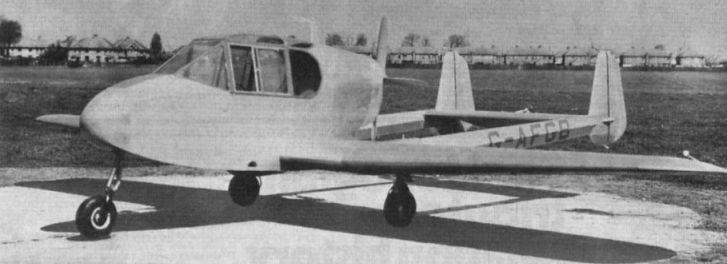
M.B.Arpin & Co of West Drayton, Britain, started the Arpin A-1, desiged by Morris Arpin, in 1937. A two-seat cabin monoplane powered by a pusher Salmson AD.9R, with MacLaren crosswind tricycle undercarriage.
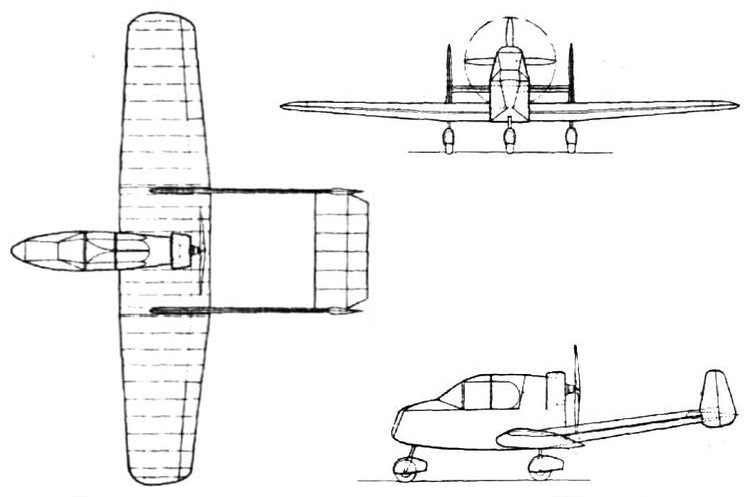
The Arpin A-1 was of wooden construction and plywood covered. The empennage was carried on a pair of diamond cross section booms mounted on the rear wing spar at the edge of the centre section. The fins were tall, with a slight extension below the boom and carrying unbalanced rudders. The booms were at wing height but the side by side two seat enclosed cabin sat on the wing with the uncowled 68 hp (51 kW) British Salmson AD.9R radial immediately behind, with its centre line well above the booms and tailplane. The pusher arrangement and a short nose provided good visibility from the cabin.
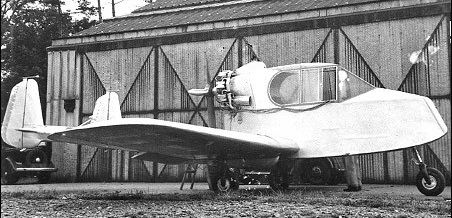
The Arpin had a fixed tricycle undercarriage at a time when most aircraft used the tailwheel configuration. It was the first British aircraft to be designed for tricycle landing gear. In 1938 a very unusual McClaren type was fitted, which allowed all three wheels to be turned parallel to each other but not to the aircraft, so that cross wind landings could be made with the aircraft pointing into wind. The front wheel could be left to caster or could be steered by the pilot.
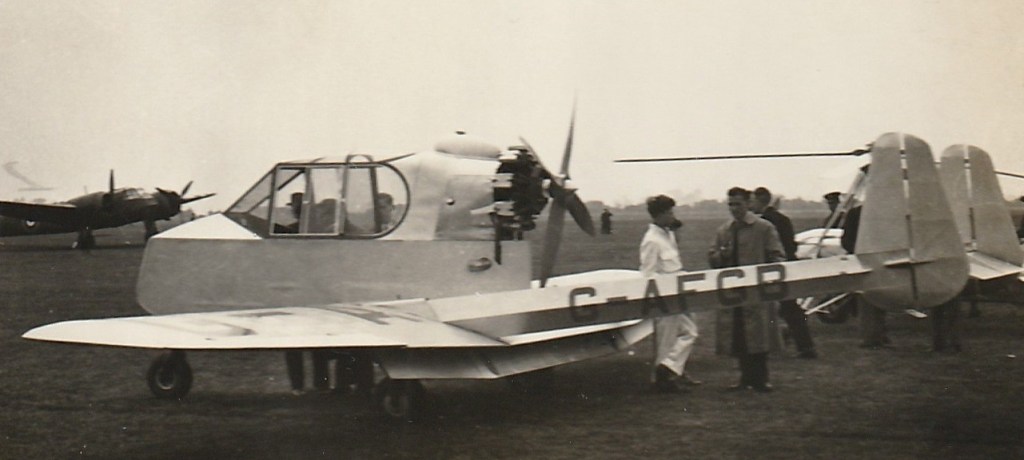
Only one A-1 was built at the company works at Longford, London, registered G-AFGB cn.1, the only one built first flew at Hanworth Aerodrome on 7 May 1938.
It was converted to Mk.2 in 1939 with a Blackburn Cirrus Minor 1 engine for Army evaluation, delivered in December 1939 to the School of Army Co-operation at Old Sarum, but not adopted. The Cirrus Minor I raised the maximum speed to 115 mph (185 km/h).
The A-1 survived WW2 to be broken up in 1946.
Powerplant: 1 × British Salmson AD.9R, 68 hp (51 kW)
Wingspan: 31 ft 6 in (9.61 m)
Wing area: 165 sq ft (15.3 m2)
Length: 23 ft 2 in (7.06 m)
Height: 7 ft 1 in (2.13 m)
Empty weight: 740 lb (336 kg)
Gross weight: 1,261 lb (573 kg)
Maximum speed: 108 mph (173 km/h, 94 kn)
Cruise speed: 95 mph (153 km/h, 83 kn)
Endurance: 5 hours
Rate of climb: 600 ft/min (3.0 m/s)
Crew: one, pilot
Capacity: one passenger
Arondel 1911 monoplane
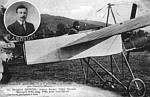
The 1911 Arondel monoplane was designed and built by P. Arondel in France.
Span: 28’4″
Length: 25′
Weight: 500 lb
Arnoux 1920 Biplane
Shortly after the war, Arnoux took up his work again. In 1919/1920, he constructed from components of war-time airplanes a tailless biplane ; it was motorized by a 130 hp rotary engine and had vertical rudder surfaces behind the pilot at both sides of the short nacelle. During 1922, a number of successful flights were made with this biplane. After modification to a single-rudder, it was demonstrated with success to the French aviation authorities, and the results of the tests were so promising that the “Société des Avions Simplex” firm was formed for the further development. The biplane was, however, destroyed in a crash in which the pilot, Fétu, sustained severe injuries.

