
A four seat design by Stelio Frati, largely based on the F8 Falco. First flown at Milan on 16 January 1958, only limited production took place.

A four seat design by Stelio Frati, largely based on the F8 Falco. First flown at Milan on 16 January 1958, only limited production took place.

Spanish design from Barcelona. Ceconite covering over steel tube structure.
Engine: Thunderbolt, 70 hp.
Speed max: 100 mph.
Cruise: 85 mph.
Stall: 35 mph.
ROC: 1200 fpm.
Take-off dist: 300 ft.
Landing dist: 300 ft.
Fuel cap: 14 USG.
Weight empty: 500 lbs.
Gross: 1100 lbs.
Height: 6 ft.
Length: 20 ft.
Wing span: 32 ft.
Wing area: 128 sq.ft.
Seats: 2.
Landing gear: tail wheel.
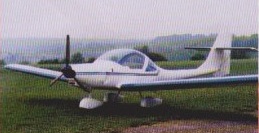
The composite two seat Hermes can take a Rotax 582 or Jabiru engine.
Engine: Rotax 912, 80 hp
Wing span: 10 m
Wing area: 15.7 sq.m
MAUW: 450 kg
Empty weight: 255 kg
Fuel capacity: 60 lt
Max speed: 180 kph
Cruise speed: 145 kph
Minimum speed: 60 kph
Climb rate: 6 m/s
Seats: 2
Price (1998): 245 000 Fttc
Plan price (1998): 2850 Fttc
Kit price (1998): 99 600 Fttc
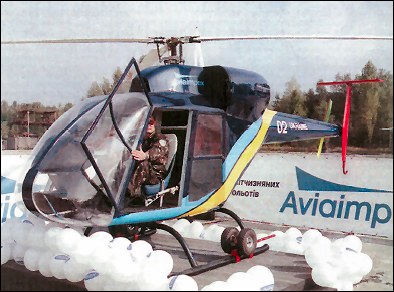
With the prototype structurally complete, the Aviaimpex Yanhol was displayed to the media on 31 August 2001. First flight was planned for June 2002.
Of pod-and-boom configuration, with T-tail and landing skids, the three seat helicopter has three-blade main and two-blade tail rotors.
COSTS: US$120.000 in Ukraine; US$150.000 export (2002),
Enghines: Two Rotax 912 ULS, 73.5kW.
Main rotor diameter: 8.28m
Tail rotor diameter: 1.30m
Length: 7.45m
Height: 2.475m
Max. take-off weight: 870kg
Empty weight: 524kg
Max. payload: 350kg
Max. speed: 184km/h
Max. cruising speed: 165km/h
Range max. fuel: 340km
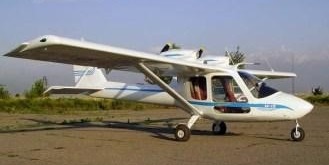
First flown in 1993, a three-seat recreational and utility lightplane.
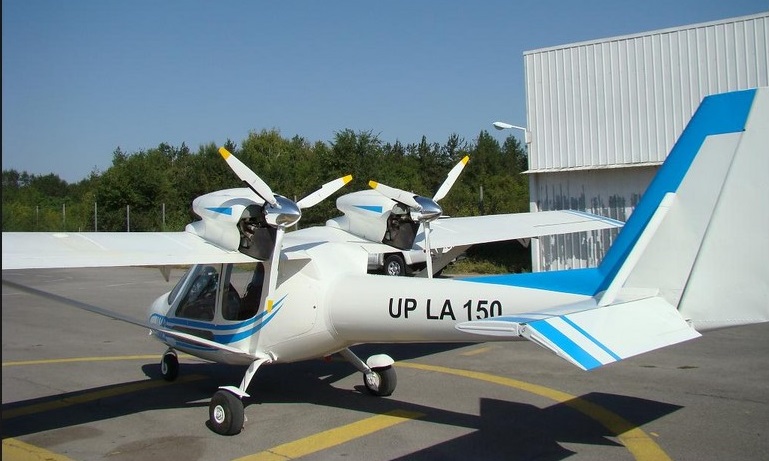
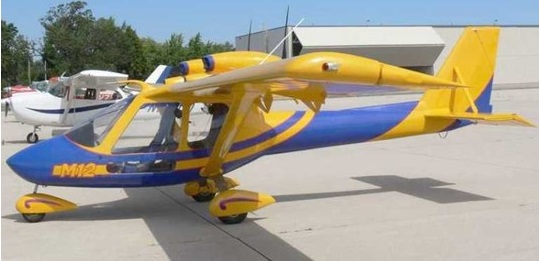
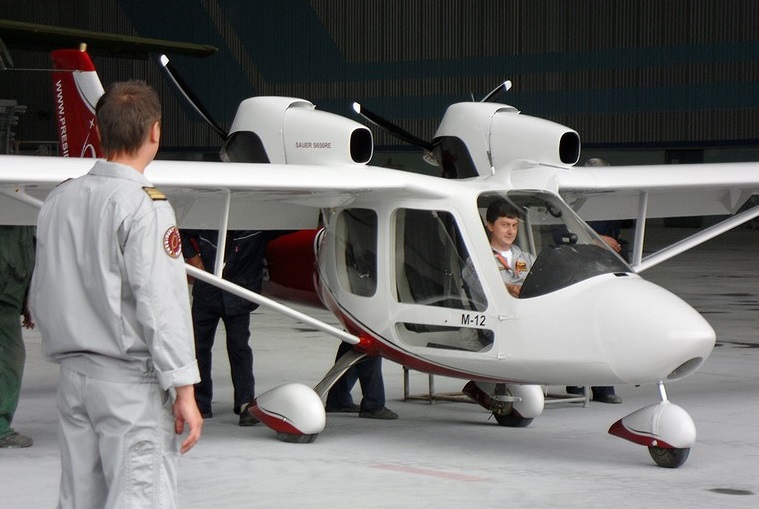
Wing Span: 10.2 m
Length: 6.7 m
Height: 2.2 m
Absolute Ceiling: 10000 ft
Optimum Ceiling: 8000ft
Maximum Speed: 102 kts
Optimum Speed: 80 kts
MTOW: 700 kg
Fuel Capacity: 70 ltr
ROC 0-100ft: 1000 fpm
ROC 100-300ft: 500 fpm
Maximum Range: 280 NM
Seats: 3
Founded 1991, has developed the Accord-201 seven-seat lightplane with twin piston engines on its high-mounted wing (first flown 1994). A four-seat business jet was under development as the Accord-Jet.

An all wood, side-by-side, enclosed cabin monoplane, of which more than 300 open cockpit derivatives had been built for the Regia Aeronautica under and Italian Government contract (by Francis Lombardi & Co of Vercelli).
Variation
Meteor F.L.53-54

The Avia LD-40, designed and built by the former Avia factory of the Czechslovak nationalised aircraft industry in 1954, is a four-seat cabin monoplane of all-metal construction and powered by a 105 hp Walter Minor 4-III engine. A feature is the reverse tricycle undercarriage, the normal nosewheel being replaced by a wheel mounted immediately aft of the wing trailing edge. The main wheels are mounted well forward below the wing and, on the gound, the Avia LD-40 remains in flying attitude.
The LD-40 accommodates four people on two side-by-side bench-type seats, and the cockpit canopy slides backwards.

The Avia M 337 (originally designated the Walter M337) is an inverted six-cylinder air-cooled inline engine. It was developed as a six-cylinder derivative of the four-cylinder M 332 engine, going into production in 1960. An unsupercharged version of the M 337 is designated M 137. Production transferred to Avia in 1964, and to Letecke Opravny Malesice (LOM) in 1992.
Variants:
M 337A
Basic supercharged engine – not rated for aerobatics
M 337R
Modified for pusher installation
M 337AK
modified oil system for unlimited inverted flying. “Snap” aerobatics permitted.
M 337AK1
AK fitted with alternator instead of generator
M 337B
Increased max running speed (3000 rpm) – increased power – 173 kW (235 hp).
M 337BK
Aerobatic version of B.
M 337C
Increased compression ratio – 185 kW (252 hp)
M 137A
Unsupercharged version of M 337 – 134 kW (180 hp) take-off power. Aerobatics allowed.
M 137AZ
As M 137A, with filtered air feed
Applications:
Falconar SAL Mustang
Let L-200 Morava
Zlín Z 526, Z 726
Zlín 142
Zlín Z 43
Specifications:
Aerotecknik M137A
Cycle: supercharged 4
No cylinders: 6 inline
Bore: 105 mm
Stroke: 115 mm
Compression: 6.3
Displacement: 5970 cc
Cooling: Air
Ignition: Double magneto
Drive: Direct
Weight: 147 kg
Max pwr: 180 hp at 2750 rpm
Fuel consumption: 43 lt/hr
M 337
Type: 6-cylinder inverted air-cooled supercharged inline engine
Bore: 105 mm (4.13 in)
Stroke: 115mm (4.53 in)
Displacement: 5.97 L (364.3 in³)
Length: 1,410 mm (55.51 in)
Width: 472 mm (18.58 in)
Height: 628 mm (24.72
Dry weight: 148 kg (326.3 lb)
Valvetrain: two camshaft operated valves per cylinder, sodium filled exhaust valve
Supercharger: Centrifugal
Fuel system: Low-pressure fuel injection
Fuel type: Min 72-78 Octane
Oil system: Dry sump pressure feed system
Cooling system: Air-cooled
Power output: 157 kW (210 hp) at 2,750 rpm (take-off)
Aerotecknik M137A
Cycle: supercharged 4
No cylinders: 6 inline
Bore: 105 mm
Stroke: 115 mm
Compression: 6.3
Displacement: 5970 cc
Cooling: Air
Ignition: Double magneto
Drive: Direct
Weight: 147 kg
Max pwr: 180 hp at 2750 rpm
Fuel consumption: 43 lt/hr
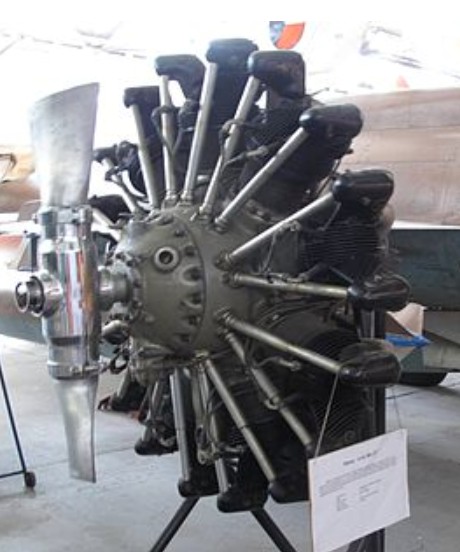
As well as producing aircraft and building Hispano-Suiza and Lorraine aero-engines under licence, Avia also designed and built their own radial engines. The Rk.17 was a 9-cylinder supercharged model, rated at 360 hp / 270 kW. It was a nine-cylinder version of their Rk.12.
It was a conventional air-cooled radial: nitrided steel barrels with integral fins were screwed into heat treated Y alloy heads. The pistons were also of heat treated Y alloy. The crankcase was cast from heat treated silumin alloy, with some minor parts using magnesium alloy. The single throw two piece crankshaft was linked to the pistons with an I-section Y alloy master rod, with a single piece big end, which carried the other eight piston rods.
Applications
Avia Ba.122
Letov Š-50
Specifications
Type: 9-cylinder air-cooled radial
Bore: 130 mm (5.12 in)
Stroke: 140 mm (5.51 in)
Displacement: 16.72 L (1,020 cu in)
Length: 1,065 mm (41.93 in)
Diameter: 1,184 mm (46.61 in)
Dry weight: 260 kg (573 lb) with ancillaries, without propeller hub
Valvetrain: one inlet and one exhaust valve per cylinder, operated by push-rods via rocker gear. Eight cam push-rod disc drive.
Supercharger: impeller drive ratio 10.7:1
Fuel system: single barrel Stromberg NAR80G carburettor
Ignition system: Scintilla magnetos, automatic advance
Fuel type: petrol, 85 Octane
Oil system: dry sump, with one pressure and one scavenging pump
Cooling system: air-cooled
Reduction gear: direct drive
Power output: rated maintained up to 2,750 m (9,000 ft), at 2,200 rpm 270 kW (360 hp)
Power output: maximum continuous at 2,200 rpm 300 kW (400 hp)
Power output: take-off at 2,020 rpm 330 kW (440 hp)
Compression ratio: 6.4:1
Specific fuel consumption: 255 g/(kW.h) (0.562 lb/(hp.h))
Oil consumption: 8.7 g/(kW.h) (0.23 oz/(hp.h))

