AVIMETA AVM 132

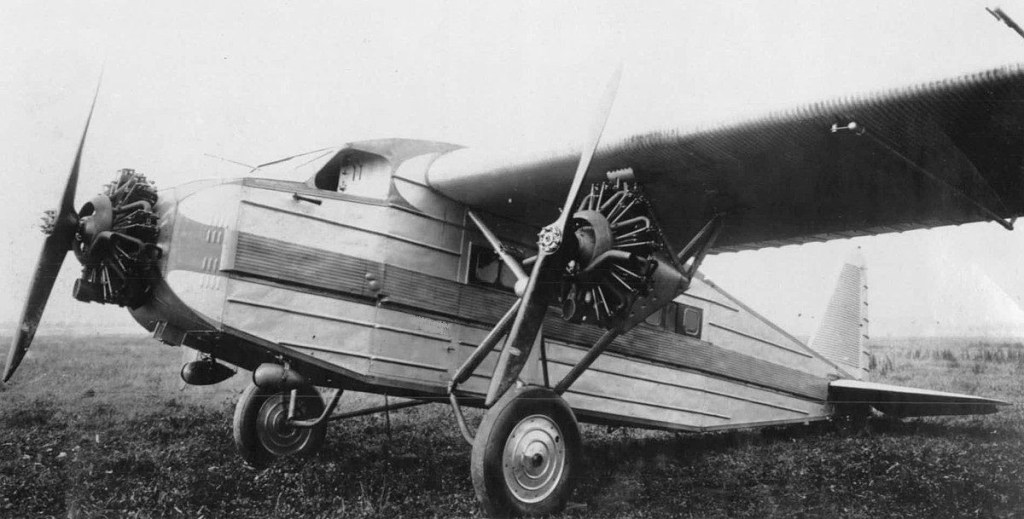
The Aviméta 132 was a three-engined monoplane transport for eight-passengers designed and built by Aviméta (Société pour la Construction d’Avions Métallique ).

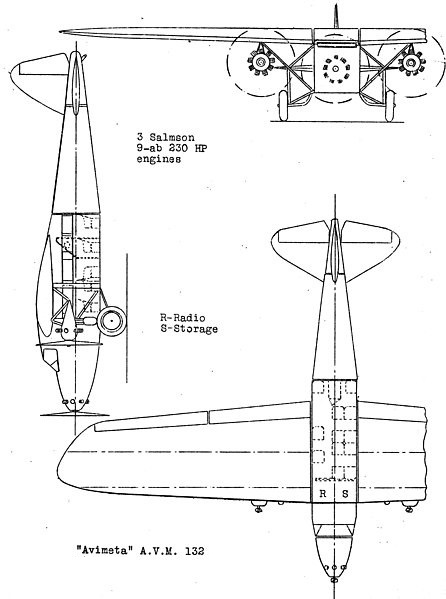
The Aviméta 132 was a high-wing monoplane with a fixed conventional landing gear, powered by three uncowled 230 hp (172 kW) Salmson 9Ab radial air-cooled piston engines. Fuel tanks were built into the wings, fitted with jettison valves to empty the tanks in an emergency. The enclosed cockpit sat two crew with a cabin for eight passengers.

First flying in 1927, it was intended to build both a day and night version but only one aircraft was built and it did not enter production. It was the first French all-metal aircraft but only one aircraft was built.

Engines: 3 × Salmson 9Ab, 170 kW (230 hp) each
Wingspan: 21.8 m (71 ft 6 in)
Wing area: 752 sq.m (8,090 sq ft)
Length: 14.3 m (46 ft 11 in)
Height: 3.75 m (12 ft 4 in)
Empty weight: 2,700 kg (5,952 lb)
Gross weight: 10,850 kg (23,920 lb)
Maximum speed: 180 km/h (112 mph; 97 kn)
Cruise speed: 170 km/h (106 mph; 92 kn)
Range: 900 km (559 mi; 486 nmi)
Service ceiling: 3,750 m (12,300 ft)
Time to altitude: 2,000 m (6,600 ft) in 19 minutes
Wing loading: 68.5 kg/sq.m (14.0 lb/sq ft)
Power/mass: 0.1054 kW/kg (0.0641 hp/lb)
Crew: 2
Capacity: 8 passenger
AVIMETA AVM-88

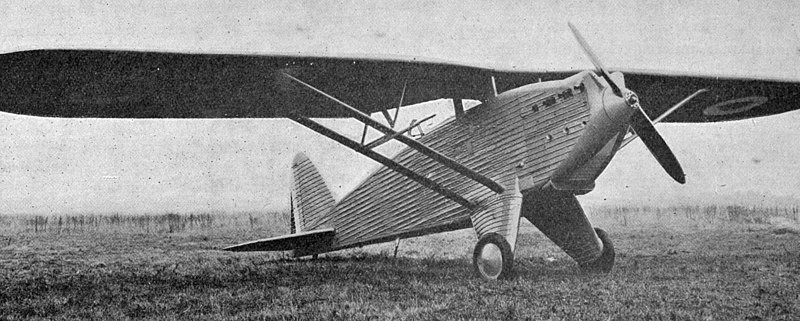
Aviméta (Société pour la Construction d’Avions Métallique) grew out of the Aeronautical Department of the Schneider-Creusot arms manufacturer. Both the frame and the corrugated covering of the Aviméta 88 were made from Alferium, an aluminium-iron alloy developed by Schneiders.

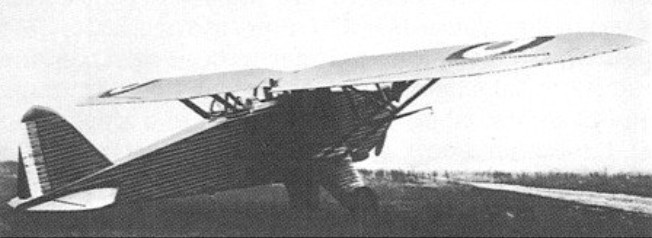
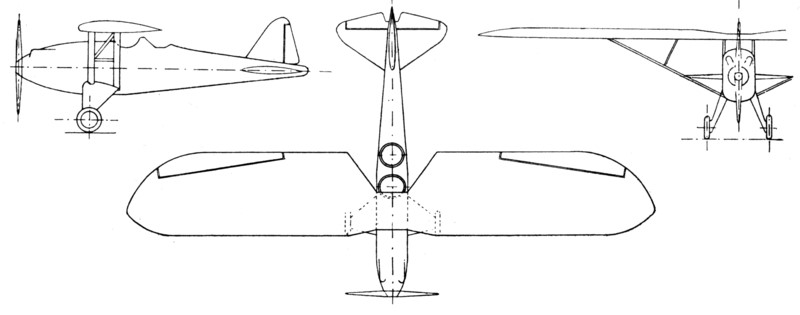
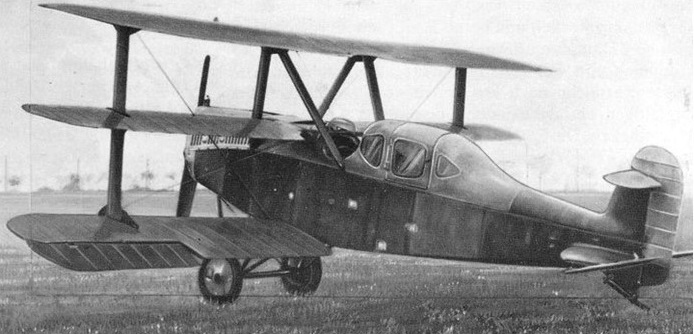
Designed by George Lapère, the Aviméta 88 was an all-metal two-seat reconnaissance-fighter or heavy fighter tested in 1927. It was a parasol aircraft, with wings of constant chord and with slightly pointed, semi-elliptical tips. The thin-airfoil-section wings were built around two lattice girder spars and had a skin thickness of 300 μm. There was a large, trapezoidal cut-out in the trailing edge to improve the view from the cockpits. Its aileron hinges were set at a shallow angle to the trailing edge.

The wings were braced to the fuselage with a parallel pair of struts from the lower longerons to the spars at about mid-span assisted by N-form, cross-braced jury struts at right angles. Four very short struts from the upper fuselage longerons to the wing centre section formed a low cabane.

The square-section, rounded-cornered fuselage was built around these four longerons and a set of diagonally braced formers. The Aviméta’s 444 kW (595 hp) Hispano-Suiza 12Hb water-cooled V-12 engine was in a pointed nose, driving a two-blade propeller. There were two open cockpits, with the pilot forward at mid-chord and the gunner/observer behind in line with the trailing edge. Behind the cockpits the fuselage tapered rapidly in profile to a conventional empennage, with the tailplane mounted at mid-fuselage. Both horizontal and vertical surfaces were strongly tapered, particularly on the leading edges, with a broad tailplane and fin but with small, inset elevators and rudder. The Aviméta 88 had independent bungee-sprung wheels on legs enclosed in tapered trouser fairings attached to the lower longerons at the bottom of the wing struts. The fuel was in crash proof and in-flight jettisonable tank.

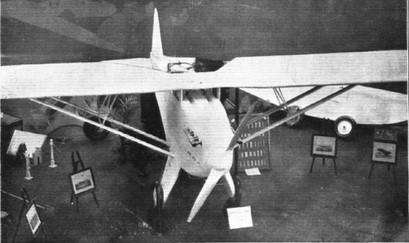
The Aviméta 88 was on show at the December 1926 Paris Aero Salon. It may not have flown by that date, and rather little is known about its later history, though it gave a “pretty impressive” display at Villacoublay in September 1927. Development was terminated when the official call for a two-seat fighter-reconnaissance aircraft was rescinded.

Engine: 1 × Hispano-Suiza 12Hb, 444 kW (595 hp)
Propeller: 2-bladed
Wingspan: 17.00 m (55 ft 9 in)
Length: 9.76 m (32 ft 0 in)
Height: 3.55 m (11 ft 8 in)
Wing area: 40 sq.m (430 sq.ft)
Empty weight: 1,550 kg (3,417 lb)
Gross weight: 2,400 kg (5,291 lb)
Fuel capacity: 310 kg (680 lb) (420 l (92 imp gal; 110 US gal))
Maximum speed: 240 km/h (149 mph; 130 kn) at sea level, 220 km/h (140 mph) at 5,000 m (16,000 ft)
Service ceiling: 7,500 m (24,600 ft)
Time to altitude: 16 min to 5,000 m (16,000 ft)
Crew: two
Armament: two fixed, synchronised 7.7 mm (0.303 in) Vickers machine guns firing through propeller disc and two more mounted on the wing. A pair of Lewis guns on flexible mounting in rear cockpit.

Avid Magnum

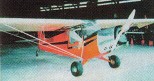
Designed by Dean Wilson, the Magnum will take off the ground in less than 150 feet and will climb 1800 fpm solo. It features a 44.5 in wide cabin (ches) and an open baggage area of 28.5 cubic feet. There is an optional jump seat for a small adult or a couple of kids. The Magnum was available in the Tri or tail-gear landing gear configuration.
The Magnum fuselage, landing gear and tail are built of welded 4130 Steel tubing. The wing features aluminum spars with wood ribs. All welding and fabricating is done at Avid’s factory. The wing ribs are pre-built and fiberglass parts are formed. All that is left is assembly and covering.
The design of the Magnum’s folding wings, similar to the system used on the Mark IV, allows the Magnum to be towed or trailered.

March 1993

Engine: Lycoming
Wing span: 9.75 m
Wing area: 12.9 sq.m
MAUW: 794 kg
Empty weight: 431 kg
Fuel capacity: 106 lt
Max speed: 249 kph
Cruise speed: 209 kph
Minimum speed: 64 kph
Climb rate: 7 m/s
Seats: 2

Engine: Lycoming O-320, 150 hp.
HP range: 150-180.
Speed max: 155 mph.
Cruise: 130 mph.
Range: 450 sm.
Stall: 40 mph.
ROC: 1800 fpm.
Take-off dist: 150 ft.
Landing dist: 200 ft.
Service ceiling: 17,500 ft.
Fuel cap: 28 USG.
Weight empty: 950 lbs.
Gross: 1750 lbs.
Height: 6.2 ft.
Length: 21 ft.
Wing span: 32 ft.
Wing area: 140.3 sq.ft.
Seats: 2+1.
Landing gear: nose or tail wheel.

Avid Mark IV

Mark IV

The STOL was an easy to build 350 hour kits. Equipped with quick folding wings, the AVID STOL takes off in 50 feet, climbs at 2250 fpm and cruise at 85 110 mph, lands in 100 feet and stalls at 25 mph. Trike or taildragger. All steel fuselage pre welded at the factory, with no special tools required to build.
Designed by Dean Wilson.

March 1999

Avid Aircraft Mk.IV
Stall: 31 kt / 36 mph / 58 kmh
Cruise: 113 kt / 130 mph / 209 kmh
VNE: 156 kt / 180 mph / 290 kmh
Empty Weight: 449 kg / 990 lbs
MTOW Weight: 794 kg / 1750 lbs
Climb Ratio: 1800 ft/min / 9 m/s
Take-off distance (50ft obstacle): 225 ft / 69 m
Landing distance (50ft obstacle): 200 ft / 61 m

Mk.IV Speedwing
Engine: Rotax 582, 65 hp.
HP range: 65-80
Speed max: 135 mph
Cruise: 120 mph
Range: 566 sm
Stall: 46 mph
ROC: 850 fpm
Take-off dist: 300 ft
Landing dist: 600 ft
Service ceiling: 12,500 ft
Fuel cap: 18 USG
Weight empty: 510 lbs
Gross: 1150 lbs
Height: 6.9 ft
Length: 17.91 ft
Wing span: 23.96 ft
Wing area: 97.31 sq.ft
Seats: 2
Landing gear: nose or tail wheel
Aerobatic.

STOL
Engine: Rotax 582, 65 hp
HP range: 65-80
Speed max: 135 mph
Cruise: 95 mph
Range: 340 sm
Stall: 36 mph
ROC: 1000 fpm
Take-off dist: 140 ft
Landing dist: 200 ft
Service ceiling: 12,500 ft
Fuel cap: 14 USG
Weight empty: 510 lbs
Gross: 1150 lbs
Height: 5.91 ft
Length: 17.91 ft
Wing span: 29.89 ft
Wing area: 122.5 sq.ft
Seats: 2
Landing gear: nose or tail wheel.

High-Gross STOL
Engine: Rotax 582, 65 hp
HP range: 65-80
Speed max: 135 mph
Cruise: 95 mph
Range: 340 sm
Stall: 36 mph
ROC: 1000 fpm
Take-off dist: 140 ft
Landing dist: 200 ft
Service ceiling: 12,500 ft
Fuel cap: 14 USG
Weight empty: 510 lbs
Gross: 1150 lbs
Height: 5.91 ft
Length: 17.91 ft
Wing span: 29.89 ft
Wing area: 122.5 sq.ft
Seats: 2
Landing gear: nose or tail wheel.

Avid Amphibian / Catalina

The Catalina was formerly named Avid Amphibian. Designed by Dean Wilson, the original prototype was powered by an air-cooled engine, but was changed for the Rotax 582. The sponsons contain the main wheels as well as providing a step, and the drooped wingtip have built-in floats.

March 1999

Engine: Rotax 582, 65 hp.
Speed max: 80 mph.
VNE: 80 kt / 92 mph / 148 kmh
Cruise: 75 mph.
Range: 364 sm.
Stall: 36 mph.
ROC: 900 fpm.
Take-off dist: 300 ft (750 ft water).
Landing dist: 500 ft (275 ft water).
Service ceiling: 12,500 ft.
Fuel cap: 17 USG.
Weight empty: 600 lbs.
Gross: 1200 lbs.
Height: 5.75 ft.
Length: 19.4 ft.
Wing span: 36 ft.
Wing area: 150 sq.ft.
Seats: 3.
Landing gear: retractable tail wheel.

Engine: Rotax 532.
Empty wt.: 560 lbs
Max wt. lbs: 1,200
Wing span: 36ft
Wing area: 150 sq.ft.
Wing loading: 8 lbs/sq.ft
Power loading: 18.75 lbs/hp
Max speed: 80 mph
Cruise: 75 mph
Stall: 25 mph
Vne: 80 mph
Seats: 2

Aviation Trader ATL.98 Carvair

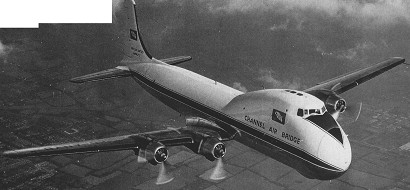
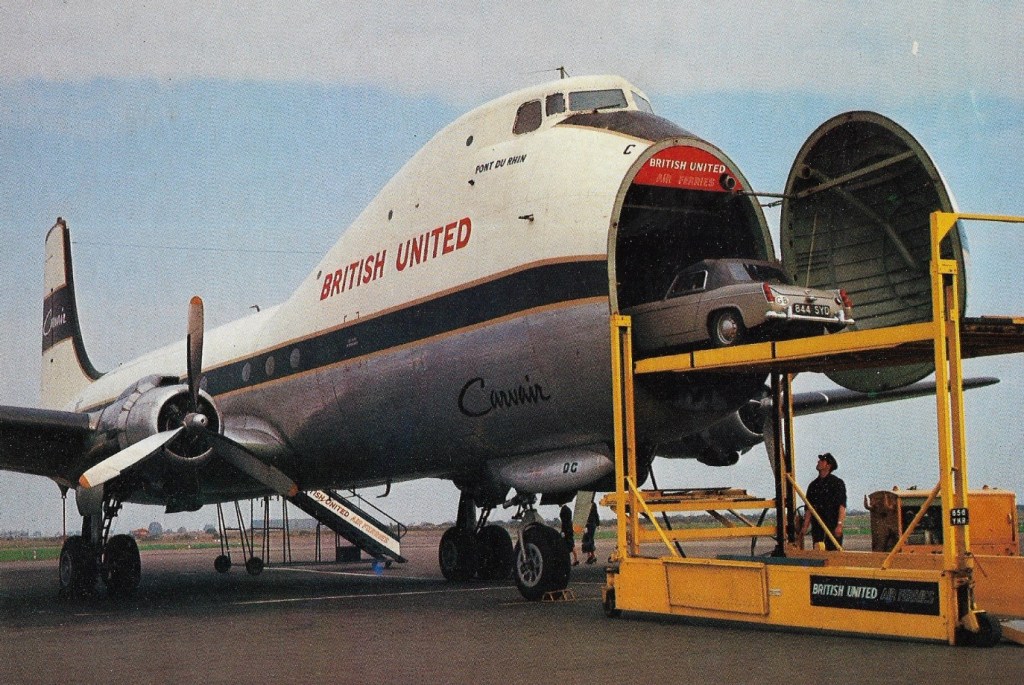
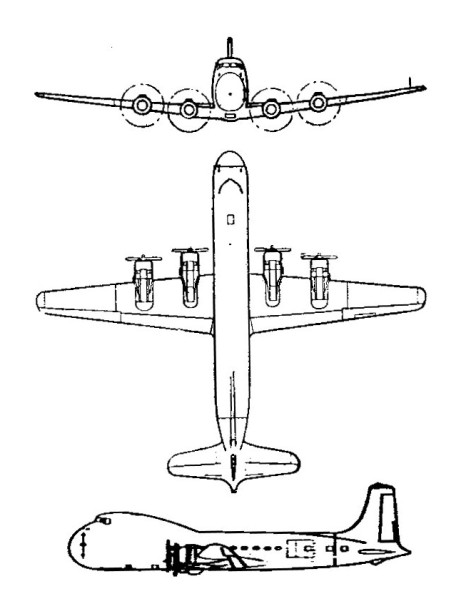
At Laker’s suggestion, A. C. Leftley, chief designer of Aviation Traders, designed a nose-loading car ferry conversion of the Douglas DC-4/C-54 after investigating a variety of other types as potential car ferries. With second-hand DC-4s and C-54s available for £40,000 and conversion costs of around £150,000 the Carvair (Car-via-air) was significantly cheaper than any new design. A new bulbous nose was fitted, with a much ¬raised cockpit. All the controls, most of which were mechanical, had to be re-routed from the new flight deck, but the ATL-98 Carvair, as it came to be known, proved easy to fly, and the bulbous nose reduced its speed by only four knots. The tail surfaces were increased in size to match those of the DC-7. DC-6 brakes were fitted to cope with the higher all-up weight of the Carvair, which could carry five full-size saloon cars and 23 passengers.

Aviation Trader ATL.98 Carvair Article

The prototype Carvair was based on an Air Charter DC-4 and first flew on 21 June 1961. Conversions of DC-4s lasted for eight years, from 1960 to 1968, and they continued to fly for British Air Ferries until 1 January 1977. Twenty-one Carvairs were eventually produced.

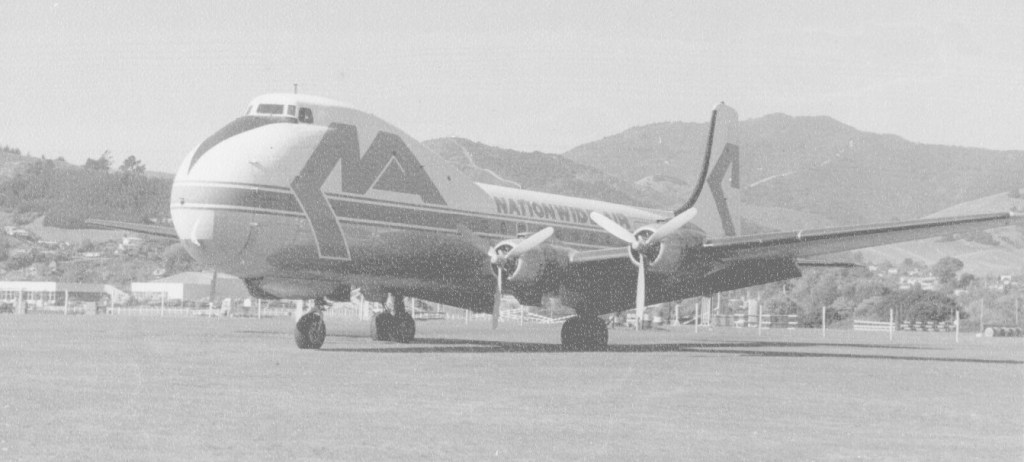
Nationwide Air, Nelson, New Zealand, circa 1979

Gallery

Powerplant: 4 x Pratt & Whitney R2000-7M2, 1450 shp take-off power 2700 rpm
Props: Hamilton Standard 3 blade 13 ft 1 in diameter
Span, 117 ft 6 in
Length, 102 ft 7 in
Height, 29 ft 10 in
Gross wing area, 1 462 sq.ft
Max. usable floor area, 665 sq.ft
Max. usable cabin volume, 4 630 cu.ft
Max. cabin length, 80 ft 2 in
Max. width, 9 ft 8 in
Max. height 6 ft 9 in.
Accommodation: 22 passengers in rear cabin or all-passenger version 85.
Basic operational, 42,465 lb
Total fuel, 17 208 lb
Max. take-off; 73 800 lb
Max. landing weight: 64,170 lb
Max. payload (weight limited), 18,035 lb
Max. zero fuel, 60,500 lb
Power loading (max. take-off weight), 12.7 lb/shp
Wing loading (max. take-off weight), 50.5 lb/sq.ft
Wing loading (max. landing weight) 43.9 lb/sq.ft
High-speed cruise, 191 kt. at 10,000 ft
Long-range -cruise, 175 kt. at 10,000 ft
Approach speed, 93 kt
Balanced field length, ISA at sea level, 4,200 ft
Landing field length, ISA at sea level, 4,470 ft
Range with no reserves, max. fuel, 14,867 lb payload, 3000 nm

Aviation Normand Dube Aerocruiser

A side by side two seater with standard undercarriage and high wing, the Aerocruiser has a fuselage and wing of fabric covered aluminium Conversion to floats takes one hour.

Engine: Rotax 912, 80 hp
Wing span: 9.75 m
Wing area: 16 sq.m
MAUW: 479 kg
Empty weight: 239 kg
Fuel capacity: 41 lt
Max speed: 169 kph
Cruise speed: 135 kph
Minimum speed: 48 kph
Climb rate: 4.5 m/s
Fuel consumption: 10 lt/hr
Seats: 2
Certification: Canada
Price (1998): Can$43,500
Kit price (1998): Can$37,000