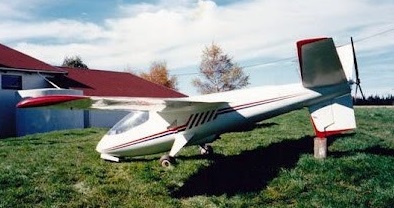
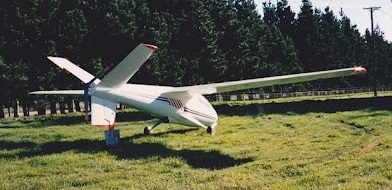
Bill Barber of Dacre in Southland, New Zealand, started off with the Snark HA 1 which was a single seater. Barber Snark HA 1 ZK-FOU (c/n MAANZ 409) was first registered to Bill Barber on 11/8/87. It was built of Kevlar foam sandwich construction with carbon fibre spars and full flaperons. It had a Rotax 503 engine driving a 3 bladed propellor through an 8 foot long driveshaft.
Barber flew the Snark HA 1 twice, for two short hops, and on reflection thinks it was a good aircraft. However, development problems caused him to go on to design and build his two seater Snarks.
This view shows the unusual tail configuration. ZK-FOU was withdrawn and cancelled on 26/7/95. It is currently stored on a trailer at Mandeville.
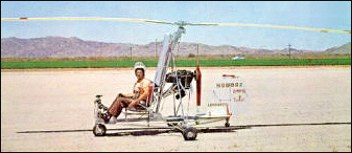
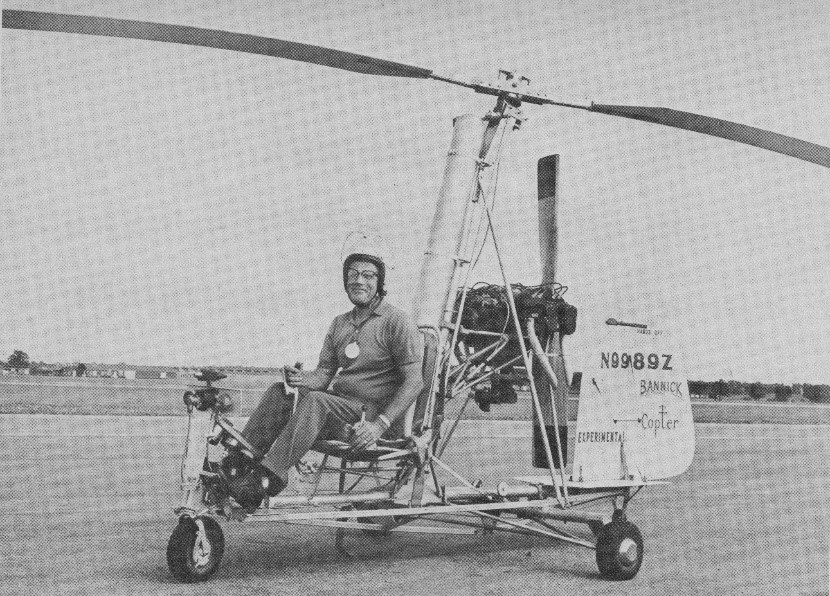
Lester J. Bannick developed the Bannick Model T Copter (N9989Z) in 1964. An open-frame gyrocopter, similar to the Bensen Gyrocopter with a wooden rotor and a pusher 65hp Lycoming engine, it was marketed in the form of plans ($25) for home construction, at about $600.
The only welding is in the motor mount, only machining is in the rotor head, the remainder of construction is with hand tools.
Bannick then completed the prototype of the Bannick Model C Copter which flew in 1967. It used the rotor system of the Model T with a streamlined glass-fibre fuselage incorporating a large tail fin and a 135hp Lycoming engine. It is believed that the Model C was eventually abandoned.
Bannick Model T Copter Engine: Lycoming, 135 hp Rotor dia: 25 ft Length: 7 ft 4 in Empty weight: 350 lb MTOW: 800 lb Top speed: 129km/h Cruise: 80 mph Take-off speed: 26 mph Range: 100 mi
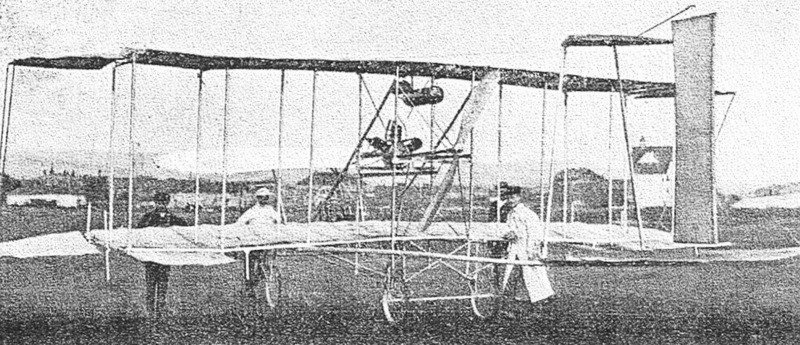
A pusher biplane designed and built by Felix Balzer in Gommern, Germany, in 1910. The engine was a 25 hp Anzani, which didn’t give enough power to make it leave the ground. Another lighter “Apparat” was projected, but nothing more is known.
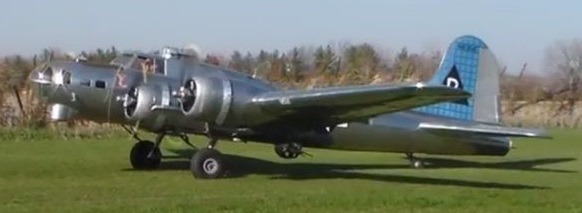
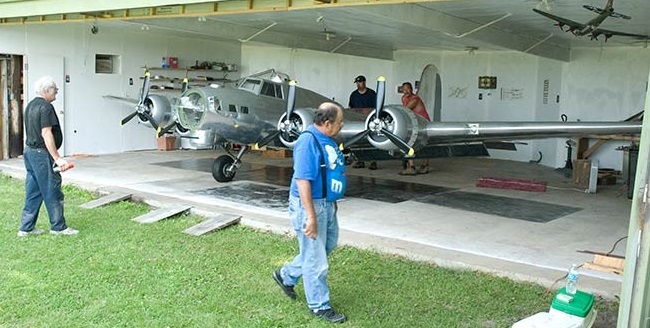
Bally’s Bomber is a ⅓ Scale B-17G aircraft built using 1/9 scale RC model aircraft plans, and carries a single pilot. It is powered by four Hirth 3002 4-cylinder 2-stroke engines, spans 34′ 7″ and weighs an estimated 1,800 lbs.
The unique aircraft received airworthiness certification in September 2016 following initial engine and taxi tests. The first flight was intended to be a high speed taxi test, but the machine was said to “just kind of [take] off”.
On 14 November 2016 Jack Bally`s 1/3 scale B-17 replica performed its maiden flight, departing from its home field in Illinois for a short flight to a local airport, where it was to undergo continued flight tests.
Power Plant: 4 x Hirth 3002, 60 hp Wing Span: 34 ft. 7 in. Length: 25 ft. Tail Height: 6 ft. 10 in. Fuel Capacity: 42 USgal. Empty Weight: 1800 lbs. (Est.) Cruising Speed: 110 kts. (Est.) Crew: 1 Number Built: 1
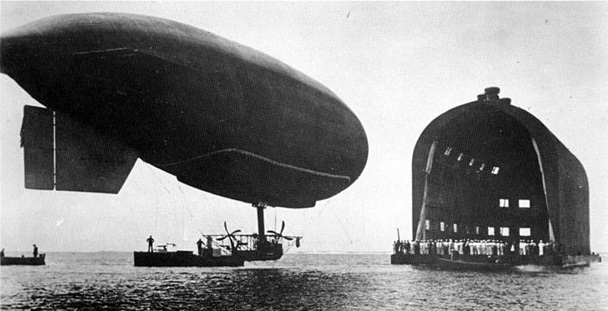
The DN-1 was the US Navy’s first airship. Captain Mark L. Bristol, the second Director of Naval Aviation, supported the development of the dirigible in the anti-submarine role. Victor Herbster, Holden Richardson and LCDR Frank McCrary drew up the specifications for the DN-1. The contract was awarded on 1 June 1915 to the Connecticut Aircraft Company of New Haven, CT. The U.S. Navy had no experience with airships and it seems neither had any of the principles of Connecticut Aircraft Company. They were a lawyer who was the financial backer, a amusement park owner who acted as manager; the technical staff was an Austrian, Hans Otto Stagel, who claimed to be a dirigible pilot and a German engineer and mechanic, who claimed to be Zeppelin experts. Jerome Clarke Hunsaker of MIT and his assistant Donald Wills Douglas, later founder of the Douglas Aircraft Company, aided the Connecticut Aircraft Company in the design of DN-1. The Chief Engineer was James F. Boyle and the Production Manager was J.J. DeLunay. The civilian inspector and designer was Thomas Scott Baldwin and the resident Navy inspector was Frank M. McCrary.
The DN-1 envelope was made of two layers of cloth, with rubber between them. The outer layer of fabric was yellow to prevent deterioration caused by light. The gondola control car, built by George Lawley & Son of Dorchester, Massachusetts, was a large rectangular box with two four-bladed propellers on outriggers. There were originally two engines, built by the B. F. Sturtevant Company of Hyde Park, MA, were mounted in the open gondola, and the propellers could be swiveled to provide thrust in either the horizontal or vertical planes. A 1-1/2 hp Indian engine was provided to maintain air pressure in the two ballonets when the engine was not running. The gondola was water-tight as the Navy intended to operate the DN-1 off water. The specification for the DN-1 provided for being capable of being moored to a mooring mast which had first been used with HMA No. 1 in 1911. The DN-1 was photographed beside a mooring mast but there appears to be no evidence it was ever moored to it.
The DN-1 was announced in the press before its flight program. The DN-1 was shipped to Pensacola, Florida, in late 1916 and assembled in a floating hangar constructed for it. The day of the planned first flight, the DN-1 was removed from its hangar, only to lose lift and sink. Crew member Petty Officer James F. Shade, up to his chin in the water, invited spectators to come aboard for “the first submerged flight of the DN-1.” The DN-1 was returned to its hangar and lightened. One step take to lighten the DN-1 was the removal of one engine.
When the test program began on 20 April 1917 the DN-1 was a disappointment. DN-1 lacked lift, barely met the speed requirement of 35 miles per hour (56 km/h) and the transmission overheated, melting the bearings. The DN-1 was piloted for its first flight by LCDR Frank M. McCrary USN, LT Stanley V. Parker assisted by PO Jimmy Shade. It was 27 April before the airship flew again. Two days later the handling party which was attempting to tow the airship across the water damaged the DN-1.The Navy decided that the airship was not worth repairing and the DN-1 was scrapped. The “The Rigid Airship Manual (GPO, 1928) commented upon the DN-1 “was so overweight that it could barely lift itself off the ground. It’s envelope leaked and the power plant functioned badly. It did, it did, however, actually fly and since the firm had built the ship in good faith and at a cost greatly in excess of the contract price[$45,636], it was formally accepted.”
The DN-1 forced the Navy to take a more effective approach to following airship development depending upon more reliable contractors and closer involvement of the Navy in design and management. The subsequent B, C, and D-Class airships were quite successful.
After its demise the DN-1 came to be considered the A class. Such designation was never officially used by the Navy, nor was it used during DN-1’s short life.
Engine: 1 × Sturtevant Model 5, 140 hp (104 kW) Length: 175 ft 0 in (53.51 m) Diameter: 35 ft 0 in (10.67 m) Volume: 115,000 ft3 (3256.4 m3) Maximum speed: 35 mph (56 km/h)
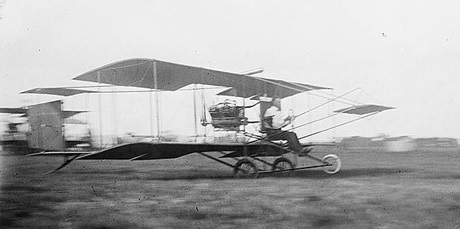
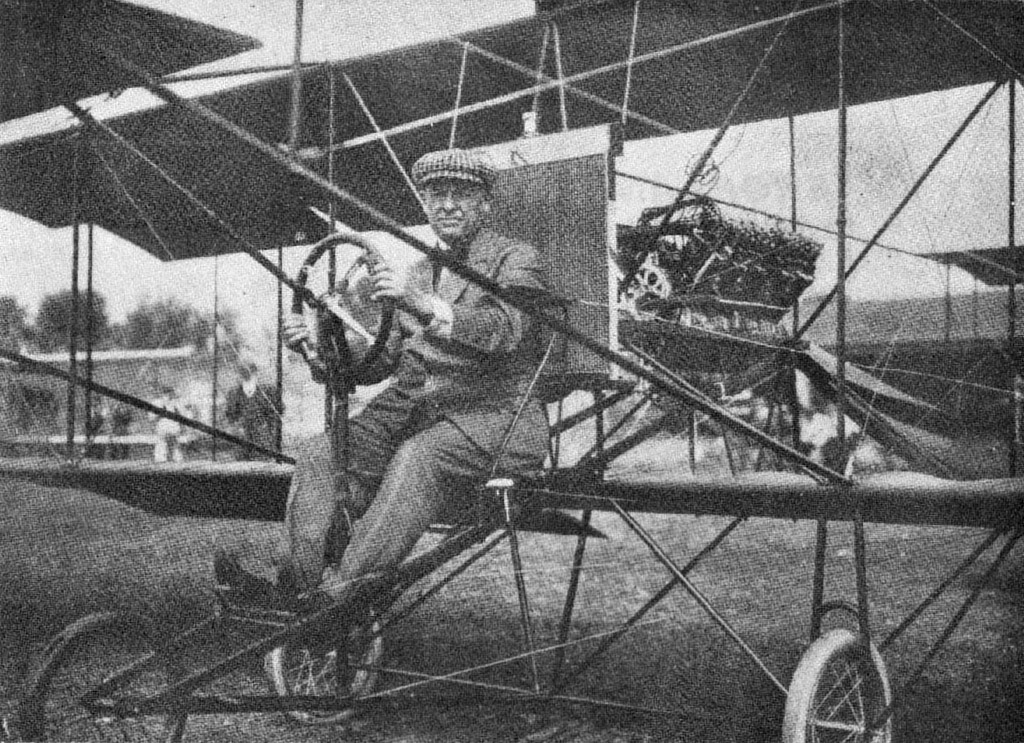
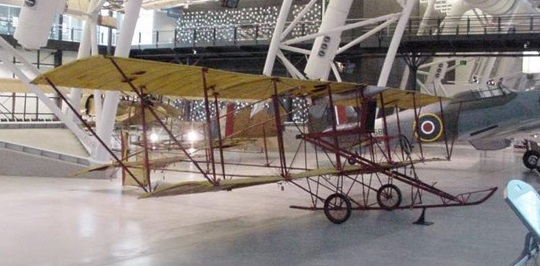
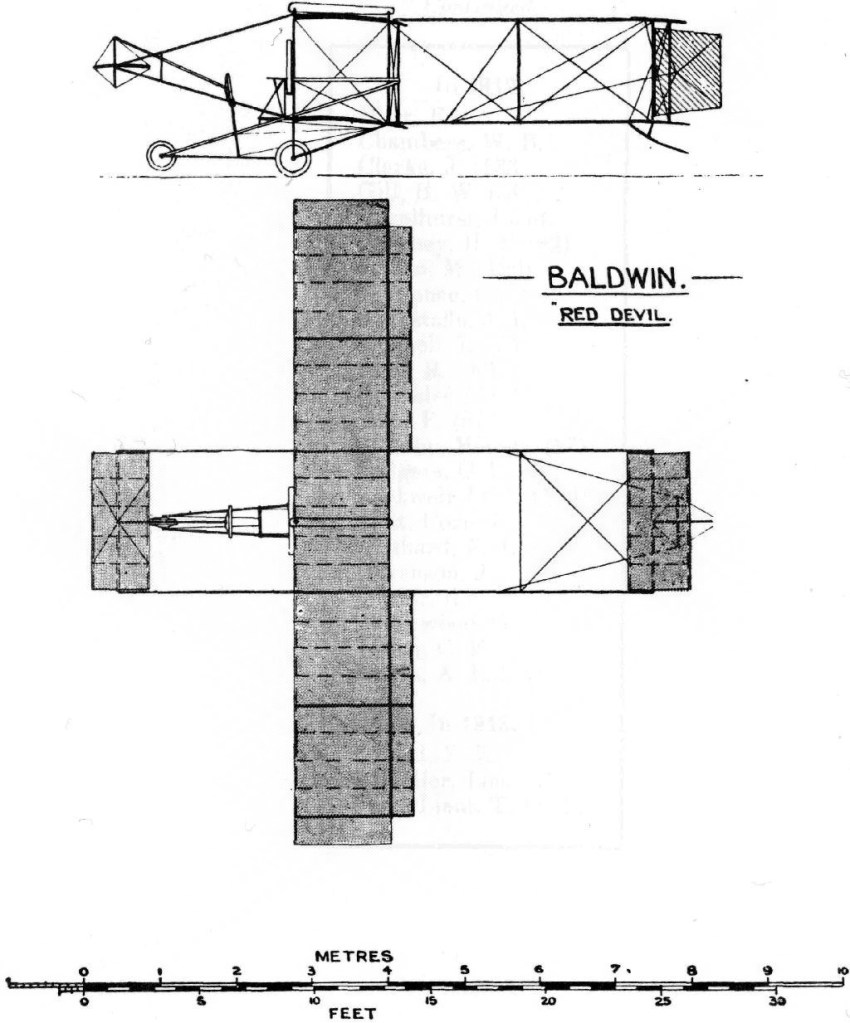
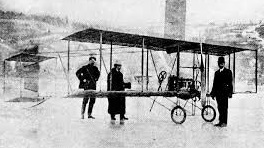
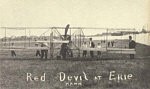
When Thomas S. Baldwin returned from the 1910 Pacific tour, he began testing a new airplane at Mineola, New York. The new aircraft was similar to the basic Curtiss Pusher design but was constructed of steel tubing instead of wood with cloth wings. The aircraft was constructed by C. and A. Wittemann of Staten Island, New York, and was powered by a 60 horsepower (45 kW), Hall-Scott V-8. It was capable of 60 mph (97 km/h). Baldwin named his new aircraft the “Red Devil III”, and thereafter each of his designs would be called a “Baldwin Red Devil”. Tony Jannus flew actress Julia Bruns in a Red Devil on October 12, 1913, in a New York Times Derby.
About half-a-dozen steel biplanes have been produced in 1911 by Captain Baldwin, and he and other aviators, Badger, Hammond, Miss Scott Mass, etc., have flown these at various exhibitions and meets.
Three or four were built; one built for James C “Bud” Mars for his exhibition 1910-11 tours of the USA, Hawaii, and the Orient. Subsequent versions, built by Wittemann, had 60hp Hall-Scott or 75hp Rausie, wingspan of 31’3″ and 32’0″ length.
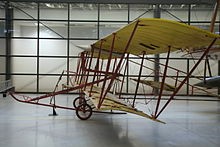
Baldwin’s Red Devil, located at the Steven F. Udvar-Hazy Center
Baldwin Red Devil Engine: Hall-Scott, 50-60 hp Propeller: Requa-Gibson Prop diameter: 7 ft / 2.13 m Prop pitch: 6 feet / 1.82 m Span: 28 ft 8 in / 8.75 m Length: 28 ft 3 in / 8.60 m Speed: 60 mph / 97 kph
In 1910 Thomas Scott Baldwin designed his own airplane, and it was built by Glenn Hammond Curtiss. It used a 25 horsepower (19 kW), four-cylinder Curtiss engine that was later replaced by a Curtiss V-8 engine. On September 10, 1910 Baldwin made history with the first airplane flight over the Mississippi River. The St. Louis flight started just east of Bellefontaine Cemetery. Baldwin and his Red Devil plane took off at 5:11 p.m. 200,000 citizens lined the riverfront on both sides to watch the red biplane fly from the north St. Louis field and land in Illinois across the river from Arsenal Street. On the return flight, the aviator astounded the crowds by flying under both the Eads and McKinley bridges at fifty miles per hour (80.5 km/hr). Baldwin landed at 6:05 back at his starting place.
Baldwin flew it at an air meet in Kansas City, Missouri, on October 7, 1910. He spoke to State University of Iowa engineering students on October 11, 1910 and flew demonstrations at the Iowa City, Iowa fairgrounds on October 12–13, 1910. The flight on October 12 was unsuccessful. On October 13, he flew two flights, one of which was photographed by Julius Robert Hecker. On the second flight he did not gain sufficient altitude and the plane was damaged on a barn but he was uninjured. He then took his airplane to Belmont, New York. He put together a company of aerial performers including J.C. “Bud” Mars and Tod Shriver in December 1910 and toured countries in Asia, making the first airplane flights in many of those locations. The troupe returned to the United States in the spring of 1911.
The Philippines can claim south-east Asia’s earliest encounter with manned powered flight, when American aviator James C. “Bud” Mars thrilled spectators in his Skylark pusher biplane (a modified Curtiss design) at the Manila Carnival on February 21, 1911. Mars was part of a Pacific Aviation Exhibition tour organised by fellow American Capt Thomas Baldwin, who followed Mars’s Skylark display at the Carnival with a demonstration of his own Baldwin Red Devil, the pair having arrived with their dismantled aircraft aboard a steamer from Hawaii ten days previously. The exhibition had not gone so well in Hawaii, where the locals had quickly established a principle that has caused headaches for airshow organisers ever since; why pay for a ticket to enter the showground when you can see an air display from any nearby vantage point? The Manila Carnival organisers must have found a way to sidestep this issue, as the pair of aviators made numerous flights during the week-long festival. Baldwin sold his machine before the duo moved on to complete the Pacific tour with visits to Thailand, Hong Kong and Japan.
The Red Devil was later used by the first flight school in the Philippines, opened by Lt Frank Lahm of the US Army Signal Corps in March 1912.
When he returned from the Pacific tour, Baldwin began testing a new airplane at Mineola, New York. The Red Devil III.
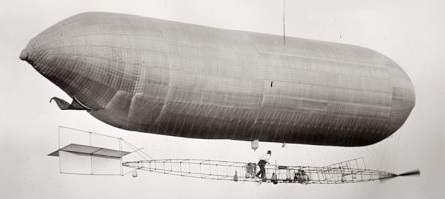
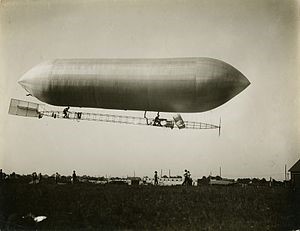
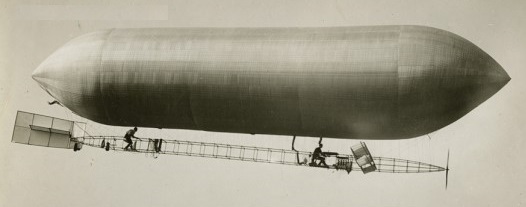
The No. 9, the “Baldwin-9” followed in 1909. Number 9, was an “Exhibition airship”. In the Baldwin design, this girder-gondola framework was made of bamboo, Oregon spruce, and metal. The “square” frames of the skeleton are 1 meter apart and the No 9 has 24.
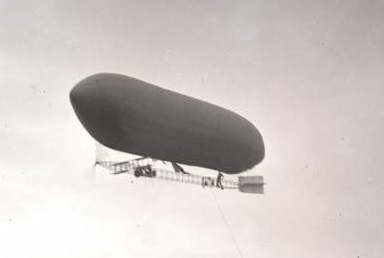
In 1909, Baldwin built the No. 10 for George L. Tomlinson, a wealthy industrialist and aviator. The d’Orcy Airship Manual says the Tomlinson airship was a “Baldwin-9 type.” According to the d’Orcy Airship Manual, the major difference between the Baldwin-9 and the Tomlinson (Baldwin 10) was a barely perceptible “0.6 m” difference in gas-bag diameter.
The Tomlinson and the Baldwin-9 particiated in the Hudson-Fulton Celebratin of Summer 1909.
Works No: 9 Year: 1909 Length: 58 ft / 26.2 m Diameter: 6.1 m Volume: 530 cu.m Engine: Curtiss, 20 hp Speed: 35 kph
Works No: 10 Name: Tomlinson Year: 1909 Length: 26.2 m Beam: 5.5 m Volume: 500 cu.m Engine: 20 hp Speed: 36 kph
On April 18, 1906, a massive earthquake struck San Fransisco. This was the great quake of 1906. Baldwin had one airship remaining, which he had relocated to Hammondsport, New York, before the earthquake. Baldwin then moved to Hammondsport and, in collaboration with Glenn Curtiss was able to use Curtiss’s facilities for his continued airship work.
Baldwin’s demonstration of the abilities of the “California Arrow near the end of 1904, very much impressed the US Army, and in 1907 announced a request for bids for an airship, the result of urgings by Chief Signal Officer Brigadier General James Allen. Baldwin was awarded a contract to provide the Army with an airship.
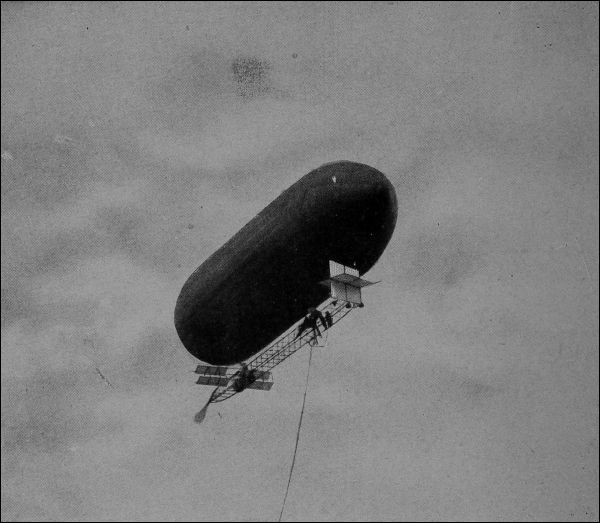
The “square” frames of the skeleton are 1 meter apart and the SC-1 has 30. The SC-1 has some tubes near the pilot used for pressure control of the inflated balloon.
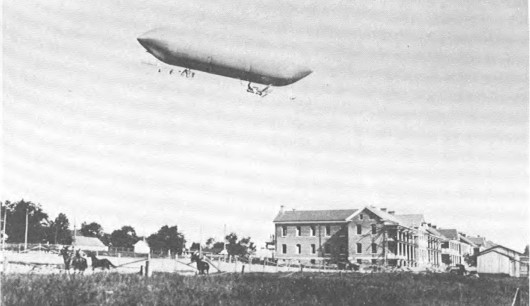
In 1908 he delivered a 95-foot long airship which could be crewed by two, and the Army accepted it, and it entered inventory as “Signal Corps No. 1”. Signal Corps Dirigible No. 1 was the first powered aircraft ordered for the Signal Corps by the Aeronautical Division of the United States Army. The craft fell short of a 2-hour, 20 mph objective to meet a $8,000 per unit award. The Army formally accepted the craft as Signal Corps Dirigible No. 1 paying $5,737.50 on 5 August 1908. The Army tested SC-1 at Fort Myer, Virginia and on 12 August, 1908 the first test flights were made with Thomas Baldwin as pilot, and another aviation pioneer as flight engineer – Glenn Curtiss. On 28 Aug. 1908 Lieutenants Frank Lahm, Thomas Selfridge and Benjamin Foulois were taught to fly the craft. Selfridge, known as being the first fatality from a heavier-than-air craft aboard a Wright Brothers aircraft (the Wright Flyer) flown by Wilbur Wright on September 17, 1908, less than one month after his first training on the SC-1.
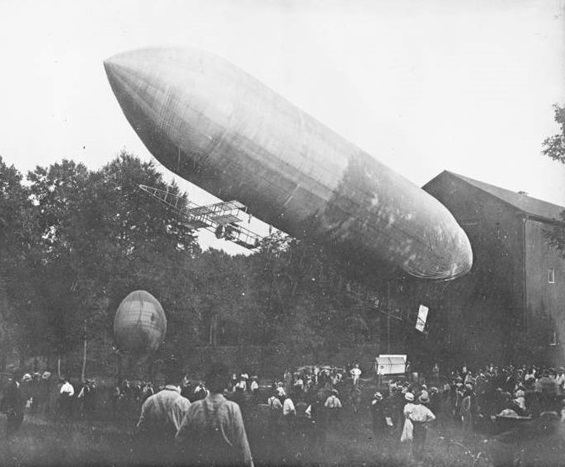
U. S. Army (Baldwin) airship “Signal Corps No. 1” (SC-1) outside old balloon shed at Fort Myer, Virginia, nose pitched upwards, probably on August 3, 1908, prior to the fully inflated and rigged airship being moved to the parade ground. Note not-yet-attached tail rudder section being carried by two men at right background, and “nurse” balloon tethered at left with extra hydrogen for airship.
Lieutenants Lahm and Foulois became the first “US Army Airship Pilots” on May 26th, 1909 when they became the first “airmen” to ascend in the SC-1 without Baldwin. After Second Lieutenant John G Winter Jr of the 6th Cavalry was assigned to duty in the Aeronautical Division, the balloon detachment was transferred to Fort Omaha, Nebraska.
On 26 May, pilot Lieutenant Lahm and Lieutenant Foulois made a flight in SC-1 at Fort Omaha, and manoeuvred the craft at will. SC-1 remained there until scrapped in 1912. The Army did not purchase another dirigible until after World War I.
After working with the Army to train Army Officers to fly the airship, Baldwin built at least another couple of airships in 1909. He then moved into heavier-than-air work, but joined the Army in WW I where he served the Signal Corps as Chief of Balloon Inspection and Production.
Powerplant: 1 × Curtiss, 20 hp (15 kW) Volume: 800 cu.m Length: 36 m Diameter: 18 ft 6 in / 6 m Weight: 1,360 lb Useful lift: 1,360 lb (620 kg) Maximum speed: 17 kn; 32 km/h (19.61 mph) Cruise speed: 12 kn; 22 km/h (13.75 mph) Crew: 2