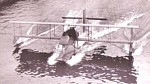
The 1913 Bathiat-Sanchez single float seaplane was designed and built by Bathiat (French) and Sanchez (Chile).
Span: 44’3″
The 1913 Bathiat-Sanchez single float seaplane was designed and built by Bathiat (French) and Sanchez (Chile).
Span: 44’3″

The 1913 Bathiat-Sanchez Type E monoplane was designed and built by Bathiat (French) and Sanchez (Chile).
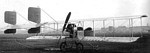
The 1913 Bathiat-Sanchez pusher biplane was designed and built by Bathiat (French) and Sanchez (Chile).
Span: 44’3″
Length: 33’2″
Weight gross: 1815 lbs
Speed: 56 mph
The 1910 Bates-Harroun engine was built specifically for the (Roy) Harroun-Bates Blériot XI.
It was a 24hp air-cooled 2-cylinder, horizontally opposed engine, weighing 95 lb.
The Bates O-77 of 1924 was an air-cooled 26hp 77ci 2-cylinder horizontally opposed engine.
The Bates Junior / O-120 were 36-40hp 120.3ci air-cooled 2 cylinder horizontally opposed.
The Bates 8-B built circa 1914 was a 110hp water cooled 8-cylinder Vee.
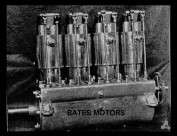
Carl S. Bates built aircraft motors and gained a reputation for their lightness and reliability.
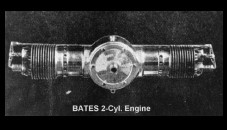
Early engines included:
1908 20hp 2 cylinder, horizontally opposed air-cooled
1909 30hp 4 cylinder, horizontally opposed air-cooled
1910 8-10hp 2 cylinder, horizontally opposed air-cooled
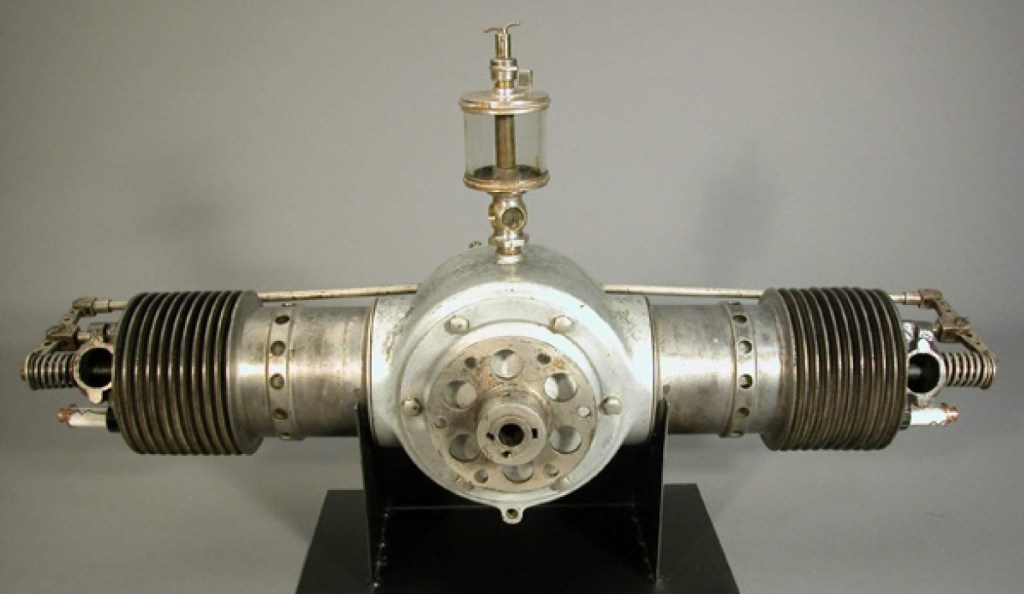
This engine was manufactured by the Bates Engineering Company of Chicago, Illinois, about 1910. It is believed to be a 19 kW (25 shp) Model 2 B. The engine had automatic intake valves and mechanically actuated exhaust valves.
Matthew B. Sellers, builder of the first Kentucky-manufactured aircraft, flew his first quadraplane from 1908 to 1913 powered by various 2-cylinder, horizontally-opposed engines. This Bates Model 2 B was one of these engines.
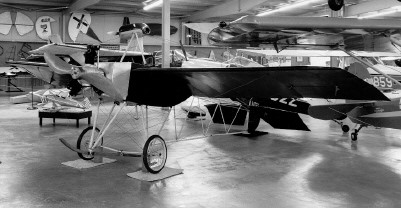
The 1912 Bates Monoplane was built by Carl S. Bates at Cicero Field near Chicago, IL. Bates was a farm boy from Clear Lake, IA who became interested in flying at an early age. He was only 14 when he constructed a man-carrying kite in 1898. In 1903, he moved to Chicago to attend the Armour Institute of Technology and there came under the guidance of aeronautical pioneer Octave Chanute.
In 1911, he is credited with a monoplane of original design, powered with a Bates 30 hp motor. The airplane in the AirVenture Museum is a redesign of that aircraft. The Bates Monoplane fore part of the fuselage is of wood, while the structure back of the cockpit is of steel tubing, oval in cross section, with a “pigeon-tail” empennage and a generous rudder.
Walter Kutz of Skokie, IL who later moved to Waterford, WI, purchased the aircraft in 1918. He stored the aircraft in a barn, but never flew it. In 1957, Leon Tefft, an EAA member, restored the aircraft for Kutz. After Mr. Kutz died, his family decided to loan the airplane to EAA for display in the AirVenture Museum. As displayed in the museum, the aircraft has a Poyer engine.
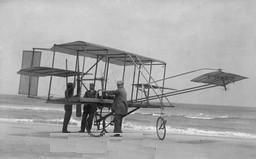
The first powered aircraft of aviation pioneer Carl Sterling Bates, Iowa, USA, the Bates Airship of 1909 was also referred to by the newspapers as the Bates Flyer. Bates took this biplane to Daytona Beach, Florida, where he raced it against a Buick automobile and lost. Purportedly this was the first ever race between a car and an airplane.

