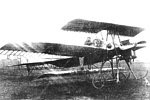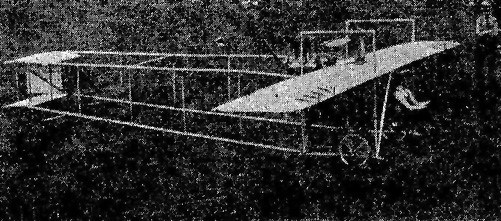
Beachey 1910 monoplane

Lincoln Beachey and his brother Hillery started experimenting with monoplane aircraft construction after the January 1910 Los Angeles meeting. He was present at the Wright team’s inaugural meeting at the Indianapolis Motor Speedway in June 1910, but he didn’t make any flights in his monoplane. Two weeks later, perhaps hoping to learn by studying aeroplanes up close, Beachey secured a position as “chief assistant” to Charles Willard. In that capacity, he brought his monoplane to the Curtiss team’s meeting at Minneapolis in late June 1910. He made some short flights there, but the machine reportedly never got more than three feet off the ground. On June 24th he damaged the machine by crashing into a fence, and after that it seems to have lost interest in it.
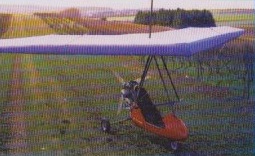
BBG Amigo

A faired in two seater, the Amigo uses cantilever rear undercarriage.

Amigo 1100
Empty weight: 195 kg
Wing area: 15.5 sq.m
Fuel capacity: 40 lt
Certification: Vz
Engine: BMW, 90 hp
MAUW: 450 kg
Seats: 2
Max speed: 120 kph
Cruise speed: 85 kph
Minimum speed: 55 kph
Climb rate: 5 m/s
Fuel consumption: 8 lt/hr
Price (1998): 18 000 DM

B & B Aircraft Sandpiper

Single seat single engined high wing monoplane with conventional three axis control. Inverted V tail. Pitch/yaw control by elevon; control inputs through stick for pitch/roll and pedals for yaw. Integrated flaps and ailerons. Wing braced from below by struts; wing profile; NASA high-lift airfoil double surface. Undercar¬riage has three wheels in tricycle formation: spring steel, inflatable tires. Aluminium tube framework, without pod. Engine mounted below wing driving pusher propeller.
Two struts either side of the pilot support the high wing, and there are no rigging wires, the absence of a kingpost making for a very clean design. Wings are foam blanks fitted to aluminum spars and heat-shrink covered with Dacron. The maker says that 3 inch (7.6 cm) square section tubing is used for the structure, which as a result can handle 9 g. It has a single large diameter vertical wing support between pilot and engine.

Engine: Rotax 38 hp
Prop: 52”
Wingspan: 30’.
Wing area: 150 sq.ft.
Empty weight: 243 lbs.
Gross weight: 625 lbs.
Fuel capacity: 5 USG.
Fuel consumption: 1.5 gph.
Load factors: +9, -6 G’s.
Takeoff roll: 100’.
Climb rate: 950 fpm.
Landing roll (full flaps): 60’.
Stall speed: 20 knots.
Max cruise: 63 mph.
Available as: plans and materials; plans and all parts kit or complete flight tested aircraft.

Baumgartl PB-63

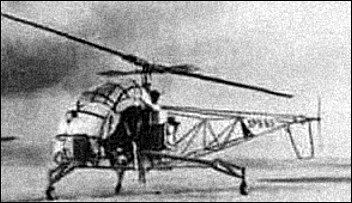
Paul Baumgarti was an Austrian who had worked on three helicopter designs during the war years before emigrating to Brazil. He experimented with a number of light helicopters in the 1950s and 1960s including the single-seat PB-60 unpowered ground-towed rotor kite, and the PB-64 which was an ultra-light single-seater with a minimal tubular fuselage structure. Baumgarti subsequently built his PB-63 under Brazilian Air Ministry funding. After the first model with coaxial rotors, it was given a traditional two-blade articulated rotor. This was a conventional helicopter with a single seat and semi-enclosed cabin, powered by an 85hp Continental C.85 engine. No production of any of these designs was undertaken. The last of a family of experimental helicopters designed in Brazil by the engineer Paul Baumgarti.

PB-63
Engine: 1 x Continental C85-12, 85hp
Rotors: 2-blade main; 2-blade tail
Rotor diameter: 6.0m / 19 ft 8 in
Gross weight: 360kg / 794 lb
Empty weight: 238kg
Cruising speed: 60 m.p.h.
Ceiling: 2285m / 7,500 ft
Seats: 1

Baumgartl Heliofly

Baumgartl Heliofly I

The Austrian engineer, Paul Baumgartl, concerned himself during the Second World War with the design of small single-seat helicopters, in the suburbs of Vienna. Baumgartl’s first product was the Heliofly I of 1941, which was little more than a strap-on autogyro glider for sporting use.

The Heliofly III-57 resulted from previous work. This had a rotor consisting of two co-axial contea-rotating single blades, each of which was to be driven by its own 8 hp Argus As 8 engine, which also acted as a counter-balance.

Baumgartl Heliofly III-59

When it became apparent that the Argus engines could not be readily obtained, the helicopter was redesigned in 1943 as the Heliofly III-59 to be powered by a single 16 hp engine. In this design, the engine drove and counterbalanced the lower blade and, through gearing, also drove the upper blade, so that torque was still counterbalanced by contra-rotation. A weight, instead of an engine, counterbalanced the upper blade, and the flapping rotor system had cyclic pitch control.
Heliofly III-59
Engine: 16 hp / 12kW
Rotor diameter: 6.10m
Max take-off weight: 120kg
Empty weight: 35kg
Crew: 1

Bauman 250 / 290 Brigadier / Piper PA-21

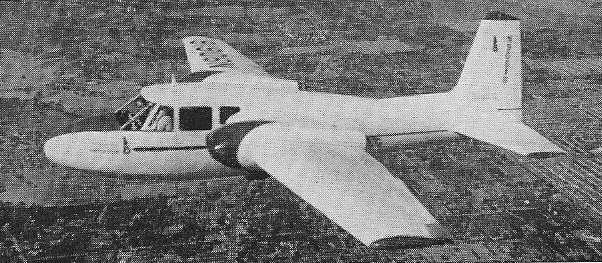
The Bauman B-250 Brigadier prototype first flew in June 1947.

The production aircraft were designated Model 290 differed from the B-250 only in having higher power engines. Pilot production commenced in 1951 and the type certificate was received in 1952.

The Piper PA-21 factory designation was applied to a 1949 purchased Baumann B-250 Brigadier NX/N30025 c/n 1 to be used for evaluation. Piper acquired rights with a stipulation agreeing not to manufacture the design, or any variant of it, with pusher engines—Baumann retained those rights. Wings were redesigned for tractor engines in late 1949, but the project was cancelled when completion was judged as financially impractical. The plane went to a local school instead.

B-250

B-290
Engines: 2 x 145 hp Continental C145
Wingspan: 41 ft
Wing area: 207 sq.ft
Length: 27 ft 5 in
Height: 10 ft 4 in
Empty weight: 2150 lb
Loaded weight: 2150 lb
Max speed: 190 mph
Cruise: 165 mph
ROC: 1200 fpm
Seats: 5

Bauhauer Helicopter         

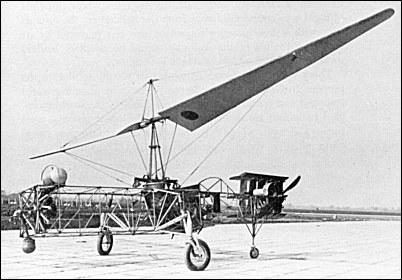
Dutchman A. G. von Baumhauer built a helicopter in 1925 that flew in a very limited fashion. Able to stay in the air only briefly, this unsuccessful machine had a single main rotor and a small vertical tail rotor to offset torque. It needed the weight of dangling chains at each corner to keep level. A separate engine powered the tail rotor, which operated independently of the main rotor.

Batson Air Yacht

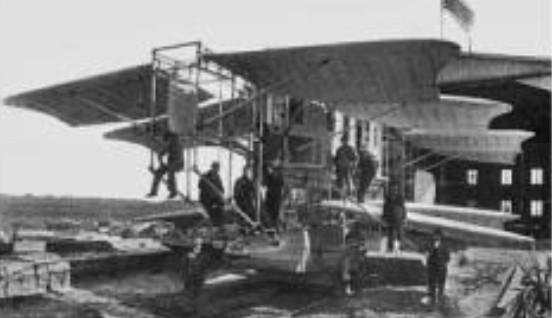
Matthew A. Batson built the Air Yacht during 1912 and 1913 with the intention of flying it on a transantic flight from Georgia to Liverpool, England. The airframe consisted of six forty-foot wings and a gondola type cabin, fixed with struts and braces to a seventy-foot pontoon. Powered by three 120 hp Emerson six cylinder engines, the craft was sucessfully launched but reportedly never achieved sustained flight.

Weight empty: 3968 lb