Blackshape Prime

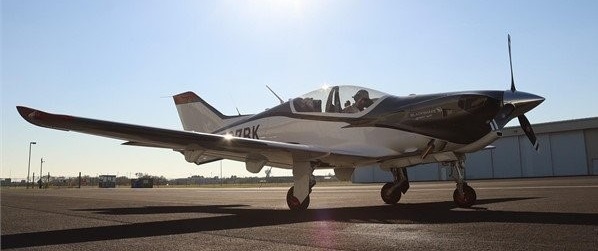
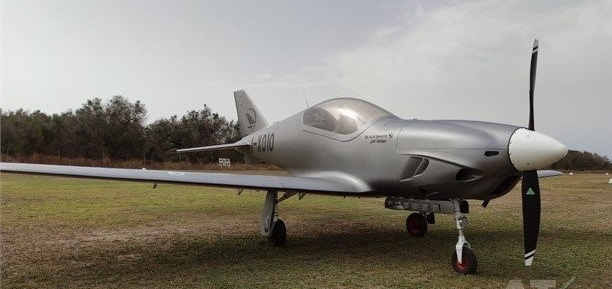
The Blackshape Prime started as the Millennium Master, but the design was later acquired and further developed by Blackshape. The aircraft was designed to comply with the Fédération Aéronautique Internationale microlight rules. It features a cantilever low-wing, a two-seats-in-tandem enclosed cockpit under a bubble canopy, retractable tricycle landing gear and a single engine in tractor configuration.
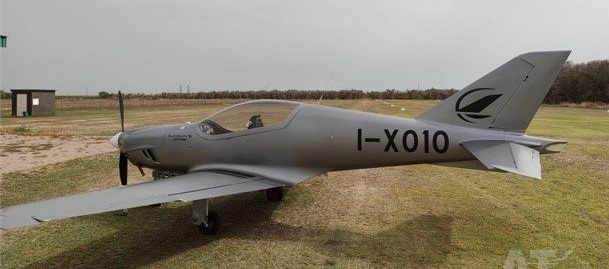
The aircraft is made from pre-preg carbon fibre. Its 7.94 m (26.0 ft) span wing has an area of 9.96 sq.m (107.2 sq ft) and double slotted flaps. The standard engine available is the 100 hp (75 kW) Rotax 912ULS four-stroke powerplant, driving a two bladed constant speed propeller, which gives it a maximum level speed of 300 km/h (186 mph) and a cruise speed of 275 km/h (171 mph). The 115 hp (86 kW) Rotax 914 was also available as an option.
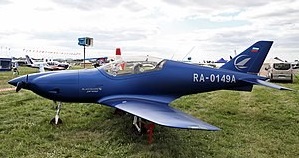
The aircraft first flew in 2007 and was introduced at the Aero show held in Friedrichshafen in 2009. It is supplied as a complete ready-to-fly-aircraft by Blackshape srl, the company founded in Monopoli by Luciano Belviso and Angelo Petrosillo.

Powerplant: 1 × Rotax 912ULS, 75 kW (101 hp)
Propeller: 2-bladed MT-Propeller MTV-33-1-A constant speed
Wingspan: 7.94 m (26 ft 1 in)
Wing area: 9.51 m2 (102.4 sq ft)
Length: 7.18 m (23 ft 7 in)
Height: 2.41 m (7 ft 11 in)
Empty weight: 296.5 kg (654 lb)
Gross weight: 472.5 kg (1,042 lb)
Fuel capacity: 66 litres (15 imp gal; 17 US gal)
Maximum speed: 300 km/h (190 mph, 160 kn)
Cruise speed: 275 km/h (171 mph, 148 kn)
Stall speed: 65 km/h (40 mph, 35 kn) flaps down
Never exceed speed: 305 km/h (190 mph, 165 kn)
Wing loading: 49.68 kg/m2 (10.18 lb/sq ft)
Crew: one
Capacity: one passenger

Engine: Rotax 115 HP 914 ULS3
Prop: 2-Blade, Variable Pitch, HYD, MTV-33-1-A/175-200
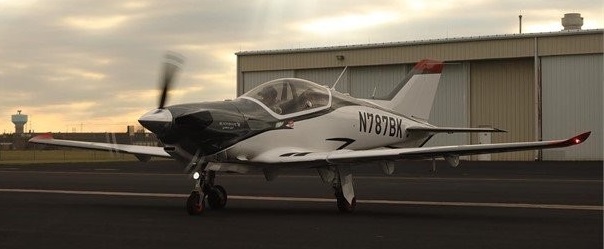
Blackshape Gabriel           

The Blackshape Gabriel trainer aircraft was developed by Italian aircraft maker Blackshape to serve both military and civil pilot training.

The Bk160 Gabriel aircraft base model was launched at the AERO Friedrichshafen trade show held in April 2017, while its upgraded version, designated Gabriel Turboprop (Gabriel-TP), was launched at the Singapore Airshow 2020.

The Gabriel trainer aircraft received design organisation approval and the type certificate in CS-VLA (Very Light Aeroplanes) category from the European Aviation Safety Agency (EASA).

Powered by a turboprop engine, the upgraded trainer variant is intended primarily for military pilot training.

Blackshape plans to cooperate with aircraft manufacturers in South East Asian countries including Vietnam, Myanmar, Philippines, and Malaysia to provide either knock-down kits or full technology transfer for local production of the Gabriel trainer.

Blackshape Bk100-Prime ultralight aircraft serves as the basis for the Gabriel trainer aircraft as well as for ISR and optionally-piloted aircraft versions. A total of 58 Blackshape Prime aircraft were operational in 18 countries, while its special configurations were in service with military operators.

The Gabriel trainer aircraft features aerodynamic fixed-wing design with its design optimised to reduce maintenance and direct operating costs.

Carbon fibre is used in the construction of the aircraft and the fuselage is equipped with low-wing configuration with a wing area of 10.31m² and a wing span of 9m.

The overall height of the trainer is 2.45m, while the overall length is 7.45m. The aircraft has a maximum take-off weight of 850kg, a useful load of 220kg with the capacity to carry 33kg of baggage on-board.

The aircraft is outfitted with an electrical systems with military-grade wiring, temperatures and fuel capacity sensors, anti-blast fuel tanks, and five-point certified safety seat belts. It is also fitted with a ballistic parachute.

The on-board differential braking system is used to steer the aircraft, while the landing gear is electrically actuated.

Gabriel trainer aircraft is equipped with glass cockpit with dual flight controls. It accommodates two pilots in tandem configuration.

The Gabriel can be armed with external payloads, allowing for the training of pilots on light-strike or counter-insurgency (COIN) operations.

The Blackshape Gabriel trainer aircraft is powered by a Lycoming IO-320-D1B engine of 160hp power at 2,700rpm. The engine has a compression ratio of 8.50:1 and drives Hartzell Raptor Series composite propellers in tractor configuration.

The power-plant offers a maximum speed of 164k at sea level and can reach altitudes of 15,000ft. The maximum rate of climb is 1,550fpm, while the maximum endurance is 192 minutes. The trainer requires a take-off distance of 250m and the landing ground roll of 190m.

The load factor of the aircraft is +4.4/-2g. Equipped with Roll Royce turboprop engine, the Gabriel-TP variant can attain a true airspeed of 200k at sea level.

Blackhawk Aircraft Model M

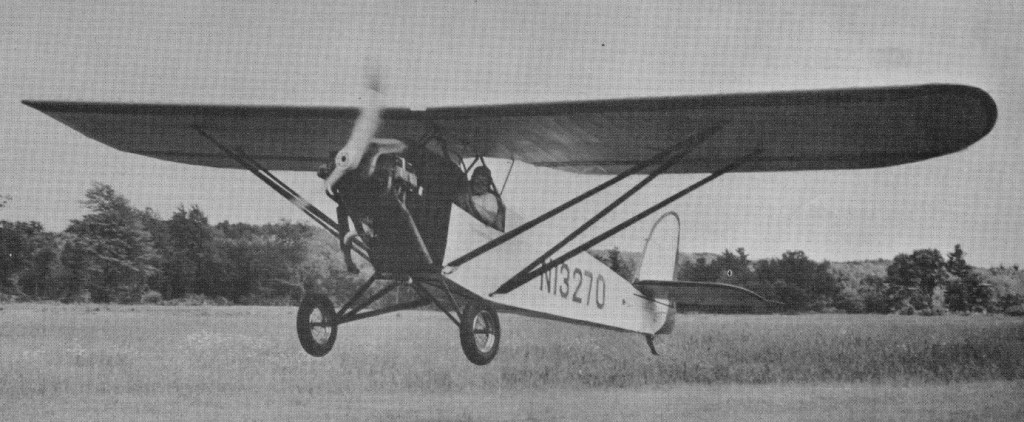
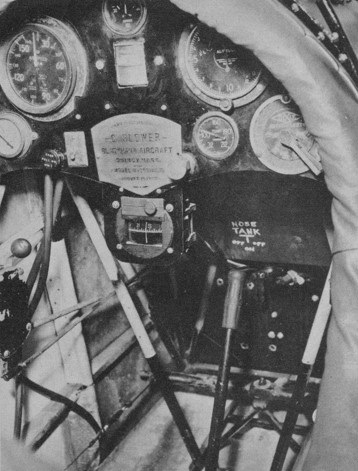
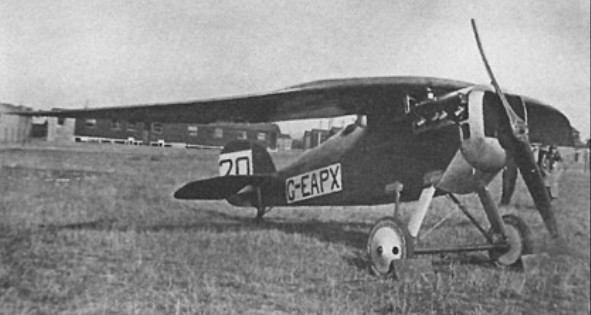
The Blackhawk Aircraft partners Slower and Rheinhardt second model, the Model M, serial 2, featured wooden wings, tubular steel fuselage and tail, with a 60 hp Anzani engine.

The first flight was on 3 August 1933.

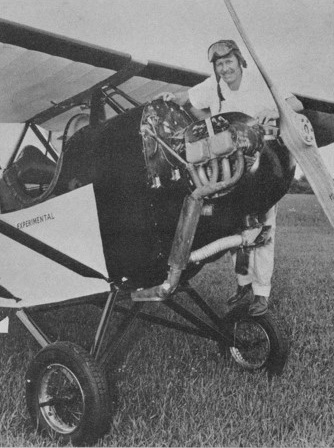
Stored in a garage, the Model M was re-discovered by Elden Langley of Norfolk, Massachusetts. Langley restored to one-of-a-kind which flew again on 13 June 1964. Unable to locate a workable Anzani a Franklin 90 hp was installed. The cost of acquiring and rebuilding, including the replacement engine, was $2000.

Engine: Franklin 90 hp
Span: 30 ft
Airfoil: USA 35A mod
Wing chord: 65 in
Length: 17 ft
Height: 6 ft 2 in
Empty weight: 840 lb
Gross weight: 1200 lb
Top speed: 70 mph
Cruise: 65 mph
Landing speed: 30 mph
Endurance: 3 hr 30 min
TO to 50 ft: 1000 ft

Burney & Blackburne Thrush

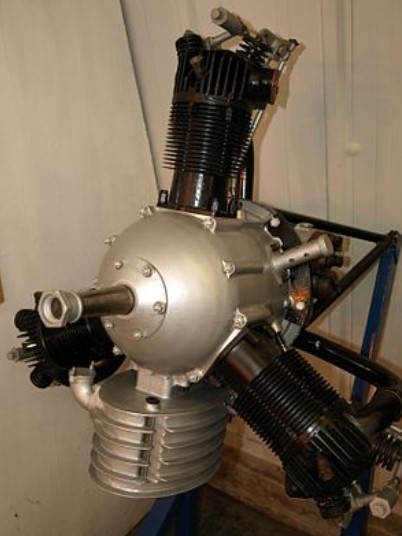
The Blackburne Thrush was a 1,500 cc three-cylinder radial aero-engine for light aircraft produced by Burney and Blackburne Limited. Burney and Blackburne were based at Bookham, Surrey, England and was a former motorcycle manufacturer.

First produced in 1926 the engine was based on an earlier 1924 design with improvements to allow use on light aircraft.

Applications
ANEC IV
Blackburn Bluebird
Clarke Cheetah
Cranwell CLA.4
Parnall Pixie
Supermarine Sparrow
Vickers Vagabond
Westland Widgeon

Specifications:
Type: 3-cylinder air-cooled radial
Bore: 3.16 in (81 mm)
Stroke: 3.78 in (96.8 mm)
Displacement: 88.97 cu in (1.5 L)
Dry weight: 132 lb (60 kg)
Valvetrain: Overhead poppet valve
Cooling system: Air-cooled
Power output: 35 hp (26 kW)
Power-to-weight ratio: 0.26 hp/lb

Burney & Blackburne Tomtit

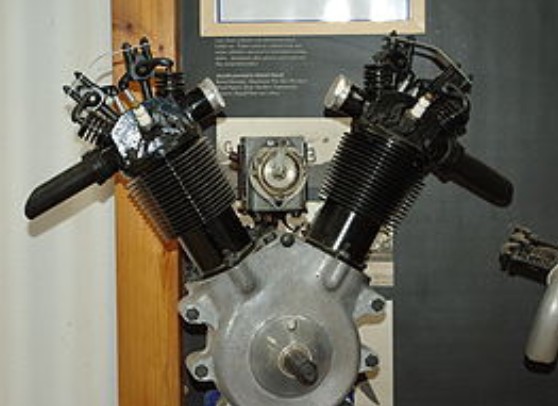
The Blackburne Tomtit was a 670 cc V-twin aero engine for light aircraft that was designed and produced by Burney & Blackburne Limited. Burney and Blackburne were based at Bookham, Surrey, England and was a former motorcycle manufacturer.

The Blackburne Tomtit engine was developed from Blackburne’s motor-cycle engines. The first one adapted to aircraft use was the best performing engine at the Lympne light aircraft trials of 1923, despite the lack of refinement. The Tomtit was a modified version of the Lympne 696 cc V-twin, marketed specifically for flight.

The Tomtit could run upright or inverted and was the first British engine to fly inverted, in the ANEC I. The inverted configuration was more common, but the Avro 558 used it in the upright arrangement, and the Avro 560 flew with both upright and inverted Tomtits.

Applications:
ANEC I
Avro 558
Avro 560
BICh-3 (the world’s first flying wing)
Darmstadt D-11 Mohamed
de Havilland Humming Bird
Gloster Gannet
Gnosspelius Gull
Handley Page H.P.23
Heath Parasol
Parnall Pixie II
Reid biplane
Short Cockle
Wheeler Slymph

Specifications:
Type: Vee twin four stroke piston engine
Bore: 71 mm (2.80 in)
Stroke: 88 mm (3.46 in)
Displacement: 696 cc (42.5 cu in)
Dry weight: 34 kg (75 lb)
Power output: 16 hp (12 kW) at 2,400 rpm
Specific fuel consumption: 0.58 pint (0.33 litre) per hp per hour
Oil consumption: 0.035 pint (0.02 litre) per hp per hour

Cirrus Bombardier

The Blackburn Cirrus Bombardier was a British, inline, four-cylinder aircraft engine that was developed and built by the Blackburn Aircraft company in the mid-1950s. The engine featured fuel injection.

Variants:
Cirrus Bombardier 203
Military version, 203 hp (151 kW).
Cirrus Bombardier 702
Civil version, 180 hp (134 kW).

Applications:
Auster AOP.9
Cierva W.14 Skeeter IIIB
Miles Messenger

Cirrus Bombardier 203
Type: Inline, air-cooled, inverted 4-cylinder
Bore: 4.8 in (122 mm)
Stroke: 5.5 in (140 mm)
Displacement: 398 cu in (6.5 L)
Length: 45.3 in (1,151 mm)
Width: 19 in (483 mm)
Height: 30.95 in (786 mm)
Dry weight: 325 lb (147.4 kg)
Valvetrain: 1 inlet and 1 exhaust valve per cylinder
Fuel system: Fuel injected
Fuel type: 100 octane petrol
Cooling system: Air-cooled
Power output: 203 hp (151 kW) at 2,100 rpm
Compression ratio: 7:1
Power-to-weight ratio: 0.62 hp/lb (1 kW/kg)