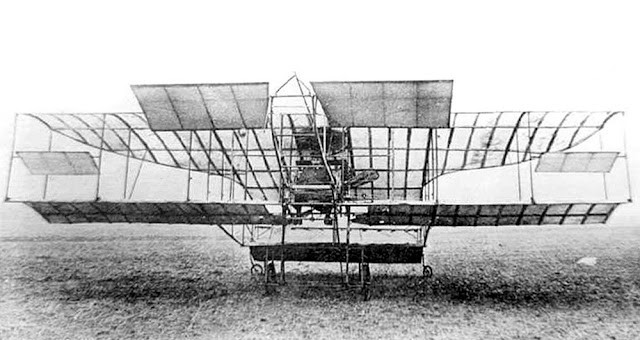
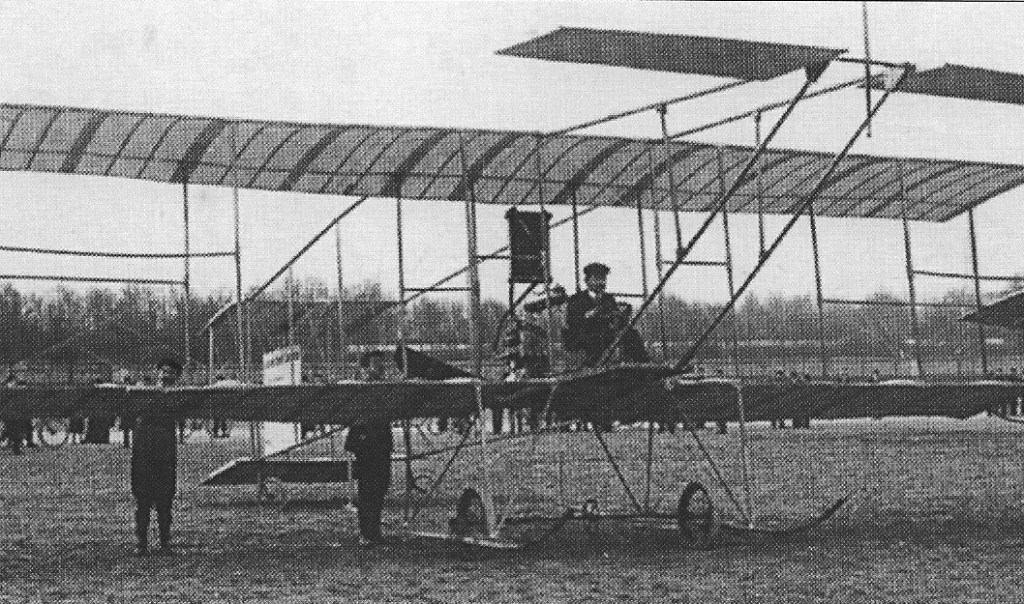
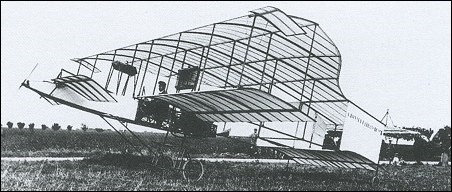
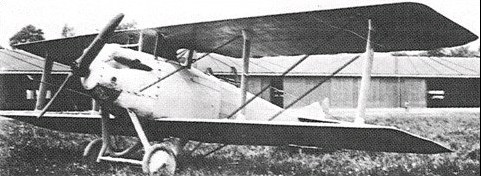
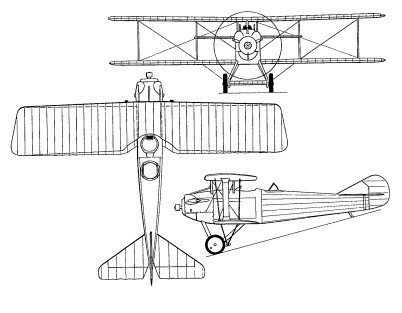
Designed by Charles Audenis and built by the Boncourt- Audenis-Jacob concern at Bron, the BAJ Type IV was a tandem two-seat fighter powered by a 300hp Hispano-Suiza 8Fb eight-cylinder water-cooled engine. The Type IV was armed with one synchronised 7.7mm Vickers machine gun and a pair of 7.7mm Lewis guns on a T.O.3 ring mounting in the rear cockpit. Of relatively clean design, with aerofoil-section single interplane struts and a close-cowled engine, the Type IV was officially ordered on 1 May 1918 by the Aviation Militaire. The first prototype was delivered to Villacoublay for official trials late in November 1918, but these were apparently delayed by the need for modifications which were undertaken by the Hanriot concern and completed on 28 January 1919. The first prototype was returned to the Boncourt-Audenis-Jacob concern for repairs in the summer of 1919, official trials being continued with a second prototype. No production order for the Type IV was placed and no specification for this type has apparently survived
Bo 209-150 Engine: Lycoming O-320, 150 hp Prop: fixed pitch
Bo 209-150 Engine: Lycoming IO-320-D1A, 160 hp Prop: Constant speed Wingspan: 27 ft 6.75 in / 8.40 m Length: 21 ft 7.75 in / 6.60 m Empty weight: 1067 lb / 484 kg Max payload: 504 lb / 229 kg MTOW: 1807 lb / 820 kg Max cruise 75% 8000ft/2440m: 148 kt / 170 mph / 274 kph ROC SL: 1180 fpm / 360 m/min Service ceiling: 18,100 ft / 5520 m Max range, 65%, no res: 647 nm / 745 mi / 1200 km Cabin length: 4 ft 7 in / 1.40 m Cabin width: 3 ft 3.75 in / 1.01 m Cabin height: 3 ft 6.75 in / 1.11 m Seats: 2 side-by-side
Bo 209S Engine: Rolls-Royce Continental O-240, 130 hp Non-retractable nosewheel Wing: non-folding
Bjorn Andreasson of Sweden, originally designed and constructed the prototype BA-7 in his garage in San Diego, while employed as an engineer at Convair. Andreasson’s BA-7 major objectives were good performance, economy, unusual visibility and maneuverability. Fifteen hundred hours of work, one thousand dollars, and a used seventy-five horsepower Continental engine was the expenditure in the project.
Andreasson first flew his 75hp Continental powered BA-7 homebuilt prototype on 10 October 1958.
Bjorn “Andy” Andreasson and BA-7 Junior prototype October 1958, 75 hp Continental
The fuselage is a sheet metal box with exterior longerons and only three bulkheads. The horizontal tail is all-flying; the vertical tail has been changed to conventional fin-and-rudder combination and swept to enhance directional stability.
The wings, using an airfoll only 8.5% thick, have an extruded spar at 30 percent, and a light rear spar at 75% chord. A heavy magnesium skin adds strength, and countersunk rivetting ensures smoothness. By undoing the rear spar bolts, the wings can be folded alongside the fuselage for easy towing or storage, an attractive feature.
The visibility comes from the slight forward sweep of the wings, the occupants sitting forward of the spar. The one piece free blown canopy is hinged at the rear and held down by two latches, one of which is sufficient to hold it at maximum speeds. The main gear is built around two tapered steel rods, anchored to a box beam. The nose gear has a coil spring, is air damped, and is steared by the rudder pedals. Elevators and ailerons are actuated by a single centrally located stick; rudder pedals are dual, and a single hydraulic cylinder gives braking action to both wheels.
The flap control incorporates a nonreversing mechanism that holds the flap in any selected position. The fuel supply is positioned over the center of gravity behind the pilot, and with the 75 horsepower engine in the prototype, the twenty US gallons provides six hundred miles range. A plastic tube is used to indicate the fuel level.
Liftoff is at about sixty-five miles per hour, and an actual top speed of over 150 has been achieved. A more powerful engine is contemplated for the production version. Present approach speeds are on the order of 70-85, and touching speed approximately 55 miles per hour.
MFI Trainer
Andreasson was producing three copies of the MFI Junior, as it’s been renamed, and with Malmo Flygindustri, Mahno, Sweden, a series of ten to test its market potential.
A couple of years later Andreasson returned to Sweden where he joined up with theMakno Flygindustri company, later becoming head of the Aircraft Division of Malmo, a subsidiary of Saab Scania.
While there he put together an improved version of his BA-7, powered by a flat-four engine of 100hp. Following its test flight, the BA-7 design rights were acquired by Malmo Flygindustri and the BA-7 was renamed Malmo MFI-9 or just MFI to the team. Under the designation MFI 9 Junior, the first prototype Junior took to the air on 17 May 1961. Limited production commenced in 1962 and the first production model flew on 9 August 1962. The Junior is certificated for normal and Utility categories and for glider towing.
The basic MFI, of which 25 were produced by Malmo, had reasonably good beginnings and in 1962 Bolkow Apparatebau GmbH (Germany) became involved. Bolkow started producing the Bolkow B208 Junior as an expansion of the MFI-9 under licence to Malmo and by 1970 had produced 200 examples.
Bolkow 208c
A manufacturing licence agreement was reached with the West German firm of Bölkow-Entwicklungen KG, Munich, and licensed production began in 1962 in Germany at the Bolkow factory as the Bo208 Junior.
Bo.208
Two years later a new model, the Bo208C, emerged with the addition of electrically operated flaps, a trailing link nosewheel suspension and a former optional longspan wing as standard. Amongst other features, the Bolkow had tubular steel main gear well before Cessna adopted the concept. The Bo208 has only required three relatively minor mandatory modifications. Its only real problem came with the nosewheel it was prone to falling off once the aircraft was airborne. The addition of the trailing link nosewheel suspension in the B model sorted that problem out. The Bolkow remained one of the fastest 100hp two seat light aircraft with a duration of four hours in the air (range 804.7km with maximum payload), cruis¬ing at 120 mph. Aerobatic. 186 built in total.
In 1964 nine examples were assembled in Burbank, California, by Pioneer Aviation, the U.S. distributor. The 1964 price was US$7800 fully equipped but minus radios, with its American type certificate A1EU.
Slab tail surfaces were featured on the prototype in original form along with a system of springs to return the elevator to neutral or trimed position. The spring tension is not affected by speed, the stick loading remains light at high speed. With an anti-servo tab the feel heavies up as the speed increases. Andreasson eventually adopted the anti-servo tab for better all-round efficiency. After some experimentation, the rectangular rudder was abandoned for the more conventional swept tail.
The large, one-piece canopy is just under 1/8in thick. It measures 38in across at the widest point and has a base length of 30in. American models have a single, centrally located canopy latch instead of the left and right side handles fitted to German aircraft. The seats are independently mounted. A luggage compartment is situated directly behind the seats and below the fuel tank. It is accessable from the cockpit only.
In order to achieve the excellent visibility from the cockpit and still keep the centre of gravity within permissable limits, Andraesson swept the wings forward three degrees. The employment of the “droop snoot” leading edge has the effect of providing a more forward centre of pressure at higher angle of attack. Structurally the fuselage has four external longerons and the skins are all flat sheets. To prevent excessive vibration, two longitudinal stiffeners are formed in each side panel. The single spar (an I-beam extrusion) wing is composed of a minimum of parts, each panel having only seven ribs. The airfoil is an NACA 23008.5 section modified at the leading edge. The main legs of the landing gear are flexible steel shafs weighing about eight pounds each.
Reinforced fibreglass mouldins are used at the wing tips and on the engine cowling. Self-aligning bolt bearings are used in such places as the top engine mount lug and fuselage wing strut fittings.
Dual throttles, located on the extreme right and left side of the instrument panel, are connected by a transverse torque tube behind the panel. Friction on the torque tube is adjusted by a small knob in the centre of the panel.
Cleveland hydraulic brakes are actuated simultaneously by a lever mounted on the left side of the central keel. A simple ratchet lock disengages easily by pulling the handle a little to one side. The anti-servo trim tab has a lever in the cockpit moving a sheathed, 1/8in steel rod connected to a 1.5in long bellcrank at the tailpost. The bellcrank, fitted with a small friction-disk brake, is linked to the tab by a short rod.
Aileron mass balance weights on the BA-7 were fully enclosed in the wing tips. They are in about the same place on the Junior, but project into the airstream with up aileron. Rudder weights are entirely external and the horizontal tail has a heavy leading edge, largely with the weight necessary for balance.
In its original form the Junior was equipped with manually-operated self-locking flaps which were quick and positive. However, the operating handle was situated above shoulder level between the occupants and on the rear cross tube. During certification tests in Germany, the inspector banged his head several times on the handle and this prompted a recommendation that the system be operated electrically. A small window actuating motor from a Mercedes 220 automobile was adapted for aircraft use.
The toggle switch controlling the flaps is located next to the throttle. A simple flap indicator is an endless sheathed cable running from the flaps to a small pointer projecting through a vertical slot on the instrument panel. The slot is marked to show any position from 0 to 35 degrees. A second, electrical fuel pump is fitted.
In the original BA-7, the elevator was not adequately powerful to keep the nose up at low speeds, which meant that the aircraft had to land faster than should have been necessary. By increasing the elevator area on the Junior and giving it an inverted camber, control was more powerful and touchdown speed was reduced. Recommended approach speed is 70 kt / 80 mph. The Junior’s ailerons are small, 32in x 10.5in, but effective and a 360 degree roll takes under 3 seconds. The landing gear is sprung, with 500 x 5 tires all round. The thrust line is offset 1.5 degrees to the right.
Empty weight has been raised from 590 lb of the BA-7 to 750 lb, due primarily to the use of aluminium instead of magnesium and the use of the 100 hp Continental with full electrical system.
Some 210 Bolkows were built in the years following 1962, ceasing in 1970.
Bo.208C Junior
Meanwhile, Malino had further developed the MFI-9 from which came the MFI-9B Trainer with an enlarged cabin. The 9B was purposely designed for the military as a basic trainer, although the type later became very useful in a ground attack role. Malmo, which built nearly 50 9Bs, was hoping that the Swedish Air Force would acquire its trainer, but that didn’t eventuate.
MFI-9HB
The MFI 9B was followed by a T tailed version with provision for underwing stores, evolving to the MF 15 which was used a military trainer.
About five rocketting 9Bs saw service with the Biafran Air Force during the Biafra-Nigeria Civil War in 1969, when Biafra was fighting for its independence from the much larger country. The five 9Bs actually made up the air component of the BAF, along with a few inactive Harvards. Known as “Biafran Babies”, the militarised 9Bs were flown by Swedish and BAF pilots and were up against the likes of the Nigerian Air Force’s (NAF) MiG-17 jet fighters and the much bigger Ilyushin Il-28 twin-engine jet bombers. It is reported that the little 9Bs either severely damaged or totally wrecked numerous MiGs and three of the NAF’s six Il-28 bombers during ground attack, hit-and-run operations. Other Nigerian targets attacked by the 9Bs included key airfields, armoured vehicles, troop and transport lines and oil depots. One 9B returned to base from a low-level sortie with 12 bullet holes in it.
The 9B was also used in a ‘MiniCOIN’ role, a contraction of miniature counter-insurrection. At the end of seven months of flying combat missions, the BAF’s strike force assets numbered two. Two MFI-9Bs had been shot down with the loss of their pilots and one had been damaged beyond repair.
Bolkow 208C Junior Engine: Rolls Royce Continental 0-200A, 100 hp Wingspan: 26 ft 4 in / 8.02 m Length: 19 ft 0 in / 5.79 m Empty Weight: 874 lb / 380 kg Max All Up Weight normal: 1390 lb / 630 kg Max All Up Weight utility: 1320 lb / 600 kg Fuel Capacity: 21 Imperial Gallons (100 Litres) Max cruise Speed: 111 kt / 127 mph / 205 kph Max ROC SL: 785 fpm / 240 m/min VNE: 153 kt Service ceiling: 14,780 ft / 4500 m Range max fuel: 538 nm / 620 mi / 1000 km Seats: 2
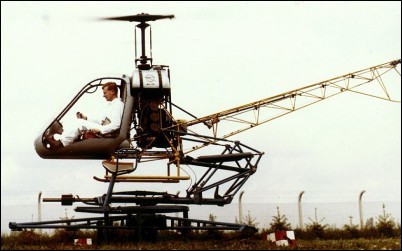
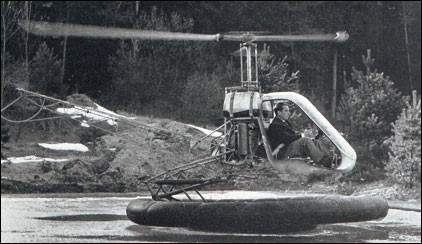
Rolled out in 1959, the Helicopter Trainer was powered by a Hirth 40hp ILO piston engine and had a twenty-one foot counterbalanced fibreglass rotor blade.
Developed in land and water based versions, both of were semi-captive. This feature allowed the helicopter to rise to a height of 0.6m, turn around a vertical axis and dip at up to 6° but prevented it from flying outside these limits.
In all eighteen of these HeliTrainers were built operating throughout Europe, training military helicopter pilots. Although unable to fly, they were ideal for the teaching of hovering techniques and were replaced by dual trainer helicopters.
Bo-102 Engine: 1 x Hirth ILO, 40 hp / 30 kW Main rotor diameter: 6.58m Length: 5.68m Take-off weight without a platform: 325kg