Borgward Kolibri

The German car manufacturer, Borgward set up a helicopter division in 1956 under the leadership of Prof. Heinrich Focke, whose Focke-Wulf Fw.61 aircraft of 1937 was one of the earliest successful helicopters. The Kolibri I is the first helicopter of German design to have flown since the war.

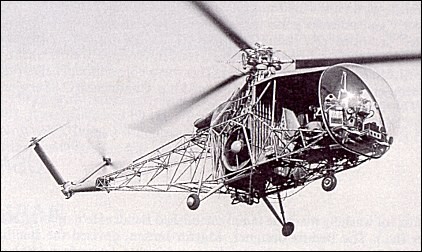
A light three-seat helicopter, the Kolibri I, was designed with a three-blade main rotor. Blades have steel-tube spar, with plastic-bonded plywood covering. Fully-articulated hub with adjustable friction dampers. Main rotor drive is via two-stage cam-wheel. Tail rotor drive via hollow steel-tube shaft and two bevel-gears. Two tail rotors, inclined at 45° to horizontal, at extremities of tail stabilisers. Tail rotor blades of plastic-bonded plywood.

The uncovered steel-tube girder fuselage had a conventional tail boom and a tricycle type landing gear. Shock-absorption by torsion spring and Borgward hydraulic damper. Fuel tank aft of rear fire-wall.

Normal seating for three persons, with a central seat behind and on a higher level than front two seats, with a forward cockpit enclosed with bubble canopy. Alternative loads can include up to 300kg of freight slung from an under-fuselage hook.

The prototype had a 260hp Lycoming VO-435-A1B engine in the centre section.
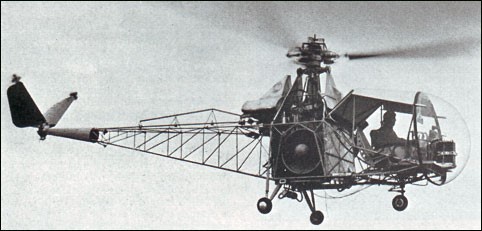
The prototype made its first free flight on July 8, 1958, piloted by Herr Ewald Rohlfs, who set up several international helicopter records in the pioneer Fw.61 in 1937. Airworthiness trials were progressing satisfactorily in the Spring of 1959, and plans are being made to put the Kolibri in production.

Kolibri I
Engine: 1 x Lycoming YO-435-A1B, 260hp
Main rotor diameter: 9.40m
Main rotor blade area (each) 1.28 sq.m
Main rotor disc area 70 sq.m
Length of fuselage: 8.30m
Height to top of main rotor head: 3.05m
Weight empty: 800kg
Weight loaded: 1200kg
Fuel capacity: 180 litre
Wheel track 1.93m
Wheel base 1.80m
Tail rotor diameter: 1.66m
Tail rotor disc area (total) 4.3 sq.m.
Main rotor/engine r.p.m. ratio 1 : 10
Tail rotor/engine r.p.m. ratio 1 : 6.75.
Max speed (est.): 160km/h
Cruising speed (est.): 140km/h
Rate of climb at sea level (est.): 240m/min
Vertical rate of climb at sea level (est.): 60m/min
Absolute ceiling (est.): 4500m
Hovering ceiling OGE (est.): 600m
Endurance: 3.0h
Borgnis-Desbordes et de Savignon Triplane / Borgnis de Savignon et de Desbordes

First version

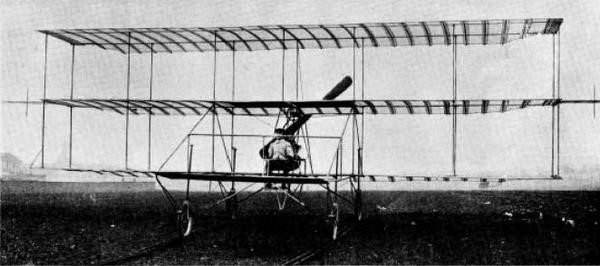
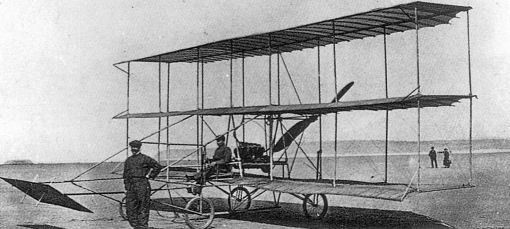
The Borgnis-Desbordes et de Savignon Triplane, also known as the Borgnis de Savignon et de Desbordes, was named after its designers/financier, Achille and Paul Borgnis, and Desbordes de Savignon. A development of the second Bousson-Borgnis, it was of all-metal construction, built at Gennevilliers. There were no rear tail surfaces: steering was done with ailerons set on forward outriggers, and a forward elevator was set low ahead of the 4-wheel undercarriage.

The first version of the Borgnis et Desbordes de Savignon, 12 March 1909

According to reports this triplane actually left the ground several times in Gennevilliers on January 31, 1909.
The first version was later modified. In the modification the elevator was brought to the rear of the machine and with new undercarriage, it was driven to Yffiniac on the northern coast of Brittany, where it flew and made a “memorable crash”. Repaired, this machine was destroyed in a collision at the end of 1910, ending the aviation related careers of the Borgnis brothers.

Engine: 6-cylinder, 28 hp
Span: 14.5 m / 47′ 7″
Wing area: 80 sq.m
Gross weight: 570 kg / 1250 lb

Bonsall Mustang MkII

The single seat Bonsall Mustang MkII, often referred to as “The Pride of Yorkshire”, was built by D.C. Bonsall in the United Kingdom in 2011. The unique 8/10th scale replica of a P-51 Mustang aircraft has wooden frame/spars with fibreglass wings and skin, titanium fuel tanks and many titanium fittings.

It is a UK LAA Permit to Fly aircraft, maintained per UK LAA Maintenance Requirements.

Capable of 200 kts and powered by a 300 hp Lycoming IO-540 engine and McCauley 3-blade B3D36C431-B propeller it is registered G-BDWM S/N PFA 073-10200.

It was for sale in 2019 with an asking price of £120,000.

Gallery

Bonney Gull       

Leonard Bonney, an aviation pioneer and one-time First World War US Army and Navy flying instructor. Bonney became obsessed with the shape of a gull’s wing, which he believed to be the most efficient and capable wing form in nature. He set out to design an airplane that mimicked its qualities.

Through mechanical mechanisms he sought to be able to vary the wing’s incidence and sweep. The design, wind tunnel testing and fabrication of the Bonney Gull took him almost five years. At a time when a new airplane cost about $3,000, the Gull’s development cost was $83,000.

The aircraft had so many new features and looked so unpredictable that Bonney could not get a test pilot to take it up—so he did it himself. On 4 May 1928 at Curtiss Field, Long Island after a quick flight in another aircraft to refresh his skills, he took the Gull into the air on its first flight. At a height of about 50 feet, the porpoising aircraft nosed over and dove straight into Long Island. Leonard Bonney was killed.