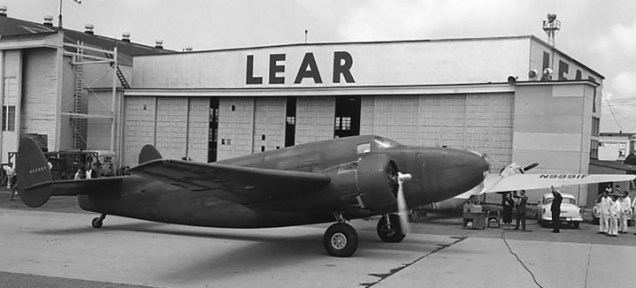
Gates Learstar

Shortly after World War II, Bill Lear bought a fleet of Lodestars. In 1953, Gordon Israel signed on with William Lear to redesign the Lockheed Lodestar into the Learstar executive transport. Lear tinkered with their noses and streamlined the fuselages. He added fairings to the landing gear and beefed up the horsepower. Lear’s new plane was one of the first truly executive aircraft, and Lear guaranteed a 300 mph cruise speed for businessmen who were in a hurry.

When the Learstar was finished, it was 52 knots faster than the stock Lockheed, and Lear eventually sold 72 of the big long range twins, one of them going to the Krupps of Germany on a delivery flight that went from Santa Monica to Dosseldorf, Germany with only one stop, at Frobisher.
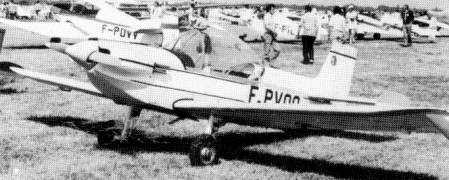
Gatard AG02 Stratoplan Poussin

M. Albert Gatard’s Poussin (chick) has excellent aerobatic qualities with 20 seconds of inverted flying possible. Several are under construction around the world, including one in Zaire. The control system uses a unique, variable-incidence lifting tailplane of large area. The pilot lowers full-span slotted aileron/flaps and adjusts the tailplane to maintain pitching equilibrium. Aircraft is single-seat wooden low-winger, fixed gear.
Development continued into the 1970s.

Engine modified 24 hp VW, 1200cc.
Gross weight 617 lbs.
Empty weight 375 lbs.
Wingspan 21 ft.
Length 14 ft 10.5 in.
Wing area: 66 sq.ft.
Cruise speed 89 mph.
Climb rate 435 fpm.

Gasuden KR-1 Chidorigo (Plover)

Production of the D.H.83 reached a total of 98 aircraft completed in England, plus two examples in Australia and one copy in Japan. That machine was modelled after several original examples sold to that country, but it was fitted with a Gasuden Jimpu 3 radial engine of 150 hp. The aircraft went by the name of Gasuden KR-1 and was christened ‘Chidorigo’ (Plover). As far as is known, just this one example was built. The single Gasuden KR-1 was flown by the Japanese Aerial Transport Company.

Gasturbine101 The Swarm

A man living in the UK known only as “Gasturbine101” created a 54-propeller drone not only capable of sustaining ordinary flight, but sustaining flight with him on board.

The drone contains 54 counter-rotation propellors and six grouped control channels with Hobbyking KK2.15 stabilization. The craft’s maximum takeoff weight is around 148 kg (326 lbs) while possessing the ability to sustain flight for roughly ten straight minutes. Power is approximately 22KW.

The Swarm cost about £6,000 to build and is powered by four cell batteries.

There is a flaw in the design of the vehicle. The large number of props running at high speed means the net torque reactions are relatively low, so the craft has little yaw authority. It probably needs a tail rotor for spot turns.

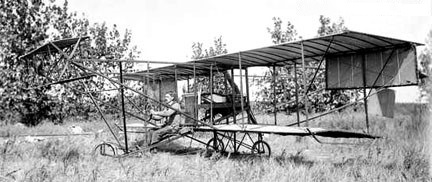
Gasnier 1908 Biplane

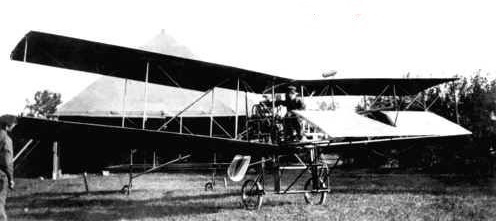
The Gasnier Biplane of 1908 was the first pusher biplane designed and built by René Gasnier. Powered by a 50 hp Antoinette motor and featuring a distinctive front elevator that could also be tilted to work as a rudder. This machine was damaged on its first day of flight.

Rene Gasnier said, “We are like children compared with the Wrights”.