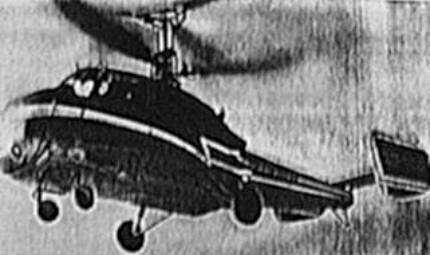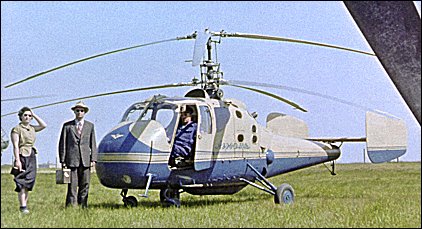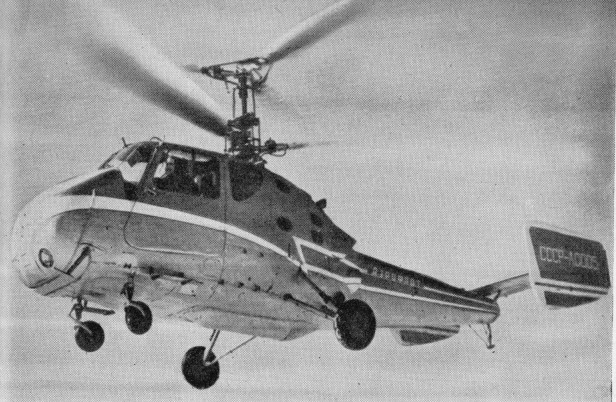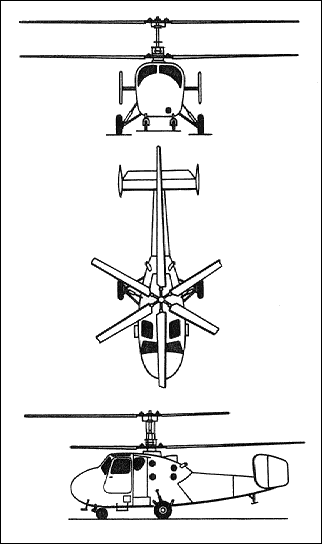
Kamov Ka-22 Vintoryl

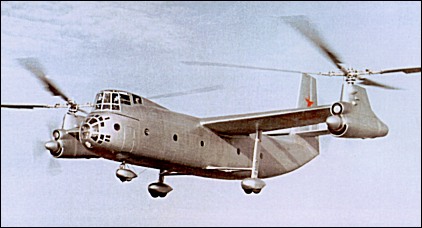
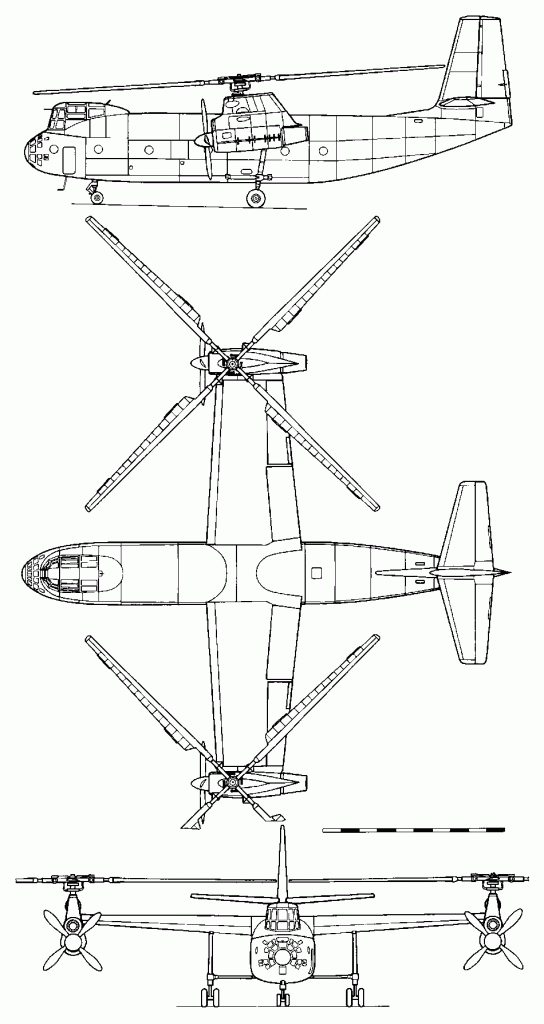
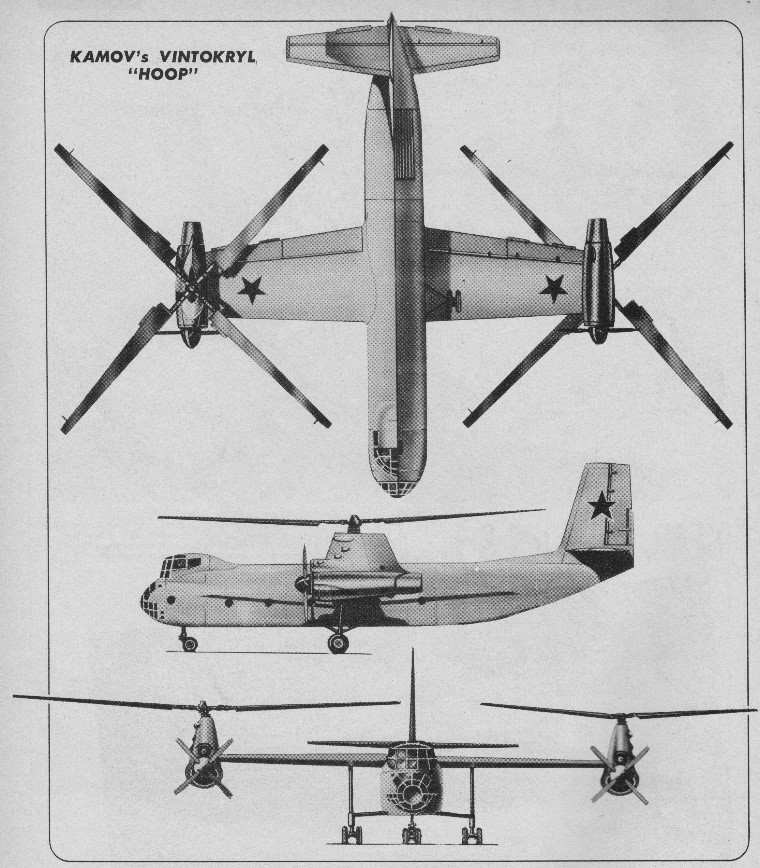
In 1951 various attempts were being made to increase the effective range of helicopters, notably by towing them in the outward direction behind an Li-2, with the lifting rotor autorotating. The idea occurred to Kamov designer Vladimir Barshevsky that it would be possible to dispense with the tug aircraft if a helicopter could be provided with wings and an aeroplane propulsive system. After obtaining permission from Kamov, his deputy V. V. Nikitin took a proposal to the Kremlin and in a matter of days the OKB had a Stalin directive to get started. In response to the GOR issued by the Ministry of Defence, Kamov decided to build an experimental compound helicopter, the Ka-22. Dubbed “Vintokryl” (lit. “screw-wing”), it featured two lifting rotors and two tractor propellers for forward thrust, both mounted at the wingtips. This was an aircraft, combining the advantages of the helicopter capable of vertical take-off and landing and of the aeroplane possessing greater lifting capacity, range and speed as compared to the helicopter.
N.I.Kamov focused the attention of the team on the design of high-speed lifting rotors which would enable the compound aircraft to cruise at 400-450km/h. At high forward speeds the wing was intended to decrease rotor disc loading as much as possible, ensuring low drag factors. This allowed the tips of the main rotor blades to reach the speed of sound and the rotor to work in a mode close to autorotation. N.I.Kamov’s decision to retain minimum required rotor disc loading at high speed sufficient for damping rotor oscillations and for ensuring stable rotor behaviour during manoeuvers proved to be of fundamental importance.

The engines were to be TV-2 (later TV-2VK) turboshafts supplied by N. D. Kuznetsov, and many organizations were involved in research for this challenging project, starting with model tests in the T-101 tunnel at CAHI. The final go-ahead was issued on 11th June 1954. An order for three Ka-22s was placed on the factory at Ukhtomskaya, which had been derelict since Kamov was evacuated from there in October 1941. Concentration on the small Ka-15 (the OKB’s first production helicopter) and other problems so delayed the programme that on 28th March 1956 prototypes 2 and 3 were cancelled.
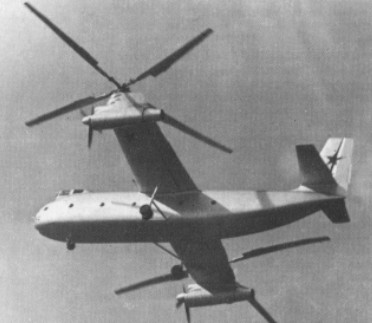
Development and construction of the Ka-22, project 1955, under the leadership of S.Ya.Finkel, developed a whole set of methods to determine the aircraft’s parameters, rotor blade configuration, basic performance characteristics of the rotorcraft and its aerodynamic design, to calculate aerodynamic loads, aerodynamic balancing etc. Special research was made to ensure optimum characteristics in transitional flight modes, to select structural stiffness characteristics of the airframe components, to prevent rotor blade flutter and “ground resonance”.
A major contribution to the creation of the Ka-22 was made by S.B.Garshtein, AI.Dreizin, Z.Z.Rosenbaum, A.G.Satarov, E.A.Petrosian, L.A.Potashnik, V.N.Kvokov and other members of the OKB staff, as well as by TsAGI specialists M.K.Speransky, I.O.Faktorovich and E.V.Tokarev.

Work on the unique powerplant and systems of the aircraft was headed by deputy chief designer N.N.Priorov, and deputy chief designer M.A.Kupfer was responsible for the rotor system and the airframe. Yu.S.Braginsky was appointed Ka-22 leading designer and V.B.Al’perovich was the leading engineer of the flight test programme. First deputy chief designer V.I.Biryulin was responsible for all the work on the compound helicopter.

The Ka-22 was basically a stressed-skin compound helicopter with its engines on the wingtips, with geared drives to both propellers and lifting rotors. The airframe was all light alloy stressed-skin, the high wing having powered ailerons and plain flaps depressed 90° in helo mode, with auto control linking fuel flow with prop pitch in cruise. The fuselage had a glazed nose, three-seat cockpit above the nose and a main cargo area 17.9×3.1×2.8m for 80 seats or 16.5 tonnes of cargo. The entire glazed nose could swing open to starboard for loading bulky items or a vehicle. The high flight deck carried two pilots and a radio engineer. The original prototype was powered by 5,900shp TV-2VK engines, but these were later replaced by the 5,500shp D-25VK. These had free turbines geared via a clutch to the main rotor and via a front drive to the four-blade propeller and a fan blowing air through the oil cooler from a circular inlet above the nacelle. The two free-turbine outputs were interconnected by a 12-part high-speed shaft ‘about 20m long’. The propulsion system, in the form of a pair of 5600 horsepower Ivchenko turbine engines, provided the propulsive force for both the lifting flat-mounted rotors and the normally-positioned forward-pushing propellers. The tailpipes of these powerplants are assessed to have tail pipes that can be deflected downward to provide additional lift during the vertical flight phase of the trajectory. The main rotors were larger derivatives of those of the Mi-4. In helicopter mode the propeller drive was declutched and the flaps were fully lowered.
Flight control was by differential cyclic and collective pitch. In aeroplane mode the lifting rotors were free to windmill and the aircraft was controlled by the ailerons and tail surfaces. The twin-wheel landing gears were fixed. A conventional aeroplane tail was used only in aeroplane mode.

The engine normally has a rear drive from a free turbine, and the installation has a rear jetpipe and air from inlet ducted round underside of cowling, driving at rear to high-speed shaft to reduction gearbox under rotor shaft, from which front drive goes to propeller. Upper circular inlet feeds fan-assisted oil cooler.
Superficially rotors and hubs resembled those of Mi-4 and Yak-24, but with trailing-edge tabs inboard; handed, left rotor being clockwise seen from above.

In June 1958 the LD-24 rotor blades began testing on an Mi-4. The Ka-22 itself first lifted from the ground on 17th June 1959, and made its first untethered flight on 15th August 1959, the test crew being led by pilot D. K. Yefremov. Serious control difficulties were encountered, and the Kamov team were joined by LII pilots V.V.Vinitskii and Yu.A.Garnayev. Though still full of problems the Vintokryl was demonstrated on 11th October 1959 to MAP Minister P.V.Dement’yev and VVS C-in-C K.A.Vershinin. Gradually difficulties were solved and in July 1960 an order was received to manufacture three Ka-22s at GAZ No.84 at Tashkent, with D-25VK engines.

On 23rd May 1961 a speed of 230km/h was held for 37 minutes. On 9th July 1961 the Ka-22 caused a sensation at the Aviation Day at Tushino.

In 1961 an OKB test crew captained by D.K.Yefremov, assisted by V.V.Gromov, set eight world records on the Ka-22, including the world helicopter speed record and the payload to 2000m altitude record. On 7th October 1961, with spats over the wheels and a fairing behind the cockpit, a class speed record was set at 356.3km/h, followed on 12th October by 336.76km/h round a 100km circuit. The spats and fairing were then removed and on 24th November 1961 a payload of 16,485kg was lifted to 2,557m.
OKB testing was completed early 1964.
The compound helicopter was impressive by any standards: maximum take-off weight was 42500kg; the cargo cabin was 17.9m long, 2.8m high and 3.1m wide. To compare the maximum take-off weight of the then biggest Kamov helicopter, the Ka-25, was 7000kg.

Preparations were then made to ferry AM 0I-01 and the third machine AM 0I-03 from Tashkent to Moscow for Nil acceptance testing. Both departed on 28th August 1962. While making an intermediate stop at Dzhusaly 0I-01 rolled to the left and crashed inverted, killing Yefremov and his crew of six. The cause was diagnosed as ‘disconnection of No 24 cable joint of the linkage with the starboard lift rotor collective-pitch control unit’. At Tashkent and in Turkestan the cable joints and cyclic-pitch booster brackets were inspected on 0I-02 and 0I-03 and found to be incorrectly assembled. Changing the direction of rotation of one lifting rotor did little at lower speeds and caused problems at higher speeds – ‘When’, said lead engineer V.S.Dordan, ‘Shockwaves off the blades sounded like a large machine gun’. To improve stability and controllability the complex AP-116 differential autopilot was installed, continuously sensing attitude and angular accelerations, feeding the KAU-60A combined flight-control unit. On 12th August 1964 the heavily instrumented 0I-03 took off on one of a series of tests conducted with VVS (air force) and GVF (civil) crews. Take-off was in aeroplane mode, and 15 minutes later at 310km/h the aircraft suddenly turned to the right, ‘not arrested by full rudder and aileron…the aircraft turned almost 180° when Garnayev intervened, considering the problem was differential pitch of the propellers… turn rate slowed, but the aircraft pitched into a steep dive…the engineer jettisoned the flight-deck hatches, and one struck the starboard lift rotor causing asymmetric forces which resulted in separation of the entire starboard nacelle. Garnayev ordered the crew to abandon the aircraft’. Three survived, but Col S.G.Brovtsev, who was flying, and technician A.F.Rogov, were killed. By this time the Mi-6 heavy helicopter was in wide service, and the Ka-22 was ultimately abandoned. Several years later the two surviving machines, 0I-02 and 0I-04, were scrapped. An article about the Ka-22 in Kryl’ya Rodiny (Wings of the Motherland) for November 1992 does not mention the fact that two crashed.

Ka-22
Crew: 5
Engines: 2 x D-25VK turboshaft, 4050kW
Rotor diameter: 22.5m
Fuselage length: 27m
Height: 2.8m
Max take-off weight: 42500kg
Payload: 16500kg
Max speed: 356km/h
Service ceiling: 5500m
Range: 450km
Kamov Ka-20

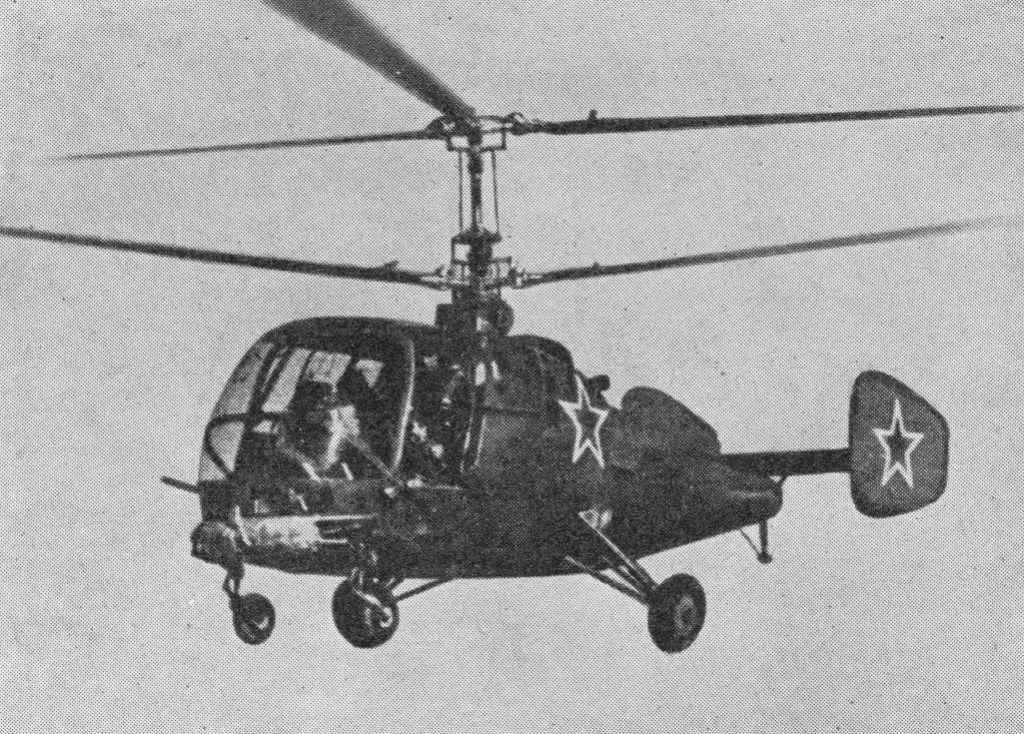
To meet a Soviet Naval Air Force specification in the late fifties for an antisubmarine helicopter for ship or shore-based use, the Kamov bureau developed a helicopter powered by twin turbines installed side-by-side above the cabin, with two three-bladed coaxial, contra-rotating rotors as on their other aircraft. It was first seen at the Tushino air display in July 1961 and was assigned the NATO reporting name Harp.

The Harp was characterized by a large radome under the nose and a fairing beneath the tail boom. The armament consisted of two fixed machine guns in the nose and two small missiles at the sides of the fuselage.

The Ka 20 was later developed as the Ka 25 shipboard and shore-based antisubmarine helicopter. Despite the small number of changes made in the transition from prototype to production standard, the reporting name Harp was not continued, the Ka 25 being allocated the name Hormone.

Rotor diameter: 15.74 m (51ft 8 in)
Length: 9.83 m (32ft 3 in)
Weight: 7300 kg (16 100 lb)
Powerplant: 2900 shp Glushenkov GTD 3 turboshafts
Range: 400 km (250 miles)
Maximum speed: 220 km/h (137 mph)

Kamov Ka-18

The Kamov Ka-18 (NATO reporting name Hog) was a four-seat development of the Ka-15M. Retaining the same engine, rotor, transmission, control systems and landing gear, the main changes were to the fuselage, which was stretched to make room for two passengers and a baggage compartment (up to 200kg). The doors hinged at the rear, and 176 litres of fuel was in floor tanks. De-icing of the blades and windscreen used alcohol, and an exhaust heater muff fed hot air on demand to the cabin.
The prototype was completed in 1956 and flight testing began early in 1957.

In 1958 the Ka-18 was awarded a Gold Medal at the World Exhibition in Bruxelles.
The Ka-18 was produced with blind-flying instruments and an optional 70-litre ferry tank for AV-MF, VVS and Aeroflot.
A limited number of the Ka-18 were built for use as air ambulances and for forestry patrol, geological survey and agricultural work. Towards the end of 1960, the production aircraft were given a 275hp AI-14VF engine (VF stands for Vertolet Forsirovannie meaning helicopter with turbocharger) instead of the AI-14V, thus enabling the payload to be increased by about 100kg and the ceiling by 300-500m. The chord of the end plate fins was also enlarged.
There was a Uka-18 dual control variant.
Approximately 200 were built.

Ka-18
Crew: 1
Passengers: 3
Engine: 1 x Ivchenko AI-14VF, 200kW / 280 hp
Rotor diameter: 10.0m
Length: 10.0m
Height: 3.4m
Max take-off weight: 1502kg
Max speed: 160km/h
Cruising speed: 130km/h
Service ceiling: 3500m
Range with max fuel: 450km
Range with max payload: 300km

Kamov Ka-15

Shipboard operations with the Ka-10 showed the necessity to start the construction of a new rotary-wing machine capable of lifting greater loads and less restricted by weather conditions. In 1950 AV-MF wrote an outline requirement for a larger two-seat helicopter with an enclosed cabin and much greater endurance.

Kamov Ka-15 Article

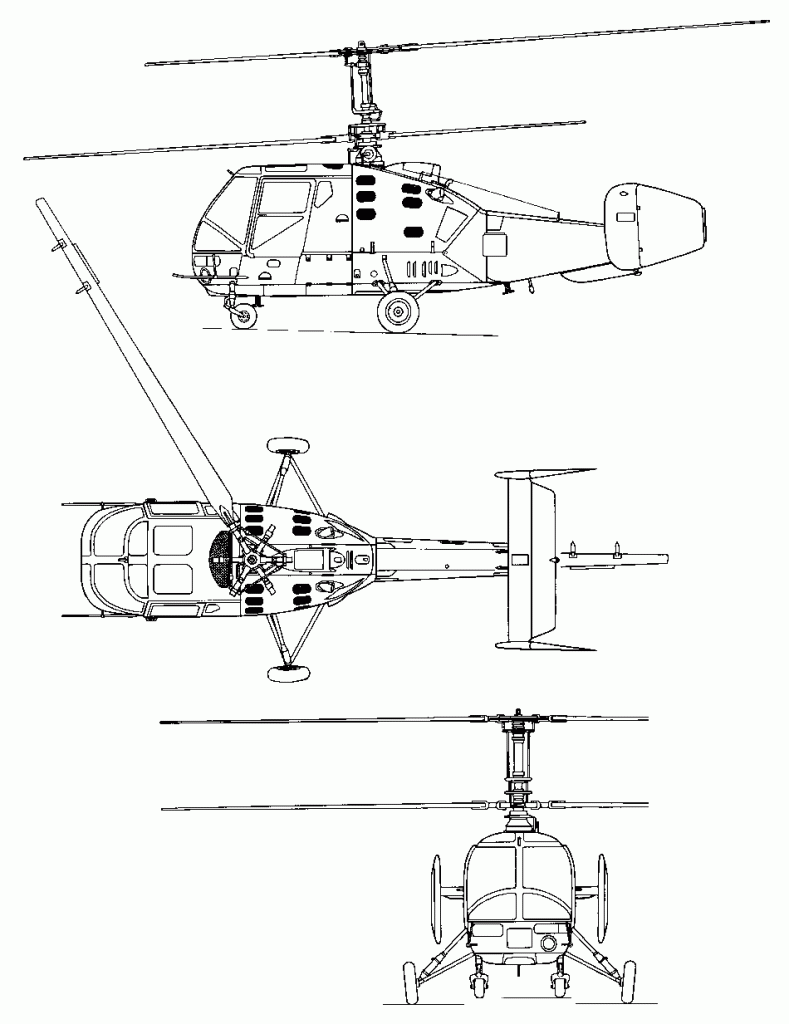
These requirements were met by the Ka-15 which, like its predecessors, featured the co-axial layout. It was a two-seat helicopter with side-by-side seating for the pilot and a mission equipment operator or a passenger.
The rotor hubs and blades were scaled up but compared with Ka-10M, the only significant change was low-density foam filling the blades between ribs and taper of blades towards the tip.
The airframe was welded steel tube, with a covering of ply or dural removable panels and thin plastic glazing and sliding side doors round side-by-side cockpit ahead of rotor, with the engine behind.
The powerplant was a 225hp AI-14V air-cooled radial engine installed at the center of the fuselage, but towards the end of 1960, most Ka-15Ms were given uprated 275hp AI-14VF engines. The engine was mounted with the crankshaft horizontal, driving a cooling fan, 90 degree angle drive to the rotor via over-running clutch, and DC generator starter. From the engine to tail was of stressed-skin dural construction, with a fixed tail comprising braced tailplane and two endplate fins toed in at front (parallel on some Ka-15s), with pedal-driven rudders for yaw control.
The Ka-15 made its first flight on April 14, 1953 at the hands of test pilot D.K.Yefremov. State acceptance trials were completed in 1955, and next year the helicopter entered production at aircraft factory No.99 in Ulan-Ude.
Most fitted with two main and two nose landing wheels, plus tail bumper. The nose wheels were castoring and the main wheels were braked. At least one had pontoons and one with three skis.
AV-MF used substantial number for liaison, ship-based recon and dual Uka-15 for training. Ship trials in 1954 included dripping sonar, but it was unable to carry the equipment needed for ASW missions. The leadership of the Soviet Navy ordered a fly-off between the Ka-15 co-axial helicopter and the Mil Mi-1 single-rotor helicopter, during which both types operated from the cruiser “Mikhail Kutuzov”. By virtue of its small size and manoeuvrability the Ka-15 successfully performed take-offs from and landings on the ship’s small helipad even in sea state 6 conditions. Conversely, the Mi-1 was considerably hampered by its long tail boom and tail rotor and could not operate when air turbulence and pitching and rolling motion of the ship were present. The results of the fly-off finally convinced the Navy that choosing the co-axial layout for a shipboard helicopter was the right decision.

The ASW version the Ka-15 was fitted with two RGB-N sonobuoys or with the SPARU-55 automatic airborne receiver unit. One of such helicopters dropped sonobuoys in the designated part of a sea, the other received information from them about the presence or absence of a submarine. Once a submarine was detected, a third Ka-15 equipped with the OPB-1R sight and two 50-kg depth charges entered service. The first units equipped with Ka-15 helicopters were formed in 1957-58. In 1958 work commenced on equipping the destroyer “Svetly” (Project 57) with a helipad. In 1960-1961 the Navy took delivery of eight Project 57 ships featuring helipads, support equipment for helicopter operations and accommodation for pilots and maintenance personnel.

The Ka-15 evolved into a number of specialized versions, including the multi-purpose Ka-15M, the UKa-15 dual-control trainer version and the four-seat Ka-18. In each case prototype construction began at factory No.82 in Tushino and was completed at the OKB’s own experimental shop near Ukhtomskaya railway station.

The Ka-15 and its versions remained in service for almost 20 years. Between 1958 and 1963, rotor blades of new design were developed, tested and introduced on the Ka-15M and the Ka-18. They were made of composite materials which improved the lift/drag ratio of the rotor and extended the service life of the blades. In 1958-59 test pilot V.V.Vinitsky established two world speed records on the Ka-15M (5 May 1959 170.455km/h over 500km). The Ka-15 marked the beginning of co-axial helicopters operations in the Navy and Civil aviation, the Soviet state airline. As was universally acknowledged, V.B.Barshevsky, M.A.Kupfer, N.N.Priorov, A.J.Vlasenko and D.K.Yefremov made major contribution to the development of the Ka-15.
From 1958 civil Ka-15M used for many roles including ag-spraying; Ka-15S equipped to carry two external stretchers.
The NATO reporting name for the Ka-15 is Hen.

Ka-15
Crew: 1
Passengers: 1
Engine: 1 x AI-14V, 188kW / 225 hp
Rotor diameter: 9.96m
Fuselage length: 6.26m
Height: 3.35m
Width: 2.85m
Max take-off weight: 1370kg
Empty weight: 968kg
Internal payload: 364kg
Max speed: 155km/h
Service ceiling: 3050m
Range: 350km

Kamov Ka-10 Hat

By 1948 Kamov had completed drawings an improved and enlarged (but still single-seat) machine. The structure was similar to the Ka-8 but refined. A co-axial helicopter for observation and liaison duties designated Ka-10, it was designed to meet a general operational requirement (GOR) submitted by the Naval Air Arm.

The rotor diameter was increased by 0.2m over the Ka-8, and blade camber was introduced. Significant changes were made to the helicopter’s control system.

The AI-4G engine was completely new, designed by Ivchenko for this application with two stages of reduction gearing, freewheel with centrifugal clutch and improved power split between rotors. It was fitted with electric start and engine-driven cooling fan.

The first Ka-10 was flown by D.K.Yefremov in September 1949. It was followed by three more prototypes and eight Ka-10M pre-production models; the latter were distinguished by the fact that they had a different rotor assembly and an endplate fin tail unit instead of the single fin of the Ka-10.

These helicopters were tested at length by AV-MF, and one made the first Soviet deck landing on 7 Dec 1950.
ASCC reporting name “Hat”.

Ka-10
Crew: 1
Engine: 1 x AI-4G, 40kW
Rotor diameter: 5.8m
Fuselage length: 3.9m
Height: 2.5m
Width: 1.97m
Max take-off weight: 370kg
Max speed: 90km/h
Service ceiling: 2500m
Range: 170km

Kamov Ka-8 Vertolet

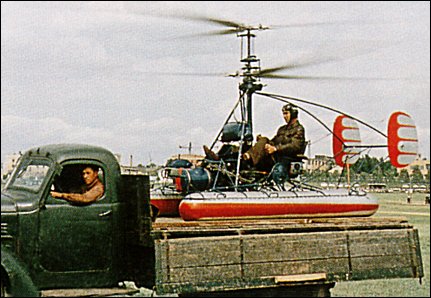
Official disinterest in autogyro made Kamov switch to helicopters, and he decided to build one-man Vozdushnii Mototsikl (flying motorcycle) for civil or military use in 1946. It is reported to have taken 18 months before permission was granted to organize a small informal group and build the Ka-8.
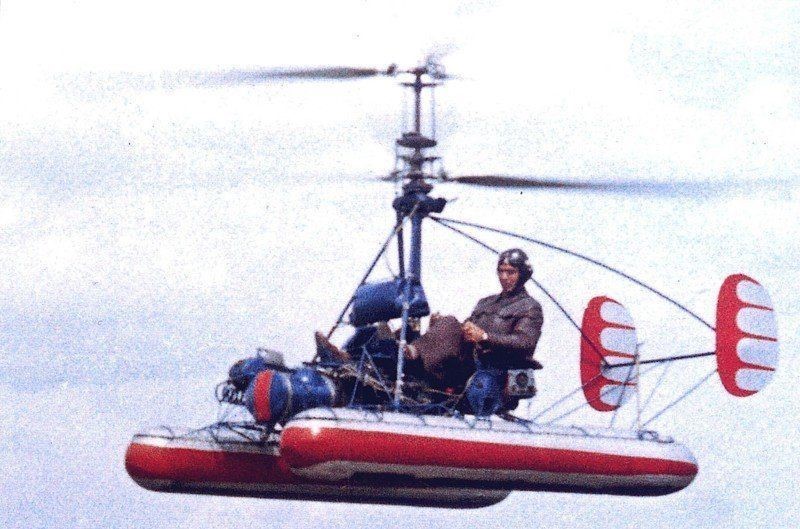
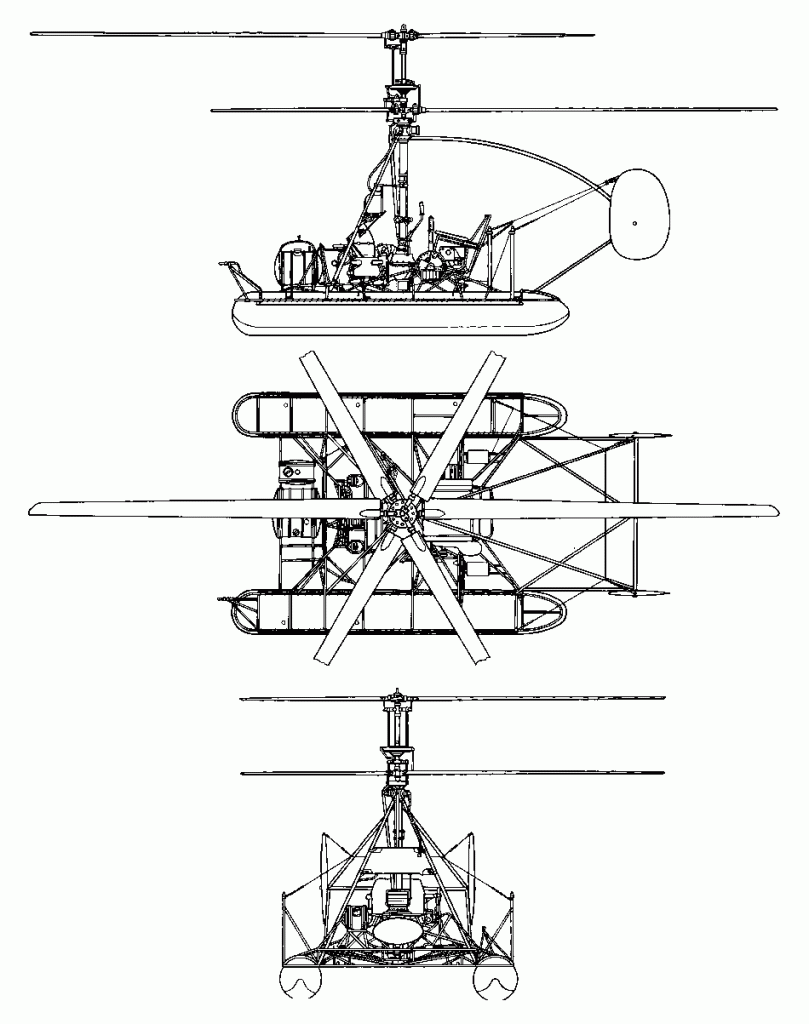
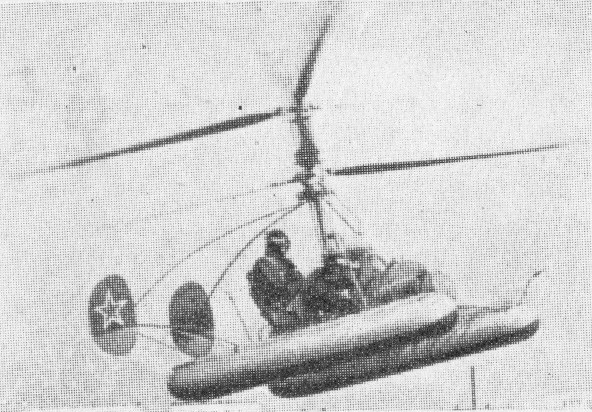
The design featured coaxial rotors, each with three built-up wooden (mainly spruce) blades of NACA-230 profile with glued construction and fabric covering. Metal root of the blades was held in the hub with drag and flapping hinges driven by superimposed swashplates moved directly by pilot. The rest of the airframe was welded steel tube, with the pilot and fixed fin at the rear and the engine and fuel tank at front, resting on two pontoons of rubberized fabric.

The Ka-8 was powered with a 27 hp motorcycle engine, boosted to 45 hp by using alcohol for fuel.
First flown in 1947, piloted by Mikhail Gurov, the low output of the two-cylinder motorcycle engine and its unsuitability for aeronautical use handicapped the aircraft.
The handlebar flight control was replaced by a vertical collective and cyclic levers, pontoons tapered front to rear, and the fin was changed to rudder driven by pedals.
It was the first single-place helicopter built in USSR.
The Ka-8 “Irkut” performed on July, 25, 1948 at the Tushino airfield in Moscow during the airforce parade.
Only three were built.

After this aircraft made its successful flights Nikolai Kamov was ordered to design the new helicopter for Soviet Navy.

Ka-8
Crew: 1
Engine: 1 x M-76, 20kW
Rotor diameter: 5.6m
Length: 3.7m
Height: 2.5m
Max take-off weight: 275kg
Empty weight: 183kg
Max speed: 80km/h
Service ceiling: 250m
Hovering ceiling: 40m-50m

Vertolet
Engine: 20 hp. Aubier-Dunne
Rotors: 2 x 3-blade co-axial.
Seats: 1

Kamov AK

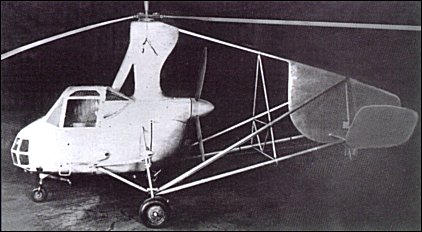
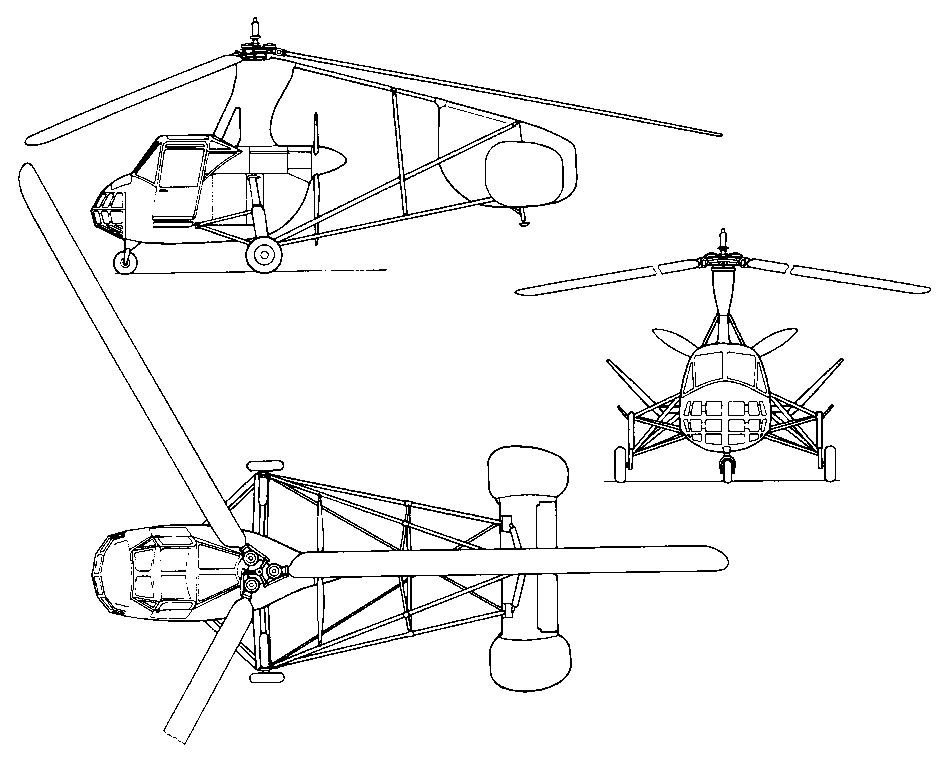
Kamov took job of chief designer in factory at Smolensk opened 1939 to make production autogyros (beginning with A-7-Za). Kamov obtained permission to build a side-by-side observation machine with side doors. The AK was fitted with tricycle gear, a single fin rudder on struts from rotor head and main gears, and no wings.
Work was delayed by evacuation in July 1941 but work restarted at a new facility in Lake Baikal region in 1942. The project was abandoned 1943 because of termination of interest by VVS.

AK
Engine: 1 x MV-6
Rotor diameter: 13.5m
Loaded weight: 1317kg
Empty weight: 1026kg
Max speed: 176km/h
Ceiling: 4,700m

Kamov A-7

This autogyro designed by Kamov was considerably more stream-lined than its predecessors. The rotor had three blades, the fuselage was completely covered by a light alloy skin and the landing gear was streamlined.
A later version, the A-7-3, which had two small fins below the stabilizer, was used during the last war for some observation missions.
Kamov created the only (in the World) armed autogyro (A-7-3) that saw (limited) combat action.

Kamov-Skrzhinski KASKR-2

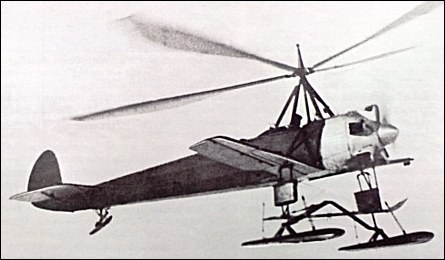
A major reconstruction of the KaSkr-1 with much more powerful cowled engine resulted in the KaSkr -2. Other minor changes included a rudder of better shape.
First flown in 1930, it was operated on skis in the winter of 1930-31. Pilot D.A.Koshits had flown the KaSkr-2 on 90 occasions by late 1931.
The KaSkr-2 led to the 2-EA and A-4 at CAHI.

KaSkr-2
Engine: Gnome-Rhone Titan 5-cylinder radial, 168kW / 230 hp
Rotor diameter: 12m
Length: 9m
Loaded weight: 1100kg
Empty weight: 865kg
Speed: 110km/h
Ceiling: 450m
Endurance: 28min

Kamov-Skrzhinski KaSkr-I / Krasny Inzhener

KaSkr-1

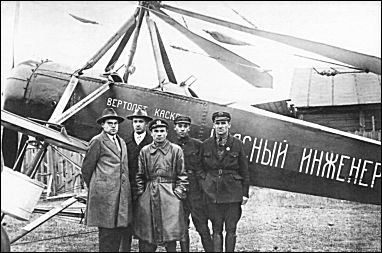
Designated from Kamov and N.K.Skrzhinskii, autogyro Krasnyi Inzhyener (Red Engineeer) was based on the Cierva C.8 using an Avro 504 (U-1) fuselage, landing gear and most of flight controls. The original rotor had four braced blades, and small wings were fitted. The first ground running test was 1 Sept 29. The rotor began to spin, but the control system proved ineffective and was subjected to major changes. The U-1 rudder was changed for a larger surface, then the torque of the engine/propeller almost overturned machine. This was rectified by hanging an 8kg weight under the right wingtip. Test pilot I.V.Mikheyev was unable to fly aircraft because of a lack of power. The KaSkr-1 was rebuilt as the KaSkr-2.

KASKR-1
Engine: 1 x M-2, 90kW / 100 hp
Rotor diameter: 12m
Fuselage length: 8.8m
Max take-off weight: 950kg
Empty weight: 750kg
Max speed: 90km/h
Operating ceiling: 15-25m
Endurance: 1.5hr
Crew: 1