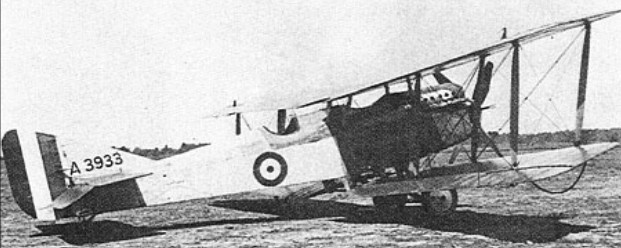
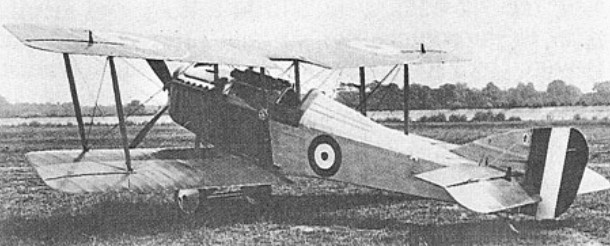
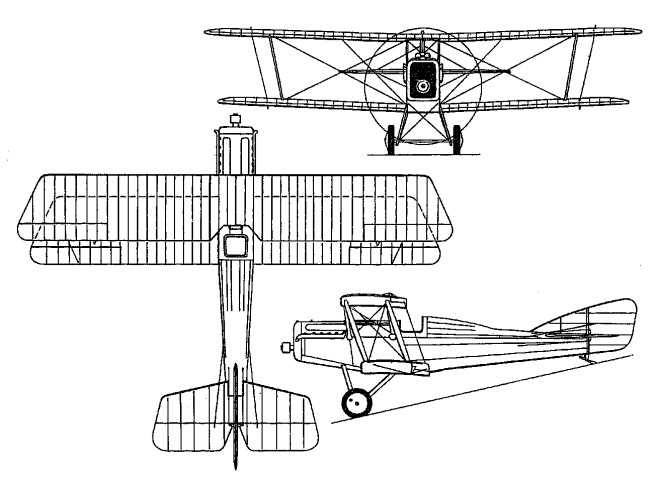
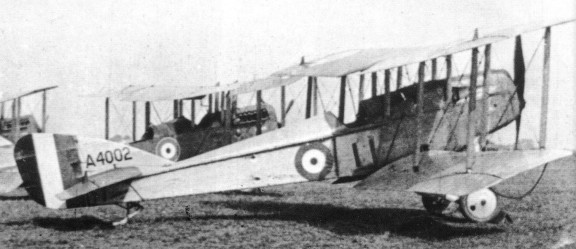
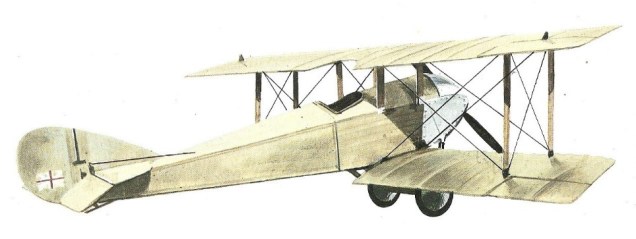
Of more modern concept that the F.1, the F.2 two-seat fighter was, like its predecessors, of wooden construction with fabric skinning, apart from the sides and top decking of the fuselage which were plywood covered.
Designed and built while the F.1 was under construction, the F.2 underwent official testing two months prior to its predecessor, in May 1917. The F.2 was powered by a 200hp Hispano-Suiza 8Bd eight-cylinder water-cooled engine and carried an armament of one fixed and synchronised 7.7mm Vickers gun and one Lewis gun on a Scarff ring. Shortcomings revealed during official trials ruled out a production order, and the prototype was utilised as a test-bed for the then-new Sunbeam Arab engine.
Max speed, 120 mph (193 km/h) at sea level Time to 10,000 ft (3 050 m), 13.5 min Endurance, 2.5 hrs Empty weight, 1,547 lb (702 kg) Loaded weight, 2,355 lb (1 068 kg) Span, 32 ft 0 in (9,75 m) Length, 25 ft 0 in (7,62 m) Height, 8 ft 2 in (2,49 m) Wing area, 334 sq ft (31,03 sq.m)
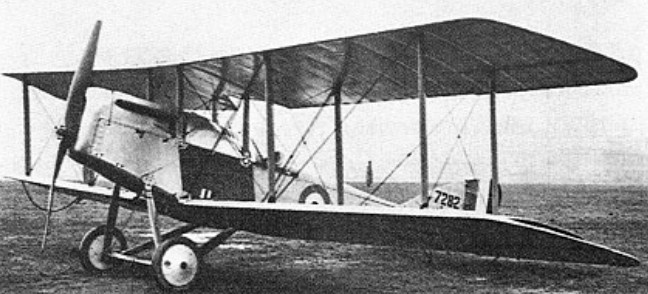
The F.1 two-seat fighter was conceived late in 1915 as a tractor biplane in which the gunner occupied the forward cockpit and stood upright to fire a 7.7mm Lewis gun on a mount built into the upper wing centre section.
Two prototypes were ordered on 16 September 1916 under WO Contract No87/A/435, Serial Numbers A3933 & A3934.
A3933 was tested at CFS Upavon 11.6.17 to 22.7.17 Exp Stn Orfordness, HD Patrol 22.8.17; HD Patrol from Rochford 29.9.17; AP Hendon by April 1918; Hendon 9.4.18; Orfordness 12.4.18; Hendon 1918; RAE Farnborough 21.6.18 last mention 18.3.19 (Petrol system tests)
Powered by a 250hp Rolls-Royce Mk III engine (later to become known as the Eagle III), the F.1 suffered a somewhat protracted development and, by the time that it was officially tested in July 1917, it was already obsolete. Obviously not acceptable for operational use, the F.1 was not further developed.
Max speed, 109 mph (175 km/h) at 6,500 ft (1 980 m) Time to 10,000 ft (3 050 m), 13.66 min Endurance, 3.75 hrs Empty weight, 2,198 lb (997 kg) Loaded weight, 3,260 lb (1 479 kg) Span, 44 ft 6 in (13,56 m) Length, 29 ft 1 in (8,86 m) Height, 8 ft 6 in (2,59 m) Wing area, 467 sq ft (43,38 sq.m)
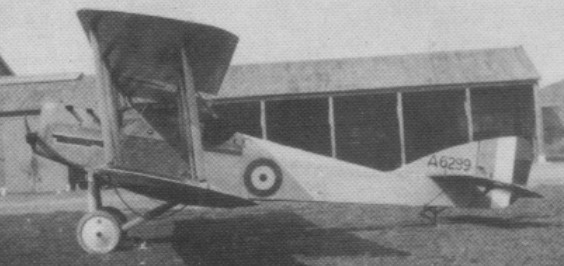
Derived from the Elephant via a single-bay experimental variant of the earlier design by A A Fletcher, the R.G. bore a close resemblance to its predecessor and was initially flown late in 1916 with a 190 hp Rolls-Royce Falcon I 12-cylinder water-cooled engine. Armament comprised a fixed 0303-in (7,7-mm) Vickers gun on the port upper longeron, outside the cabane struts, and a Lewis gun on the starboard side of the cockpit. After official trials in February 1917, the R.G. was revised in a number of respects. The cockpit was moved aft and the centre section cut-out was enlarged, the span of the lower wing was reduced, the rear top decking was raised, armament was revised and consisted of two 0303-in (7,7-mm) Vickers guns immediately in front of the cockpit, and a 275 hp Falcon III engine was fitted. In this form, the R.G. had, according to the official report, a “performance … far and away better than any other machine manufactured”. However, develop¬ment was discontinued in favour of the superior F.3.
Span, 32 ft 0 in (9,75 m) Length, 25 ft 10 in (7,87 m) Height, 9 ft 10 in (2,30 m) Wing area, 310 sq ft (28,80 sq.m). Empty weight, 1,740 lb (789 kg) Loaded weight, 2,261 lb (1 026 kg) Max speed, 132 mph (212 km/h) at 6,500 ft (1 980 m) Time to 10,000 ft (3 050 m), 7.33 min Endurance, 2 hrs
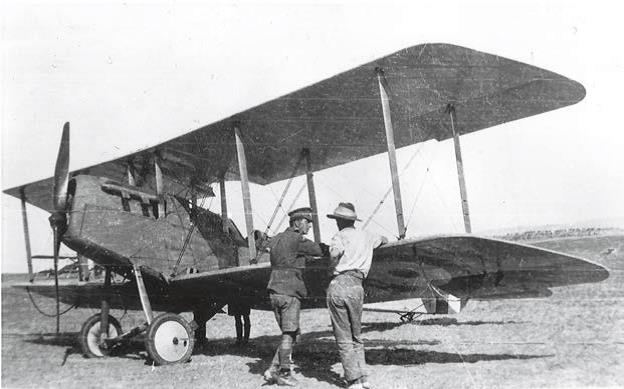
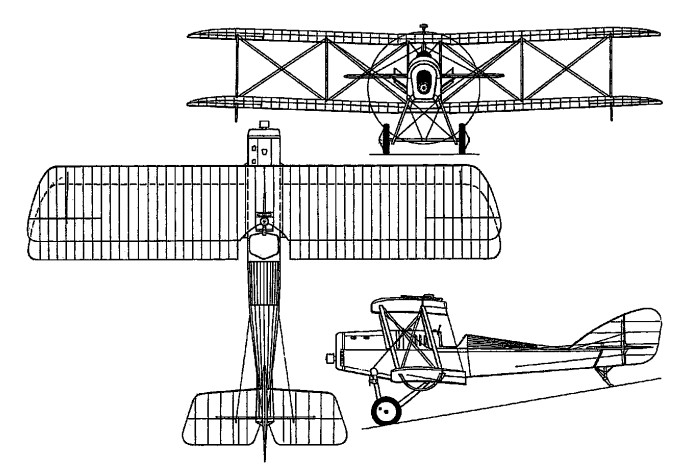
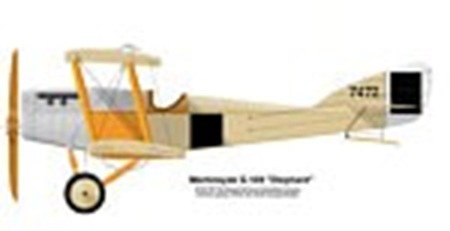
An unusually large aircraft by contemporary standards for a single-seater, the Elephant two-bay equi-span staggered biplane was designed by A A Fletcher of the Martinsyde Company, a prototype powered by a 120 hp Austro-Daimler engine entering test in the autumn of 1915. The G.100 featured two spar wings and wooden fuselage. The entire airframe is fabric covered, except for plywood side panels on the fuselage between the wings. Conventional control surfaces with ailerons on all four wings.
The initial production version, the G.100, was powered by a 120 hp six cylinder Beardmore engine and was armed with a single 0.303-in (7,7-mm) Lewis gun mounted above the centre section (this later being augmented by a similar weapon bracket-mounted to port behind the cockpit), deliveries to the RFC commencing in 1916.
The G.100 was succeeded by the G.102 version which differed in having a 160 hp Beardmore engine doubling the bombload and replaced the lower-powered model progressively.
The G.100 and G.102 Elephant was used in both France and the Middle East, although only 27 Squadron RFC squadron was completely equipped with this type, a total of 271 being manufactured. They flew G.100/102s from March 1916 until December 1917 on operations in France, and the squadron’s unique equipment is per¬petuated today in 27 Squadron’s official badge motif of an elephant. Many other individual ‘Elephants’ saw active service in Palestine and Macedonia with 14, 30, 63, 67 and 72 Squadrons of the RFC. Larger than most contemporary single seaters, the ‘Elephant’ was renowned for good flying characteristics, while its endurance of approximately 4.5 hours, fully loaded, was considered excellent for what were then regarded as reconnaissance and bombing sorties. Although not particularly successful as a fighter owing to its poor agility by comparison with its smaller contemporaries, the Elephant performed a useful service as a bomber, carrying up to 230 lb (104 kg).
The Martinsyde G.100 was operated as bomber and escort machine by the Australian 1 AFC in the Middle East, and was the type flown by Lt F.H. McNamara when he was awarded the VC.
G.100 Engine: Beardmore, 120 hp Wingspan: 38 ft Wingbarea: 410 sq.ft Length: 26 ft 6 in Height: 9 ft 8 in Empty weight: 1759 lb MTOW: 2424 lb Max speed: 95 mph at 6000 ft Service ceiling: 14,000 ft Endurance: 5 hr 30 min Armament: 2 x Lewis mg Bombload: 112 lb
G. 102 Max speed, 103 mph (166 km/h) at sea level Time to 3,000 ft (915 m), 3.5 min. Endurance 4.5 hrs Empty weight, 1,793 lb (813 kg) Loaded weight, 2,458 lb (1115 kg) Span, 38 ft 0 in (11,58 m) Length, 26 ft 6 in (8,08 m) Height, 9 ft 8 in (2,95 m) Wing area, 410 sq ft (38,09 sq.m) Armament: 2 machine-guns, 118kg of bombs
The first original wartime design was S.1 single-seat scout, built October 1914.
Engine: Gnome, 80 hp Wingspan: 27 ft 8 in / 8.43 m Length: 21 ft / 6.40 m Height: 8 ft 2 in / 2.49 m Max speed: 84 mph / 135 kph Armament: 1 x mg Crew: 1
At the outset Martin considered the best decision was to build a machine virtually identical with the M.B.3, but with a Rolls Royce Griffon engine. By the end of 1942 the Griffon engined M.B.4 had been almost finished as far as drawings were con¬cerned, but it contained a number of unsatisfying compromises. Early in 1943 Martin took the decision to start again and, while making the maximum possible use of MB.3 philo¬sophy and hardware, create an optimised fighter that would have no obvious shortcomings.
The wing of the M.B.5 was similar to that of the M.B.3, though Martin reduced the armament to four 20mm Hispanos, with his own patented flat ¬feed mechanism, which met the F.18/39 specification. The wing was simpler than that of the M.B.3, with light alloy sheet structure except for the spar booms which were of laminated high ¬tensile steel. The fuselage philosophy was the same but the shape was considerably different, and the steel ¬tube longerons were joined by flanged sleeves to which the diagonal, vertical and transverse struts were secured by fork ends held by close tolerance tapered bolts. Light alloy secondary structure supported heavy section rubber mouldings against which the large skin panels were pressed by Dzus fasteners. Control surfaces were metal skinned and driven by spring tabs, and the landing gear, brakes and up/down flaps were worked by compressed air (not at 60 lb/sq in but 350, giving a lighter system).
The construction of the instrument panel itself was arranged for ease of maintenance. Mounted on a sub frame, it was designed to hinge open for access to the interior and the instruments themselves. The position of the cockpit afforded an excellent view over the nose and wing leading edges. The cockpit also included a full floor, which in 1944 was rather novel.
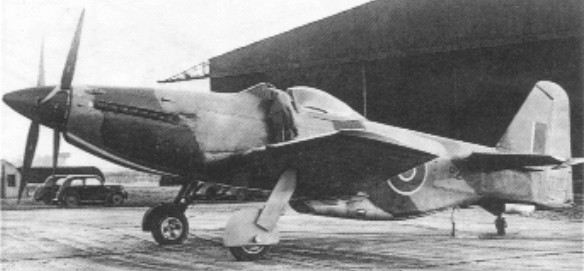
The pilot sat on fuel tanks of 70 and 130 Imp gal, and the Griffon 83 engine had its air intake just behind the spinner of the Botol six blade contra rotating propeller, and was cooled by a three unit radiator inter-cooler, main cooler and oil cooler ¬in a neat diffuser duct under the rear fuselage. The propeller shafts were mounted coaxially, the drive for the forward one passing through that for the rear. Contra rotation had been chosen to provide greater performance at altitude, and to permit higher power at take off than would otherwise have been feasible.
A Rolls Royce Bendix Stromberg injection carburettor was adopted, the long carburettor air intake extending up to the spinner and forming an integral part of the engine cowling; vertical ‘splitters’ ensured stiffness and reduced turbulence.
The three cooling radiators needed were placed in a diffuser duct under the rear fuselage. In the forward position was the intercooler, aft of this the main radiator and finally the oil cooler. This arrangement ensured that, when warming up, the heat from the main radiator prevented coring of the oil, and the full oil pressure was obtained within a few minutes of start¬up. Fuel was contained in two tanks of 70 and 130 imp. gallons (318 and 590 litres) situated one ahead of and one behind the pilot.
The MB.5 prototype received the serial R2496, originally allotted for the second MB.3 (which was never completed). On the morning of May 23, 1944, R2496 was ‘knocked down’ at Denharn in about an hour, placed aboard a Queen Mary road transporter and taken to Harwell.
Reassembled in just over an hour, the MB.5 was inspected and flown for the first time in the afternoon by Captain Bryan Greensted, Rotol’s chief test pilot, who had been seconded to the programme by MAP. During the company testing Greensted found the MB.5 well thought out and was impressed by all but the directional handling. Fin and rudder modifications were swiftly made involving an extension to the fin leading edge and a larger and taller rudder. With these modifications, W/C Maurice Smith, who later briefly flew R2496 for Flight magazine found that the handling was “pleasing in every way”.
Towards the end of October 1944, after 40 hours in the air, R2496 was taken to Farnborough for demonstration by Bryan Greensted before visiting VIPs, including Winston Churchill. During this display the Griffon failed when a piston shattered. As his cockpit filled with smoke, Greensted reached up to jettison the canopy, while travelling at a speed of over 400mph (644km/h). As he did so, his arm became caught in the slipstream and was very severely dislocated. Meanwhile the canopy had clipped the tailplane causing slight damage. Greensted elected to remain aboard, however, and managed a deadstick landing. As a result of this experience, the offending hood jettison lever was repositioned.
In early 1946, with 80 hours 45 minutes flown, the MB.5 was handed over to A&AEE at Boscombe Down. The first testing report, on maintenance and accessibility was issued on March 1. Prominently at the beginning it stated, “It is considered that the general design and layout of the Martin Baker 5 is excellent, and is definitely better from the engineering and maintenance aspect than any other similar type of aircraft”. It went on “The layout of the cockpit might very well be made a standard for normal piston engined fighters” and “The time necessary for a quick turn around… would appear to be very low when compared with existing types of aircraft”.
Flight test comments passed by Boscombe praised R2496 as virtually viceless. It was found that the contra prop simplified take off and gave an immediate and powerful response to engine power changes, over a very wide speed range. Minimal engine vibration was experienced, and the cockpit noise level was low. Both the rudder and elevators were light, and control was exceptional especially near the stall, which was very gentle. Use of the trimmer was found necessary only infrequently; even at low speed with flaps down, when the aircraft became mildly tail heavy, it was not sufficient to warant moving the trimmer from its usual neutral position. The only mildly adverse comment was over a slight lateral instability caused by comparatively ineffective ailerons the rate of roll was mediocre but could be improved by use of rudder. Lt Cdr Eric M Brown, doyen of Service test pilots described R2496 as “superb”.
Flaps of the split trailing edge type are either selected up or down, no inter¬mediate position being provided, so a take off is made without flap. The mini¬mum take off for the M B V is 420yd over 50ft in zero wind. Wheels retract quickly, the only indi¬cation that they have moved and locked being that given by the warning lights. The throttle lever, placed above the pitch control, has a long quadrant and moves smoothly and positively. The pitch lever is, by comparison, rather sensitive, and a big change in rpm results from quite a small lever movement. Engine speed is controlled over a range of roughly 1,800 rpm to 3,000 rpm, and the blades cannot be feathered. At about 8,000 ft the M B V cruised along very sweetly at about 315 mph indicated with 4 lb boost and 2,250 rpm. This is somewhat less than the recommended cruising power and the speed is at least 100 m.p.h. less than the maximum for this height.
All of the controls have spring tabs.
With flaps down, engine idling and attitude very slightly nose up, the con¬trols became pretty sloppy at 110 mph indicated at 5,000ft and the aircraft stalled very gently away to the left at just over the 100 mph.
The sole prototype MB.5 passed from hand to hand attracting praise wherever it went. In June 1946, it was demonstrated at Farnborough by S/L Jan Zurakowski. After this, the MB.5 returned to Boscombe, where the Commandant, Air Commodore Sir Henry Paterson Fraser, flew it. He found R2496 free of vice. The MB.5 was popular and unique. Later, R2496 was taken to the newly acquired Martin Baker airfield at Chalgrove. There, it was used to examine oiling problems in the propeller translation bearing between the pair of blade sets.
Martin took out a patent for the automatic oiling unit developed as a result of these trials. It continued in use in the de Havilland contra rotating propellers of the Avro Shackleton. The MB.5 was maintained in an airworthy condition, flight testing continuing into 1947, the sole prototype being scrapped thereafter.
Engine: One Rolls-Royce Griffon Mk 83 piston engine with two stage, two speed supercharger Maximum power, 2,340 h.p. at 750ft (M gear), 2,120 h.p. at 12,250ft (S gear) with 25 lb/sq in boost Max speed: 460mph (740kph) at 20,000 ft (740 km/h at 6,096m) Stalling speed (assumed ISA, SL) 95 mph (153 km/h) Range at 225 mph (362 km/h) 1,240 miles (2,000 km) Service ceiling: 40,000ft (12,192m) Empty weight 9,233 lb (4,188kg) Empty wt, equipped 9,345 lb (4,230kg) All up wt: 11,500 lb (5,216kg) Wingspan: 35ft (10.6m) Length: 37ft 9in (11.5m) with final tail unit Height: 15ft (4.5m), with final tail unit Wing area, 262.64 sq ft (24,40 sq.m) Wing loading: 44 lb/sq ft Armament: Four 20mm Hispano cannon with 200 rpg.
The second of the three MB.3 prototypes ordered by MAP, R2496, was intended to be Griffon powered, and was referred to as the MB.4. At the time of R2492’s crash, the necessary drawing amendments for the MB.4 were complete and manufacture had started. It was intended to enter the competition against Specification F6/42 but the attempt was unsuccessful. However, Martin felt that he could improve on the MB.3/MB.4 concepts. R2496 was left uncompleted and work on the third intended aircraft, R2500, was not begun. Early in 1943, the difficult decision was taken to start afresh, tempered by the knowledge that the firm had received verbal assurances from MAP that if a new fighter design were produced, a contract for one prototype would be awarded, again to Specification F5/39. With the then hand built nature of a prototype, in an experimental shop, with design adjustments made on the spot, and drawings brought into line afterwards, made resources available out of all proportion to the effort. By 1943, when work on the MB.5 had begun.