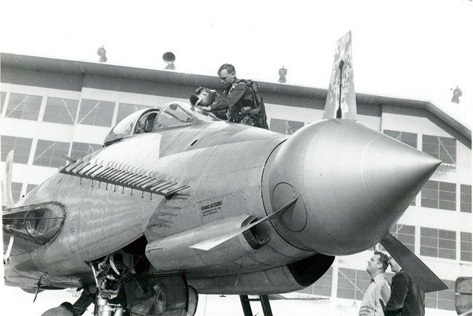
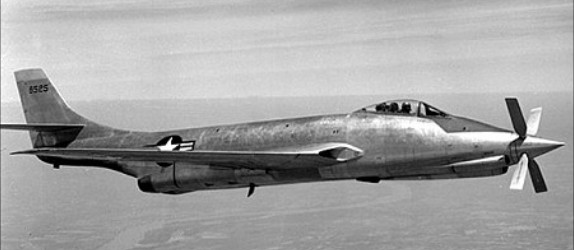
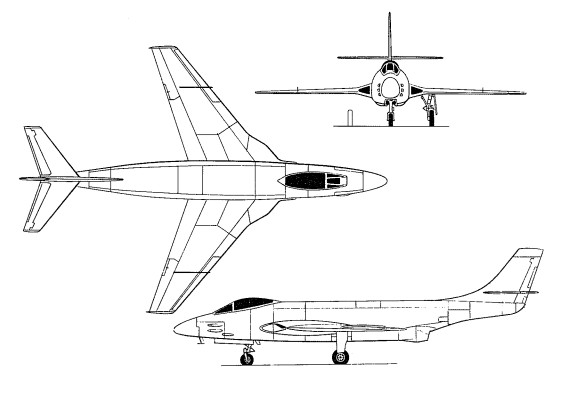
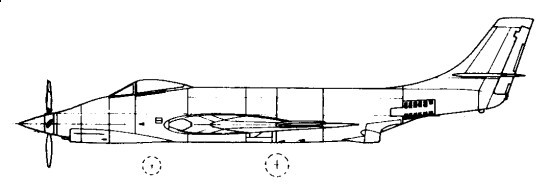
Designed to meet a requirement for a single-seat long-range escort fighter, the XF-88 was recipient of a contract for two prototypes on 14 February 1947. Powered by two 3,000 lb st (1361 kgp) Westinghouse XJ34-WE-13 turbojets, the first XF-88 was flown on 20 October 1948, but proved seriously underpowered. The second XF-88 was therefore fitted with two XJ34-WE-22 engines fitted with short afterburners which boosted thrust to 3,600 lb st (1 633 kgp), a change in designation to XF-88A accompanying this modification.
Performance was still insufficient, but the XF-88 was considered by the USAF to possess development potential and a Letter of Intent was issued covering further evolution of the basic design into what was eventually to become the F-101 Voodoo.
The first prototype was then recast as the XF-88B testbed for the Allison XT38 turboprop, with which it undertook many flights from April 1953 with 27 different propellers featuring varying numbers of blades in diameters between 4 and 10 ft (1.2 and 3.05 m). The XF-88s airframe then went forward to provide the structural and aerodynamic basis for the F-101 interceptor and reconnaissance fighter.
Engines: 2 x Westinghouse J34-WE-13 turbojets, 3000-lb (1361-kg) thrust Max speed, 641 mph (1 032 km/h) at sea level Time to 35,000 ft (10 670 m), 14.5 min Range, 1,737 mls (2 795 km) Empty weight, 12,140 lb (5 507 kg) Normal loaded weight, 18,500 lb (8 391 kg) Span, 39 ft 8 in (12,09 m) Length, 54 ft 1.5 in (16,50 m) Height, 17 ft 3 in (5,26 m) Wing area, 350 sq ft (32,52 sq.m)
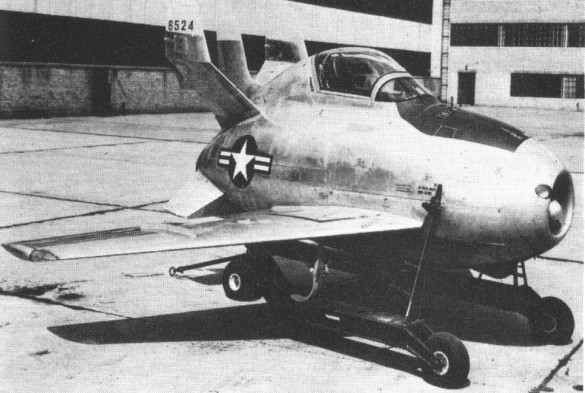
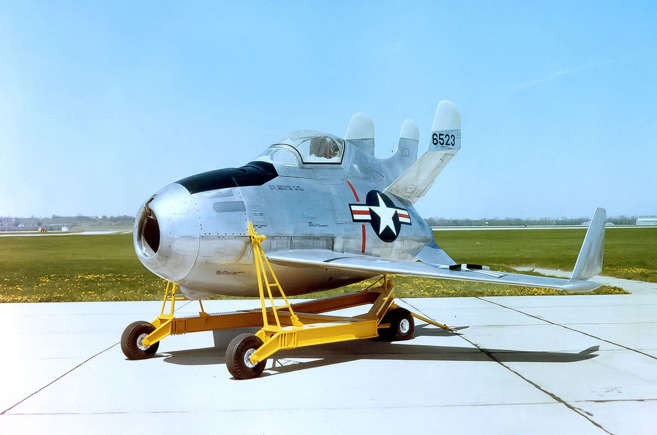
McDonnell proposed a ‘parasite’ (‘symbiote’) fighter had to be small enough to be carried aloft by a bomber and released as required. As early as 1942 McDonnell had proposed such a type as the MX-472 for semi-external carriage by the B-29, and further evolution of the concept resulted during 1945 in four variants of the Model 27 design for internal carriage by the Northrop B-35 and Convair B-36 heavy bombers. Under the spur of early ‘Cold War’ events, McDonnell reworked the Model 27 into the XF-85 Goblin. Designed under the leadership of Herman D Barkley, the XF-85 the subject of a Letter of Intent for two prototypes on 9 October 1945. The XF-85 was to be stowed in the number one or four bomb bay of the B-36 intercontinental bomber. Over target, it would be dropped free to protect the B-36 from enemy interceptors.
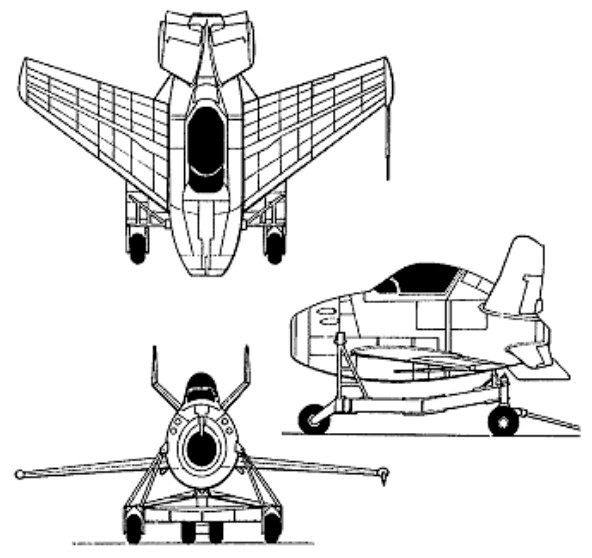
The fuselage was virtually filled by the 3000-lb (1361-kg) thrust Westinghouse J34-WE-7 turbojet and its fuel plus the four 0.5-in (12.7-mm) machine-guns and their ammunition, the pilot being seated astride the engine under a bubble canopy immediately aft of the hook that permitted aerial release and recovery of this tiny fighter. The wings were swept at 37 degrees and arranged to unfold from their vertically stowed position, which gave the fighter a ‘hangared’ width of only 5 ft 4.75 in (1.64 m), for an extended span of 21 ft 1.5 in (6.54 m) after being lowered from the parent aircraft. The fighter was intended to be launched from and recovered by a retractable trapeze which was to be extended beneath the parent bomber, no undercarriage being fitted.
In 1947, indoor tests were begun to evaluate the mating arrangement between the Goblin and a mock-up of a B-36 fuselage. On 9 November 1947 the first of two XF-85s was disassembled at the manufacturer’s St Louis plant and flown aboard a C-97 transport to Moffett Field, California, for wind-tunnel tests. While being positioned in the tunnel, the aircraft fell 12.2 m, was badly damaged, and had to be returned to St Louis, being replaced at Moffett by the second machine.
On 5 June 1948, this second XF-85 was transported to Muroc AFB, California, and, with no B-36 airframe available for evaluation of the parasite fighter concept, experiments began using an EB-29B Superfortress. Ed Schoch, a former US Navy F6F Hellcat pilot with four air combat kills in the Pacific war, was the only man ever to fly the XF-85.
Flight trials were initiated by the second prototype which was powered by a 3,000 lb st (1361 kgp) Westinghouse J34-WE-37 turbojet. After five captive flights on the trapeze of a specially modified Superfortress (EB-29B), the XF-85 was launched at 20,000 ft (6 095 m) on 23 August 1948, this first free flight terminating in an emergency landing. On his first attempt on 23 August 1948, Schoch was attempting to re-engage the bomber’s trapeze when he slammed into it, shattering his canopy, ripping his helmet off, and knocking him unconscious. Schoch recovered in time to make a shaky landing on the XF-85’s underside skid in the Muroc desert, damaging the plane.
The second flight on 14 October 1948, resulted in a normal mid-air drop and subsequent hook-up. Three more times, however, struggling to manoeuvre the tricky Goblin, Schoch was forced to make belly landings in the desert rather than regain his link-up with the Superfortress.
On 8 April 1949, the original XF-85 made its first and only flight. In budget-lean 1949, the XF-85 programme was quietly terminated after 2 hr 19 min of test flying, although the Strategic Air Command eventually became interested in the parasite fighter concept when it became possible to carry an RF-84K aboard a B-36. The first XF-85 is on display at the Air Force Museum in Dayton, Ohio, while the second is at the Strategic Air Command Museum in Omaha, Nebraska, displayed in inaccurate markings with a spurious tail number.
Max speed (calculated), 664 mph (1 068 km/h) Combat endurance, 30 min Empty weight, 3,740 lb (1 696 kg) Loaded weight, 4,550 lb (2 064 kg) Span, 21 ft 1½ in (6,44 m) Length, 14 ft 10.5 in (4,53 m) Height, 8 ft 3.25 in (2,56 m) Wing area, 90 sq ft (8,36 sq.m)
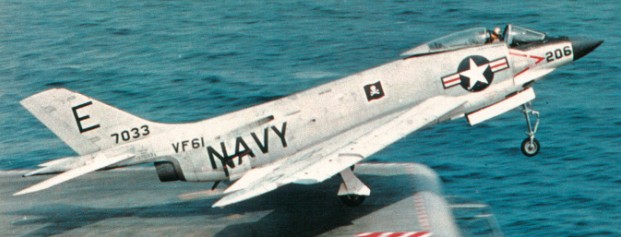
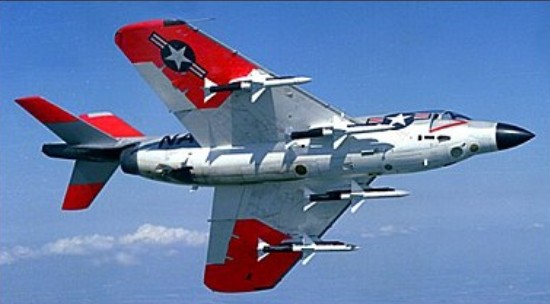
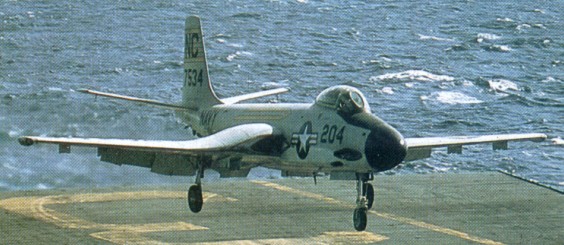
The prototype of the Demon naval fighter first flew on 7 August 1951 but proved to have poor stability, poor forward visibility and a low roll rate. These faults were corrected on the initial production model, but the poor reliability and performance of the J40 engine meant that most of the 58 built never flew.
The airframe had mid-set wings, swept-back at 45 degrees, swept-back tail surfaces and one-piece all-moving tailplane. The wings were fitted with leading edge slats and trailing edge slotted flaps. Airbrakes were in the upper surface of each wing root trailing edge and on the sides of the rear fuselage. The outer wings fold upward for storage. In-flight fuelling is fitted.
The tricycle undercarriage had a single wheel on each unit, the mains retracting inwards into the wings, and the nose wheel retracting rearward.
By June 1955 the F3H 2 had been produced with the Allison J71 engine, which still gave limited power. A modified afterburner system gave power in the range needed to make safe carrier landings.
They served with the US Navy in three versions – F3H-2N all-weather fighter, F3H-2M missile-armed day fighter, and F3H-2P for photo-reconnaissance.
The first naval fighter to be armed with guided missiles was the F3H-¬2M.
F3H-2 Demon Engine: 1 x Allison J71-A-2E turbo-jet, 62.23kN / 14,250 lb with afterburner Wingspan: 10.77 m / 35 ft 4 in Wing area: 48.22 sq.m / 519.04 sq ft Length: 17.96 m / 58 ft 11 in Height: 4.44 m / 14 ft 7 in Max take-off weight: 15377 kg / 33901 lb Empty weight: 10039 kg / 22132 lb Max speed: 730 mph at SL Max ROC: 12,800 fpm Service ceiling: 13000 m / 42650 ft Range w/max.fuel: 2205 km / 1370 miles Armament: 4 x 20mm cannons, 2722kg of weapons Crew: 1
F3H-1N Demon Carrier-based day and night fighter Engine: Westinghouse J40-WE-22 turbojet, 7,500 lb with afterburner Wingspan: 35 ft. 4 in Length: 59 ft Loaded weight: about 23,370 lb Max speed: over 750 m.p.h. Ceiling: 45,000 ft. Range: about 2,000 miles. Armament: 4×20 mm. cannon Crew: 1
F3H-2N Engine: Allison J71-A-2 turbojet, with afterburner, 9,700 lb. thrust
By the beginning of 1943 Westinghouse had made considerable progress with the engines, and the next job was to design an efficient airframe. The US Navy’s Bureau of Aeronautics decided to call on the services of the McDonnell Aircraft Corporation, the resultant joint effort to be designated XFD-1.
The designers set out to produce the smallest possible fighter that would satisfactorily carry a pilot, four 0.50-inch guns and their ammunition for a specified length of time. Weight, wing area and even engine power were treated as secondary consideration. Everything was to be kept as simple as possible with no “frills” or unnecessary gadgets to complicate production. Unorthodox ideas such as a tailless or tail-first layout (to keep the tail out of the way of the jet exhaust) or a prone position for the pilot were quickly put aside.
The McDonnell engineering team took just about a year to finalise the design of the XFD-1, although a preliminary mock-up inspection was held at St Louis at the end of May 1943. The release of drawings for structural work began on 25 January 1944 and construction of the prototype took a further year. By January, 1945, the last drawings had been finished, the last airframe parts made and assembled. On paper, the Westinghouse 19B was now promising a thrust of 1,500 lb (680 kg) in a version designated WE-19XB-2B for the prototypes of the XFD-1, but, in practice, engines reaching McDonnell were unable to produce this thrust and deliveries were lagging behind airframe availability.
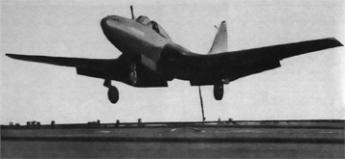
The first prototype McDonnell Phantom during deck-landing trials aboard U.S.S. Franklin D. Roosevelt.
In order to minimise the delay, taxy trials of the first XFD-1, by now named Phantom, began with only one engine installed, and ballast in the other engine bay, during January 1945. Although the 19B engine was producing only 1,325 lb at this stage, the company’s chief test pilot Woodward Burke felt confident enough to allow the aircraft to get airborne on 26 January 1945 in what has subsequently become widely re¬corded as the Phantom’s first flight. According to Kendall Perkins, though, this was only an “initial hop (rising a short way off the ground)”; the first real flight followed a few days later, after the second engine had been installed.
Satisfactory results were recorded in the first few weeks of flight testing, including a speed of 483 mph (778 km/h) at 20,000 ft (6 100 m), an initial rate of climb of 5,000 ft/min (25 m/sec) and a range of 750 mls (1 200 km). Consequently, the Navy was ready to initiate production of its first jet fighter, placing a contract for 100 FD-1s on 7 March 1945. They were to be powered by 1,600 lb st (726 kgp) Westinghouse J30-WE-20 turbojets, these being productionised WE-19s. The pro¬duction aircraft would closely resemble the prototypes, but would have increased internal fuel capacity, provision for a belly drop tank, a taller, square-tipped fin, slightly lengthened front fuselage and (on all but the first three production aircraft) dive brakes in the upper and lower surfaces of the outer wing panels.
Within a few months of production being launched, the war was over, first in Europe and then against Japan. VJ Day, on 2 September 1945, brought massive and immediate cuts in aircraft contracts in the US and that for the FD-1 was cut back to 30 aircraft, but later increased again to 60. Some considera¬tion was given to using an improved Model 19C version of the Westinghouse engine in the second batch of 30 aircraft, perhaps to have been designated FD-2s, but this did not materialise, and the entire production run was of the FD-1 configuration. After a first flight of a production FD-1 on 28 October 1946, deliveries were made from January 1947 to 29 May 1948, with the designation changing from FD-1 to FH-l halfway through the run, on 21 August 1947 (and then becoming retrospective for the Phantoms already in service).
First production aircraft designed by the company, the McDonnell FH-1 Phantom was notable in being also the first jet designed to operate from an aircraft-carrier. The US Navy placed the original letter of intent on 30 August 1943, and the first prototype made its initial flight from St Louis airport, Lambert Field, on 26 January 1945. The type was certainly not over-powered, because the final propulsion system, adopted after many studies of alterna¬tives, was two slim Westinghouse 19B engines buried in the wing roots. Later produced in small numbers as the J30, these were hardly enough for ade¬quate performance.
The first flight is thus all the more remarkable in that, at that time, Westinghouse had been able to deliver only one engine, and one of the wing-root engine bays was empty.
At that time McDonnell’s US Navy designator letter was D, the pro¬totype being the XFD-1, but because of confusion with Douglas (which also used letter D) McDonnell was assigned letter H, so that the 60 pro-duction Phantoms were designated FH-1, first flying on 28 October 1946. They were gentle and easy to fly, and on 21 July 1946 a prototype landed on and took off from USS Franklin D. Roosevelt. The production aircraft were delivered from December 1946 and served mainly with US Marine fighter squadron VMF-122. Their fault was lack of performance and lack of fire¬power, and the next-generation F2H Banshee was a vast improvement on both counts and after equipping one US Navy and two USMC squadrons, were withdrawn in 1950.
FH-1 Phantom Powerplant: two 726-kg (1,600-lb) thrust Westinghouse J30-20 turbojets Maximum speed 771 km/h (479 mph) at sea level / 813 km/h (505 mph) at high altitude Cruising speed 215 kt / 399 km/h Service ceiling 13000 m (43,000 ft) Range 1110 km (690 miles) without belly drop tank. Empty weight 3031 kg (6,683 lb) Maximum take-off weight 5459 kg(12,035 lb) Wing loading 43.67 lb/sq.ft / 213.0 kg/sq.m Wingspan 12.42 m (40 ft 9 in) Length 11.81 m (38 ft9 in) Height 4.32 rn (14 ft2 in) Wing area 25.64 sq.m (276 sq ft) Armament: four 12.7 mm (0.5-in) machine-guns in upper part of nose Crew: 1
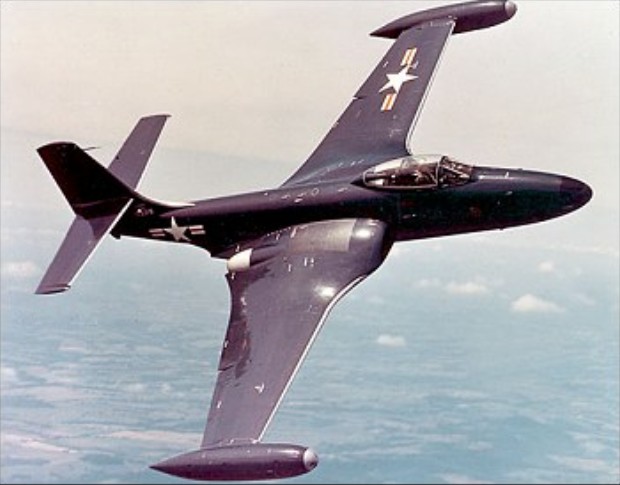
The McDonnell F2H Banshee began life even before the end of World War II when the US Navy requested an improved version of the FH-1 Phantom. Designed by a team headed by Herman D. Barkley, bearing a resemblance to the earlier type, the Banshee was of increased size, incorporating folding wings, and with a lengthened fuselage to house more fuel, and with similarly-mounted and more powerful Westinghouse turbojet engines. Conventional ailerons, elevators and rudder were fitted, and split trailing-edge flaps. Small air-brakes were in the top surface of the outer wings. A tricycle undercarriage, with a single wheel on each unit, has the mains retract outward into the wings, and the nose wheel retracts rearward. Fuel was in five tanks in the fuselage.
Three prototypes being ordered on 22 March 1945, as XF2D-1s, these later gaining the name Banshee. First flying in prototype form from St Louis, Missouri, on 11 January 1947, by then redesignated XF2H-1.
Initial trials were successfully accomplished, McDonnell being rewarded in May 1947 by a contract for 56 production F2H-l fighters, which began to enter service with VF-171 of the Atlantic Fleet during March 1949.
Like the later Phantom II, the Banshee proved to be a versatile machine, satisfactorily undertaking day and night fighter tasks, all-weather interception, close air support and photographic reconnaissance.
Following on from the original F2H-1 came the F2H-2, which had slightly more powerful engines and a longer fuselage. Production of the basic F2H-2 totalled 364, some of which were later modified to F2H-2B standard for close support tasks.
F2H-2 Banshee
14 examples of the F2H-2N specialized night-fighter derivative were also completed, these incorporating airborne interception radar in a slightly longer nose.
For reconnaissance, 89 F2H-2P aircraft were completed as new, these being unarmed and featuring six cameras in an elongated nose section.
Production then switched to the F2H-3 (in 1962 redesignated F-2C), which was optimized for all-weather fighter duties, the first of 250 entering service during April 1952 and being easily recognizable by virtue of a fusel¬age- rather than fin-mounted tailplane, and was 8 ft longer than the -2, with more than double the internal fuel capacity and APQ-41 radar in the nose (250 built).
During the summer of 1949 the first US pilot to ever use an ejection seat escaped his F2H-1 Banshee while speeding over coastal South Carolina at 500 kts.
From November 1955, 39 ex-US Navy F2H-3s were transferred to the Royal Canadian Navy. That service’s first operational jet fighters, they were operated from HMCS Bonaventure until 12 September 1962, when the last examples were retired from service. They proved to be the last carrier-based fighters in Canadian service. Plans to acquire the F2H-3P for reconnaissance were abandoned.
The final production model was the F2H-4 (F-2D), which introduced improved APG-41 radar and more powerful engines, the 150th and last bringing production of the ‘Banjo’ to a close in August 1953.
The F2H was finally phased out of front line US Navy use on 30 September 1959, but remained with reserve units until the mid-‘sixties.
Contracts were to call eventually for a total of 892 production aircraft.
XF2D-1 / XF2H-1 Engines: 2 x Westinghouse J34 turbojets Number produced: 3
F2H-1 Banshee Engines: 2 x Westinghouse J34-WE-22 turbojets, 3000 lbs.st. Length 40 ft 2 in Armament: 4 x 20 mm cannon. Number produced: 56
F2H-2 Banshee Engines: 2 x Westinghouse J34-WE-34 turbojets, 3250 lbs.st. Length 40 ft 2 in Armament: 4 x 20 mm cannon. Number produced: 364
F2H-2B Banshee Engines: 2 x Westinghouse J34-WE-22 turbojets, 3000 lbs.st. Length 40 ft 2 in Armament: 4 x 20 mm cannon, 2 x 500 lb bomb.
F2H-2N Length 40 ft 2 in Number produced: 14
F2H-2P Banshee Armament: none Number produced: 89
F2H-3 / F-2C Engines: two 14.45kN (3,250-lb) thrust Westinghouse J34-WE-34 turbojets Maximum speed 933 km/h (580 mph) at sea level Service ceiling 14874 m (48,800 ft) Max range 2374 km(1,475 miles) Maximum speed 35,000 ft / 10,668 m: 532 mph / 856 kph Empty weight 55056 kg (11,461 lb) Maximum take-off 7802 kg (17,200 lb) Wingspan 12.73 m (41 ft 9 in) Length 14.68 m (48 ft 2 in) Height 4.42 m (l4 ft 6 in) Wing area 27.31 sq.m (294 sq.ft) Armament: four 20-mm cannon, plus (Canadian aircraft only) two AIM-9 Sidewinder air-to-air missiles. Crew: 1 Number produced: 250
F2H-4 / F-2D Engines: 2 x Westinghouse J34-WE-38 turbojets, 3600 lbs.st. Wingspan: 44 ft. 11 in Length: 47 ft. 6 in Loaded weight: approx. 19,000 lb Max speed: 610 m.p.h Ceiling: 56,000 ft Typical range: 2,000 miles at over 500 mph Armament: 4 x 20 mm. cannon Crew: 1
The McCulloch MAC-101, also called the MC-101 and MC101, is a two-stroke, single cylinder engine that was designed and produced by McCulloch Motors Corporation for kart racing use, being introduced in 1967. It was also used in the late 1970s and early 1980s as an ultralight aircraft engine.
All models in the MC-101 series have a bore of 2.280 in (5.791 cm), a stroke of 1.835 in (4.661 cm) and a displacement of 7.5 cu in (122.90 cc).
Variants: MC-101 Introduced in 1967
MC-101A Introduced in 1969
MC-101AA Introduced in 1971
MC-101B Introduced in 1974
MC-101C Introduced in 1969
MC-101D Introduced in 1971
MC-101M/C Introduced in 1973
Applications: AmEagle American Eaglet Aviastroitel AC-4 Russia Birdman TL-1 Eipper Quicksilver Farner HF Colibri 1 SL Hovey Whing Ding II Skyhigh Skybaby UFM Easy Riser
Specifications:
MC-101B Type: single cylinder, two-stroke engine Bore: 2.280 in (5.791 cm) Stroke: 1.835 in (4.661 cm) Displacement: 7.5 cu in (122.90 cc) Fuel system: carburetor Oil system: pre-mixed Cooling system: air-cooled Power output: 12.5 hp (9 kW) at 9000 rpm
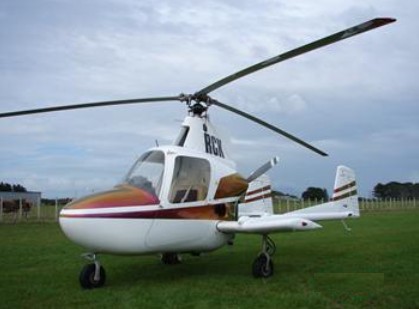
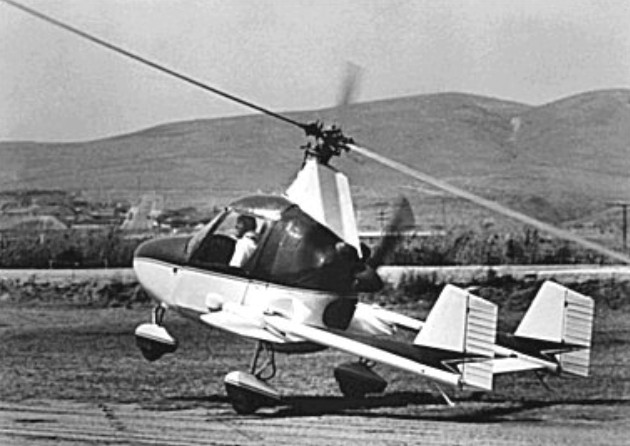
A two-seat light autogyro, the actual prototype J-2, designed by D.K.Jovanovich, first flew in June 1962. Deliveries of production aircraft began in 1970 and by early 1972 a total of 83 had been built. Power was provided by a 180hp Lycoming O-360-A2D engine.
In 1974 Aero Resources took over production of the J-2 two-seat light autogyro from McCulloch Aircraft Corporation. A version known as the Super J-2 was developed from the J-2, powered by a 180hp Lycoming O-360-A2D flat-four engine.
The J-2 has a Hughes 300 three-blade rotor system (wind-driven and inverted) and is powered by a 180 hp Lycoming pusher engine. This gyro is capable of a “jump” lift-off with the aid of its powerful pre-rotator.
Aero Resources Inc assumed responsibility in 1974 for continued production of the J-2 gyroplane, designed by D. K. Jovanovich, and manufactured previously by McCulloch Aircraft Corporation. It also developed an improved version, with 200 hp engine, designated Aero Resources Super J-2.
The J-2 is now classified as a Class 2 Microlight (it was a full C of A Aircraft) so can be flown on Microlight Gyroplane Licence.
Patrick Lewis I am an ex US Army pilot and after a voluntary RIF in 1970 at the end of my second Vietnam tour emigrated to Australia. I worked for several helicopter companies there and was offered a position with Hawker de Havilland based at their Bankstown GA airport during the mid 1970s. HdH Had purchcased 8 J-2s and needed an experienced rotory wing instructor pilot for sales demonstrations and flight training. My first job was to draft a flight manual sylabus that satisfide The senior examiner. The first J-2 arrived with an instructor pilot who checked out HdHs test pilot who in turned checked me out. I then checked out the local rotory examinar who then signed me off as a qualified instructor. HdH mechanics outfitted a J2 with an extra fuel tank and I made sales demonstration trips from Melbourne in the south to the sheep stations in the Darwin area and on to the North west cattle stations.
Jeff Jacobs In 1971 I was a young fixed-wing CFI working for Bel-Air Aviation at Long Beach CA, the first dealer and school for the J-2. I had no prior rotor experience but was being trained to fly and instruct in the J-2. I had soloed the J-2 a few weeks earlier, and on 5/5/71 my boss and instructor Ken McGuire and I flew N4303G from Long Beach to Compton for more practice. We touched down in a light crosswind, and despite the slow speed I lost directional control and the aircraft rolled over on the runway. It was the third J-2 landing rollover accident in three months, which as I recall was almost half the fleet built to that time. FAA ordered modification to the J-2’s nosegear, and that summer the company flew me out to the factory at Lake Havasu where I flew with Bill Evans in a modified J-2.
Bill Evans I went to work for McCulloch Aircraft in 1969 and at the time the company was located in El Segundo,CA. At that time the J-2 was just undergoing it’s final FAA certification and later on the entire operation was moved to Lake Havasu City, AZ. I was there for two years until they moved back to Gardena,CA and it then became Aero Resources. During my time in LHC I was doing the Flight Training and later became an FAA designated pilot examiner for Gyroplanes. I also was doing Production Flight Test and Experimental flight test for the company. I stayed on with the company until 1974 when they finally closed their doors. This was at the Van Nuy, CA airport. I think my total time in the J-2 was around 2200 hours. I flew the J-2 at the Paris Air Show and all over France. Also crossed the English Channel and did some flying in England as well. All and all it was a really fun aircraft to fly but had so many limitations when it came to performace. One of the biggest problems was the noise it produced. This really plagued the engineering department and nothing seemed to help. We had to wear special David Clark headsets and still the noise level in the cockpit was deafening. We did experiment with a 200 HP Lycoming engine and also a 3 bladed constant speed Hartzell prop. These improvement helped a little but in the end, it still did not have the desired performance. It had a very limited range with a lot of unuseable fuel left. The required distance for takeoffs was far more than acceptable. We were able to land in off airport locations but with the wood props it was usually an invitation to some major damage. The landing gear struts would some times remain extended or be uneven and this will make landing sometimes very exciting if you didn’t expect it. We did develop several techniques that would enhance both the take and landing performance but was never able to get them certified.
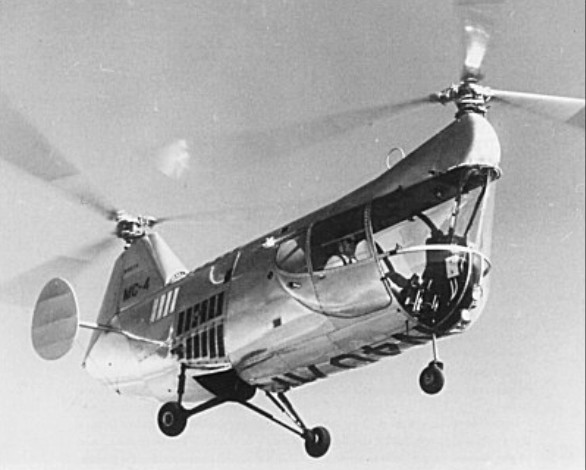
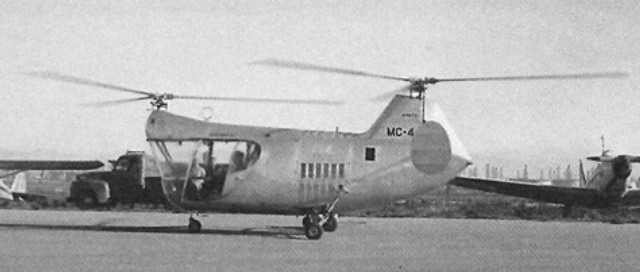
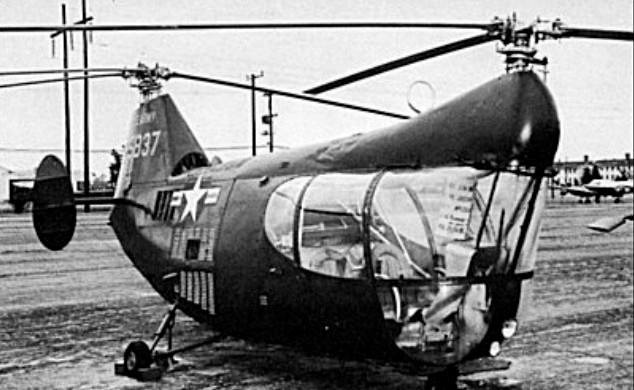
In 1949 Helicopter Division of McCulloch Motors Corporation appointed as chief designer D. K. Jovanovich, formerly of Helicopter Engineering and Research Corporation, who developed his JOV-3 as McCulloch MC-4 tandem rotor two-seat helicopter, first flown Los Angeles March 20, 1951.
This was the first tandem-rotor helicopter to be certificated by the U.S. Civil Aeronautics Administration for commercial use, and is also one of the smallest helicopters to be built with a tandem layout. Its development began in 1946 with the Helicopter Engineering and Research Corporation headed by D.K. Jovanovich and F. Kozloski, where a small 2-seat prototype (N9000H) was built with the designation JOV-3. This aircraft, powered by a 125hp Lycoming O-290, was flown successfully in 1948.
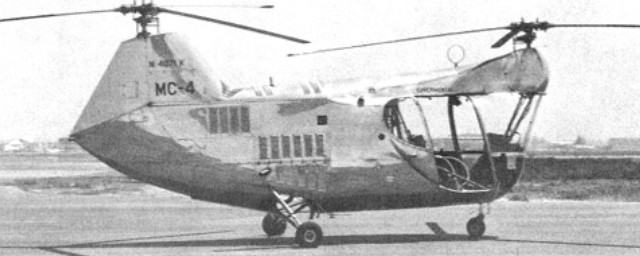
Jovanovich and Kozloski transferred in 1949 to the newly-formed helicopter division of the McCulloch Motors Corporation, where an enlarged development of the JOV-3 was built as the MC-4 with 6.71m rotors and a 165hp Franklin 6V4-165-832 engine. The main drive shaft is driven through a 12-unit vee-belt system. This prototype (N4070K) flew for the first time on March 20, 1951 at Los Angeles, and soon afterwards McCulloch began the construction of a prototype MC-4C (N4071K) and three generally similar YH-30’s (52-5837 to ’39) for evaluation by the U.S. Army. These were slightly larger than the MC-4, having 200hp Franklins and egg-shaped tail fins mounted on outriggers below the rear rotor head. The YH-30’s trials programme yielded no military orders, and no civilian customers were immediately forthcoming for the MC-4C, which was certificated by the CAA on 17 February 1953.
Jovanovich and Kozloski left McCulloch when the Airplane Division was closed, and formed Jovair Corp in 1957 to continue their work on helicopters. They resumed the design rights and purchased one of the MC-4A’s (N4071K) which had been produced for evaluation by the USN (as the HUM-1).
Four-seat 4E Sedan with the 1962-built Jovair 4A, a stripped-down two-seat agricultural and training aircraft
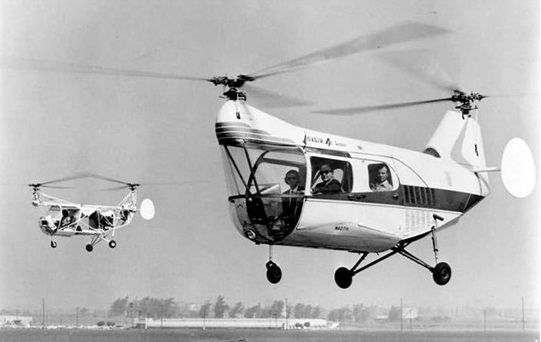
Jovair modified the MC-4C as a prototype for a four-seat private helicopter designated the Sedan 4E. The Sedan 4E was powered by 210 hp Franklin 6A-335 engine and received certification in March 1963. A version with a turbocharged engine was designed as the Sedan 4ES and a more basic Sedan 4A for agricultural use. By 1965 a small number of Sedan helicopters were built. In 1969 McCulloch regained the rights to the helicopter designs who continued development of the Jovair 4E Sedan as the McCulloch MC-4E.
The design was offered to the U.S. Army as the XH-30 (MC-4C, serials 52-5837 through -5839) and to the Navy as the XHUM-1 (MC-4A) by McCulloch Motors Corporation. Three were built for the Army and two for the Navy in 1953. Neither service had a use for them and they were returned to McCulloch.
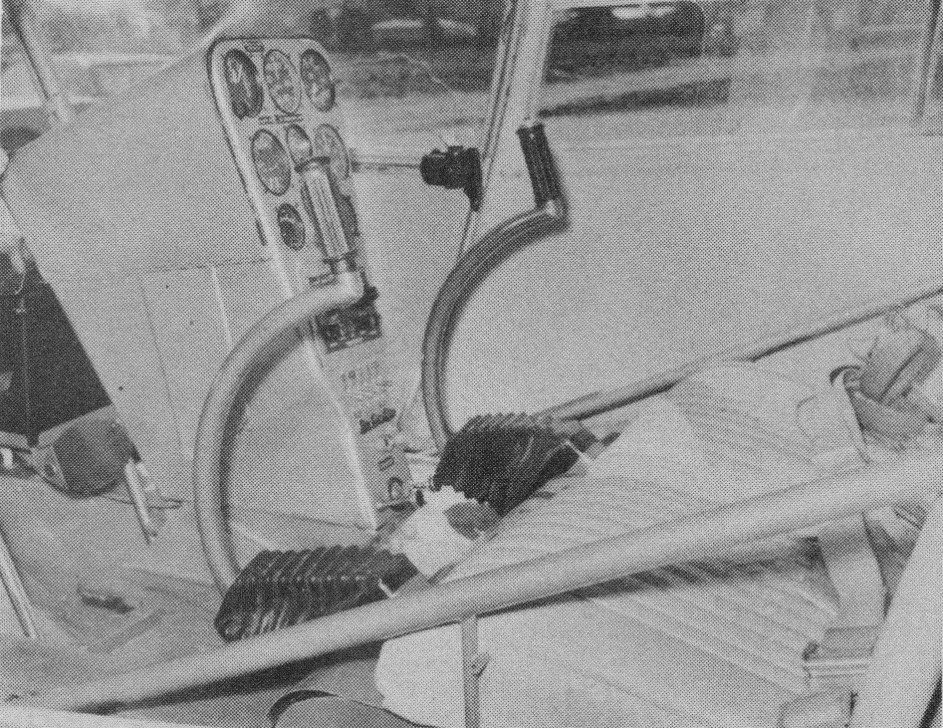
The YH-30 was a craft of relatively simple construction, consisting of a steel tube framework to which was attached a light metal skin. The helicopter’s single 200hp Franklin engine was mounted horizontally amidships and drove the two inter-meshing tandem rotors through a single horizontal drive shaft and two right-angled reduction units. Two small endplate rudders were fixed to the rear fuselage to provide additional lateral stability, and the aircraft was equipped with wheeled tricycle landing gear. The craft’s two crew members enjoyed better than average visibility to the front and sides, though the view upward was blocked by the overhanging front rotor housing.
The Army’s evaluation of the YH-30 showed the helicopter to be somewhat underpowered and its drive system to be overly complex. The type was therefore not procured in quantity, and the three evaluation machines were declared surplus in mid-1953 and disposed of.
McCulloch MC-4
An MC-4C was used in the 1954 science fiction production Gog.
The civil version, the slightly larger MC-4, was unable to generate any sales and McCulloch lost interest in the project and turned it back over to the original designer D. K. Jovanovich.
Jovair Corporation produced N4071K in developed form as the prototype for a new 4-seat private or executive helicopter known as the Sedan 4E. The Franklin 6A-335 of 210hp was now installed and the fuselage offered comfortable accommodation and easy 4-door access to 3 passengers in addition to the pilot. A supercharged version, the Sedan 4ES, was offered with a 225hp Franklin 6AS-335. The Sedan 4E received type approval from the FAA in March 1963, and some two years later small-scale production of this version was begun; a version, with a 235hp 6A-350 engine, is slightly heavier. In mid-1963 Jovair offered the stripped-fuselage Sedan 4A as an agricultural, training or utility cargo version, with provision for some 450kg of cargo or crop spraying equipment in place of the rear passenger compartment.
Jovair Sedan
Jovair 4E
The Jovair E4 features independently removable components for ease of maintenance, including heavy-duty vibrationless control system, interchangeable rotor balades and ground resonanceless design. Landing gear is fixed type tri-gear. The Jovair Sedan has skinned, steel tube fuselage structure. Rotor blades are all metal using bonded, wrap-around skin construction, factory balanced. A hinged type rotor system is utilised. Vibrationless flexible Vee-belt drive transmits power to the shafts and gears (2 sets of bevel gears used) and one-size flex-spline type coupling replaces universal joints.
In 2008 two MC-4Cs were still registered in the United States. The Pima Air and Space Museum has a HUM-1, registration N4072K (Serial Number: 133817). The Yanks American Air Museum at Chino are restoring a MC-4C to flying condition although they have no plans to fly it. It may be N4071K or N4091K. One of the three YH-30 miitary prototypes is preserved by the US Army Aviation Museum at Fort Rucker, Alabama. It is c/n 001 and has the military serial 52-5837. As of April 2013 it remains in a storage building and is not on public display.
Variants: McCulloch MC-4 Prototype with a 165 hp Franklin engine, two built, one for evaluation by the United States Navy.
McCulloch MC-4A Variant for evaluation by the United States Navy as the XHUM-1, two built.
McCulloch MC-4C Prototype with a 200 hp Franklin engine, one built and an additional three for United States Army evaluation as the YH-30.
Jovair Sedan 4E Production civil four-seat version powered by a 210 hp Franklin 6A-335 engine.
Jovair Sedan 4ES Sedan with a turbocharged 225 hp Franklin engine.
Jovair Sedan 4A Simplified agricultural version.
YH-30 Military version of the MC-4C, three built.
XHUM-1 Two MC-4As for evaluation by the United States Navy, later redesignated HUM-1.
Jim Trego 02.09.2011 I was one of the engineers on the project. There were only 23 people on the project including engineers, welders, mechanics and a test pilot. A real fun project that didn’t go anywhere because the Korean war ended and so did the market for helicopters.
MC-4 Engine: 1 x Franklin 6A4-200-C6, 149kW / 200 hp Rotors: 2 x 3-blade tandem inter-meshing Rotor diameter: 7.01m / 23 ft Fuselage length: 9.88m Height: 2.77m Max take-off weight: 1043kg / 2,300 lb Empty weight: 726kg Max speed: 169km/h / 120 mph Cruising speed: 137km/h Ceiling: 3048m / 10,000 ft Range: 322km / 200 miles at 85 mph with full load Crew: 2
HUM-1 Engines: 1 Franklin 6A4-200-C6 200 hp Rotor diameter: 23 ft Length: 32 ft 5 in Height: 9 ft 3 in Weight: 2,300 lbs Max. Speed: 105 mph Service Ceiling: 8,000 ft Range: 200 miles Crew: 2
YH-30 Powerplant: 1 × Franklin O-335-6 (6A4-200-C6), 200 hp (147.1 kW) Crew: two Length: 32 ft 0 in Main rotor diameter: 2× 22 ft 0 in Height: 9 ft 2 in Empty weight: 1200 lb (544 kg) Gross weight: 2000 lb (907 kg) Maximum speed: 105 mph (168.98 km/h) Range: 200 miles (321.86 km)
Jovair 4E Rotor blade diameter: 23 ft Rotor blades chord: 6.76in Overall width: 18 ft Height: 9 ft Overall length: 33 ft 2 in Fuselage length: 18 ft Empty weight: 1463 lb Useful load: 837 lb Gross weight: 2300 lb Cruise speed: 90+ mph Endurance: 2 hr Service ceiling: 12,500 ft Hover ceiling IGE: 6000 ft Hover ceiling OGE: 3000 ft Undercarriage tread: 6 ft 6.75 in Undercarriage track: 7 ft Basic price: $48,500
In 1949 Helicopter Division of McCulloch Motors Corporation appointed as chief designer D. K. Jovanovich, formerly of Helicopter Engineering and Research Corporation, who developed his JOV-3 as the McCulloch MC-4 tandem rotor two-seat helicopter, first flown Los Angeles March 20,1951. Four-seat version developed as MC-4E. Later initiated quantity production of Jovanovich’s J-2 two-seat gyroplane, first flown in June 1962.
McCulloch Aircraft moved to California in 1946 and was renamed McCulloch Motors.