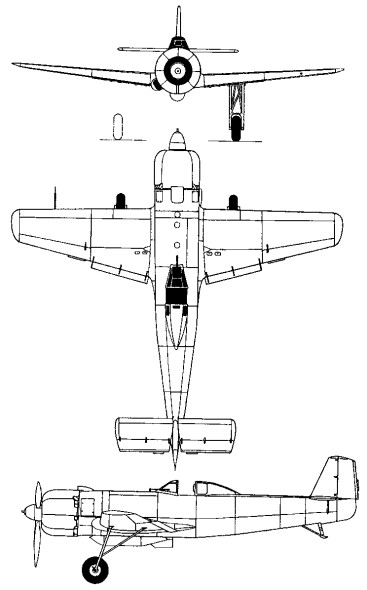
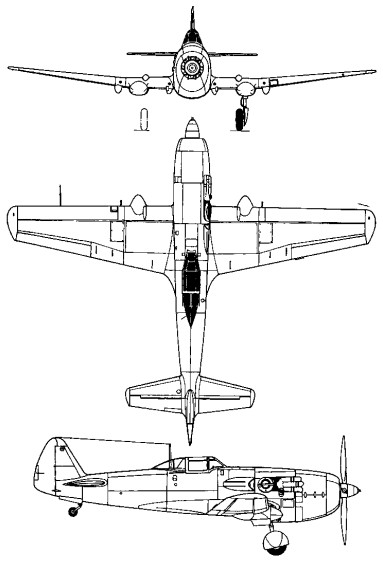
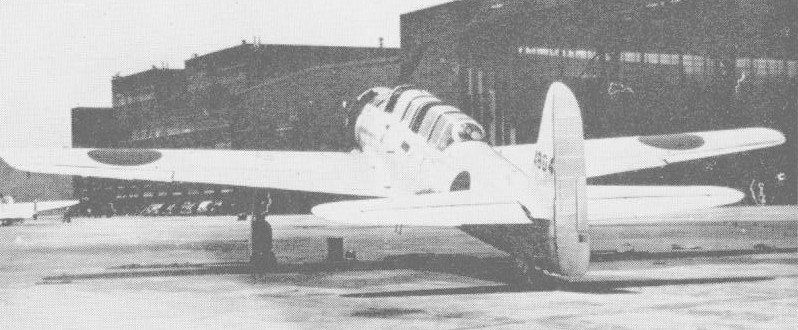
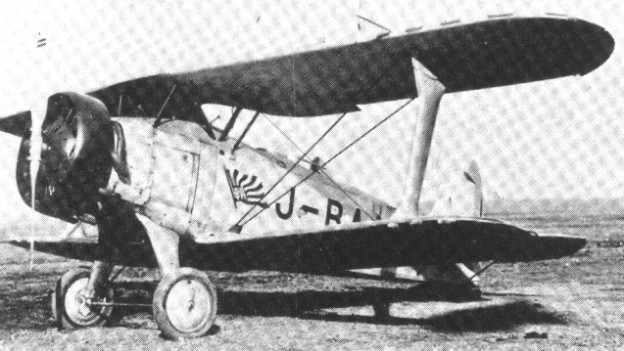
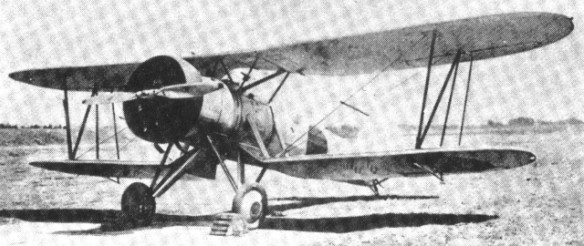
Nakajima Kotobuki / Ha-1 / Army Type 97

In 1917, Chikuhei Nakajima set up the “Airplane Institute” at Ojima Town in Gunma Prefecture. In 1918 they built their first airplane; the “Nakajima Type 1” with a U.S.A. made engine. In 1920 the company sent Kimihei Nakajima to France to study European advances, and in 1922 started their own engine factory in Tokyo. This led to production of engines based on the Lawrence A-3 two-cylinder air-cooled horizontally opposed engine.

At the time the Lawrence was an oddity. Most air-cooled engines at that time were using cylinders that rotated together with the propeller, but Kimihei overheard that an engine with good cooling capability with fixed cylinders was being developed in England. He observed the English Gloster Gamecock fighter with its Bristol Jupiter engine, which was an advanced design for the era with an automatic adjustment device for tappet clearance, spiral piping for even intake distribution, and a four-valve intake and exhaust system. He acquired a manufacturing license for the Jupiter in 1925. In 1927, after inviting two production engineer instructors from the Bristol company, the Jupiter Type 6 of 420 PS and Type 7 of 450 PS with a turbocharger were put into production at the Nakajima factory.

After studying the Pratt & Whitney Wasp 9-cylinder radial, Nakajima tried to combine the good points found in Jupiter design with the rational design of the Wasp. Nakajima then produced a series of engine types, named “AA”, “AB”, “AC”, and “AD”, as engineering exercises. The next engine design, the “AE”, was innovative, with a bore of 160 mm and a stroke of 170 mm.

Prototypes were made and performance tests were done, but this engine was not adopted due to its very complex engineering. Nakajima continued testing different cylinder designs. In 1929, the “AH” design, with bore and stroke of 146 × 160 mm and a total displacement of 24.1 L, was completed. This was to be the final version of this basic engine design.

In June 1930 the first prototype of was completed and it passed the durability test for the type approval in the summer. Then flight tests were started using a Nakajima A2N carrier plane. Nakajima had designed the first Japanese originally designed air-cooled 9-cylinder engine, the 450 PS “Kotobuki”.

In December 1931, this engine was approved and adopted by the Navy as the Ha-1 Ko for the Type 97 carrier fighter. The engine was named, in connection with the Jupiter engine, “Kotobuki” (寿, “Longevity”).

The “Kotobuki” engine was improved and developed into the “Hikari (light)” engine with the bore and stroke expanded to the limit of the cylinder (160 × 180 mm for a displacement of 32.6 L), with the power was increased to 720 PS. The “Hikari” was used in Type 95 carrier fighters and Type 96 Carrier Attack Plane.

In search of more power the basic design was extended into a 14-cylinder 2-row engine, the “Ha-5 Ha-41 Ha-109” series.

Variants:
2-Kai-1 – 585 hp (436 kW)
2-Kai-3 – 610 hp (455 kW)
3-Kai – 710 hp (529 kW)

Applications:
Mitsubishi A5M
Mitsubishi Ki-18
Nakajima A1N2
Nakajima A2N
Nakajima Ki-8
Nakajima Ki-27
Nakajima E4N
Nakajima E8N
Nakajima Ki-34
Nakajima Type 91

Specifications:
Type: 9-cylinder radial piston engine
Bore: 146 mm (5.75 in)
Stroke: 160 mm (6.3 in)
Displacement: 24.1 L (1,471.2 cu in)
Dry weight: 350 kg (772 lb)
Cooling system: Air-cooled
Power output: 550-780 hp
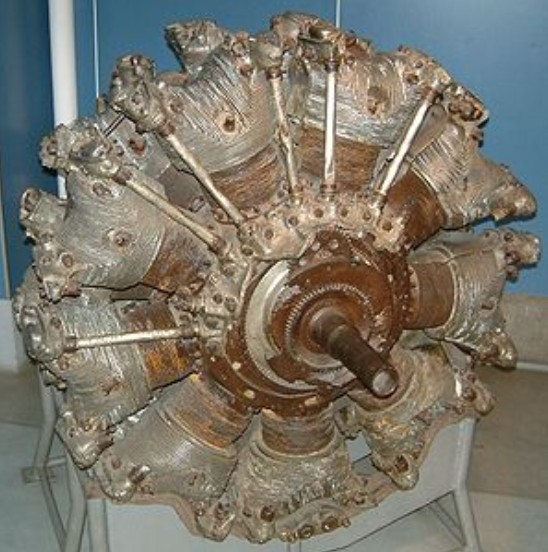
Nakajima NK7 Mamoru / Mamoru-Kai / Ha-103

The Mamoru was Nakajima’s seventh air-cooled design, which lead to its designation: N for Nakajima, K for air-cooled, 7 for the 7th design, and A for the major model number. Designed by Kiyoshi Tanaka, the Nakajima Mamoru engine was a 14-cylinder, air-cooled, two-row radial engine of 1870 hp. It was one of the largest 14-cyl. engines in the world and was to compete with early 18-cyl engines. The Nakajima model designation for this engine was NAK while it was an experimental project, in service it was known as the NK7, and known as the Ha-103 by the Army and “Mamori” or “Mamoru” by the Navy. According to unified designation code it was Ha-36. The meanings of these two Japanese words are very similar, Mamori translates as protection and Mamoru, translates as to guard, protect, defend and obey.

First run in 1941, the first application of the Mamoru was on the first prototype of the G5N1 Genzan. The G5N1 had been designed on the basis of the Douglas DC-4E as Japan’s first four-engine bomber, and proved to be a disappointment. These problems were compounded by the unreliability of the early Mamoru engines, which had to be de-tuned and left the G5N1 underpowered. The G5N1’s maiden flight was on 10 April 1941, and a further four prototypes were built with the Mamoru. In an attempt to salvage the project, two additional airframes were fitted with 1,530 hp Mitsubishi MK4B 12 “Kasei” engines and redesignated G5N2s. Although the Mitsubishi engines were more reliable than the original Mamoru 11s, further development was halted. Of the six completed Shinzans, four of them (two G5N2s and two G5N1s re-engined with the Kasei 12) were relegated for use as long-range Navy transports under the designation Shinzan-Kai Model 12 Transport G5N2-L.

The Nakajima Mamoru was also used on the Nakajima B6N Tenzan (heavenly mountain) carrier based attack aircraft. The Navy requested this aircraft based on the Kasei, but Nakajima’s Kenichi Matsumara insisted on using their Mamoru. The B6N first flew on 14 March 1941, demonstrating several problems, notably the poor engine reliability. With the delay of 2 years, by 1943 the engine had improved to the point where serial production was allowed to start, but after only 133 B6N1s had been delivered the Navy ordered the switch to the 1,850 hp (1380 kW) Mitsubishi MK4T Kasei 25. The rest of the 1,268 B6N2s were Kasei powered.

Two sub-models were built with minor changes, the Model 11 for the Navy, and the Model 12 for the Army. Both produced 1,850 hp. Production of the Mamoru was ended by the Navy after only a few hundred production examples were built.

Variants:
Mamori 11 NK7A (for IJN aircraft)
1,870 horsepower (1,390 kW) at 2600 rpm (take-off)
1,750 horsepower (1,300 kW), 2500 rpm at 1,400 metres (4,600 ft)
1,600 horsepower (1,200 kW), 2500 rpm at 4,900 metres (16,100 ft)

Mamori 12 Ha-103 (for IJA aircraft)
1,870 horsepower (1,390 kW) at 2600 rpm (take-off)
1,750 horsepower (1,300 kW), 2500 rpm at 1,400 metres (4,600 ft)
1,600 horsepower (1,200 kW), 2500 rpm at 4,900 metres (16,100 ft)

Applications:
Nakajima B6N 1 X 1,870 hp (1395 kW) Nakajima NK7A Mamoru 11
Nakajima G5N 4 X 1,870 hp (1395 kW) Nakajima NK7A Mamoru 11
Nakajima Ki-49 2 X 1,870 hp Nakajima Ha-103
Mitsubishi Ki-67 (prototype) 2 X 1,870 hp Nakajima Ha-103

Specifications:
Nakajima NK7A Mamoru type 11, 12
Type: 14-cylinder supercharged, air-cooled two-row radial piston engine
Bore: 155 mm (6.1 in.)
Stroke: 170 mm (6.7 in.)
Displacement: 44.9 lt (2,740 cu.in)
Diameter: 1380 mm (54.3 in.)
Dry weight: 870-903 kg (1,918-1,991 lb.)
Valvetrain: push rod operated overhead-valve
Supercharger: Two-speed single stage centrifugal
Cooling system: Air-cooled
Reduction gear: 0.578
Power output: takeoff: 1870 hp at 2600 rpm, cruise: 1750 hp at 2500 rpm at 1400 m
Compression ratio: 6.5

Nakajima Ha-45 Homare / NK9 / NBA / Type 4

The Nakajima Homare (誉, “praise” or, more usually, “honour”) was an air-cooled twin-row 18 cylinder radial Japanese aircraft engine. Given the Navy service designation NK9, the “Homare” was also given the company designation NBA, Army experimental designation Ha-45 (ハ45) or, Army long designation Nakajima Army Type 4 1,900 hp Air-Cooled Radial and, (coincidentally), unified designation code of Ha-45.

Development of the Homare was started in 1940 by Ryoichi Nakagawa, and certification was completed in 1941. It succeeded Nakajima’s previous 14 cylinder Sakae (Ha-25) engine, with its forward seven cylinders staggered from the rear seven for efficient cooling.

The design was compact, with an external diameter of 118 cm. With a bore and stroke of 130 mm x 150 mm, it was classified as a short-stroke engine. It was designed to output around 1800 hp (1340 kW), or 100 hp (75 kW) per cylinder. However, the tight design of the engine made it difficult to maintain quality in manufacturing, and unreliability in the field was a significant problem; actual output of early models at altitude was in the range of 1300 hp (970 kW), far below the designed capability. Later models had improved performance, and it became one of the predominant powerplants of Japanese military aircraft in the latter part of the war. A total of 8,747 were produced.

Variants:
Homare 11 – 1,650 hp (1,230 kW), 1,820 hp (1,357 kW), 1,900 hp (1,417 kW)
Homare 12 – 1,825 hp (1,361 kW)
Homare 21 – 1,990 hp (1,484 kW)

Applications:
Aichi B7A
Kawanishi N1K-J
Mitsubishi A7M
Nakajima C6N
Nakajima G8N
Nakajima Ki-84
Yokosuka P1Y1

Specifications:
Type: 18-cylinder air-cooled twin-row radial engine
Bore: 130 mm (5.12 in)
Stroke: 150 mm (5.91 in)
Displacement: 32 lt (1,940 cu.in)
Length: 1,778 mm (70 in)
Diameter: 1,182 mm (46.5 in)
Dry weight: 830 kg (1,830 lb)
Valvetrain: push rod operated overhead-valve system with 2 valves per cylinder
Supercharger: Two-speed single stage centrifugal
Fuel system: Water-methanol injection
Cooling system: Air-cooled
Power output: 1,485 kW (1,990 hp) at altitude
Specific power: 46.4 kW/L (1.02 hp/cu.in)
Compression ratio: 7.0
Power-to-weight ratio: 1.79 kW/kg (1.09 hp/lb)

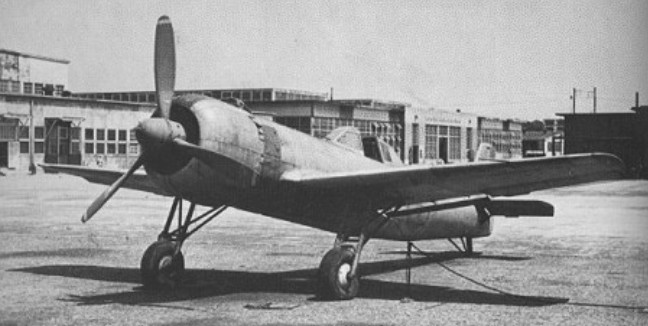
Nakajima Ki-115 Tsurugi

In January 1945 Nakajima was ordered by the Imperial Japanese Army to design and develop, as quickly as possible, a basic aircraft that could carry a bomb of up to 800kg weight for use in kamikaze attacks. The resulting Nakajima Ki-115 low-wing monoplane prototype was of mixed construction, powered by a Nakajima Ha-35 radial engine and had welded steel-tube main landing gear units, without any form of shock absorption, which were intended to be jettisoned after take-off on a kamikaze mission. Flight tests showed that ground handling was unacceptable in this configuration, leading to the introduction of main landing gear units with simple shock absorbers. In this form, and incorporating some minor modifications, the aircraft entered production as the Ki-115a Tsurugi (Sabre). However, Nakajima had built only 104 production aircraft by the time the war ended, and none of these was used operationally.

Ki-115
Engine: 1 x Nakajima Ha-35, 843kW
Wingspan: 8.6 m / 28 ft 3 in
Length: 8.55 m / 28 ft 1 in
Height: 3.3 m / 10 ft 10 in
Wing area: 12.4 sq.m / 133.47 sq ft
Max take-off weight: 2880 kg / 6349 lb
Empty weight: 1640 kg / 3616 lb
Max. speed: 550 km/h / 342 mph
Range: 1200 km / 746 miles
Armament: 800-kg bomb
Crew: 1

Nakajima Ki-115 Tsurugi

Nakajima Ki-87

The Nakajima Ki 87 was an experimental high altitude fighter. The first and only example flew in April 1945.

Engine: 1 x Nakajima Ha-44 Model 11, 1800kW
Wingspan: 13.42 m / 44 ft 0 in
Length: 11.82 m / 38 ft 9 in
Height: 4.5 m / 14 ft 9 in
Wing area: 26 sq.m / 279.86 sq ft
Max take-off weight: 5632 kg / 12416 lb
Empty weight: 4387 kg / 9672 lb
Max. speed: 706 km/h / 439 mph
Ceiling: 12850 m / 42150 ft
Armament: 2 x 30mm cannons, 2 x 20mm cannons, 250-kg bomb
Crew: 1

Nakajima Ki-87

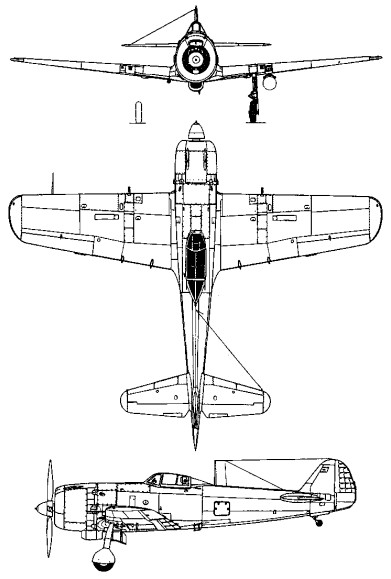
Nakajima Ki-84 Hayate

The Nakajima Ki-84 Hayate (Gale) was flown in prototype form in April 1943. The Ki-84 met with immediate approval by Japanese army air force pilots, but was subjected to lengthy service trials which undoubtedly delayed its introduction to combat operations. Production of the Ki-84-1a got under way at Nakajima’s Ota plant in April 1944, pre-production aircraft having equipped the 22nd Sentai in China the previous month. Immediately afterwards 10 sentais of the Ki-84-I, codenamed ‘Frank’ by the Allies, were deployed in the Philippines to confront the advancing American forces. As a dive bomber it was capable of carrying two underwing bombs of up to 550 lb.

Nakajima Ki-84 Hayate Article

In an effort to accelerate production of the new fighter, Nakajima opened up a new line at its Otsonomiya plant. The Ki-84 -1b and -1c differed in armament fitted. As Boeing B-29 raids began to take their toll of Japanese cities a new ‘bomber destroyer’, the Ki-84-Ic, was produced with an armament of two nose mounted 20mm cannon and two wing mounted 30mm cannon.

In the last 17 months of war 3,382 aircraft were completed, this despite the B-29 raids and the fact that, owing to such damage at Musashi, Nakajima’s engine plant had to be transferred elsewhere.

Named after Col. Frank MacCoy, ‘Frank’ was first assigned to an unknown fighter called the T.K.4, which was later coded ‘Harry’. The ‘Frank’ was ultimately assigned to the Ki.84.

Engine One 1416kW / 1,900 hp Nakajima Ha 45/11.
Length 32 ft 7 in (9.92 m)
Wing span 36.8 ft (11.21 m)
Height: 3.39 m / 11 ft 1 in
Wing area: 21 sq.m / 226.04 sq ft
Weight empty 5,860 lb (2,660 kg)
Max take-off weight: 3890 kg / 8576 lb
Max speed 390 mph. (630 kph)
Range: 1,080 miles (1,740 km.)
Ceiling: 10500 m / 34450 ft
Armament 2 x 20 mm Ho5 cannon, and 2 x 12.7 mm Ho103 machine guns
Bomb load 1, 100 lb. (500 kg.)
Seats: 1.

Ki.84-ia
Engine: Nakajima Ha.45/11 Type 4, 1900 hp
Wingspan: 36 ft 10.25 in
Length: 32 ft 6.5 in
Height: 11 ft 1.25 in
Empty weight: 5864 lb
Loaded weight: 7965 lb
Max speed: 388 mph at 19,680 ft
Service ceiling: 34,450 ft
Max range: 1815 mi
Armament: 2 x 20 mm Type 5 cannon, 2 x 12.7mm Type 103 mg
Bombload: 1100 lb
Crew: 1

Nakajima Ki-84 Hayate / Frank

Nakajima Kikka

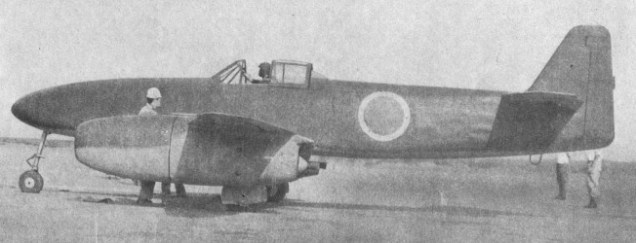
Japan’s interest in jets increased in September 1944, when the Japanese air Attache in Berlin sent a large number of detailed reports on the German Me262 program. The Japanese naval staff instructed Nakajima to develop a single seat attack bomber based on the Me 262, capable of a speed of 690 km/h (430 mph) and able to carry a small bombload.

Design started in Septem¬ber 1944 under the direction of Kazuo Ohno and Kenichi Matsumur, and the resulting aircraft resembled the Ger¬man design although somewhat smal¬ler owing to the very low power avail¬able from the early Japanese jet en¬gines. The Kikka first design studies envisaged the use of 440 lb. thrust TSU-11 units which were based on the Campini principles and employed the Hitachi Hatsukaze (Fresh wind) piston engine to drive a ducted fan compressor. However, at an early design stage the Tsu-11 was dropped in favour of the Ne-10 (TR-10) centrifugal-flow turbojet, and the 340 kg (750¬lb) thrust NE-12 (TR-12), which added a four-stage axial compressor to the front of the Ne-10. The first mock-up of the Kikka was inspected by Naval Officials on January 28, 1945, but estimated performance with the NE-12 turbo jet was uninspiring, and it was decided to make a further power plant change, supplanting the NE-12 with two 475 kg (1,047 1b) thrust powerful NE-20.

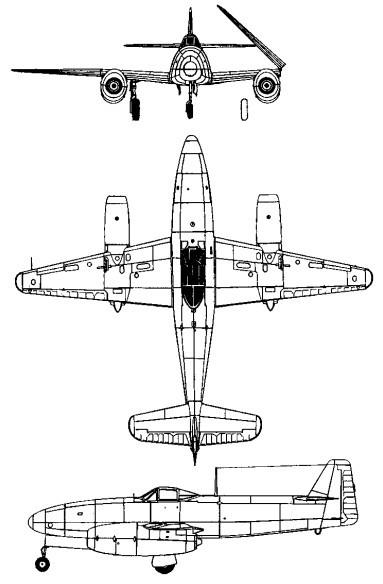
The Kikke was a single-seat twin-jet attack bomber, of all-metal construction with fabric-covered tail surfaces.

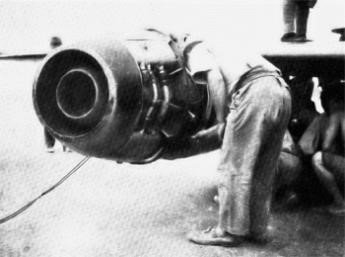
Ishikawajima NE-20 fitted on Kikka No1

These also proved inadequate and for the first flight Ne 20 axial flow turbojets were fitted; however, it was still necessary to employ an auxiliary rocket for assisted take off.

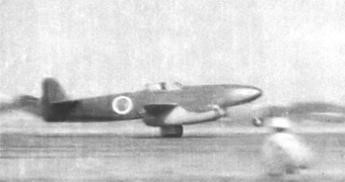
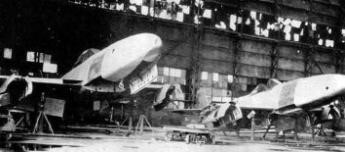
The prototype commenced ground tests at the Nakajima factory on 20th may 1945, and on 25th June the first Kikka was completed. The following month it was dismantled and delivered to Kisarazu Naval Air base where it was re-assembled and prepared for flight testing. Ground tests continued on this airfield until 13th July.

On the 7th August 1945, Lieutenant Commander Susumu Takaoka made the first flight, with a duration of 11 minutes at Kisarazu Naval Air Base. His take-off run of 2,380 ft. took 25 seconds at an all-up weight of 6,945 lb. Wind speed was 23 ft.per second. He landed in 3,280 ft.

A ceremonial official “initial” test flight was made on 11th August, four days later. For this flight, rocket assisted take off (RATO) units were fitted to the aircraft. Because their alignment had been miscalculated, the acceleration was so heavy that the nose of the aircraft came up, the tail went down and skidded along the runway. Tanaoka abandoned the take off and the aircraft was damaged when it ran off the end of the runway. Before it could be repaired Japan had surrendered and the war was over.

A second prototype was then nearing completion and manufacture of between 18 and 25 further aircraft had started.
Some of these were two-seat trainers. On 15 August, the entire programme was abandoned. Production, which included versions for training, reconnaissance and air combat, had also been planned.

Gallery

Kikka (1st prototype)
Powerplant: two Ishikawajima Ne 20 axial flow turbojets, 475 kg (1,047 1b) thrust
Wing span 10.00 m (32 ft 10 in)
Length 8.125 m (26 ft 8 in)
Height 2.95 m (9 ft 8 in)
Wing area 13.2 sq.m (142.08 sq.ft)
Empty weight 2300 kg (5,071 lb)
Maximum take off weight 4080 kg (8,995 lb)
Wing loading: 54.3 lb./sq. ft.
Power loading: 3.7 lb./lb. s. t.
Max speed sea level (est): 387mph
Max speed 697 km/h (433 mph) at 10000 m (32,810 ft)
Climb to 10000 m (32,810 ft) in 26 min
Service ceiling 12000 m (39,370 ft)
Range 940 km (586 miles)
Armament: one 800 kg (1,764 lb) bomb
Crew: 1

Nakajima Kikka

Nakajima C6N Saiun

C6N

Until 1942 the Imperial Japanese Navy, like other navies, flew reconnaissance missions with aircraft designed primarily for defensive or offensive combat. In early 1942 a 17 Shi specification was issued calling for a purpose designed carrier reconnaissance aircraft, with the greatest possible speed and range.

Nakajinia’s design team under Fukuda and Yamamoto fitted a 1358kW Nakajima Homare 11 radial engine engine into the slimmest possible fuselage, and 1360 litres (299.2 Imp gal) of fuel into the small wing. The latter had a laminar flow section, and slats and tabbed Fowler flaps were used to meet the severe limit on landing speed of 70 knots (130 km/h, 81 mph).

Pilot, navigator and radio operator were seated in tandem, the navigator having cameras in the belly and ventral and side observation windows and the radio operator manning a 7.92 mm (0.31 in) Type 1 machine¬gun. The prototype flew on May 15, 1943, and altitude performance proved disappointing.

Eighteen more prototype/pre-series aircraft followed, some with the more powerful 1990 hp Nakajima NK 9H Homare 21 two row 18 cylinder engine, before the type was ordered into production in April 1944 as the Navy Carrier Reconnaissance Plane Saiun (Painted Cloud / Nakajima C6N1).

Production aircraft began to be delivered to the JNAF in august 1944 although some of the prototypes had been pressed into service some two months earlier.

After its first action in the Battle of the Marianas it was code named ‘Myrt’ by the Allies. Fitted with a drop tank it had a range of over 5300 km (3300 miles), and despite the shortfall in performance was almost impossible to catch even with a Corsair or Hellcat.

The proposed C6NI B torpedo bomber never flew, but a few aircraft were converted into C6N1 S night fighters with only the pilot and navigator and with two 20 mm (0.79 in) Type 99 cannon mounted obliquely at 30 degrees in a rebuilt rear cockpit. They had adequate speed and climb to intercept the B 29 but at night were severely handicapped by lack of radar. No radar equipped version was plan¬ned, but at the war’s end a C6N2 had flown with turbocharged NK9 L engine giving 1780 hp at 9000 m (29 530 ft) driving a four blade propeller, and this was envisaged as the power plant of an improved night fighter.

A total of 463 had been built’ when production ended in August 1945, the total including the small number of C6N1-S two-seat night-fighter conversions from C6N1 aircraft, and one C6N2 prototype with a 1476kW Homare turbocharged engine.

A Nakajima C6N1-S Saiun (MYRT) was the last aircraft shot down in World War 2. It was shot down by Lieutenant Commander Thomas Reidy of the US Navy, flying a Corsair fighter, on August 15, 1945, a day after Emperor Hirohito’s surrender announcement. The war ended five minutes later.

C6N1
Engine: 1 x Nakajima NK9H Homare-21, 1484kW / 1990 hp
Max take-off weight: 5260 kg / 11596 lb
Empty weight: 2968 kg / 6543 lb
Wingspan: 12.5 m / 41 ft 0 in
Length: 11 m / 36 ft 1 in
Height: 3.95 m / 13 ft 0 in
Wing area: 25.5 sq.m / 274.48 sq ft
Empty weight: 6411 lb
Loaded weight: 9920 lb
Max. speed: 610 km/h / 379 mph at 20,000 ft
Ceiling: 10740 m / 35250 ft
Range w/max.fuel: 5310 km / 3300 miles
Armament: 1 x 7.92mm machine-guns
Crew: 3

Nakajima C6N Saiun / Myrt

Nakajima NAF-2

With the destruction of the NAF-1 shipboard two-seat fighter prototype in April 1933, Kiyoshi Akegawa began design of a further two-seater to meet an 8-Shi requirement, the NAF-2. Of all metal construction with fabric skinning, the NAF-2 was powered by a 580 hp Nakajiina Kotobuki 2 nine-cylinder radial and was a single-bay staggered biplane with pronounced sweepback on the upper wing. Armament comprised three 7,7-mm guns, two fixed and one on a flexible mount, and the first of two prototypes was completed in March 1934, these differing in that the first had N-type interplane struts and the second had aerofoil-section I-type struts. Although the NAF-2 met Imperial Navy requirements, a change in policy led to the abandonment of the two-seat fighter concept, and both prototypes were sold to the Asahi Press.

Engine: Nakajiina Kotobuki 2, 580 hp
Max speed, 186 mph (300 km/h)
Time to 9,845 ft (3 000 m), 9.66 min
Endurance, 4.5 hrs
Empty weight, 2,718 lb (1 233 kg)
Loaded weight, 3,770 lb (1 710 kg)
Span, 33 ft 9.5 in (10,30 m)
Length, 23 ft 9.8 in (7,26 m)
Height, 9 ft 4.2 in (2,85 m)
Wing area, 283.64 sq ft (26,35 sq.m)

Nakajima NAF-1

In 1931, the Imperial Navy instructed Nakajima to design and build, as part of a 6-Shi programme, a two-seat shipboard fighter with secondary dive-bombing capability and provision for an auxiliary fuel tank to suit the aircraft for long-range reconnaissance missions. Of all-metal construction with fabric skinning and designed by Kiyoshi Akegawa, the fighter received the company designation NAF-1. The wings could be folded aft, provision was made for an external 616 Imp gal (280 lt) auxiliary fuel tank and power was provided by a 530 hp Bristol Jupiter engine. Armament comprised two fixed for¬ward-firing 7,7-mm guns and a gun of similar calibre on a flexible mount. The sole prototype was completed in the summer of 1932, but delivery to the Navy did not take place until the following year, the NAF-1 being destroyed in a forced landing on 8 April 1933, and the programme being cancelled.

NAF-1
Engine: Bristol Jupiter, 530 hp
Max speed, 173 mph (278 km/h)
Time to 9,845 ft (3 000 m), 7.5 min
Endurance (without external tank), 4 hrs
Empty weight, 2,800 lb (1 270 kg)
Loaded weight, 4,065 lb (1 844 kg)
Span, 35 ft 2.25 in (10,72 m)
Length, 23 ft 7 in (7,19 m)
Height, 9 ft 3 in (2,82 m)
Wing area, 316.36 sq ft (29,39 sq.m)
Armament: two fixed for¬ward-firing 7.7-mm guns and 1 gun of 7.7 mm on a flexible mount.