Porsche stopped making aircraft engines around 1970.
Engines – Power
Pop’s Props Zing

First flown in 1996, optional engines are the ½ VW or Rotax.
Engine: Kawasaki 340 LC, 35 hp
HP range: 28-40
Wing span: 25.5 ft / 7.77 m
Wing area: 118.8 sq.ft / 11.05 sq.m
Length: 17 ft
Height: 5.9 ft
MAUW: 500 lb / 226 kg
Empty weight: 249 lb / 112 kg
Fuel capacity: 3.5USG / 19 lt
Max speed: 70 mph / 112 kph
Cruise speed: 55 mph / 90 kph
Stall: 26 mph / 45 kph
Rate of climb: 675 fpm / 3.25 m/s
Range: 75 sm
Takeoff dist: 100 ft
Landing dist: 250 ft
Service ceiling: 6000 ft
Seats: 1
Landing gear: tailwheel
Plan price (1998): US$60
Pop’s Props Pinocchio
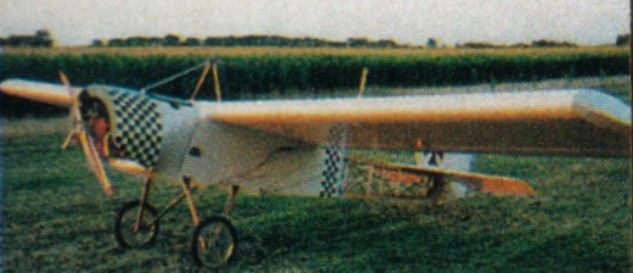
First flown in 1994, the prototype is powered by a twin-carburetted, two cylinder VW, with plans that will include optional motor mount illustrations for Kawasaki installation. The aircraft boasts three-axis controls and large tail surfaces. Wings carry full-span ailerons and can be detached for trailering. Its wire-bracing, spoked wheels and radial cowling gives the craft a very nostalgic look.
All wood construction. Estimated hp of the 2 cylinder VW is 40-45 hp. Construction. The fuselage is all wood incorporating 3mm plywood skin from firewall to seat back and aft of the seat on the centre section. From there, full length gussets all the way to the tail of all four corners.

Laminated bows help round out the fin and rudder and scallops accent the elevator and rudder trailing edges. The stabiliser leading edge is .8mm ply wrapped around wood formers to create a rigid D box and wire bracing tops off the lightweight but strong tail package.
The 16% Clark Y airfoil and 54” chord were chosen for the wings because of its superior stall speed characteristics and high lift capabilities. 30 dihedral was added for stability and 20 of incidence. Teleflex push-pull cables operate the full span ailerons safely and precisely. Leading edge is .8mm plywood wrapped around 3/4” foam nose ribs with 1/8” ply formers at each end and on all butt joints. Wire bracing not only makes for quick and easy wing removal but adds to the look of early aviation. Fuel is pulled from a 4.8 USG plastic tank tucked neatly above the pilot’s shins and filler is recessed into the rounded aluminium cover. Laminated foam cowl cheeks taper the round cowling into the fuselage which makes for a smooth flowing transition.
“Pinocchio’s” airframe requires no welding, no fibreglass work and the prototype was designed and constructed in approximately 500 hrs.
Speed max: 70 mph
Cruise: 60 mph
Range: 150 sm
Stall: 27 mph
ROC: 450 fpm
Take-off dist: 250 ft
Landing dist: 350 ft
Service ceiling: 2,000 ft
Engine: ½ VW, 45 hp
HP range: 35-50
Fuel cap: 4.8 USG
Weight empty: 254 lb
Gross: 500 lb
Height: 5.5 ft
Length: 16.5 ft
Wing span: 25.75 ft
Wing area: 115.8 sq.ft
Seats: 1
Landing gear: tail wheel
Tail span: 7’ without tips
Cockpit length: 46 1/2”
Cockpit width: 21 3/4”
Gear span: 46 1/2”
Payload: 230 lbs
Kit: Yes
Construction materials: Wood/fabric
Plans: Yes
Options: 2 cycle firewall forward capable.
Engine: Rotax 447, 40 hp
Wing span: 8 m
Wing area: 10.76 sq.m
MAUW: 226 kg
Empty weight: 115 kg
Fuel capacity: 19 lt
Max speed: 130 kph
Cruise speed: 100 kph
Minimum speed: 45 kph
Climb rate: 2.5 m/s
Fuel consumption: 2.5 lt/hr
Seats: 1
Plan price (1998): US$120
Kit price (1998): US$3995
Pop’s Props Cloudster
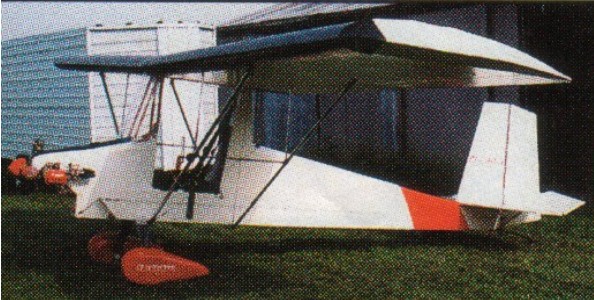
The Cloudster is a parasol winged monoplane built in wood and covered in Dacron. The pilot sits astride the fuselage.
Engine: ½ VW, 35 hp
HP range: 28-45
Wing span: 30 ft / 9.20 m
Wing area: 138 sq.ft / 12.8 sq.m
Length: 16 ft
Height: 7.6 ft
MAUW: 500 lb / 226 kg
Empty weight: 250 lb / 112 kg
Fuel capacity: 2.5 USG / 10 lt
Speed max: 96 kph / 50 mph
Cruise: 80 kph / 40 mph
Minimum speed: 38 kph
Range: 60 sm
Stall: 26 mph
Service ceiling: 2,000 ft
ROC: 3 m/s / 500 fpm
Take-off dist: 175 ft
Landing dist: 200 ft
Seats: 1
Landing gear: tail wheel
Fuel consumption: 7 lt/hr
Plan price (1998): $65
Kit price (1998): $3225
Popejoy 1980 Parasol
In 1980 Edward Popejoy built a high-wing, open cockpit monoplane registered NX2933. It was loosely based on Pietenpol, but considerably larger and faster. Specially outfitted for aerial photography with internal and external camera mounts.
Engine: 90hp Continental C-90-12
Wingspan: 27’2″
Length: 21’0″
Useful load: 688 lb
Max speed: 104 mph
Cruise: 95 mph
Stall: 48 mph
Range: 350
Ceiling: 12,500′
Seats: 2
Pope Thunderbird P-2
Built by Leon Pope in 1959, the Thunderbird P-2 was a single-place, open cockpit biplane. Registered N379, it looked like a Pitts, but actually was an original design, first flying on 18 June 1959.
Engine: 100hp Lycoming O-235
Wingspan: 18’9″
Length: 15’0″
Useful load: 280 lm
Max speed: 145 mph
Cruise: 115 mph
Stall: 55 mph
Range: 400 mi
Seats: 1
Pope Southern Cross
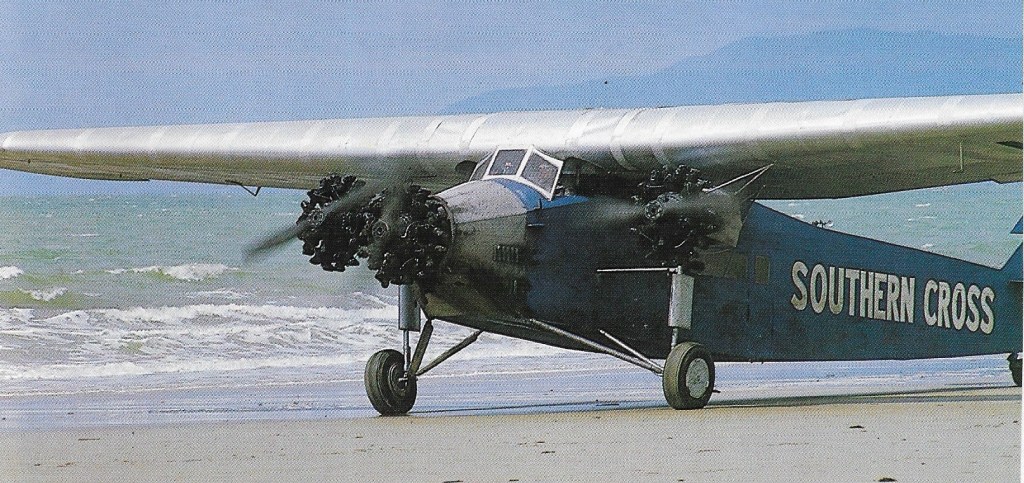
The plane’s replica was the project of South Australian flying instructor John Pope, who created the plane as a travelling history lesson that would fly around the country. Southern Cross is a flying close replica of the famous record breaking Southern Cross Fokker FV11B of Sir Charles Kingsford Smith from the 1920s and 1930s.
Built in South Australia in the period 1980 to 1987 as a tribute to Smithy, the aircraft toured Australia during the 1988 Bicentenary raising money for the Royal Flying Doctor Service registered VH-USU.
She is a faithful replica built to modern standards using the traditional aircraft construction of steel tubing and timber with doped Irish Linen for the fuselage and an all wooden (spruce and plywood) wing. She is the largest “exact replica” aircraft in the world and has the largest one piece wing ever made in Australia.
Aircraft Research and Development Unit was tasked to carry out the test flying of a replica of the 1926 Fokker Tri-Motor as flown by Australian aviation pioneer, Sir Charles Kingsford-Smith. The purpose of the test programme was, firstly, to ensure safe operation of the aircraft throughout its proposed flight envelope and, secondly, to provide data to allow the issue of a Certificate of Airworthiness or Permit to Fly. The trial included a cockpit and systems assessment as well as an evaluation of the aircrafts flight and ground handling characteristics. Airborne assessments covered stability and control characteristics, stall characteristics, general aircraft performance, asymmetric power characteristics and an evaluation of the aircrafts take-off and landing performance and handling. The flight characteristics of the test aircraft were found to be similar to those expected from an original Fokker VIIb-3M. Consequently, the aircraft could not meet some modern certification requirements. Notwithstanding this the aircraft was found to be generally safe and airworthy provided it was operated by experienced pilots in daylight Visual Meteorological Conditions and that the main recommendations of this report are adopted.

The aircraft first flew in 1987 and during the 1988 Bicentenary she toured around Australia as a fund raising exhibit for the Royal Flying Doctor Service. The aircraft was a major drawcard to the 1988 Bicentennial Air Show and many thousands of people saw her. In 1990 the aircraft even ventured to New Zealand for air show appearances.
After 555 hrs flying tine, on the 25th of May 2002 it had an accident at Parafield South Australia when she lost a main wheel on takeoff. Landing on the one good wheel and the tail, the pilot kept the damaged wheel off the ground by keeping its wing high in the air. When the aircraft stopped the high wing came down and snapped off around 3 metres from the wing tip. HARS bought the damaged plane in 2000.
After considerable negotiation HARS acquired the aircraft from the SA Government in 2010. It is being restored to full airworthy status.
Engines: 3 x Jacobs R-775 A2, 300 bhp
Wing span: 22.1 m
Length: 14.3 m
Height: 4.3 m
Maximum takeoff weight: 5,700 kg
Cruising speed: ~155 km/h (max ~185 km/h)
Ceiling: 8,500 ft
Endurance: 7.5 hr
Crew: 2 x pilots
Poorboy PB-1
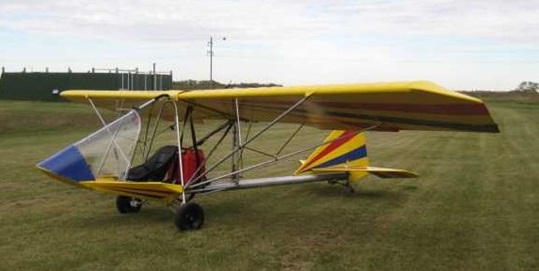
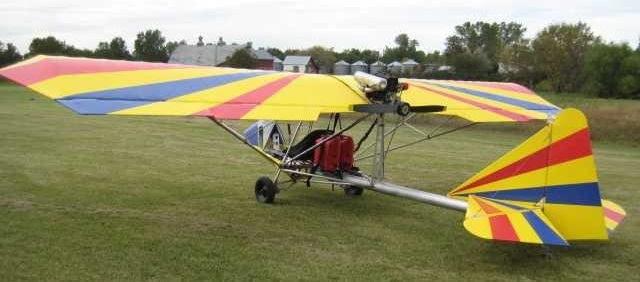
The Poorboy PB-1 is a single seat, pusher, tailwheel ultralight, first flown in 2010.
Owned by James Hartung of Minot, ND, United States.
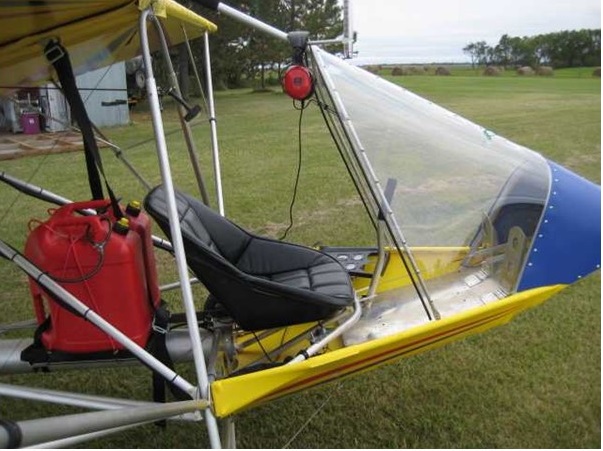
Engine: Cuyuna
Prop: Ultraprop
Ponzelli-Miller Aerocurvo
The 1909 Ponzelli-Miller ” Aerocurvo ” monoplane was designed by Riccardo Ponzelli and built by Franz Miller in Italy.
Pons Velocípedo Aéreo
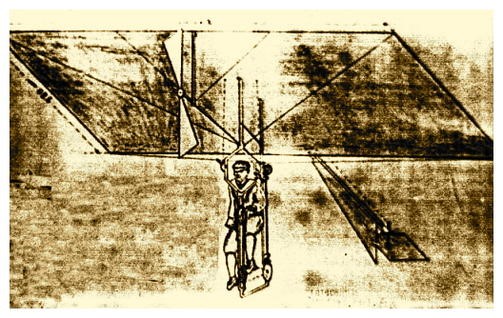
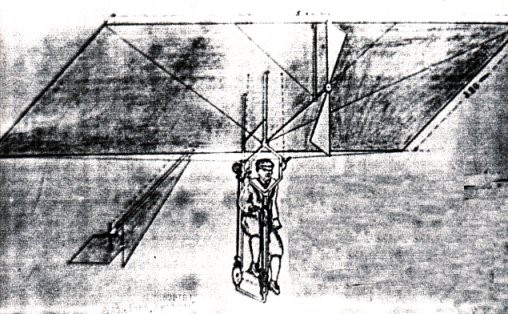
The first attempt to create the planes in Cuba dates back to 1893, when the leader of Cuban independence Jose Marti Patriot was approached Arturo Comas Pons, Cuban agronomist and journalist, to create a flying machine “to make it applicable to uses of war “, steel and aluminum.