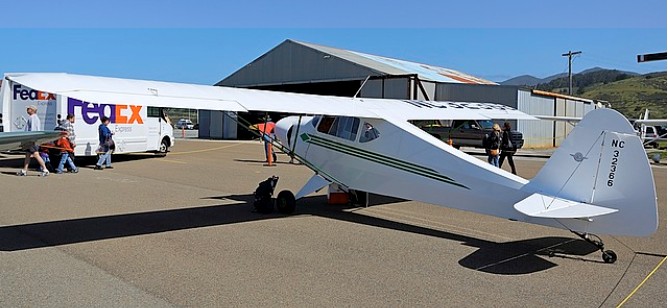
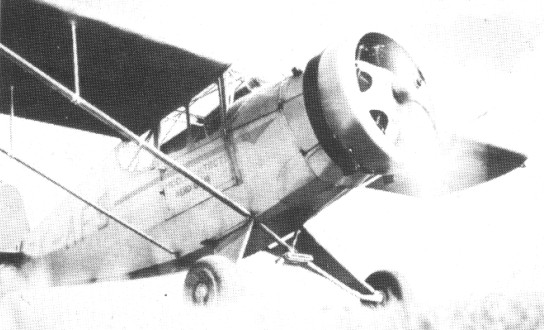
Porterfield LP-65
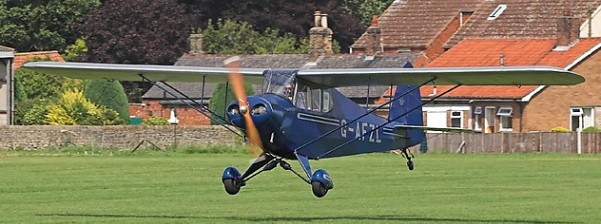
The 1937 CP-50 Collegiate (ATC 690) prototype was NC21953. Fifty were built, priced at $1,495, or $1,695 for the deluxe version with dual mags, brakes, tail wheel.
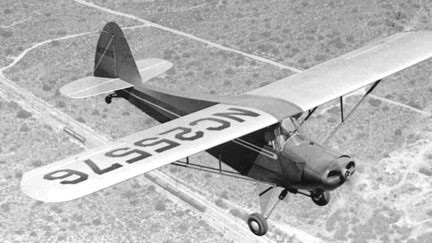
The Porterfield CP-65 of 1940 (ATC 720) sold for $1,665, or $1,895 for the deluxe version with dual mags, brakes, tail wheel.
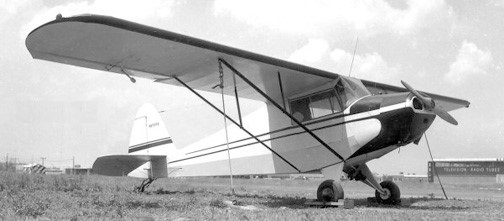
Rankin Aircraft was founded to market an improved version of the prewar Porterfield CP-65, as Collegiate two-seat lightplane for $15,000 in 1984.
CP-50 Collegiate
Engine: 50hp Continental A-50
Wingspan: 34’9″
Length: 22’6″
Useful load: 436 lb
Max speed: 102 mph
Cruise: 91 mph
Stall: 32 mph
Range: 270 mi
Seats: 2
CP-65 Collegiate
1940 (ATC 720)
Engine: 65hp Continental A-65
Wingspan: 34’9″
Length: 22’8″
Useful load: 500 lb
Max speed: 110 mph
Cruise: 100 mph
Stall: 32 mph
Range: 300 mi
Seats: 2
FP-50 Collegiate
1941 (ATC 690)
CP-50 with 50hp Franklin 4AC.
FP-60 Collegiate
1941 (ATC 720)
FP-50 with 60hp Franklin 4AC
$1,560.
FP-65 Collegiate
1940 (ATC 720)
CP-65 with 65hp Franklin 4AC
$1,590.

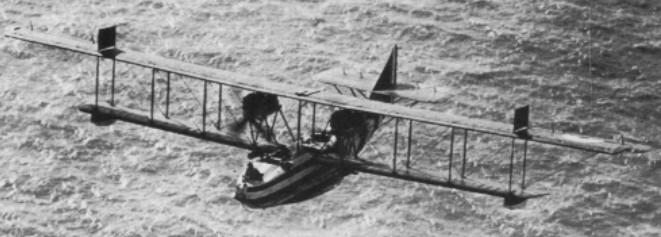
Porte’s ultimate design was a triplane flying boat, unofficially nicknamed the ‘Porte Super Baby’, but officially designated Felixstowe Fury. With wings spanning 37.5 m (123 ft), the Fury was powered by five 360hp Rolls Royce Eagle engines, two as tractors and three as pushers. Flying controls, initially, were power assisted by servomotors. After successful flying trials, the Fury was in the last stages of preparation for a projected flight to South Africa on August 11, 1919, when it was wrecked in Harwich harbour. All work on a second Fury was then stopped and the Fury programme cancelled. In October 1919, John Cyril Porte, the man whose inventive genius had conceived the F series of flying boats, died in Brighton of tuberculosis.
Engines: 5 x 334 hp Rolls-Royce Eagle VII
Span: 37.5 m (123 ft)
Length: 19.2 m (63 ft 2 in)
Height: 8.4 m (27 ft 6 in)
Maximum speed: 156 km/h (97 mph) at 609.5 m (2000 ft)
The Admiralty placed orders for Curtiss H.4 and H.12 flying-boats in 1924-15 on the recommendation of Squadron Commander John Porte. When they arrived, Porte fitted some with much improved hulls of his own design, built at the Naval Air Station of Felixstowe and by private manufacturers.
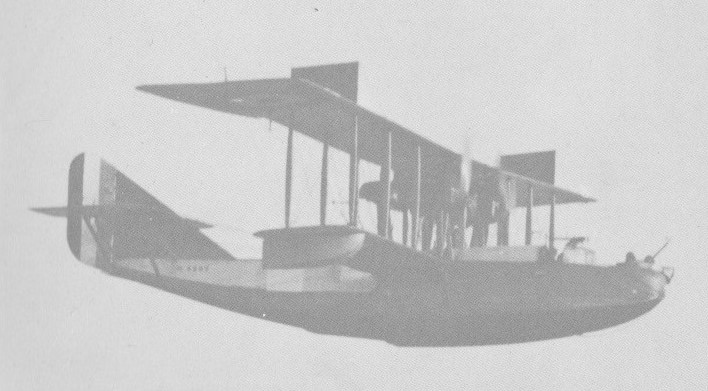
The engines were also replaced by Rolls-Royce Eagles in the H.12’s, which were redesignated F.2A.
They featured three-bay biplane wings with two spar wood construction and fabric covering. The hull was wood with plywood covering. Conventional controls with ailerons on the top wings only. Stabilising floats were under each lower wing tip.
Normal defensive armament was four Lewis machine guns: one in the nose cockpit, one in the rear cockpit aft of the wings and one on each side of the fuselage. Sometimes the nose and rear positions were each fitted with two guns, and an additional gun could be mounted above the pilots’ canopy. Racks for two 230-lb bombs were under the wings.
Best known was the F.2A, which, in the last year of the war, formed the backbone of RNAS/RAF ocean activ¬ity. Carrying up to seven Lewis guns and two 220 lb bombs, it had a maximum weight of 11,000 lb, its two 345 hp Rolls¬Royce Eagles gave it a top speed of 95 mph and it could reach 2,000ft in 3.5min and 10,000ft in 39.5min. Despite its 120ft wingspan it was surprisingly agile. Gradually F.2s replaced H12s.
The F2A was basically a Porte II hull married to the wings and tail unit of the Curtiss H.12. Utilised by Britain during WW 1 and credited with shooting down Zeppelins L.22, L.43 and L.62.
F.2A
Engines: 2 x Rolls-Royce Eagle VIII, 345 hp
Propeller: 4 blade
Wingspan: 95 ft 7.5 in
Wing area: 1133 sq,ft
Length: 46 ft 3 in
Height: 17 ft 6 in
Empty weight: 7549 lb
MTOW: 10,978 lb
Max speed: 95 mph at 2000 ft
Service ceiling: 9600 ft
Endurance: 6 hr
Armament: 4-7 Lewis machine guns
Bombload: 2 x 230 lb
By July 1916 first examples of a larger Curtiss flying boat design began arriving in England. Designated H.8, these were quickly modified to accept more powerful twin 250 hp Rolls Royce engines, and redesignated Curtiss H.12s, or ‘Large Americas’ as the RNAS crews usually referred to them. The Curtiss H.12 hull soon proved to be inadequate for its tasks, so Porte designed a new hull (the Porte II), resulting in all round improvement in performance. With a new tail unit added, the modified craft was designated Felixstowe F.2, and its general structure became a prototype for succeeding F boats.
Large scale production of the F.2 was ordered, and the type began to equip RNAS units in late 1917. Carrying a crew of four, and a bombload of approximately 272 kg (600 lb), the F.2a (its production designation) could achieve a maximum speed of some 145 km/h (90 mph), with an endurance of perhaps six hours. It was cumbersome to handle and slow in manoeuvre, yet gave formidable operational service for the rest of the war. With at least four machine guns in nose, tail, and flank locations, it also gave a good account of itself when engaged by German seaplanes. The F.2a’s main duty was antisubmarine hunting; an air deterrent which undoubtedly proved successful in the protection of Britain’s vital mercantile shipping.
Span: 29 m (95 ft 7.5 in) (upper), 20.8 m (68 ft 5 in) (lower)
Length: 14.1 m (46 ft 3in)
Height: 5.3 m (17 ft 6 in)
Maximum speed: 153.7 km/h (95.5 mph) at 609.5 m (2000 ft)
While the ‘Baby’ began production, Porte designed a new form of flying boat hull, and tested it on a modified Curtiss H4 (No 3850). The resulting aircraft was at first titled the Porte 1, and later officially designated Felixstowe F.1.
Span: 22 m (72 ft) (upper), 14 m (46 ft) (lower)
Length: 11 m (36 ft 2 in) (hull only)
Maximum speed: approx 125.5 km/h (78 mph)
On the outbreak of the First World War, among the Admiralty’s chief responsibilities was the aerial defence of Britain, as well as the more traditional role as guardian of the island’s surrounding sea¬ways. At that time the Royal Naval Air Service was almost wholly equipped with floatplanes of limited range and unreliable performance. The obvious need for a sea¬going aircraft of long range led Captain Murray Sueter, Director of the Naval Air Department, to purchase two Curtiss flying boats.
After some operational use of these initial Curtiss flying boats, Commander John C Porte set out to improve some of the more obvious weaknesses in the design.
In September 1915, Porte was appointed in command of RNAS Felixstowe and while there finally produced his own design of flying boat. It was a large, three engined aircraft, and was allocated the serial number 9800. Quite unofficially, it was titled the ‘Porte Baby’. The largest flying boat design of its day, the ‘Baby’ was put into limited production some 20 machines and most of these saw operational service in 1916 17.
It had three Rolls Royce Eagle engines, two installed as tractors and one as a pusher. One successfully launched a Bristol Scout from its top wing while airborne over Felixstow.
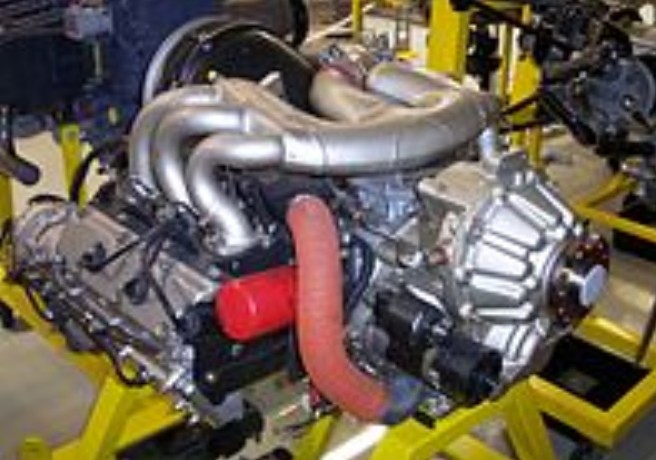
In the 1950s, European light aircraft builders began adapting the air-cooled automobile engines from the Porsche 356 and Volkswagen Beetle into aircraft engines with a series of limited modifications. Porsche cooperated with some of these builders and produced a series of factory-built engines for about six years between 1957 and 1963, the Porsche 678 series. These relatively small engines displaced about 1.6 litres (97 cubic inches) and produced between 55 and 70 horsepower, depending on the version.
First run circa 1981, Porsche’s PFM 3200 was a six-cylinder horizontally opposed air-cooled aircraft engine developed from their air-cooled line of automobile engines from the Porsche 911 sports car. The PFM designation was derived from the name of the division that designed the engines, Porsche-Flugmotoren (~ Porsche Flight Engines).
Porsche decided to re-enter the aviation market with much larger engines derived from the Porsche 911, starting development in 1981. As the engines ran at higher speed than most aircraft engine designs, the propeller drive used a 0.442:1 reduction gearing so it could drive common propellers. The high operating speed meant the engine ran more smoothly than older designs, and the use of a muffler meant it was quieter as well. With about 3.2 litres (195 cubic inches) displacement, the normally aspirated N-series models produced about 210 hp, while the turbocharged T-series produced about 240 hp. This was roughly twice the horsepower of a conventional lower-rpm design of the same size. With single-lever operation, fully aerobatic fuel and oil supplies, direct fuel injection with automatic altitude compensation and optional turbocharging, the PFM 3200 series were some of the most advanced engines on the market.
After being introduced in late 1985 and starting to generate increasing interest in the general aviation (GA) market, Porsche exited the field during the massive downturn in the market in the late 1980s, closing the lines in 1991. It is suggested that the program cost them US$75 million to develop and produce the small number of engines delivered (about 80). Although marketed for only a short period, the PFM was found on a variety of aircraft as the primary powerplant, or as one-off modifications. These included the Extra 330, Mooney M20L, Socata TB-16, Robin DR400, Ruschmeyer MF-85 and others. Only the M20L went into production, with 40 produced in 1988, and one more in 1989.
Porsche abandoned development of the PFM3200 in 1992.
In a letter dated September 17, 2007, Porsche informed the FAA that they were surrendering their type certificate for the PFM 3200 engine and that they would no longer support the engine. In March 2009, the FAA issued a special airworthiness information bulletin stating that type certificates for existing aircraft with the PFM 3200 engine were still valid and would remain so as long as the aircraft meet FAR part 43 maintenance requirements and FAR part 91 operation requirements. However, the bulletin also said that Porsche is not exporting new or replacement parts for the engine and there is no guidance as to how compliance would be possible once existing OEM parts are exhausted.
Versions:
N00: de-rated for automotive fuel
N01: 212 hp at 5300 rpm
N03: type-certified N01 for the Mooney M20L, 217 hp at 5300 rpm
T03: similar to the N03 but with a Garrett turbocharger, 241 hp at 5300 rpm, critical altitude 18,000 ft
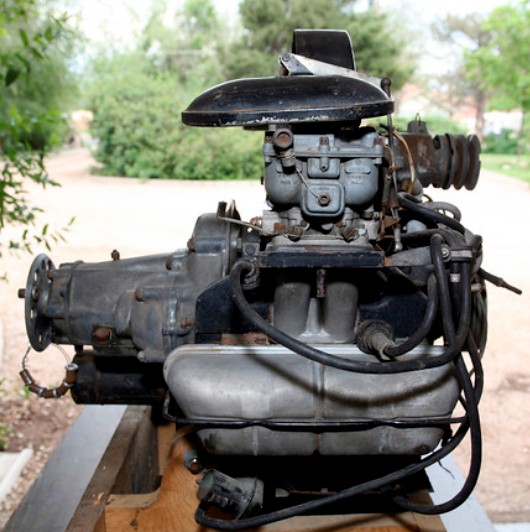
In post war Germany, General Aviation flight was not permitted until 1956. At the time of this rejuvenation, the Porsche 678 aircraft engine was being developed. This was based on the 4 cylinder Porsche 356 car engine. This air cooled engine was modified for the aviation environment.
In the 1950s, European light aircraft builders began adapting the air-cooled automobile engines from the Porsche 356 and Volkswagen Beetle into aircraft engines with a series of limited modifications. Porsche cooperated with some of these builders and produced a series of factory-built engines for about six years between 1957 and 1963, the Porsche 678 series, beginning with the 1,580-cc 678/0. These relatively small engines produced between 55 and 70 horsepower, depending on the version. The 678/4, is the last and most powerful of the four-cylinder Porsche aircraft engines, all of which were based on the 356 automotive engines. These received type certificate No. 7E2 issued on November 15, 1960 as Model 678/4 Type 4H0A.
At this time Alfons Pützer was also developing the Elster A airframe, powered by the 52HP 678/3 Porsche engine. This was followed by the Elster B version powered by the 75 HP Porsche 678/4 engine and the Rolls Royce Continental C-12F and C-14F engines.
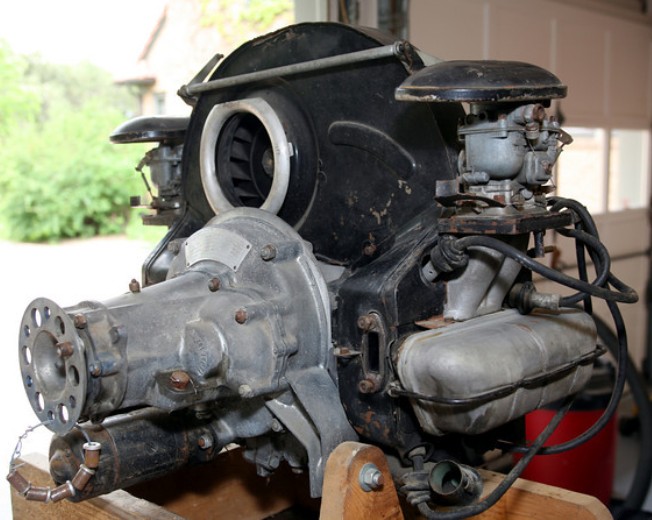
The engine differs from the car engine in many small ways, but its major departures are dry-sump lubrication, dual distributors (or magnetos, as an option) with dual spark plugs, different engine mounts, and a reduction gearbox to reduce propeller rpm to an effective range; gears could be specified as 1.46:1, 1.70:1, 1.98:1, or 2.12:1. A 12-volt electric starter and similar generator are fitted, the latter run off a dual v-belt. The external oil cooler uses a pair of 356 engine oil coolers on a special casting, and the dry-sump oil tank is connected to the pump by flexible lines. A rudimentary exhaust system piped gasses out of the fuselage.
The 678/4’s German airworthiness certificate was granted in May 1959, and FAA approval came in October 1960. Porsche’s 1959 list price for the engine (and gearbox) was $1,379. Production reportedly ended in 1962; production numbers are unknown, but it seems likely that only about 100 were made.
Earlier versions of the 678 used a low-profile cooling shroud thus could be installed in the aircraft’s nose and cooled by free air blast. The 678/4’s larger-shrouded fan air-cooling system, similar to that of the car engine, was only for enclosed rear-fuselage installation, using a pusher-type propellor, but such applications were rare.
The 678/4 was fitted to the Rhein-Flugzeugbau RW-3, a pusher-type motorized glider with retractable tricycle landing gear, seating for two, and optional wing extension. Its propellor was in the vertical tail just ahead of the rudder, with the engine set just behind the cockpit. The type was first built in 1958, and apparently only 22 aircraft were completed.
Using a Porsche engine to make an aircraft go is not a brand-new idea witness the RW3 motorglider built in Germany by Rhein-Flugzeugbau GmbH. It is powered with a Porsche 678/4 aircraft powerplant, a flat-four opposed piston engine with a reduction gearing of 1.981, a takeoff-power rating of 75 hp at 4600 rpm (propeller 2320 rpm), and max continuous power rating of 65 hp at 4500 rpm (propeller 2070 rpm). Leaned out, it delivers 55 hp at 4100 rpm (propeller 2070 rpm), with fuel consumption in economy flight mode 3.7 US gph.
Model 678/4 Type 4H0A
Displacement: 96.4 cu. in.
Bore and stroke: 3.248 x 2.913 in.
Compression ratio: 9.0:1
Reduction gearing: 1.98:1
Weight (dry): 250lb.
Max. continuous, 70hp., 4500 r.p.m. at S.L.
Takeoff (5 minute): 75 hp., 4600 r.p.m., at full throttle
Fuel (Min. grade aviation gasoline): 80
Lubricating oil : Oil Grade HD-Oil
Ambient air temperature: SAE 30:
Above 32°F: SAE 20:
32°F to 5°F: SAE 10:

