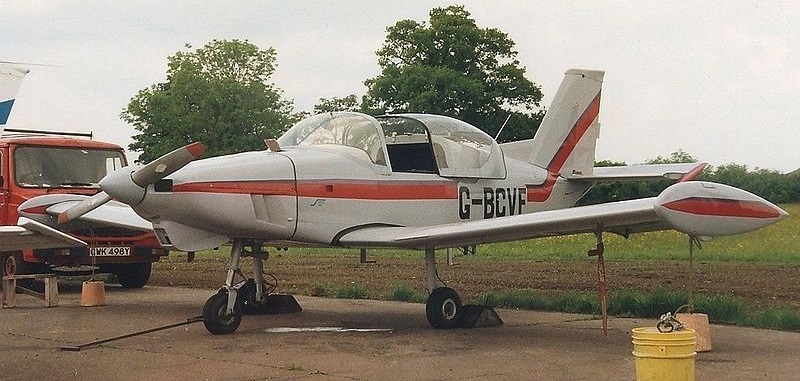
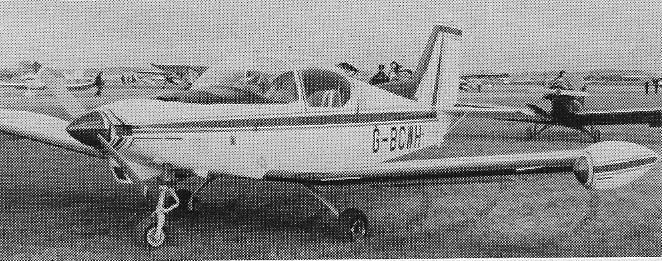
The prototype Sprite, named the Pilot Sprite, was designed by a team at Loughborough University as a British two-seat homebuilt training or touring monoplane for amateur construction. The design had been begun as a magazine-sponsored project by Peter Garrison, who worked for Pilot at the time; when the project did not move forward rapidly enough to suit him, he returned to the United States, where he modified his design into what would become his first Melmoth.
An all-metal side-by-side low-wing cantilever monoplanes with tricycle landing gear. The Sprite was powered by a Rolls-Royce Continental O-240-A piston engine.
It was the winning entry in a competition sponsored by Pilot magazine in 1968.
Plans for amateur building were marketed by Practavia Ltd as the Practavia Sprite.
First flying in 1971, eight are known to have been built.
Engine: 1 × Rolls-Royce Continental O-240-A, 130 hp (97 kW) Wingspan: 24 ft 0 in (7.32 m) Length: 20 ft 0 in (6.09 m) Height: 8 ft 3 in (2.51 m) Empty weight: 850 lb (386 kg) Gross weight: 1,400 lb (635 kg) Cruise speed: 128 mph (205 km/h, 111 kn) Crew: 1 (pilot) Capacity: 1 (passenger)
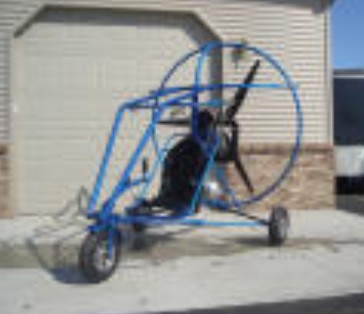
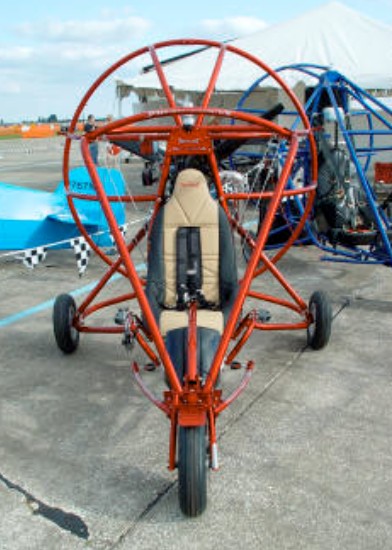
The 912 model AirWolf has either an 80 or 100 horsepower Rotax engine with a 4-cyclinder, 4-stroke, 1500 hour TBO power. It is suited for high altitudes, carrying high payloads, or extended fuel range.
AirWolf 912ULS 4-Stroke Basic Standard Factory Built features – 100 H.P. 912 ULS Electric Start 912 Throttle Quadrant w/ Choke 4 Point Seatbelts Oil Cooler Quick Connect Wiring Harness Standard extended Footbars Electric Fuel Pump Spun Aluminum Wheels Dual Hydraulic Spring Over suspension 4-Blade Warp Drive Prop w/ Super Hub Stainless Steel Exhaust Strobe Line Socks Tundra Tires Odyssey Dry Cell Battery 500 or 550 Sq. Ft. Chute 912 Engine Support
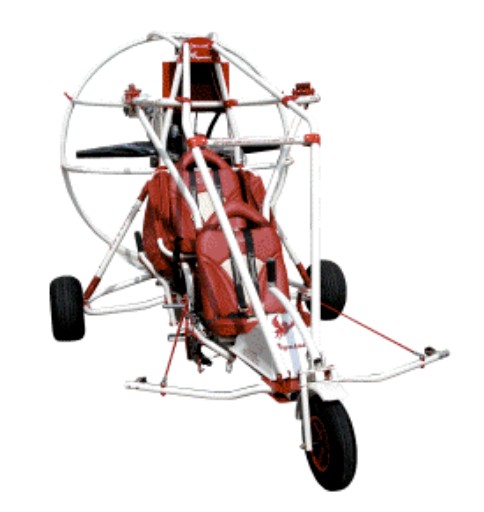
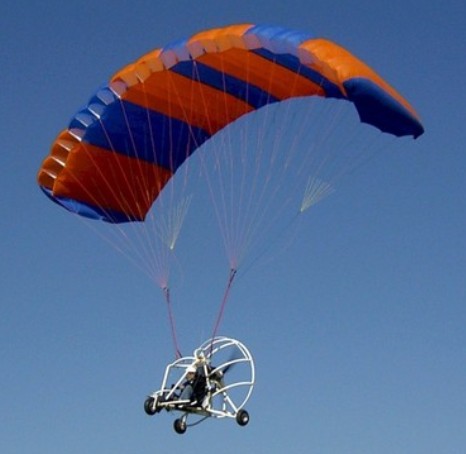
The Powrachute Sky Rascal is a single place sport machine circa 2006. It has a lightweight design, integral frontal fuselage bars, and Rotax engine. With in-House powder coating, the Sky Rascal features an instrument pod, and spun aluminum wheels.
Sky rascal standard features include – Frontal fuselage bars Front fender 3-blade composite prop analogue cht-tach/hour meter (standard for 447-(103 legal only) hydraulic spring-over strut suspension 5 gallon aluminum fuel tank Chute Bag & Line Ceramic Exhaust Basic EIS (Standard for 503) 4-Point Seat Belt Fuel capacity: 6-7 Gal
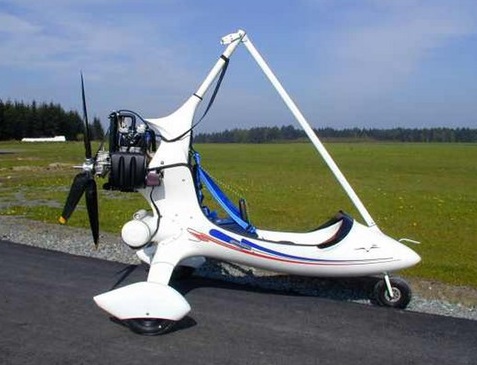
The PowerTrike Evolution is a German ultralight trike, designed and produced by PowerTrike of Mackenbach. The aircraft is supplied as a complete ready-to-fly-aircraft. As of 2014 the design was no longer available.
After a period of indifference, in June 1939 a demonstration of the Power Jets WU was made before a delegation of the Air Ministry, notably Dr Pye, Director of Scientific Research. The demonstration was so successful that the Ministry quickly arranged to buy the engine to give Power Jets working capital, lending it back to them for testing.
At the same time, a contract was placed for a “flight engine”, the W.1 (sometimes called the Whittle W.1). Designed by Frank Whittle and Power Jets, the W.1 was built under contract by British Thomson-Houston (BTH). Unlike the Whittle WU, that began bench testing in 1937, the W.1 was a symmetrical engine designed to facilitate, after development, installation in an aircraft. The W.1 used a double-sided centrifugal compressor of Hiduminium RR.59 alloy, reverse-flow combustion chambers and a water-cooled axial-flow turbine section; this was later modified to use air-cooling. The turbine blades were of Firth-Vickers Rex 78, a stainless steel developed under Dr. W. H Hatfield.
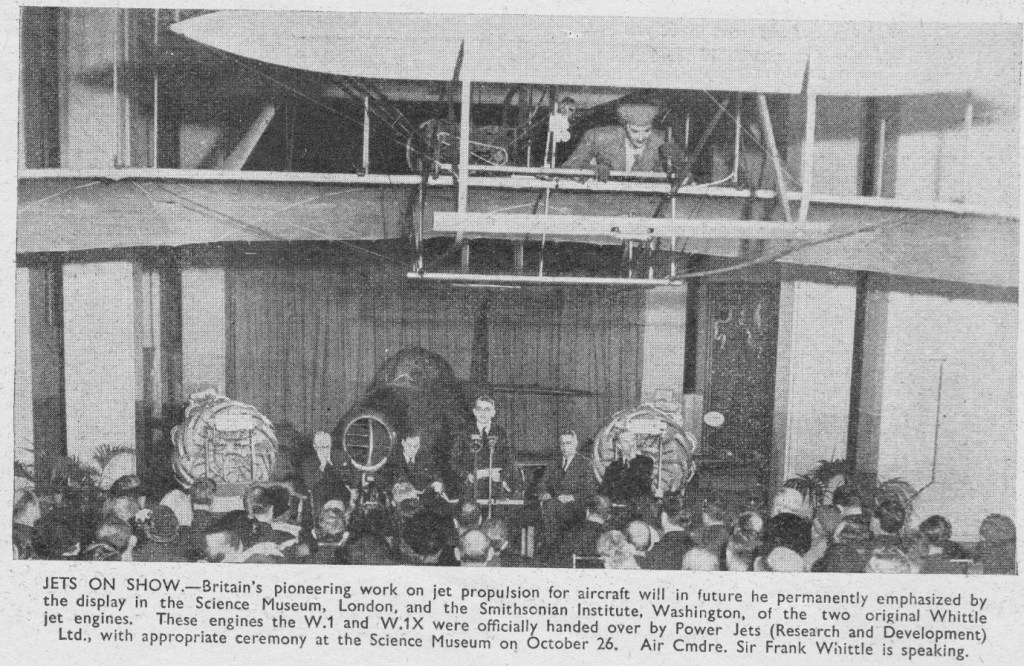
As development of the new design dragged on, it was decided to build a test unit “early engine” using any components that were deemed unairworthy along with test items. This was assembled to become the one-off W.1X.This officially unairworthy unit powered the Gloster E.28/39 on a short ‘hop’ during taxiing trials in April 1941, with flight trials taking place on 15 May 1941 at RAF Cranwell with a definitive W.1 engine.
After a visit to England in 1941, General Henry H. Arnold arranged for the W.1X to be shipped to the U.S, along with drawings for the more powerful W.2B engine. The former became the prototype of the General Electric I-16 and by April 1943 had been developed to produce 1,650 pounds force (750 kgf).
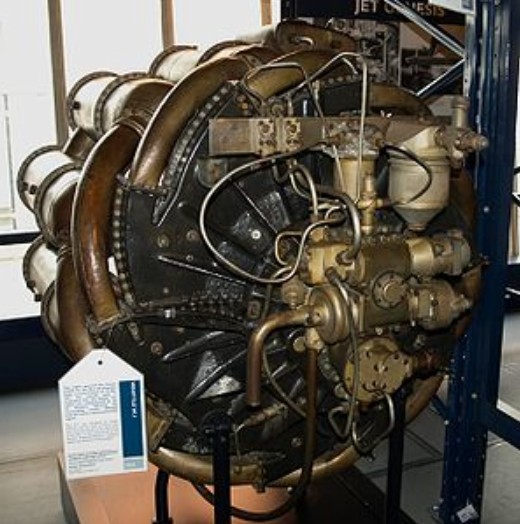
The Gloster E.28/39 and the Power Jets W.1 engine that powered it are both on public display at the Science Museum (London).
November 1949
The W.1A is preserved at the RAF College Cranwell, and the W.1X is at the Smithsonian Institution, Washington DC.
Variants: W.1(T) Bench-testing only.
W.1(3)
W.1X Intended for ground use only (aircraft taxi tests).
W.1A 1,450 lbf (6.45KN) air-cooled turbine disc
Variation: General Electric I-16 American-built version of W.1A. This is the only version of the W.1 to go into mass production.
Specifications: W.1 early development engine Type: Centrifugal flow turbojet Dry weight: 700 lb (320 kg) Compressor: Single-stage double-sided centrifugal flow Combustors: 10 reverse-flow can Turbine: Single stage axial flow Fuel type: Kerosene Maximum thrust: 850 lbf (3.8 kN) at 16,500 rpm Fuel consumption: 1,170 lb/hr (531 kg/h) Specific fuel consumption: 1.376 lb/hr/lb (38.98 g/s·kN) Thrust-to-weight ratio: 1.214:1
W.1 later development engine Type: Centrifugal flow turbojet Dry weight: 700 lb (320 kg) Compressor: Single-stage double-sided centrifugal flow Combustors: 10 reverse-flow can Turbine: Single stage axial flow Fuel type: Kerosene Maximum thrust: ~1,032 lbf (4.59 kN) Overall pressure ratio: ~3.8:1 Turbine inlet temperature: ~1,430 °C (2,610 °F) Fuel consumption: ~1401 lb/hr (~636 kg/h) Specific fuel consumption: ~1.358 lb/hr/lb (~38.47 g/s·kN) Thrust-to-weight ratio: ~1.474:1