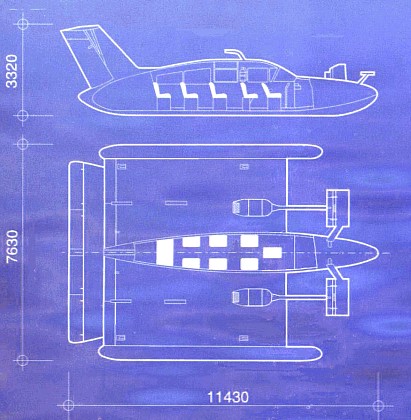
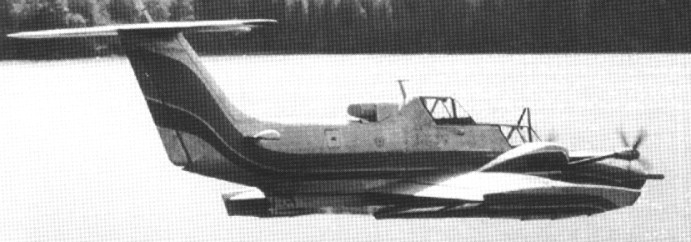
A mostly wooden UL single seater. Ply cover over foam ribs on wood / carbon spar. Two piece wing, flaperons with mix mechanism, T Tail.
Non-aerobatic.
Plans, parts, and kits were available. 51 % quick build kit from Czech Republic. All fabricated metal pre-made and materials to complete supplied. 2009 Price: 7950 EURO
Kit cost with engine but no instruments NZ$28000.00 incl ballistic chute in 2013.
Engine: 36 HP 2 cyl 4 stroke Reduction: geared belt 6000RPM about 4 /1 Span: ~6 m, Length: ~4m Empty Weight: 130 kg / 287 lbs MTOW Weight: 240 kg / 529 lbs Fuel capacity: 28 ltrs Stall: 35 kt / 40 mph / 65 kmh Cruise: 92 kt / 106 mph / 170 kmh VNE: 110 kt / 126 mph / 203 kmh Climb Rate: 400 ft/min / 2,5-4 m/s Take-off distance (50ft obstacle): 820 ft / 250 m Landing distance (50ft obstacle): 980 ft / 300 m
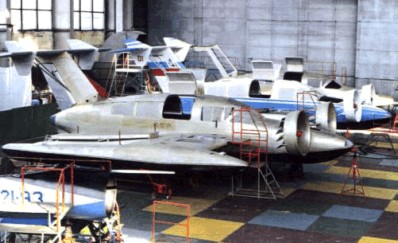
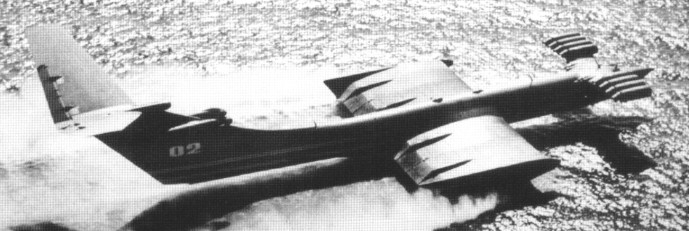
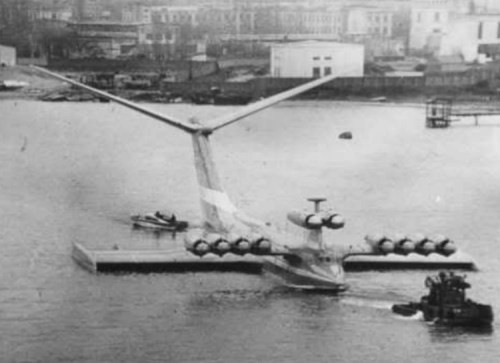
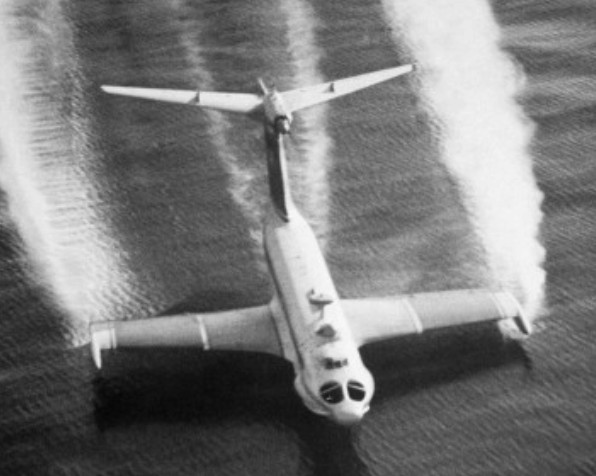
The Monster (its Russian designation was KM, derived from the words Korabl’ Maket or “ship model”) was nothing less than a juggernaut, one of the largest heavier-than-air flying machines ever built. At 500 tonnes it had a 100-tonne MAUW advantage over its fellow winged heavyweight the Boeing 747. No less than ten jet turbines constituted its propulsion system, an array of power used for take-off rather than cruise. Eight turbines were arranged in a shoulder-mounted stub-wing battery just aft of the cockpit. Capable of being deflected under the mainplane where a full-span trailing edge flap would trap their thrust, their combined power could generate an immense lifting force via a hovercraft-like static air cushion to cruise 4 metres above the water
The Lun-class ground effect vehicle (GEV), or sea skimmer, was developed by Russian engineers at the Alexeyev Hydrofoil Design Bureau.
During the Cold War, ekranoplans were sighted for years on the Caspian Sea as huge, fast-moving objects. The name Caspian Sea Monster was given by U.S. intelligence operatives who had discovered the huge vehicle, which looked like an airplane with the outer halves of the wings removed. After the end of the Cold War, the “monster” was revealed to be one of several Russian military designs meant to fly only a few meters above water, saving energy and staying below enemy radar.
The KM, as the Caspian Sea Monster was known in the top secret Soviet military development program, was over 100 m long (330 ft), weighed 540 tonnes fully loaded, and could travel over 400 km/h (250 mi/h), mere meters above the surface of the water.
These craft were originally developed by the Soviet Union as very high-speed (several hundred km/hour) military transports, and were mostly based on the shores of the Caspian Sea and Black Sea. The largest could transport over 100 tonnes of cargo. The only three operational A-90 Orlyonok ekranoplans built (with renewed hull design) and one Lun-class ekranoplan remained at a naval base near Kaspiysk.
The Lun-class (“Harrier”) Ekranoplan MD-160, dubbed the “Caspian Sea Monster” by US Intelligence services, was one of a kind. It was capable of carrying up to 124 tonnes of troops and equipment, including as many as six nuclear missiles, at speeds up to 560km/h as far as 2000km. Eight Kuznetsov 128.9kN NK-87 turbofans mounted on the front cannards provided the thrust to get the seaplane’s hull up and out of the water and engage the ground effect.
While ground-effect vehicles are a highly efficient way to transport cargo over long distances, the MD-160 had significant drawbacks in its military applications. For one thing, manoeuvrability. Anything resembling a sharp turn was right out, and allowing a wing tip to even sniff the water could result in 500 tonnes of seaplane cartwheeling along the surface of the Caspian. And since the ground effect didn’t actually take effect until the plane was out of the water, the MD-160 had to always take off into the wind.
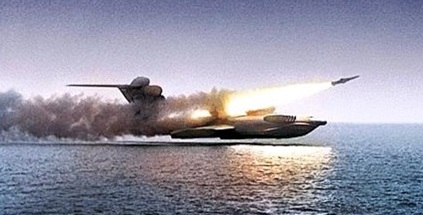
In 1987, the first flight was made by Lun, an ekranoplan-rocket carrier. It was armed with six guided anti-ship missiles “3M-80 Mosquito”.
After the successful completion of state tests “Lun” was in 1990 transferred to trial operation. However, the collapse of the Soviet Union led to the cessation of work in this area and the disbanding of the 11th Air Group of the Black Sea Fleet E-Wing.
So while the MD-160 was thoroughly impervious to subsurface mines and torpedoes, its size and complete lack of manoeuvrability made the planes sitting ducks against Western air forces (hence its NATO designation: Duck), often requiring armed escort and forward scouting boats to avoid obstacles. The Ekranoplan carried anti-ship P-270 Moskit guided missiles in six pairs mounted onto its fuselage as well as a pair of 23mm Pl-23 cannons in a tail turret and forward-facing pair under the forward missile tubes.
Despite the the MD-160’s shortcomings, Soviet high command continued to move forward with the program right up until the Soviet Union fell. A second MD-160, destined to be a mobile field hospital, was 90 per cent complete and another 30 A-90 Orlyonok GEVs, meant to strengthen the Black Sea Fleet, were on order when the program’s funding was cut. The MD-160 currently resides at a naval station in Kaspiysk.
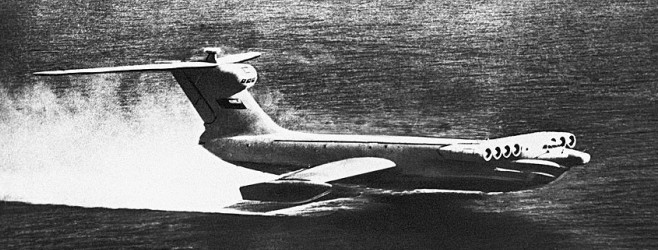
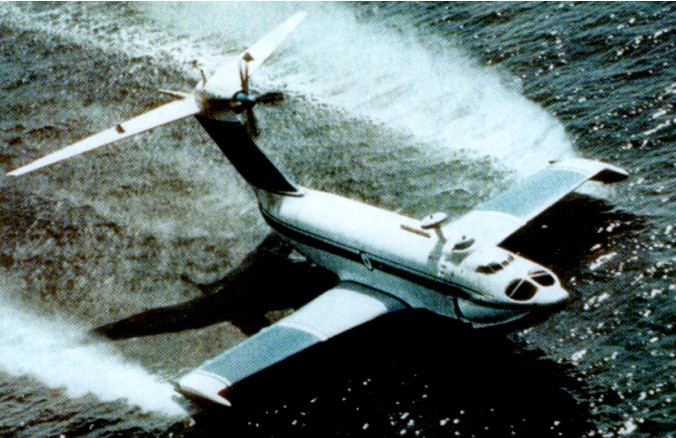
A 125-tonne, 200-knot troop transport and assault wing in surface effect craft for the Soviet forces. The development of ekranoplans was supported by Dmitri Ustinov, Minister of Defence of USSR. About 120 ekranoplans (A-90 Orlyonok class) were initially planned to enter military service in the Soviet Navy.
In 1972, the first really working military “Orlyonok” was built, intended for the transfer of amphibious assault forces to a range of up to 1,500 km.
The figure was later reduced to less than thirty vehicles, planned to be deployed mainly for the Black and the Baltic Soviet navies. Marshal Ustinov died in 1985, and the new Minister of Defence Marshal Sokolov effectively ceased the funding for the program. The only three operational A-90 Orlyonok ekranoplans built (with renewed hull design) and one Lun-class ekranoplan remained at a naval base near Kaspiysk.
A-90 “Orlyonok” in the Museum of the Navy in Tushino, Moscow
SMD/Flexiform Sky Sails Gazelle/Medium Striker is a single seat single engined flex wing aircraft with weight shift control. Rogallo wing with keel pocket. Pilot suspended below wing in trike unit, using bar to control pitch and yaw/roll by altering relative positions of trike unit and wing. Wing braced from above by kingpost and cables, from below by cables; bowsprit construction with >70% double-surface; pre formed ribs. Undercarriage has three wheels in tricycle formation; no suspension on any wheels. Push right go left nosewheel steering independent from yaw control. Optional brakes on main wheels. Aluminium -tube trike unit, without pod. Engine mounted below wing driving pusher propeller.
Chris Scoble of Southern Microlight Developments builds only the trike unit, and normally mates it to a Flexiform Sky Sails Medium Striker wing, which he strengthens in a similar fashion to the one plus one Striker wing used on the Mainair Rapier.
Gazelles tend to be tailored to the customer’s own requirements and therefore vary in specification, but they are all double pole machines with the poles placed at the extreme ends of the axle for maximum strength, rather in the manner of a UAS Storm Buggy. Normal engine fitment is a 440 cc Robin, with electric start. Heavy duty alloy main wheels are standard.
Living near the sea has encouraged Chris to take an interest in float flying and in spring 1983 he introduced them as an option. The SMD floats can be fitted without disturbing the wheels and are constructed from glass-reinforced polyester in a colour to the customer’s choice. Each has three separate compartments to minimise the effect of leakage. Along the top of each float is a GRP beam which allows the fixing points to be moved at will until correct weight distribution is attained.
Engine: Robin EC44, 40 hp at 6500 rpm Propeller diameter 58 inch, 1.47 m V belt reduction, ratio 2.4/1 Max static thrust 270 lb, 122 kg Power per unit area 0.20 hp/sq.ft, 2.2 hp/sq.m Fuel capacity 6.0 US gal, 5.0 Imp gal, 22.7 litre Length overall 11.0ft, 3.35m Wing span 34.5ft, 10.52m Sweepback 15 deg Total wing area 200 sq.ft, 18.6 sq.m Wing aspect ratio 7.5/1 Wheel track 5.0 ft, 1.52 m Wheelbase 5.6ft, 1.70 m Nosewheel diameter overall 13 inch, 33 cm Main wheels diameter overall 16 inch, 41 cm Optional floats: length 12.5 ft, 3.81 m; weight 38 lb, 17 kg each
Designed by R S Crowley, the 1933 Southern Eagles model A was a two-place open cockpit biplane, built by Southern High School students under the guidance of aircraft-mechanic instructors.
The one built, NC2392 c/n 1, was powered by a Salmson engine, and the registration was cancelled on 31 August 1934.
The 1929 monoplane was a two-place open cockpit, powered by a 60hp Anzani engine, replaced by a Chevrolet in December 1930. As NX817N it was sold to J C Norris of Collierville in November 1932, who may have reverted to an Anzani.
The registration was cancelled by the CAA in September 1934.
This could be the Fleming, according to findings by John M Jarratt, but this enigma has yet to be solved as the name of Fleming is not apparent. Mann Co officials of record also included Ricardo Houstee, Mann Jr, and E F Moreland.
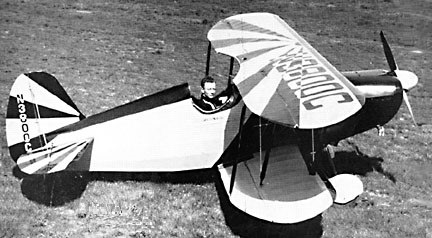
The 1950 Southern Commercial Airmotive Corp aerobatic biplane was built from salvage of a Being P-12 for Charles Short and sometimes seen credited to his name.
The one built was registered N3800C and also seen also as re-registered (Del) Denly Special in the 1950s.