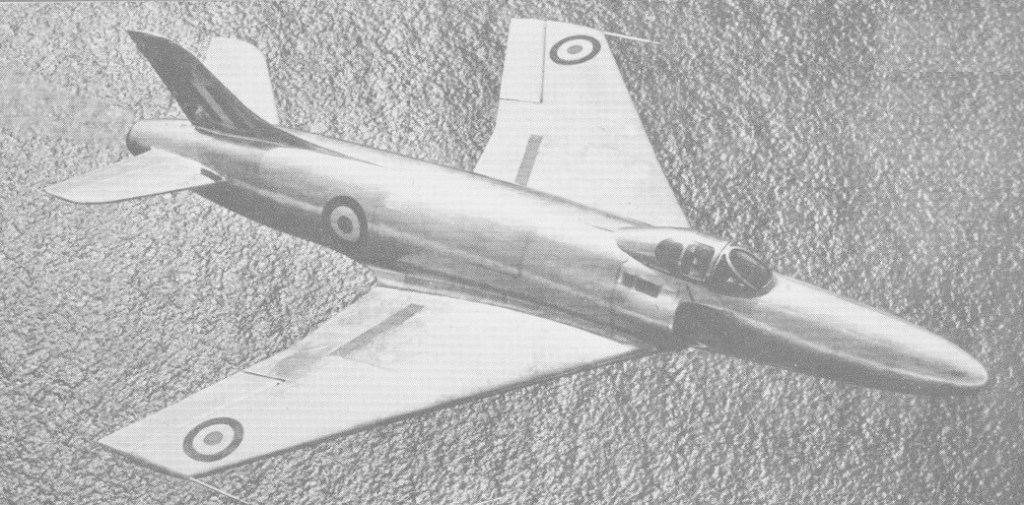
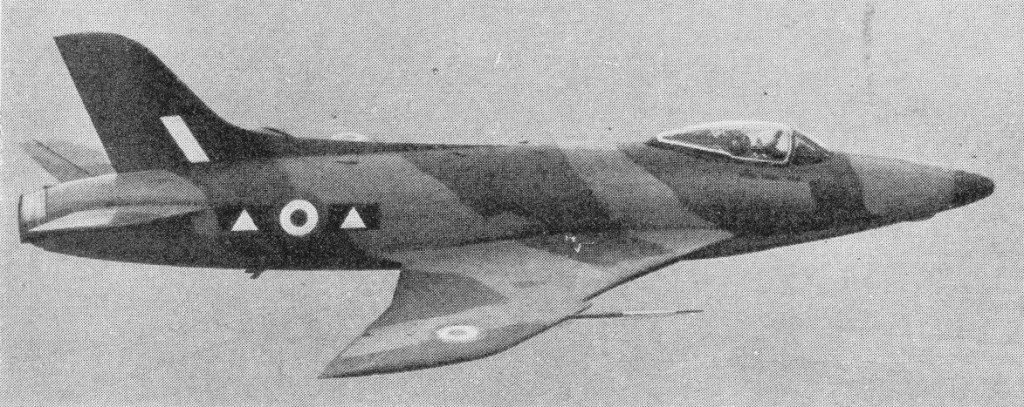
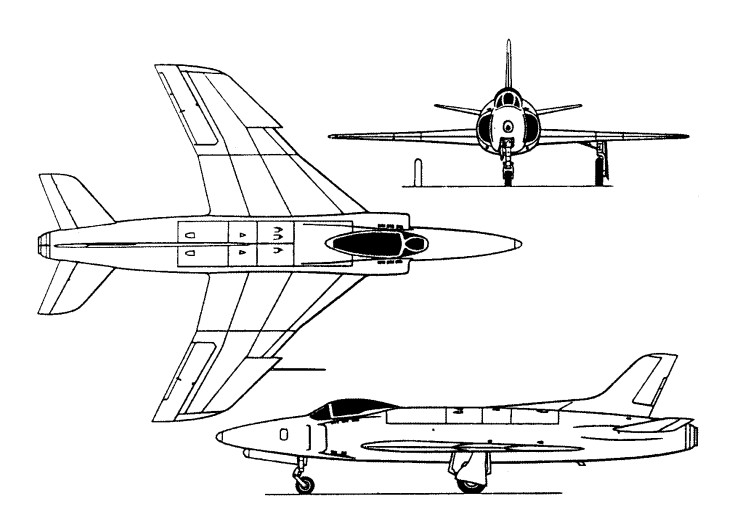
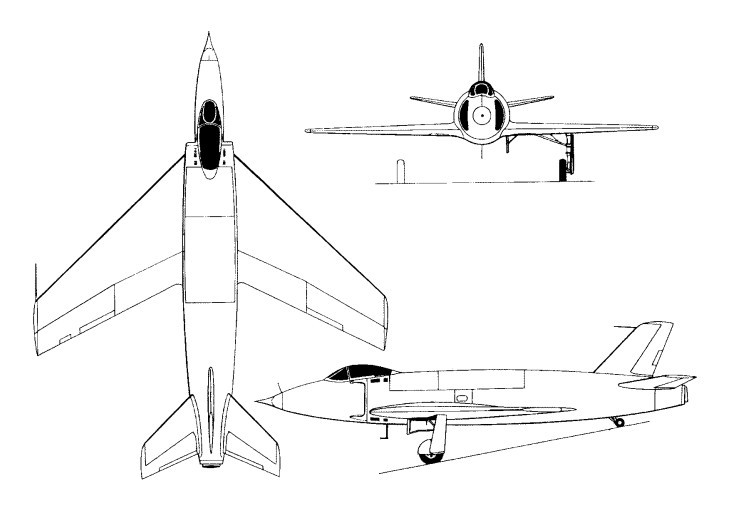
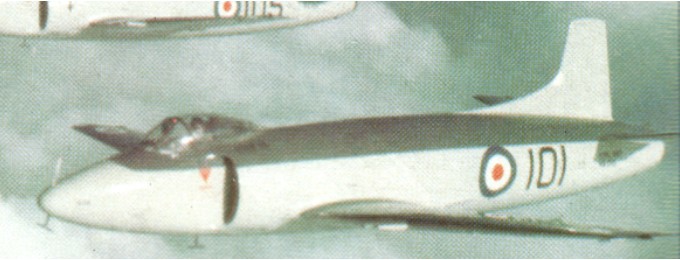
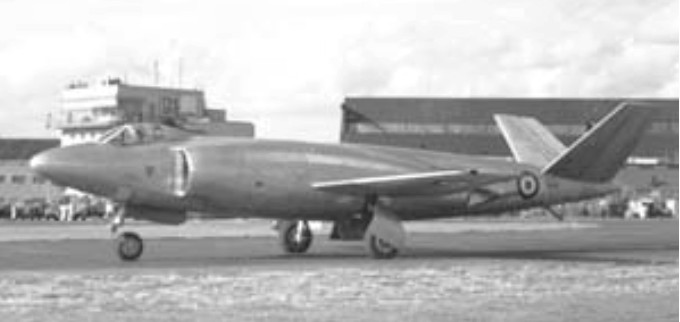
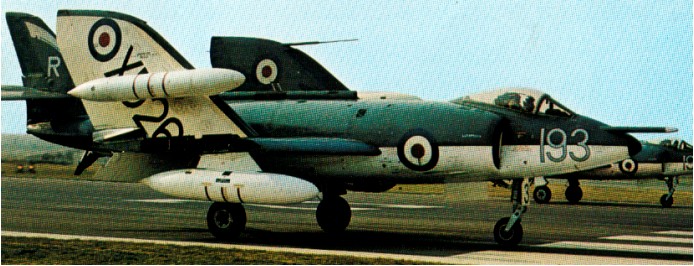
The Swift was a single-seat swept-wing fighter powered by a Rolls-Royce Avon axial-flow turbojet engine. During development the engine was changed from the Rolls-Royce Nene to the slimmer Avon. It was too late to change the fuselage, which was fatter than necessary. Flown for the first time in prototype form on 1 August 1951, the Swift appears to have proceeded fairly smoothly through its development period.
On 10 July 1952 the prototype established an international point-to-point record between London and Brussels, covering 320km in 18 minutes 3.3 seconds, representing a speed of 1,071.7km/h. Mike Lithgow piloted the prototype Swift F.Mk 4 to 1183.5 km/h (735,4 mph) over a 3 km course at Idris, Libya, of 24 September 1953. Subsequent runs were spoilt by a failed afterburner. This accomplishment was extremely short-lived, the record standing for just three days before it succumbed to a US Navy Douglas F4D-1 Skyray.
WK198 in Libya
Record holding Swift WK198 was the third production Swift F.Mk 1 and was converted as the prototype F.Mk 4. This introduced a variable-incidence tailplane to counter pitch-up problems encountered with earlier machines.
WK198 F.Mk 4
Deliveries to the Royal Air Force got under way during February 1954, the first examples of the Swift F.Mk.1 being assigned to the Air Fighting Development Squadron for operational trials. Shortly after this the type began to enter operational service with No. 56 Squadron, but the pure fighter variant was destined to enjoy only a very brief career, those examples of the Swift F.Mk 1 and Swift F.Mk 2 which equipped No. 56 being retired in March of the following year, largely as a result of the type’s poor all-round qualities. Subsequently, most of the remaining Swift F.Mk 2 and Swift F.Mk 3 production examples were passed directly from storage to technical schools, where they served as instructional airframes.
The RAF received a total of about 60 Swift F.1s, F.2s and F.3s, with an Avon RA.7 turbojet engine and two 30mm Aden cannon; four Aden cannon and a new wing planform with compound leading-edge taper; and with an Avon RA.7R engine with afterburner and changes to the rear fuselage respectively. These versions were not used operationally.
The Swift F.4 had an all-moving tail of increased area which finally cured the Swift’s pitch-up problems, and an afterburning Rolls-Royce Avon.
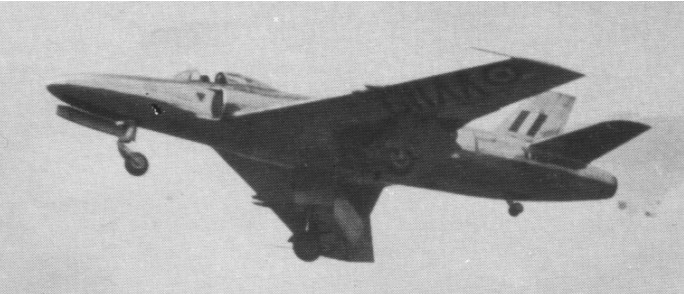
Only the FR.5 was used for any length of time and was a fighter-reconnaissance aircraft with a longer nose to accommodate 3 F95 camera- 1 facing forward & 2 facing sideways. AG45 gun camera was also fitted.
Swift FR.5
Deliveries began in 1956. Sixty were flown by the RAF; one further aircraft ordered crashed on delivery and several others were not completed.
All production was stopped in February 1955 after the 176th production machine had been completed. The final 35 aircraft were converted to the tactical reconnaissance FR Mk.5, this serving with Nos 2 and 79 Squadrons from Gütersloh, West Germany. Introduced by No.2 Squadron during February 1956, the Swift FR.Mk 5 remained operational until early in 1961 when re-equipment with the Hunter FR.Mk 10 was completed. The only other noteworthy Swift derivative was the Swift F.Mk 7 which equipped the Guided Weapons Development Squadron at Valley during the late 1950s, being employed on trials work in connection with the Fairey Fireflash guided missile. Following a single prototype, 12 examples of the Swift F.Mk 7 were completed from F Mk 4s, and one of these remained in an airworthy state until about the mid-1960s, at one time taking part in a series of trials relating to braking efficiency on wet runways.
Despite more and more modifications, it was all too late. The performance of the aircraft had been so degraded by the constant increase in weight that its intended role as an interceptor could not be fulfilled. Reheat had to be employed for take off, climb and combat, which resulted in an endurance of but 25min and a combat radius of barely 50 miles, or virtually nil if a bad weather recovery was needed. Having been plagued with problems and incidents and being clearly unsuited for its intended role as a day fighter, the aircraft was withdrawn from use by 56 Sqn during March 1955, after barely a year of service. The squadron was re-equipped with the Hunter during the following May.
Only a relatively small number of the 175 or so that were eventually completed actually attaining operational service with the Royal Air Force.
Swift F.Mk.1 Engine: 1 x Avon RA.7 turbojet Armament: two 30mm Aden cannon
Swift F.Mk 2 Engine: 1 x Avon RA.7 turbojet Armament: four 30mm Aden cannon
Swift F.Mk 3 Engine: 1 x Avon RA.7 turbojet Armament: four 30mm Aden cannon
Swift F.4 Engine: 1 x Rolls-Royce Avon RA.7R with afterburner.
Swift FR.5 Engine: 1 x 4287-kg (9,450-lb) afterburning thrust Rolls-Royce Avon Mk 114 turbojet Maximum speed 1102 km/h (685 mph) at sea level Initial climb rate 4468 m (14,660 ft) per minute Service ceiling 13960 m (45,800 ft) Range 1014 km (630 miles) Empty weight 6094 kg (13,435 lb) Maximum take-off 9831 kg (21,673 lb) Wingspan 9.85 m (32 ft 4 in) Length 12.90 m (42 ft 3.5 in) Height 4.00 m (13 ft 2 in) Wing area 30.44 sq.m (327.7 sq ft) Armament: two 30-mm Aden cannon Crew: 1
Swift F.Mk 7 Engine: 1 x Rolls-Royce Avon RA.7R with afterburner.
Three aircraft were ordered to Specification N.9/47 for a naval fighter, and, configurationally similar to the Type 505 apart from the undercarriage. In February 1950, the contract covering the third prototype was amended to introduce sweptback wings, and this, as the Type 525, became, in effect, the prototype of the Scimitar.
The Type 525 has an all moving tail with narrow chord elevators and a tail braking parachute in the streamlined fairing of the tailplane and fin. A V type arrester hook is housed in clamshell doors below the rear fuselage, and there is a fuel tank of 58 gal. capacity in the fuselage between the two jet pipes. The 525 has slotted ailerons, of a similar type to those of the Swift.
Very large flap area is provided for deck landing, wing flaps being of the chord increasing type with a slot effect, and extra area is gained by two additional hinged surfaces below the fuselage. The wing also has full span slats which are extended for slow speed control. Since the long stroke undercarriage with its large diameter wheels retracts into the fuselage forward of the flaps, fairing doors for the wheel wells are provided and close to preserve the airflow after the undercarriage is extended. The 525 also has fuselage -mounted air brake flaps hingeing forward just below the leading edge of the wing on the fuselage.
During 1946, in response to a contract to build two prototypes of a single-seat high-speed fighter to Specification E.41/46, Supermarine combined sweptback wing and tail surfaces with what was essentially an Attacker fuselage to create the Type 510. This retained the Rolls-Royce Nene 2 engine and tailwheel undercarriage of the Attacker.
The first prototype was flown on 29 December 1948. No armament was fitted, but provision was made for four wing-mounted 20mm cannon. The second prototype, designated Type 528, flew in similar configuration on 27 March 1950, and, on 8 November of that year, the Type 510, fitted with an Attacker-style A-frame arrester hook, made a series of landings and take-offs from the carrier HMS Illustrious.
Later, the first aircraft (now redesignated Type 517) was fitted with a movable rear fuselage permitting the incidence of the integral tailplane to be varied. Meanwhile, the Type 528 was fitted with an afterburning version of the Nene, a lengthened nose and a tricycle undercarriage as the Type 535, flying in this form for the first time on 23 August 1950, and providing the basis for the development of the Swift. Four wing cannon were carried by the 535, but such positioning found no official favour.
The Type 535 proved sufficiently impressive for a 100-aircraft order to be planned if the same company’s Type 541 proved a failure.
Type 510 Max take-off weight: 5534 kg / 12200 lb Wingspan: 9.66 m / 32 ft 8 in Length: 11.61 m / 38 ft 1 in Height: 2.68 m / 9 ft 10 in Wing area: 25.36 sq.m / 272.97 sq ft Max. speed: 1014 km/h / 630 mph
The Superrnarme Attacker prototype had been built to a 1944 specification. The single-seat jet fighter flew for the first time on July 27, 1946. The machine was flown by Supermarine’s test pilot, Mr Jeffrey Quill, from the A&AEE at Boscombe Down, where, as there is not at the firm’s aerodrome at High Post, there is a runway.
The prototype, T5409, was seen at the SBAC show at Radlett the following month.
Named Attacker, the aircraft uses a Rolls-Royce RB.41 (later Nene) centrifugal flow turbojet, a new fuselage and tail mounted on the laminar flow wings of the Spiteful with radiators removed.
The undercarriage was also taken from the Spiteful. The wing retained the Spiteful’s four cannon armament but the radiators for its Griffon piston engine were removed and replaced by fuel tanks.
The result was the Attacker F.Mk.1, a mediocre fighter whose main advantages were cheapness and easy handling at low level. This was put to use by adding bombs in the Attacker FB.Mk.1 version, and the Attacker FB.Mk.2 had powered ailerons and a stronger met¬al-framed canopy. The last of 145 of the three marks was delivered in 1953, also exported to Pakistan, and served until 1957.
Three prototypes were ordered in August 1944 but development was slower than anticipated due to delays in laminar flow wing research, with low speed handling problems proving difficult to solve. As the RAF had begun to lose interest in the aircraft, it was decided that the last two prototypes would be navalised.
The first prototype flew on 27 July 1946 and the second on 17 June 1947 (the name “Attacker” applied on the same day), this differing in having longer stroke undercarriage, smaller fin, enlarged tailplane, increased fuel capacity, arrester hook and an ejection seat. Folding wings would not appear until the production versions were built. By then, the RAF was no longer a prospective customer and the aircraft was ordered only tor the Royal Navy Fleet Air Arm.
The first production Attacker F.1 flew on 5 May 1950 and operational service began in August 1951 with No 800 Squadron FAA. Subsequent versions were the FB.1 fighter-bomber with provision for underwing ordnance and the FB.2 which differed mainly in its Nene Mk.102 engine with a throttle acceleration control unit to prevent flameout if the throttle was opened quickly, such as when performing a go-around. The Attacker served with only two FAA front line squadrons and had been relegated to Volunteer Reserve units by 1954 and retired two years later.
The only export was to the Pakistan Air Force, which received 36 ‘denavalised’ aircraft between 1951 and 1953 for operation from land. These lacked the folding wings and arrester gear of the Royal Navy’s aircraft but were otherwise similar to the Attacker F.1.
Attacker F.Mk.1 Engine: 1 x Rolls-Royce “Nene 3”, 22.24kN Max take-off weight: 5339 kg / 11771 lb Empty weight: 3826 kg / 8435 lb Wingspan: 11.25 m / 37 ft 11 in Length: 11.43 m / 38 ft 6 in Height: 3.02 m / 10 ft 11 in Max. speed: 950 km/h / 590 mph Ceiling: 13700 m / 44950 ft Range: 950 km / 590 miles Armament: 4 x 20mm cannon Crew: 1
Attacker FB.Mk 2 Engine: one 2313-kg (5, 100-lb) thrust Rolls-Royce Nene Mk 102 turbojet Maximum speed 950 km/h (590 mph) at sea level Initial climb (light weight 5216 kg/1,500 lb) 1935 m (6,350 ft) per minute Service ceiling (maximum weight) 11890 m (39,000 ft) Range (with 1 137-litre/250-Imp gal belly tank) 1700 km (1,060 miles) Empty weight 4495 kg (9,910 lb) Maximum take-off 7938 kg (17,500 lb) Span 11.26 m (36 ft 11 in) Length 11.43 m (37 ft 6 in) Height 3.03 m (9 ft 11 in) Wing area 21 sq.m (226 sq ft) Armament: four 20-mm Hispano Mk 5 cannon Bombload: two 454-kg (1,000-lb) bombs or eight rockets
Responding to Admiralty interest in “undercarriage-less” aircraft suitable for operation from flexible decks on aircraft carriers, Supermarine designed the Type 505 single-seat fighter in 1945. Two Rolls-Royce AJ65 (later to be named Avon) turbojets were located side-by-side in a broad centre fuselage to provide a stable base for alighting on the “carpet” and a Vee configuration kept the tail surfaces clear of the jet efflux. An armament of twin 20mm cannon was planned and provision was made to provide for a fixed tricycle undercarriage for flight development and operation from shore bases. It was thus relatively simple to incorporate a retractable undercarriage in the design when Admiralty interest in the flexible deck concept waned in late 1947 and the fighter was modified as the more conventional Type 508.
Three aircraft were ordered to Specification N.9/47 for a naval fighter, and, configurationally similar to the Type 505 apart from the undercarriage, the first of these flew on 31 August 1951. The second (as the essentially similar Type 529) followed a year later, on 29 August 1952.
In February 1950, the contract covering the third prototype was amended to introduce sweptback wings, and this, as the Type 525, became, in effect, the prototype of the Scimitar. The Types 508 and 529 were each powered by a pair of 2948kg Avon RA3 engines and had provision for an armament of four 20mm cannon.
To be broken up February 1956
Type 529 Engines: 2 x 2948kg Avon RA3 Empty weight: 8373 kg / 18459 lb Wingspan: 12.50 m / 41 ft 0 in Length: 15.24 m / 50 ft 0 in Height: 3.54 m / 12 ft 7 in Wing area: 31.59 sq.m / 340.03 sq ft Max. speed: 977 km/h / 607 mph
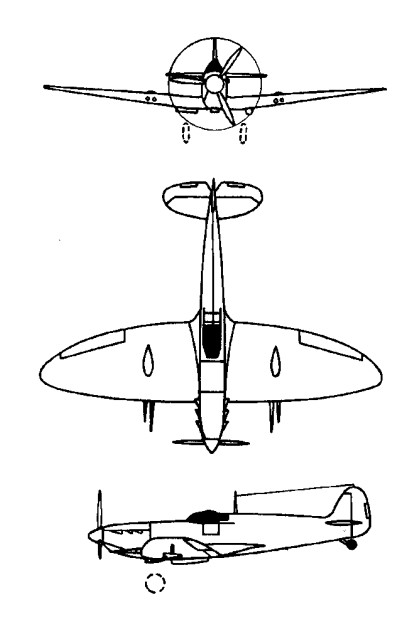
Conceived as a successor to the Spitfire, the Type 371 was projected from November 1942, initially mating a laminar flow wing with a Griffon-engined Spitfire XIV and progressively embracing a new fuselage. Three prototypes were ordered to Specification F.1/43, which was written around the project, and the first of these flew on 30 June 1944. This prototype comprised a Spitfire XIV fuselage with the new wing, a 2,035hp Rolls-Royce Griffon 61 engine and an armament of four 20mm cannon.
Named Spiteful, the second prototype flew on 8 January 1945 with the new fuselage, an all-round vision cockpit canopy and a 2,375hp Griffon 69 driving a five-bladed propeller. Production orders were placed for 188 Spitefuls, but only 16 were flown of 19 built or partially-completed (from April 1945) as the end of World War II and the advent of the jet fighter terminated plans for RAF use of the Spiteful. The designation F Mk 14 was applied to the Griffon 69-powered Spiteful; the proposed F Mk 15 had either the Griffon 89 or 90 with a six-bladed contraprop, and a single F Mk 16 had a Griffon 101 with a three-speed supercharger and five-bladed propeller. The two conversions from the Mark XIV, RB516 and RB518 were fitted with the Griffon 101 engine producing 2,420 hp and a top speed of 494 mph.
Development of a navalised Spiteful was pursued during 1945 to Specification N.5/45, and a contract was placed for two prototypes and by May 1945 nearly 150 fighters were ordered for production, the name Seafang being assigned. This aircraft was created as part of a project by Supermarine to design a new wing with a laminar profile. This began in November 1942. The machine, designated ‘Type 382’, was based on a Spiteful single seat fighter.
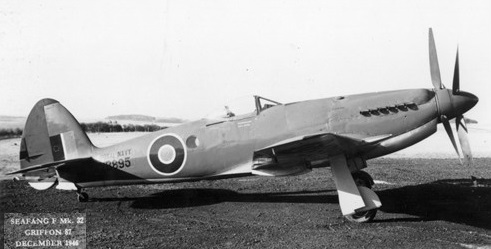
A Spiteful F Mk 15 with a “sting”-type arrester hook was tested early in 1945, and the Seafang prototypes flew in the following year. One of these represented the production Seafang F Mk 31 with Griffon 61 engine and a long-stroke undercarriage, but non-folding wings. The other represented the Seafang F Mk 32 with a Griffon 89 engine with contraprop, and upward-folding wings. The Seafang F. Mk.32 was a second production series that differed drastically from the first Mk.31 variant, and this was the version planned for mass production. Armament comprised four 20mm cannon and provision was made for carrying a pair of 454kg bombs or six 136kg rockets.
The prototype VB895 was only finished in early 1946. The aircraft was equipped with a system that allowed the wingtips to fold up for carrier flight decks. The fighter was powered by a 2350hp Rolls-Royce Griffon 89 engine and coaxial propellers. The design included all the necessary equipment to operate from aircraft carriers. Four 20-mm Hispano cannons made up the main armament, additionally the fighter could carry rockets and bombs.
After completion during 1946-47 of 10 Mk 31s and six Mk 32s (some of which were never flown) production was cancelled, and attempts to interest other countries in purchasing the Seafang also failed.
All the produced aircraft were used extensively for various testing programs.
Spiteful F 14 Max take-off weight: 4513 kg / 9950 lb Empty weight: 3334 kg / 7350 lb Wingspan: 10.67 m / 35 ft 0 in Length: 10.03 m / 33 ft 11 in Height: 4.08 m / 13 ft 5 in Wing area: 19.51 sq.m / 210.00 sq ft Max. speed: 777 km/h / 483 mph Ceiling: 12800 m / 42000 ft Range: 908 km / 564 miles
Supermarine Spiteful F 16 Engine: Rolls Royce Griffon 65, 2342 hp Length: 32.349 ft / 9.86 m Height: 13.419 ft / 4.09 m Wingspan: 35.499 ft / 10.82 m Wing area: 210.006 sq.ft / 19.51 sq.m Max take off weight: 10202.5 lb / 4627.0 kg Weight empty: 7351.5 lb / 3334.0 kg Max. speed: 413 kt / 764 km/h Service ceiling: 42995 ft / 13105 m Wing loading: 48.59 lb/sq.ft / 237.00 kg/sq.m Maximum range: 1143 nm / 2116 km Range: 490 nm / 908 km Crew: 1 Armament: 4x 20mm MG, 454kg Bomb
Seafang F Mk 32 Max take-off weight: 4740 kg / 10450 lb Empty weight: 3629 kg / 8001 lb Wingspan: 10.67 m / 35 ft 0 in Length: 10.39 m / 34 ft 1 in Height: 3.82 m / 13 ft 6 in Wing area: 19.51 sq.m / 210.00 sq ft Max. speed: 764 km/h / 475 mph Ceiling: 12500 m / 41000 ft Range: 632 km / 393 miles
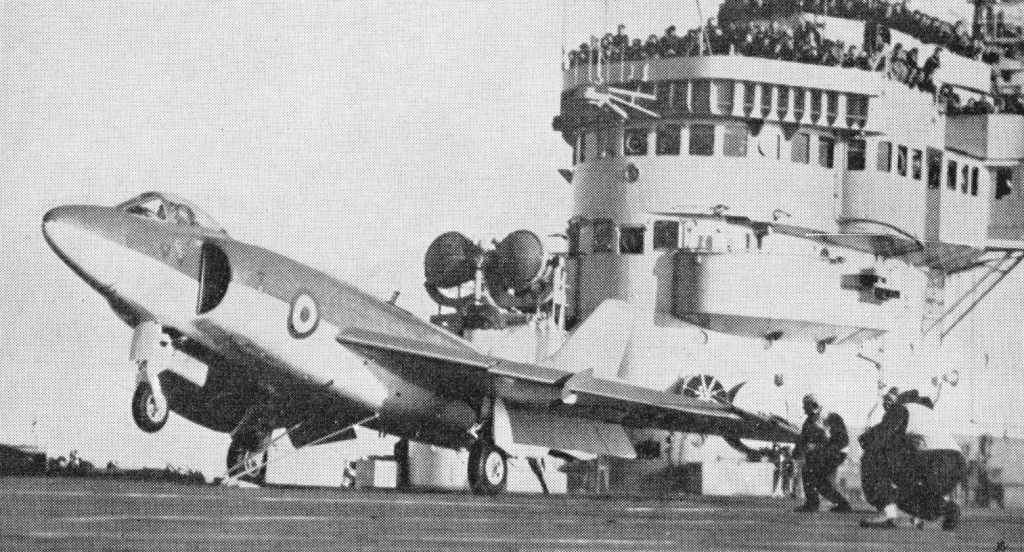
Known originally as the Supermarine N.113, the Scimitar F.1 was a large single-seat, twin-engined naval carrier-borne interceptor fighter and strike aircraft for the Royal Navy. The Royal Navy’s first single seat fighter capable of supersonic flight.
The Scimitar has mid-set sweptback wings, with slight anhedral, and dog-tooth leading edges. Blown trailing edge flaps are fitted. There are swept back tail surfaces with 10 degrees of anhedral on the tailplane. Conventional ailerons, rudder and one-piece all-moving tailplane are fitted. Engine air intakes are on each side of the fuselage by the cockpit. A tricycle undercarriage has single wheels on each unit, the mains retracting into the fuselage and the nosewheel retracts rearward. Internal tanks can be supplemented by four underwing tanks of up to 800 Imp.Gal total capacity. A flight refuelling probe can be fitted on the starboard side of the nose. The original armament was four 30mm Aden guns.
1957
The prototype flew for the first time on 19 January 1956 and deck-landing trials were successfully completed on HMS Ark Royal in July 1957.
Scimitar F.1
The first of 76 production aircraft flew on 11 January 1957 and the first operational squadron (No 803) was formed in June 1958 and embarked on HMS Victorious in the following September.
Scimitar F.Mk 1 Engine: 2 x Rolls-Royce Avon 202 turbojet, 50.04kN / 11,250 lb Max take-off weight: 15513 kg / 34200 lb Empty weight: 10869 kg / 23962 lb Wingspan: 11.33 m / 37 ft 2 in Length: 16.87 m / 55 ft 4 in Height: 5.28 m / 17 ft 4 in Wheel track: 14 ft 1 in Wing area: 45.06 sq.m / 485.02 sq ft Max. speed: 1143 km/h / 710 mph Cruise speed: 14020 km/h / 8712 mph Ceiling: 14020 m / 46000 ft Range: 2288 km / 1422 miles Armament: 4 x 30mm cannons, 4 x 454kg bombs or missiles Crew: 1
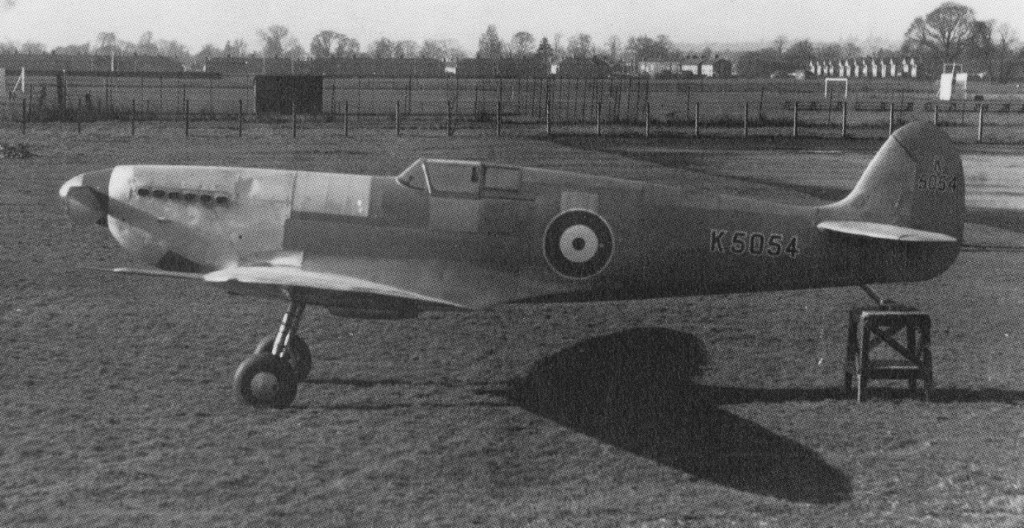
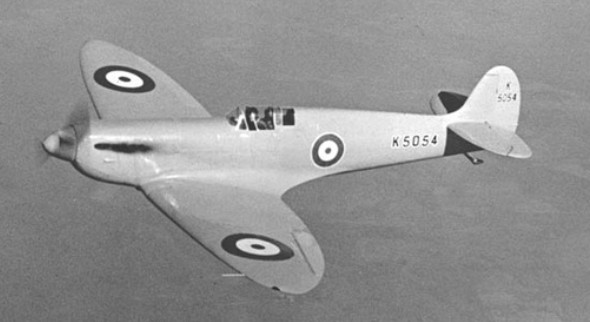
When the Type 224 performance proved disappointing, R. J. Mitchell was given a free hand to design a new single-seat fighter unfettered by official specifications. By 1934 Supermarine was actively engaged in the design of an “experimental high-speed single-seat fighter”. Mitchell outlined the Type 300 tailored around the new Rolls-Royce P.V.12 (Merlin) engine and based on experience of high speed flight through the Scneider Trophy winning seaplanes rather than contemporary fighters. With drag-reducing retractable landing gear, the wings were of distinctive elliptical shape, but they housed eight machine-guns, all of them firing outside the propeller disc. Air Ministry Specification F.36/34 was drawn up around the Type 300 and a single prototype was ordered in December 1934. It was powered by a 738kW Rolls-Royce Merlin C and flew for the first time on 5 March 1936 at Eastleigh near Southampton.
Spitfire prototype K5054 in March 1936
The Spitfire prototype went to the A&AEE in July 1936, at which time it had a Merlin C driving a de Havilland fixed pitch two-bladed wooden propeller. The performance edge over the Hurricane was evident. Service pilots at the A&AEE reported that the prototype “simple and east to fly and [had] no vices”. It had well harminised controls and the report concluded that the Spitfire could be “flown without risk by the average fully trained service fighter pilot”. One of the qualities was the extremely docile behaviour at the stall, particularly under high G. The longitudinal stability was a matter of concern from the start, and called for constant development as later marks were introduced. Of concern were the high lateral stick forces at the upper end of the speed range, not overcome until modified ailerons were introduced in 1941.
In accordance with the provision of Expansion Plan F, the Air Ministry ordered 310 Spitfire Is on 3 June 1936 defining a standard of aircraft that was generally similar to the prototype.
The crowds at the 1936 RAF Display at Hendon had a first glimpse of the prototype Spitfire in the New Types Park.
Spitfire Prototype K5054
Structurally the Spitfire was a straightforward design with a light alloy monocoque fuselage and a single spar wing with stressed-skin covering and fabric-covered control surfaces. To preserve the clean nose-cowling lines originally conceived by Mitchell, the radiator was located beneath the starboard wing with the smaller oil cooler causing some asymmetry beneath the port wing, and the carburetor air intake under the center fuselage.
Powered by a 1030 hp Merlin II, the first production aircraft flew on 14 May 1938, at Eastleigh, where the final assembly line was fed by manufacturing centres at Woolston and Itchen, near Southampton.
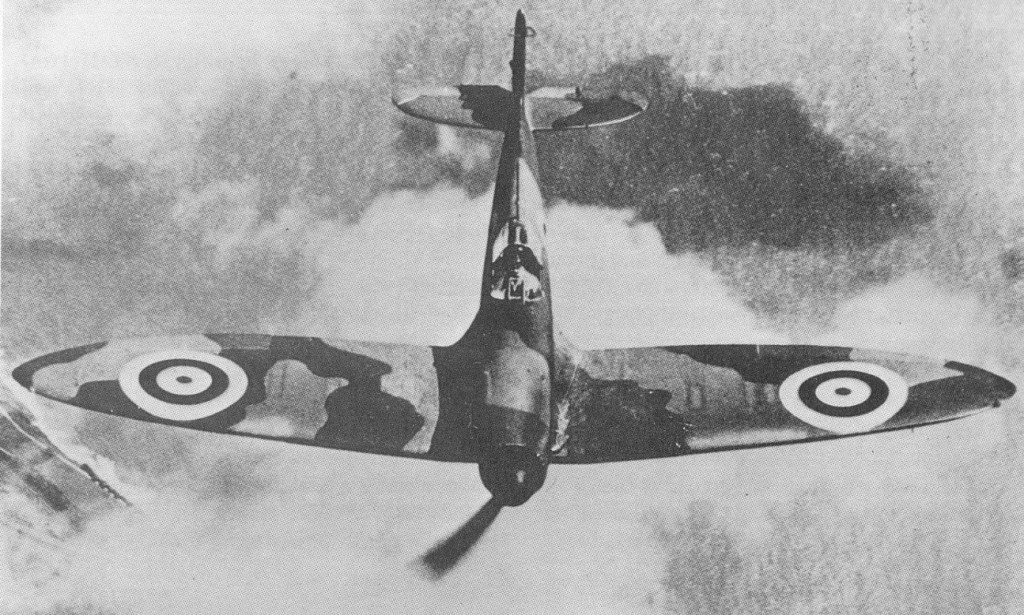
Spitfire I
A DeHavilland two-blade wooden fixed-pitch propeller was employed by the prototype and the first Spitfire I’s had the Airscrew Company’s wooden fixed-pitch two-blade. Later a DeHavilland three-blade, two position propeller was adopted after trials on the first prototype. The new propeller gave a 5 mph increase in speed. In 1940 DeHavilland three-blade constant-speed propeller were substituted. Production Spitfires had a fixed tail wheel and triple ejector exhaust manifolds. The X80 HP Rolls-Royce Merlin II and later the Merlin III engine was installed.
Supermarine failed by some six months to meet the Plan F target completion by March 1939. The problem was that the Spitfire was not a simple aircraft to build, the wing leading-edge being especially difficult. As time went by, and in particular after the Supermarine works in Southamption had been heavily bombed in Septembe 1940, Spitfire production would be dispersed widely over southern England and would bring 65 different manufacturing units into play.
Deliveries of production Spitfire I’s began in June 1938, two years after the first production contract had been placed. In those two years Supermarine laid out their Woolston factory for large-scale production and organized one of the largest subcontract schemes ever envisaged in Britain. Until that time, as it was becoming increasingly obvious that there was no limit to the likely demand for the Spitfire. It was also obvious that one factory alone was not going to be able to meet the demand even with sub-contracting. Large scale plans were laid during 1937 for the construction by the Nuffield Group of a large new shadow factory at Castle Bromwich near Birmingham for Spitfire production. On April 12,1938 a contract was placed for 1,000 Spitfires to be built at this new factory, of which the actual construction had not then even begun. In the following year, on April 29 further contracts were placed with Supermarine for 200 Spitfires and on August 9 for 450.
It was not until July 1938 that the first Spitfire Mk I reached No. 19 Squadron at Duxford. Only five had been delivered by the time of the Munich crisis in September of that year.
The first Spitfires off the assembly line had the Merlin II engine driving a two-blade fixed pitch wooden airscrew. With the 78th production aircraft, the wooden two-blade prop was replaced by a de Havilland Hamilton to-pitch three-blade metal prop, which, although incurring a weight penalty and having only marginal effect on level speed, gave a significant increase in the climb. No bullet-proof windscreen or armour was initially fitted, and although standard armament was envisaged as eight wing-mounted 0.303in Browning guns each with 300 rounds of ammunition, a shortage of these weapons led to the installation of only four guns each in early machines. Later, the introduction of a bullet-proof external windscreen was to be followed by provision of a 6mm armour plate behind the pilot’s head. After pilots on the first squadron had complained that they banged their heads on the flat roof of the cockpit canopy, a “humped” canopy was introduced.
In August 1938 No.19 Sqn RAF Duxford received two early production Spitfires and began a 400-hour intensive flying trial. Two more squadrons received Spitfires in 193 and, by September 1939, another four regular units were flying the Spitfire, and four AAF squadrons were equipped or equipping.
Spitfire I K9787 May 1938 flown by Jeffrey Quill
The Spitfire I benefited from the installation of a variable pitch constant speed propeller and to allow, a switch was made to the Merlin III from the 175th aircraft. An effort was made between June and August 1940 to ensure that all the Spitfiree Is then in service were fitted with the DH constant speed unit and this became standard on the later production Spitfire Is.
Evaluation of a Bf 109E-3 captured in France revealed that the 109 was superior in a number of respects to the Spitfire I when originally fitted with the two-position propeller. The 109 was marginally faster at most altitudes, and it could out-climb the Spitfire up to 20,000 ft / 6070 m, above which the Spitfire had the edge. Both suffered some aileron heaviness at high speed. The Spitfire possessed superior manoeuvrability at all altitudes due to the lower wing loading, its turning circle appreciably smaller, yet the injected 109 engine gave an advantage over the carburetted Merlin.
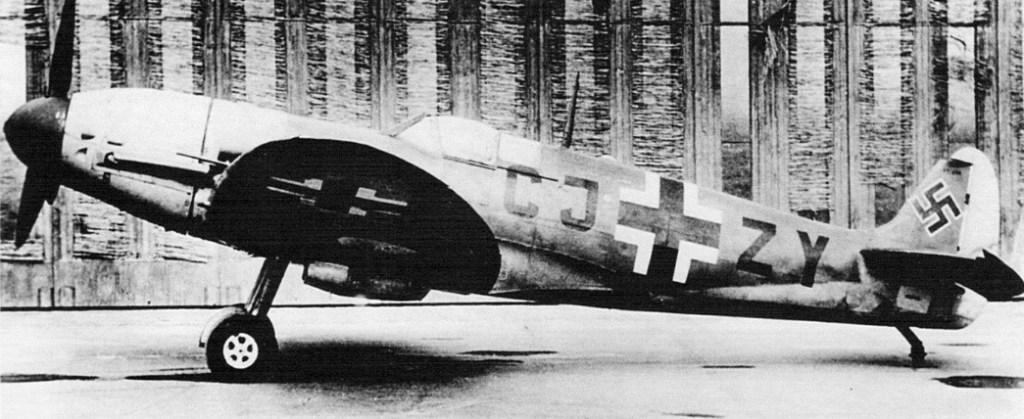
Following its capture by German forces, one early Spitfire was experimentally fitted with a Daimler-Benz DB 601 engine at Rechlin for comparison testing.
DB 601 powered Spitfire.
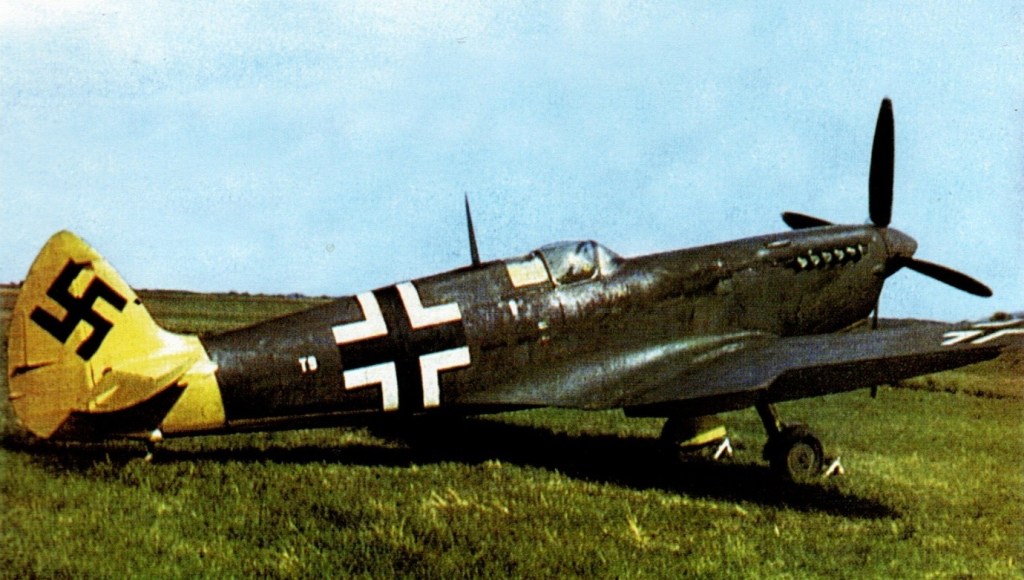
A PR XI, possibly MB945, captured on 1 March 1944 was operated by Zirkus Rosarius as T9+BB
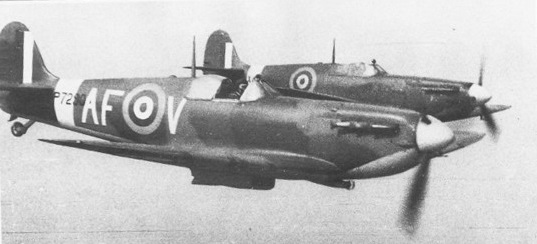
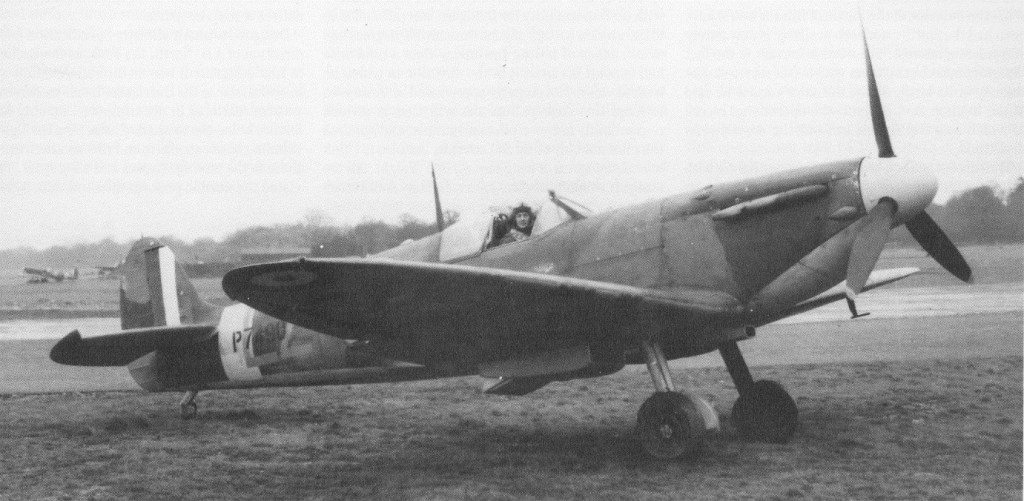
During 1939, single examples of the Spitfire I and the Hurricane I had each been fitted with a pair of 20mm cannon, with 60 rounds per gun. The Hurricane, with Oerlikon guns, was credited with destruction of a Dornier 17 on 13 August 1940, while undergoing evaluation with No.151 Squadron, but the large-scale application of cannon armament to the Hurricane had to await the production of the Mk.iiC, with four of the 20mm cannon apiece. The Hispano guns fitted in the Spitfire proved prone to stoppages but, after trials with the prototype installation, a batch of 30 Mk.Is were similarly fitted and, with four 0.303in Brownings later added to the wing armament, were delivered from June 1940 for use by No.19 Squadron. They were the only cannon-armed fighters operated by the RAF during the Battle of Britain. These Spitfires were designated Mk.IBs, and those with the original eight-gun armament then became, retrospectively, Mk.1A.
When Britain went to war on September 3,1939 a total of 2,160 Spitfires were already on order.
The Spitfire I weighed 5,280 lb. had a wing loading of 24 lb/s. ft. and a fuel capacity of 85 Imperial gallons. Its maximum speed was 362 mph its maximum diving speed was 450 mph its initial climb rate was 2,500 ft./min. and it took 9.4 minutes to climb to 20,000 feet. Its combat range was 395 miles and its roll rate was 140 deg./sec. Standard armament in what was subsequently to become known as the A wing was eight 0.303-in. Browning machine-guns with 300 rounds of ammunition. The speed of the Spitfire I was marginally higher than that of its principal opponent the Luftwaffes Messerschmitt Bf 109E and it was infinitely more maneuverable than the German fighter although the Bf 109E could out climb and out dive the British fighter and its shell-firing cannon had a longer range than the Spitfire’s machine-guns.
By the outbreak of war on 3 September 1939, the RAF had received 306 aircraft, 187 were distributed to operational squadrons, 36 had been written off and the balance went to the training units. The RAF had nine operational Spitfire squadrons, 1/3rd of Fighter Command Squadrons, and on 16 October 1939 a Spitfire of No. 603 Squadron claimed the first German aircraft to be destroyed over the UK in World War II, a Heinkel He 111. By August 1940, shortly before the Battle of Britain reached its climax, RAF Fighter Command could call upon 19 Spitfire Mk I squadrons.
The 1,175 hp Merlin XII was adopted as the standard power plant in the Type 329 Spitfire II with a Rotol three-blade propeller and 73 lb of amour protection, but this variant was otherwise similar to the Spitfire I, retaining the eight-gun armament. Deliveries commenced in 1940, the Spitfire II having followed the Mark I on the production lines and becoming the first major production variant to be delivered from Castle Bromwich. Whereas the Spitfire IA had its armour added in service, the IIA left the factory with armour installed.
Spitfire II
The production difficulties with early Spitfires were shown by comparative figures for mid-1940, when the rate was still averaging only 80 a month compared with 236 a month for the Hurricane. It would be early 1942 before the monthly output of Spitfires exceeded that of Hurricanes, and the slow build-up of production in 1938/39 combined with losses suffered by Fighter Command during the fighting over France meant there were few in August 1940.
The first two squadrons converted to fly Spitfire IIs in September 1940.
Castle Bromwich Mk.IIA
Although outnumbered by Hurricanes by three to two throughout the summer of 1940, the Spitfires of Fighter Comand inflicted more than half the total losses suffered by the Luftwaffe. The Spitfire squadrons alone lost 118 fighters in combat during August, a further 55 being damaged. Adding to those lost or damaged in accidents or by enemy bombing, 237 Spitfires were deleted from the inventory during that month alone, and the total output of the factories engaged in Spitfire production amounted to only 163 machines. Attrition in September was more serious, 156 being manufactured and 281 being lost to strength, of which 130 were destroyrd and 80 damaged in combat. In the week ending September 13, the reserves were only 47 Spitfires ready for delivery in storage units.
By December 1940 Spitfire Mk IIs were carrying out ‘Rhubarb’ sweeps over occupied Europe.
During 1940 the Spitfire MkI and MkII barely maintained superiority over the Messerschmitt Bf109E so the Air Staff turned their attention to the question of a replacement. Their preferred successor was the MkIII, fitted with a Merlin XX engine and incorporating a new wing design.
Realising it would take time to tool up for a new production aircraft and because of problems with the Merlin XX, the Air Ministry asked Rolls-Royce, as an interim measure, to install the Merlin 45 engine in the Spitfire Mk I airframe. Between 1941 and 1943 over 6500 of this Type 349 MkV version were produced. The Spitfire Mk III never did go into production but some of the new design features intended for it were incorporated into the MkV.
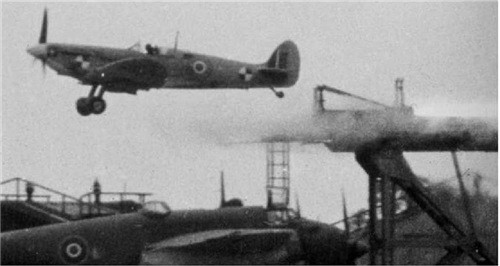
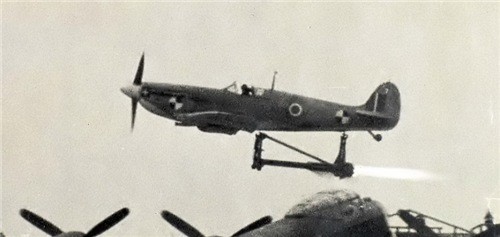
During late 1941 or the first half of 1942 experiments with Supermarine Spitfire aircraft using catapults from CAM-ships were under taken at Farnborough. Intended to replace the Hurricane
The experiments went successfully it turned out that the Spitfire was simply not required.
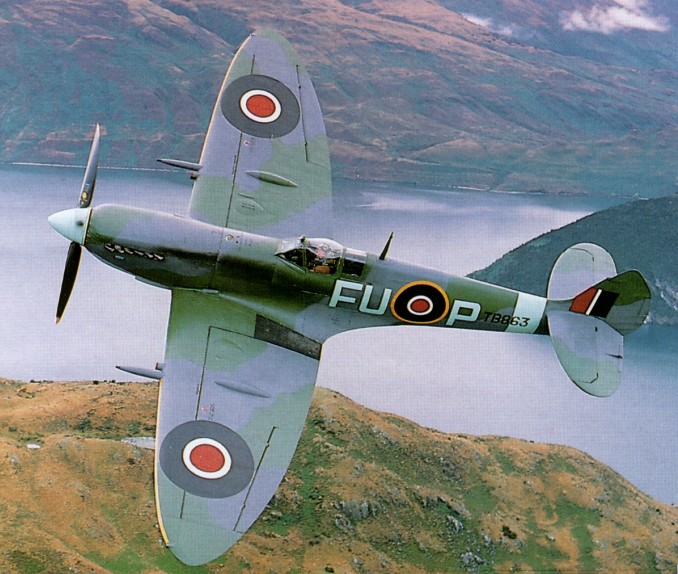
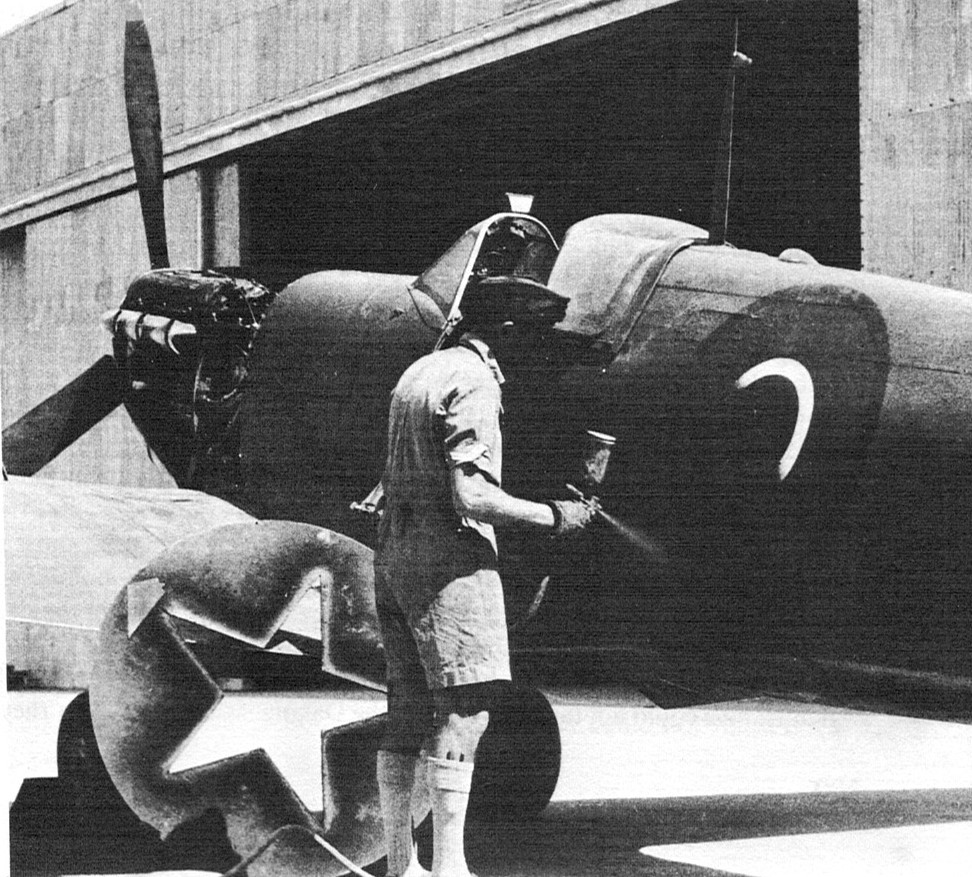
The Spitfire MkV was one of the most successful ‘stop-gaps’ ever introduced into Royal Air Force Service. Over one hundred and forty RAF squadrons operated the type. It served on all battlefronts and was supplied to nine other countries including the Soviet Union and the United States.
In Iran, June 1943, painting a Spitfire for Russia
Supermarine Spitfire Mk.Vb
By 1944 only five squadrons remained in service. Even so, two Spitfire MkV squadrons provided gunfire direction on 6 June 1944 for naval units off the D-Day beached of Normandy.
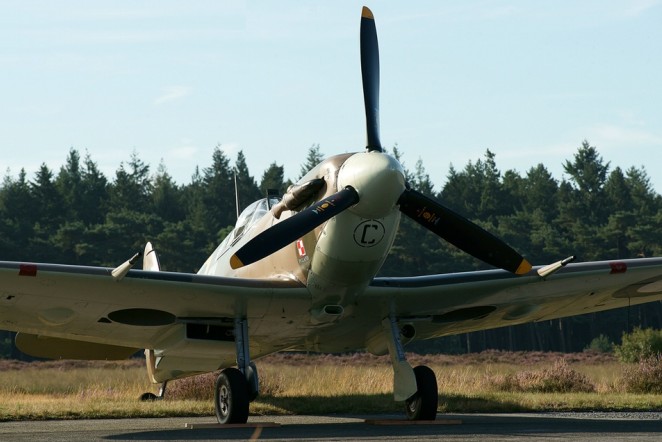
The first squadron to fly the Spitfire V was the No. 92 and in March 1942, fifteen Spitfire VBs which had been shipped to Malta on H.M.S. Eagle, became the first Spitfires to serve outside Europe. Spitfires of this Mark were later to serve in the Western Desert and the Pacific by early 1943 and Burma areas. More than 2000 Mk.V Spitfires wee tropicalised by the addition of a Volkes sand filter.
In the normal course of development, means were sought to increase the altitude performance of the Spitfire which was inferior to that of the Messerschmitt Bf 109E . This called for two principal modifications, the introduction of a pressurized cabin and the use of an engine suitably rated for higher altitude. The first version of the Spitfire so equipped was the Mark VI derived directly from the Mark VB as a result of work on pressure cabins at the Royal Aircraft Establishment and Supermarine during 1940-41. At the R.A.E., R7120 was fitted with a Merlin 47 (the high rated version of the Merlin 45) with a four-blade Rotol propeller with Jablo blades and a pressure cabin. The same engine was employed by the 100 Spitfire VI (Type 350) fighters built by Supermarine the first two of these AB176 and X4942 serving as prototypes. The production Spitfire VI also had an increase in wing area to improve controllability at high altitudes the wing being of pointed planform with a span of 40 ft. 2 in. The pressure cabin was contained between the bulkheads fore and aft of the cockpit and a special non-sliding hood was fitted to simplify the sealing problem. A Marshall blower provided a cabin differential of 2 lb./s. in. reducing apparent altitude from 40,000 feet to 28,000 feet. In other respects including armament the Spitfire VI was similar to the Mark VB.
The Spitfire VII high-altitude fighter evolved from Supermarine Spitfire VC with pressurized cockpit, sliding hood, increased fuel capacity, retractable tail wheel, two-stage, two-speed 1,565 hp Merlin 61 or 1,710 hp Merlin 64 (in Supermarine Spitfire F Mk VII) or 1,475 hp high-altitude Merlin 71 (Supermarine Spitfire HF Mk VII). Extended wing-tips usually fitted and, later aircraft, broad-chord rudder with extended tip. Prototype conversions of Mk VCs flown second half of 1942; 140 produced by Supermarine, first deliveries September 1942 and operations began same month. One Mk VII to USAAF at Wright Field in April 1943.
The Spitfire VII (Type 351) was a more extensive re-design for high-altitude work and was the first of the Spitfire series intended to make use of the two speed Merlin 60 series of engines. These two-stage engines were coupled with a re-designed cooling system which showed itself in the enlarged air intake under the port wing matching that to starboard. The wing outline remained similar to that of the Spitfire VI but the ailerons were reduced in span. The chord and area of the rudder were increased and the elevator horn balance was extended. Structural changes were made to the fuselage to take the increased engine loads and a double-glaze sliding hood was fitted to the cockpit. The retractable tail wheel first developed for the Spitfire III was applied in production for the first time on the Mark VII and the universal C -type wing was employed. Maximum speed jumped by 44 m.p.h. to 408 m.p.h. and normal loaded weight climbed to 7,875 lb.
1652 Spitfire Mk VIII variants were built.
Spitfire VIII
The Mk.IX had been a quick lash up of the MK.V to get the 60s series of Merlins into action in 1942. There were a number of minor strengthening modifications enroute, but it was still basically the same Spitfire as the Mk.I. The Mk.IX entered production in 1942. Despite a weight of 3.5 tonnes, the speed had jumped to 650km/h (405mph). About 5600 were built with British built Merlins and a further 1053 were fitted with American Packard V 1650 (Merlin 266) engines when these became available in 1943. Those Spitfires were known as LF Mk.XVI, largely for allocation to squadrons of the 2nd Tactical Air Force in 1944, with a 12 volt systems.
Spifire F.IX
A total of 5665 Mk.IX were built in three main variants; Pr.IX photoreconnaissance conversion, Pr.X (77 built, unarmed but pressurised versions with the Merlin 77), and Pr.XI conversions. Sub-variants were he LF.IX and HF.IX with clipped and extended wings for the low- and high-altitude roles respectively, and E-suffixed versions with two 0.5in / 12.7mm machine guns in place of the four of smaller calibre.
Spitfire IXe
The Mk.XVI (basically a Mk.9 with a Packard Merlin) was the final Merlin powered Spitfire, all later models were powered by the RR Griffon. The Packard Merlin 266 supercharger gear was electro hydraulically operated rather then electro pneumatically as with the RR Merlin 66 fitted to the Mk.IX.
Spitfire 16
Mk.XI and Mk.XVI were built side-by-side at Castle Bromwich so an airframe could be built as either.
The prefix LF signified 32 ft 7 in (9.88m) clipped wings (shorter than the usual F by 1.35m). The LF clipped wing variant was faster and more agile at low level for the ground attack role.
A degree of multi-role capability was to result from the development of low-altitude clipped wings (prefix LF), and high-altitude increased-span wings (HF), the standard wing being identified as F, and with variations of armament within these wings comprising eight machine-guns (suffix A), two cannon and four machine-guns (B), four cannon (C) and two cannon, two 12.7mm machine-guns and up to 454kg of bombs (E).
Spitfire LF Mk XVIE; The “E” status indicated the armament, two 20mm Hispano cannon and two 0.5 Browning machine guns.
In November 1939 Supermarine allocated Type 337 for a feasibility study of a Griffon engined Spitfire.
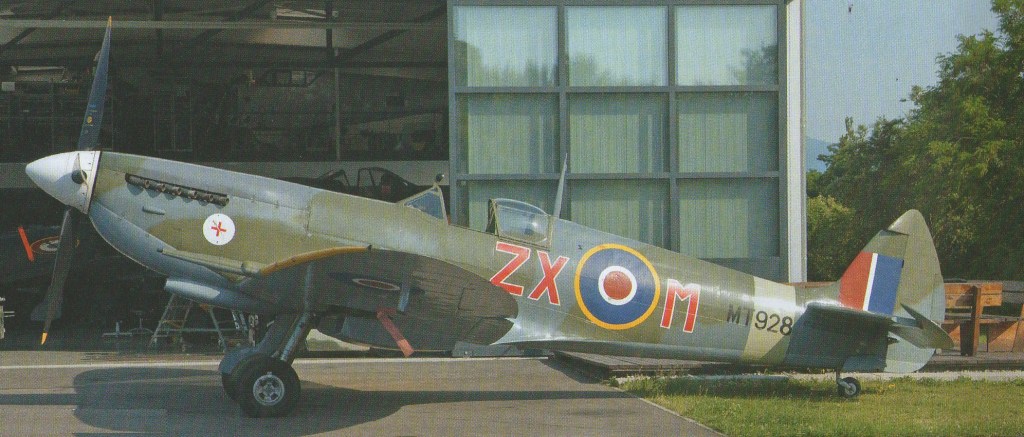
The FR.XIV was a redesigned and strengthened airframe for the 2050 Griffon 65 or 66 with a five blade prop, broad tail and tear drop canopy.
The Spitfire XIX reconnaissance version became the fastest of all the wartime Spitfires with a speed of nearly 748 km/h (460 mph).
The Mk.21 featured a stronger wing to carry two cannon in each wing, and a new, strengthened, fuselage and tail unit. The Mk.21 first flew in 1943 and entered production in 1944.
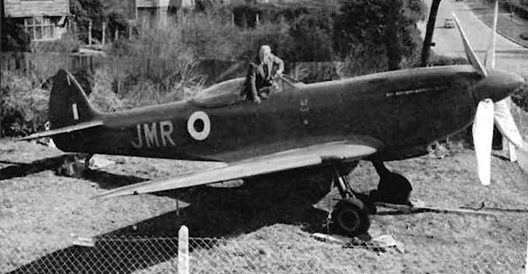
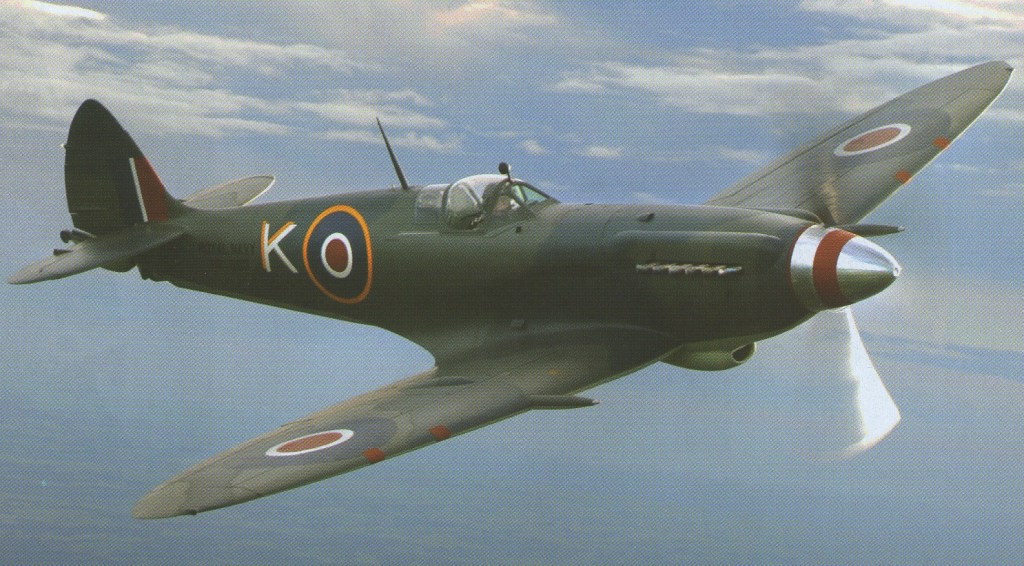
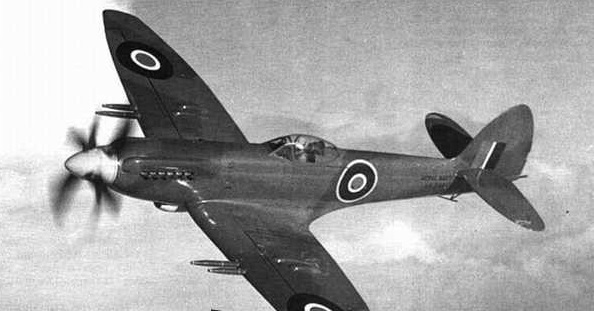
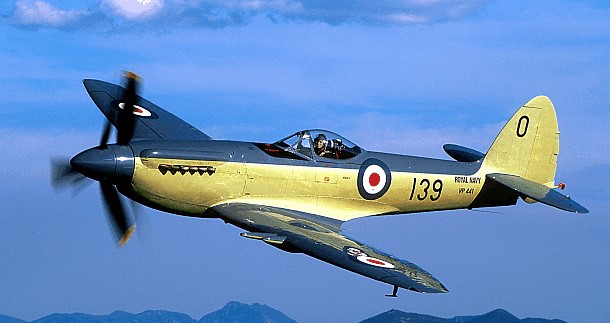
The last major production Spitfire was the F22. The F24 differed only in the smallest of details and some F24s were converted from F22 airframes. The Spitfire F24 was the ultimate development of the type, but the advent of the jet fighter meant that only small numbers were built and even fewer went into Royal Air Force service. Only seventy F24s were completed and most went into store although No.80 Squadron was fully equipped with the type.
These examples of the Spitfire incorporated all the modifications and improvements developed on earlier marks. The F24s had a tear-drop canopy for greater visibility and enlarged tail surfaces for better control. Like many of the later marks the F24 was fitted with the more powerful Griffon engine which provided a 160kph (100mph) greater top speed than the early Spitfires and almost twice the rate of climb. The weight of firepower from its cannon had tripled over the types’ original fit of eight machineguns.
Pilots who converted from the Merlin to the Griffon-engined Spitfires soon discovered that, because the Griffon engine’s propeller rotated in the opposite direction to that of the Merlin, the fighter swung to the right on take-off rather than to the left. This tendency was even more marked with the more powerful 60 and 80 series Griffon engines, with their five-bladed propellers. As a result, pilots had to learn to apply left (port) trim on take-off, instead of the right (starboard) trim they were used to applying. On take-off, the throttle had to be opened slowly, as the pronounced swing to the right could lead to “crabbing” and severe tyre wear.
Some test Spitfire XIVs, 21s, and 24s were fitted with contra-rotating propellers, which eliminated the torque effect. Early problems with the complex gearbox that was required for contra-rotating propellers prevented them from ever becoming operational in Spitfires, but they were used on later aircraft including the Seafire FR. Mk 46 and F and FR.47, which were fitted with Griffon 87s driving contra-rotating propellers as standard equipment. The Griffon 57 and 57A series, driving contra-rotating propellers, was used in the Avro Shackleton maritime patrol aircraft.
With the war nearly over only 350 Mk.21s, 22s and 24s were built of the 3000 or so ordered. The last Spitfire was built in 1947.
The Seafire (abbreviated from the original name ‘Sea Spitfire’) gave the Royal Navy (RN) a carrier-based air superiority fighter aircraft in WW2. As a direct development of the Spitfire, it suffered from a short range, but its fast climb and agility made it an effective fleet defence fighter and Seafire squadrons served in the Mediterranean, on D-Day and against the Japanese in the Pacific.
Interest in the idea of a carrier-borne Spitfire first surfaced in the late 1930s and Supermarine’s Chief Designer, Joseph Smith, had an ‘A-frame’ arrestor hook fitted on a Spitfire. This flew on 16 October 1939 as the type Type 338. Supermarine proposed a Spitfire design to the Fleet Air Arm (FAA) with the arrestor hook and with wings that swivelled and folded back, and in February 1940 the Admiralty requested the production of fifty of these but the First Lord of the Admiralty, Winston Churchill, intervened and the order was and cancelled.
Churchill regarded the production of Fulmars vital and the greater need for land Spitfires, the diversion of resources to a new navalised variant would reduce Spitfire’s production numbers.
The first Sea Spitfires were simply existing examples (Mk.Vb) with some naval equipment added (hook and catapult spools, as well as Naval instruments and radios) but without major modifications such as folding wings. However when the Seafire began operations, it was quickly found that the fuselage of these modified Spitfires was too weak for carrier operations. Reinforcing strips were riveted around hatch openings and along the main fuselage longerons to alleviate these issues. This was the Seafire Mk Ib, becoming the first of several Seafire variants to reach the FAA. Catapult and deck trails began early in 1942, and in the spring, contracts were placed to convert 116 Spitfire Mk.Vb into Seafire Mk.Ib examples. The Seafire IIc followed this. Although of similar configuration, it was purposely re-designed for naval use. To follow was the Mk.III, which was also the first to use (manually) folding wings, and this became the final version to see WW2 service. The Seafire L.III was based on the Spitfire Mk.VC.
Because of the small size of the carriers, and the harder landing-on techniques, it was found that approaches were difficult, visibility was limited, landing gear collapses were commonplace, and the arrester hooks had a tendency to miss and bounce back into the fuselage with the inevitable resultant collision with the deck park or barrier. As a low-level fleet defence interceptor, the Seafire was supreme, but its fragility was its Achilles heal. More were lost to landing gear failures in hard landings than to enemy action.
First entering service with No 807 Squadron in mid-1942 and going to sea on board HMS Furious.
After initial placement on the Russian convoy routes, the FAA’s Seafires saw the majority of their action in the Pacific campaigns. Due to their good high altitude performance (and lack of ordnance-carrying capability) the Seafires were allocated the Combat Air Patrol (CAP) defensive duties. Flying over the fleet, they were heavily involved in countering the Kamikaze attacks during the Iwo Jima landings and beyond.
Seafire XV
Work on a more powerful Seafire with a Rolls Royce Griffon began during WW2, but the Mk.XV didn’t arrive in time to take part, but it was followed by a series of Griffon powered versions and these filled the gap before the arrival of Hawker’s Sea Fury. With a bubble canopy and upgraded undercarriage, the Seafire XVII was an improved version of the XV.
Then the Seafire Mk.45 was the first version to be powered by a Griffon 60 series engine, but was a retrograde step in having fixed wings and it suffered from directional instability caused by engine torque.
Built by Vickers Armstrong at Castle Bromwich under contract B981687/39, the F Mk.46 Seafire started life as a part of the seventh order for 300 Spitfire Mk.Vc’s in March 1942. However, this contract was cancelled in 1943 but then later re-established as an order for 120 Spitfire Mk.21’s. This order was then further extended to inculde 94 Seafire F Mk.45’s and Mk.46’s.
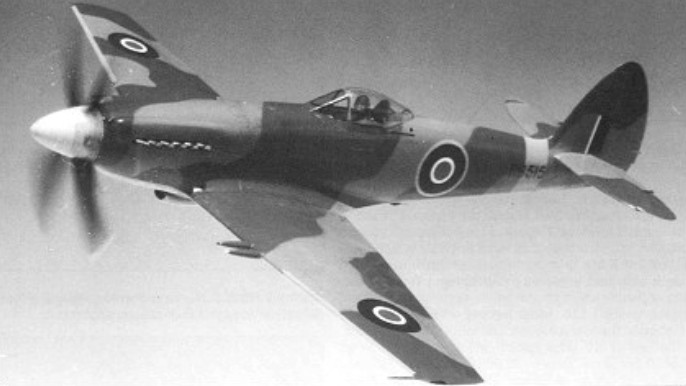
To solve the torque problems, contra-rotating propellers were introduced on the Mk.46, but curiously, folding wings were not incorporated, and so it never saw front-line service. Seen as a “semi-navalised” variant of the Spitfire Mk.22, the Mk.46 Seafire was fitted with the bubble style canopy and the cut-down rear fuselage, which was seen earlier on the Mk.XVIII Seafire, but this new aircraft lacked the curved windscreen of the earlier aircraft. The previous Mk.45 Seafire was euipped to carry 120 gallons (454 litres) of fuel; added to this the Mk.46 was fitted with a 33 gallons (125 litres) fuel tank in the rear fuselage, also it could also will fitted with two 22½ gallon (84 litre) drop tanks under each wing. The power for the Mk.46 came from a Griffon 87 engine which was connected to a six-bladed Rotol contra-rotating propeller. The double propeller system successfully counted the engine torque seen in the earlier Griffon engines. Also the Mk.46 was to be fitted with the enlarged tail section from the Spiteful airframe.
Seafire Mk.46
So with the combination of the contra-rotating propeller system and the new tail, this gave the aircraft greater stability, making it much easier to fly. The Mk.46 was fitted with a 24 volt electrical system, unlike the Mk.45 which was just 12 volts. The both the Fighter and the Fighter-Reconnaissance variants of the Mk.46 were fully tropicalised and provision was made for deck landings with a “string” type arrester hook. However, it was planned that this variant would be only used from shore bases.
The prototype, TM383, was in fact a Mk.21 Spitfire airframe modified by Cunliffe-Owen and first flew on the 8th September 1944. This aircraft was scheduled as the third prototype for the Mk.45, but was withdrawn from that contract for use on the Mk.46 trials. By January 1945 was well into its prototype trials. It was stated that during one of the trails “Dived in formation with LA436 (a Mk.45) at 495 knots LA436 was going steeper and accelerating but vibration on TM383 became such that it was eased out of the dive”.
The FR Mk.46 only differed by having the provisions for a pair of F.24 aerial cameras to be fitted in the rear fuselage, one in the vertical and the other in oblique positions. To stop mud and dirt covering the vertical camera port during take-off, a “mud-flap” was fitted over the port and was jettisoned by the pilot once airborne. Both aircraft variants were also fitted with a cine-camera mounted in the leading edge of the starboard wing.
The Mk.46 was armed with 4 x 20mm Mk.II cannons and with its strengthened wings it could carry either 8 x 25lb or 60lb head rocket projectiles and mounted uder the fuselage it could carry 1 x 250lb or 500lb bomb.
Only 24 Seafire Mk.46’s were to be finally produced and they carried the serial numbers LA541 to LA564. Entering into service in 1948, the Mk.46 was seen as an interim aircraft and as such it was not to see front fline service and was only used in the training role by Nos. 736, 738, 767, 771, 777, 778, 781 and 787 Naval Air Squadrons. Later a number of these aircraft were also to see service with various trials organisations. One airframe LA544 was used on anti-spin trials in 1946 and as such was fitted with an anti-spin parachute and fin guard.
Before the Mk.46 was retired from service in 1951, the last of the F Mk.46’s were operated by No. 1832 RNVR Squadron.
The final version, the Mk.47, with the addition of folding wings, was actually suitable for carrier operations and saw combat in Malaya and in the early campaigns of the Korean War. Eventually over 2,000 Seafires were produced, 1,200 RR Merlin powered and 800 RR Griffon powered.
Seafire F Mk. 47
The last Seafire were finally withdrawn from first-line duties in 1952.
A total of 20,334 Spitfires and 2,556 related new-build Seafire naval fighters were built. It also had the distinction of remaining in production throughout the entire war and was operational post-war, the last mission flown by a photo-reconnaissance Spitfire PR.Mk 19 of No. 81 Squadron in Malaya on 1 April 1954.
Seafire Mk.Ib 166 Spitfire Mk.Vb basic conversions with hooks; 118 Cunliffe-Owen aircraft had catapult spools. None had folding wings. Rolls-Royce Merlin 45 or 46; two Hispano cannon and two .303in Browning machine guns.
Seafire F.Mk IIc First purpose-built version of the Seafire, produced alongside the Ib still had fixed wings, but catapult spools and slinging lugs.
Seafire L.(F).Mk IIc Low altitude fighter version with ‘cropped’ supercharger Merlin 32, four blade airscrew. Spitfire Mk Vc conversion.
Seafire F.R. Mk IIc Could be ftted with two F.24 cameras.
Seafire F.Mk III
Seafire L(F).Mk III
Seafire F.R. Mk III All folding wing equipped equivalents to Mk IIc variants.
Seafire Mk III (Hybrid) Westland-built model with normal non-folding wings; Merlin 55; redesignated as L(F).Mk IIc.
Seafire Mk XV Fuselage of the Spitfire V (Seafire III), wing-root fuel tanks from the Spitfire IX, enlarged fin, rudder & retractable tail wheel from Spitfire VIII and the Griffon engine installation of the Spitfire XII, plus Seafire III folding wings.
Seafire Mk.XVII / FR.XVII Improved Seafire XV, with bubble canopy and cut-down rear fuselage adopted for last 30 Seafire XVs combined with a better undercarriage and stronger wings. The new rear-fuselage was also able to carry an extra fuel tank, which could be replaced with two cameras to produce the FR.XVII.
Seafire Mk.45 Interim model, lacking folding wings and with an older fuselage design than the Seafire XVII powered by Griffon 60 series and five-blade propeller. Based on Spitfire 21, with high back, new planform (non-folding) wings, armed with four 20mm cannon. The wings also carried four leading edge fuel tanks. Found to be unsuitable for carrier use.
Seafire Mk.46 Based on the Spitfire 22, and so had the bubble canopy and cut-down rear fuselage also seen on the Seafire XVII. It was powered by a Griffon 87 engine that drove two three-bladed contra-rotating propellers.
Seafire F.Mk.47 The final version of the Spitfire line. Navalised Spitfire Mk 24 with wing-folding (manual, later hydraulic) dual three-bladed contra-rotating airscrew and increased fuel capacity. Provision for Rocket Assisted Take Off Gear (RATOG). It could carry 287 gals of fuel, a range of about 1,000 miles. Another type ‘best’ achieved by this variant was top speeds of 452 mph. Ninety built, most converted to Fighter Reconnaissance (FR).
Type 300 Prototype: Engine: 1030 hp Merlin II / 738kW Rolls-Royce Merlin C Propeller: de Havilland fixed pitch two-bladed wooden Weight: 5322 lb / 2418 kg Speed at 16,800ft/5120m: 349 mph / 561 kg Speed at 30,000ft/9145m: 324 mph / 521 kph Time to 30,000ft/9145m: 17 min Time to 18,000ft/5485m: 5 min 42 sec Service ceiling: 35.000 ft / 10,670 m
Spitfire I 1566 built
Spitfire IA Engine: Rolls-Royce Merlin Mk II, 1016 hp Prop: Airscrew Company wooden fixed-pitch two-blade. Length: 29.921 ft / 9.12 m Height: 11.417 ft / 3.48 m Wingspan: 36.811 ft / 11.22 m Wing area 242 sq. ft Weight empty: 4,810 lb. (2,180 kg) Max take off weight: 5325.1 lb / 2415.0 kg Wing loading: 24 lb/sq.ft Fuel capacity: 85 Imperial gallons Maximum speed: 355 mph (570 kph) at 19,000 ft Maximum diving speed: 450 mph Initial climb rate: 2,500 ft./min Max ROC: 2420 fpm / 737 m/m Time to 20,000 ft: 9.4 min Range: 575 miles (920 km) Combat range: 395 miles Service ceiling: 33990 ft / 10360 m Roll rate: 140 deg./sec Standard armament: eight 0.303-in. Browning machine-guns / 300 rounds Crew: 1
Spitfire IB Engine: RR Merlin II, 1030 hp Prop: 3 blade DH 2 position Empty weight: 4517 lb / 2049 kg Normal loaded weight: 5844 lb / 2651 kg Max speed; 346 mph / 557 kph Cruise: 304 mph / 489 kph at 15,000 ft / 4570 m ROC: 2530 fpm / 770 m/min Time to 15,000 ft / 4570 m: 6.85 min Service ceiling; 30,500 ft / 9300 m T/O to 59 ft / 15 m: 1605 ft / 489 m Normal range + res: 415 mi / 668 km Econ cruise: 600 mi / 965 km at 175 mph / 282 kph Armament: 2 x 20mm Hispano cannon, 4 x .303 Browning mg
Type 329 Spitfire IIA Engine: RR Merlin XII, 1175 hp Prop: Rotol three-blade Max speed: 357 mph / 574 kph at 17,000 ft / 5190 m Time to 20.000 ft / 6070m: 7 min Max ROC: 2620 fpm / 798 m/min Armament: 8 x .303 Browning mg 750 built
Type 329 Spitfire IIB Engine: RR Merlin XII, 1175 hp Prop: Rotol Armament: 2 x 20mm Hispano cannon, 4 x .303 Browning mg 170 built
Spitfire III Single experimental, strengthened Mk.I with other changes
IV Engine: RR Griffon One built
PR IV Engine: RR Merlin 45, 1440 hp 229 built
Type 349 Spitfire V Engine: RR Merlin 45, 1440 hp Loaded weight: 6,417 lb Maximum speed: 369 mph 6464 built
Spitfire VA Engine: 1 x Rolls-Royce Merlin 45, 1102kW / 1478 hp Wingspan: 11.23 m / 37 ft 10 in Length: 9.12 m / 30 ft 11 in Height: 3.02 m / 10 ft 11 in Wing area: 22.48 sq.m / 241.97 sq ft Max take-off weight: 2911 kg / 6418 lb Empty weight: 2267 kg / 4998 lb Max. speed: 594 km/h / 369 mph at 5945 m Ceiling: 11125 m / 36500 ft Range w/max.fuel: 1827 km / 1135 miles Armament: 8 x 7.7mm machine-guns 94 built
Spitfire VB Engine: RR Merlin 45, 1440 hp Speed: 369 mph at 19,750 ft Max range: 1135 miles Armament: 2 x 20mm .303in Cannon, 4 x mg Seats: 1 3923 built
Spitfire LF.VB Powerplant: 1 x Rolls-Royce Merlin 40M, 50M or 55M,1096kW (1,470 hp) Span: 9.80m (32ft 2in) Length: 9.11 m (29ft 11 in) Normal T/O weight: 3016 kg (6650 lb) Max speed: 357 mph @ 6000 ft Operational range: 470 miles Armament: 2 x 20-mm cannon and 4 x 7.7-mm (0.303-in) mg Wingspan: 32 ft 7 in (9.88m)
Spitfire VC Engine: RR Merlin 45, 1440 hp Bombload: 500 lb / 227 kg 2447 built
Type 350 Spitfire VI Engines: 1 x Rolls-Royce Merlin 47, 1415 hp Wing span: 40 ft 2 in (12.224 m) Length: 29 ft 11 in (9.12m) Max TO wt: 6797 lb (3083 kg) Max level speed: 364 mph (586 kph). Cabin differential: 2 lb/sq.in Armament: 2 x 20mm / 4 x .303 100 built
Type 351 Spitfire VII Engine: 1,565 hp Merlin 61 Wingspan 17.3 m (40 ft. 2 in.) Length 9 m (29 ft. 11 in.) Height 3.58 m (11 ft. 5 in.) Gross weight 3,575 kg (7,875 lb.) Maximum speed: 408 m.p.h Pressurised cockpit 140 built
Spitfire HF VII Engine: 1,475 hp Merlin 71
Spitfire F VII Engine: 1,710 hp Merlin 64 Wingspan: 8.53m
Spitfire Mk VIII Engine: Rolls-Royce Merlin 70, 1710 horsepower (1275.66 kW) Propeller: Rotol Constant Speed 10’9″ diameter (3.22m) Engine driven propeller governor hydraulically controls four wooden blades. Fuel: Aviation Gasoline 100 Octane Fuselage Tank Capacity: 90 Imperial Gallons / 409 Litres / 108 U.S. Gallons Wing Tank Capacity (2): 30 Imperial Gallons / 136 Litres / 36 U.S.Gallons Wingspan: 36′ 10″ / 11.23 m Length: 31′ 3.5″ / 9.54 m Wing Area: 242 sq. ft / 22.50 sq. m Height: 12′ 7.75” / 3.85 m Empty weight: 5,805 lb / 2,633 kg Maximum Takeoff weight: 8,021 lb / 3,638 kg Maximum Speed: 361 knots / 416 mph / 669 km/h Cruise Speed: 220 knots / 253 mph / 407 km/h Armament: Two 20mm Hispano Cannons, Four .303 in. Browning Machine Guns. Bombload: one 500 lb (227 kg) or two 250 lb (114 kg) 1658 built
LF.VIII Clipped wing low altitude Un-pressurised
F.VIII Un-pressurised
HF.VIII High altitude, extended wing Un-pressurised
Spitfire IX Engine: Rolls Royce Merlin 70 Wing span: 11.3 m Length: 9.5 m Empty weight: 5610 lb / 2645 kg Max loaded weight: 9500 lb / 4310 kg Armament: 2 x 20 mm cannon, 4 x .303 mg Max speed: 650 kph / 405mph ROC: 4100 fpm / 1250 m/min Range: 434 mi / 700 km 5665 built
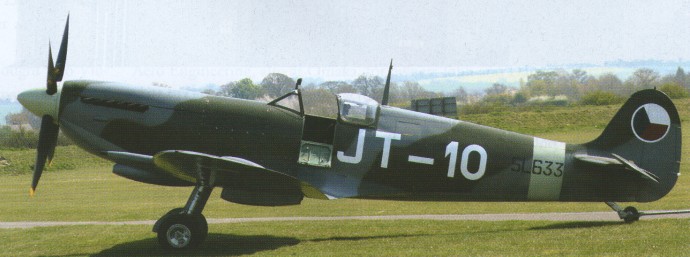
Spitfire F.IX Engine: Rolls-Royce Merlin 63. 1650 hp / 1230 kW Wingspan: 36 ft 10 in / 11.22 m Wing area: 242.0 sq.ft / 22.48 sq.m Length: 31 ft 0 in / 9.46 m Height: 12 ft 7.75 in / 3.85 m Empty weight: 5610 lb / 3545 kg MTOW: 9500 lb / 4309 kg Max speed: 408 mph / 655 kph at 25,000 ft / 7620 m Initial ROC: 3950 fpm / 1204 m/min Service ceiling: 43,000 ft / 12,105 ft Range: 980 miles / 1576 km Armament: 2 x 20mm cannon / 4 x 0.303 in mg Bombload: 1000 lb / 454 kg Seats: 1
Spitfire IXe Armament: two 20mm Hispano cannon, two 0.5 Browning machine-guns Bombload: 454kg
Spitfire Tr.IX Seats: 2
Spitfire X Pressurised photo-reconnaissance Leading edge fuel tank Engine: Rolls Royce Merlin 77 16 built
Spitfire XI Un-pressurised photo-reconnaissance Leading edge fuel tank Engine: Rolls Royce Merlin 63A, 1760 hp or Merlin 70, 1655 hp 471 built
Spitfire XII Strengthened VC or VIII airframe Engine: Rolls Royce Griffon III or IV, 1735 hp 100 built
Spitfire XIII Low-level reconnaissance Engine: RR Merlin 32, 1620 gp Armament: 4 x .303 16 built
Spitfire XIV Engine: RR Griffon 65, 2022 hp Length: 29.068 ft / 8.86 m Wingspan: 36.844 ft / 11.23 m Wing area: 244.02 sq.ft / 22.67 sq.m Max take off weight: 10281.9 lb / 4663.0 kg Weight empty: 6701.0 lb / 3039.0 kg Max speed: 448 mph (721 km/h) at 26,000 ft (7,925 m) Max. speed: 389 kt / 721 km/h Cruising speed: 315 kt / 583 km/h Service ceiling: 42995 ft / 13105 m Wing loading: 42.23 lb/sq.ft / 206.0 kg/sq.m Crew: 1 Armament: 2x 20mm MG, 2x cal.50 MG (12,7mm), 227kg Bomb. 957 built
Spitfire FR.XIVe Engine: Griffon 65 or 66, 2050 hp Prop: 5 blade Armament: two 20mm Hispano cannon, two 0.5 Browning machine-guns Bombload: 454kg
Spitfire F.XV
Spitfire XVI Engine: Packard V 1650 (Merlin 266), two speed, two-stage supercharger, 1700 hp (1245kW) Propeller: Rotol Constant Speed 10’9″ diameter (3.22m) four wooden blades Fuel: Aviation Gasoline 100 Octane Wingspan: 36′ 10″ / 9.93 m Length: 31′ 4″ / 9.55 m Wing Area: 242 sq. ft / 22.50 sq. m Height: 12′ 7 1/2″ / 3.85 m Fuselage Tank Capacity: 48 Imperial Gallons / 218 Litres / 57 U.S. Gallons Wing Tank Capacity (2): 37 Imperial Gallons / 168 Litres / 44 U.S.Gallons Empty weight: 5,985 lb / 2,715 kg Maximum Takeoff weight: 8,700 lb / 3,946 kg Maximum Speed: 361 knots / 416 mph / 669 km/h Cruise Speed: 220 knots / 253 mph / 407 km/h Armament: Two 20mm Hispano Cannon Bombload: one 500 lb (227 kg) or two 250 lb (114 kg) 1054 built
Spitfire LF XVI Engine: Packard V 1650 (Merlin 266) 12 volt systems
Spitfire LF XVIe Armament: two 20mm Hispano cannon, two 0.5 Browning machine-guns Bombload: 454kg
Spitfire XVI 300 built
Spitfire PR.XIX Photo-reconnaissance – unpressurised Engine: RR Griffon 65, 2050 hp Speed: 748 km/h (460 mph) Optional slipper tank range: 1800 mi / 2900 km 225 Mk.XIX built
Spitfire PR.XIX Photo-reconnaissance – pressurised Engine: RR Griffon 66, 2050 hp Speed: 748 km/h (460 mph) Optional slipper tank range: 1800 mi / 2900 km 225 Mk.XIX built
Spitfire 21 Post-war redesigned structure and shape. Engine: RR Griffon 66 or 65 Armament: 4 x 20mm Bombload: 1000 lb / 454 kg 122 built
Spitfire 22 Bubble hood, 24v Engine: Rolls Royce Griffon 65, 2,375 hp Prop: contra-rotating (some) 278 built
Spitfire F22
Spitfire F.24 Redesigned tail, short-barrel cannon, rocket launchers Engine: 2350 hp Rolls-Royce Griffon Maximum speed: 450 mph 54 built
Seafire IIC Strengthened undercarriage, Universal wing Engine: RR Merlin 32, 1645 hp Prop: 4 blade 282 built by Supermarine, 110 built by Westland
Seafire III Manual double folding wing Engine: RR Merlin 55M, 1585 hp Westland built 870 Cunliffe-Owen built 350
Seafire L.III Engine: Rolls Royce Merlin 55, 1450 hp Length: 29.987 ft / 9.14 m Height: 11.155 ft / 3.4 m Wingspan: 36.68 ft / 11.18 m Wing area: 241.975 sq.ft / 22.48 sq.m Max take off weight: 7102.3 lb / 3221.0 kg Weight empty: 5400.0 lb / 2449.0 kg Max. speed: 306 kt / 566 km/h Cruising speed: 190 kt / 351 km/h Service ceiling: 33793 ft / 10300 m Cruising altitude: 20013 ft / 6100 m Wing loading: 29.32 lb/sq.ft / 143.0 kg/sq.m Maximum range: 630 nm / 1167 km Range: 404 nm / 748 km Crew: 1 Armament: 2x 20mm MG, 4x cal.303 MG (7,7mm) Bombload: 227kg
Seafire XV / F.15 Asymmetric radiators Engine: RR Griffon VI, 1850 hp Prop: 4 blade 390 built
Seafire XVII / F.17 Increased fuel, bubble hood 232 built
Seafire 45 New aircraft entirely – fixed wing Engine: RR Griffon 61 – 5-blade prop Engine: RR Griffon 85 – contra-prop Armament: 4 x 20mm 50 built
Seafire F Mk.46 and FR Mk.46 Supermarine Type 388 Engine: Two-stage two-speed Supercharged Griffon 87, 1,540 hp Wing Span: 36 ft 11 in Length: 33 ft 3 in (tail up), 34 ft 6 in (to tip of arrestor hook) Height: 11 ft 6 in (Tail up), 12 ft 6 in (tail down) Max Speed: 435 mph at 24,000 ft Max altitude: 40,700 ft Armament: Four Hispano 20mm Mk.II Cannons Bomb Load: One 250lb/500lb bomb under fuselage, eight (four each wing) rocket projectiles. Crew: 1 50 built
Seafire 47 Navalised Spitfire 24 Hydraulic folding wing, increased fuel Empty weight: 7625 lb / 3458 kg Max loaded weight: 12,750 lb / 5784 kg Max speed: 451 mph / 724 kph ROC: 4800 fpm / 1463 m/min Range: 405 mi / 652 km 140 built
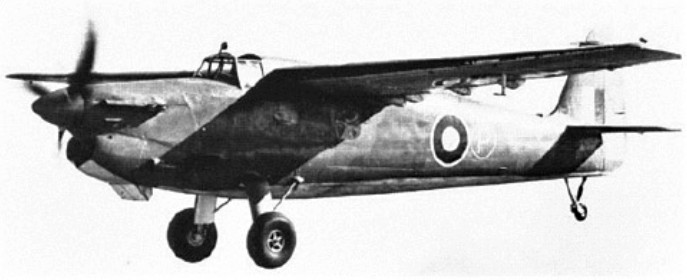
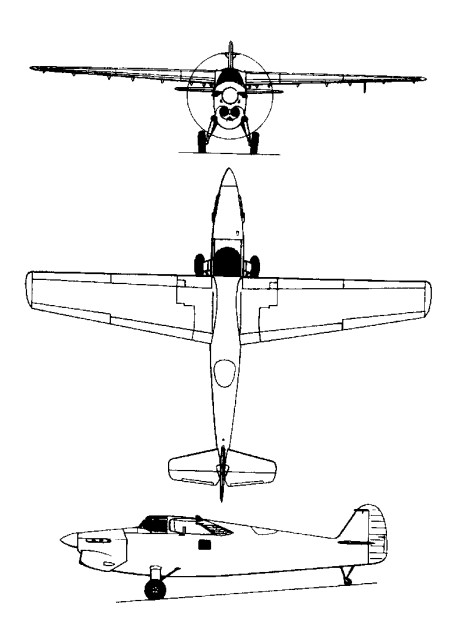
The first prototype flew on February 6, 1943. Did not enter production. Two built.
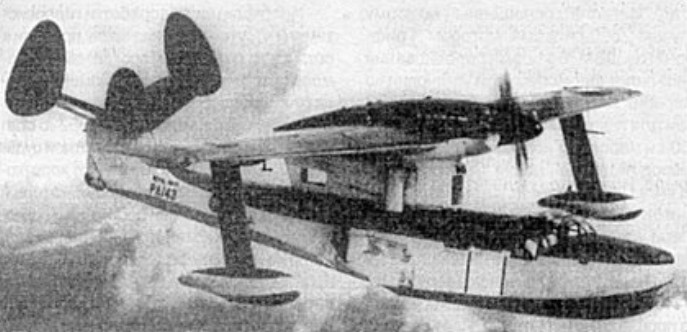
322 Dumbo Engine: 1 x Rolls-Royce Merlin 32, 1230kW Armament: 2 x 7.7mm machine-guns Bombload: 6 x 113-kg or a torpedo
322 Dumbo Engine: 1 x 1300hp Rolls-Royce Merlin 30 Max take-off weight: 5448 kg / 12011 lb Empty weight: 4165 kg / 9182 lb Wingspan: 15.24 m / 50 ft 0 in Length: 12.19 m / 40 ft 0 in Height: 4.32 m / 14 ft 2 in Wing area: 29.68 sq.m / 319.47 sq ft Max. speed: 449 km/h / 279 mph Range: 1328 km / 825 miles Crew: 3 Armament: 2 x 7.7mm machine-guns Bombload: 6 x 113-kg or a torpedo