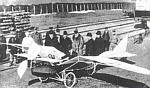
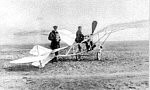
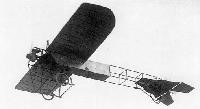
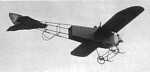
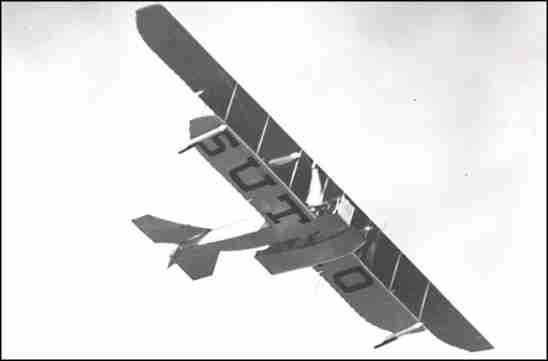
Assisted by Waldo Waterman, California millionaire Adolf Gilbert Sutro designed and built this machine in San Francisco, and, powered by a Hall-Scott 60 hp engine, it flew quite successfully.
Reportedly it was used to set several international records, including a speed record of 51 mph in 1913.
Engine: Hall-Scott 60 hp Upper span: 45 ft Lower span: 33 ft Length: 25 ft
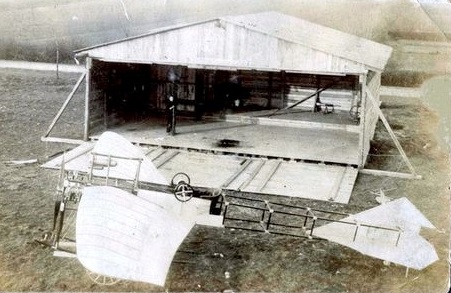
Joseph Suwelack built this airplane after he had managed to acquire a motor in Dresden. On 12 March 1910, Josef Suwelack continued his flight tests in Dornau with the new flying machine, a monoplane, with 8.8 m span and a length of 8.9 m. This machine was powered by a 36 HP engine and had weight with pilot 300 kg. Before departure, the machine was placed on a 18 m long rail track, and by a rope with a 600 kg weight in the 8 m high tower was connected. Because of the falling weight of the apparatus was moved over the rails and obtained by the gravity of the weight of the necessary airspeed.
Inspired by the experiments of Graf von Zeppelin, Heinrich Suter of Arbon, Switzerland, built an airship of 40 metres length. The Paris-made, cigar-shaped, 5-chamber envelope had a reported volume of 1000 m³. The movements of the LTA/HTA craft were carried out by propellers, while the balloon was used only to lift the machine and aeronaut. On a wooden pole under the balloon hung by a ball joint, was the actual flying machine, which enabled a free, independent movement of the two parts. Suter’s connection of a balloon with a flying machine was based on the principles of Ingenieur Kreß of Vienna. In Gustav Adolf Saurer, the founder of the “Ersten Schweizerischen Velociped-Fabrik Arbon”, Suter found the perfect construction partner. Inside the metal structure that connected to the ball joint, he built a velo-drive. Pedals drove outside of the “cage”, mounted and by hand, a pivotable double propeller. In this way, Suter believed to be able to control the occurrence of different air currents, while the position of the steering sail could also be altered manually. On April 19, 1901, from the purpose-built shed at the Hotel “du Lac” the inflated airship was pulled to the shore of Lake Constance. Many curious onlookers as well as journalists were in attendance to witness the spectacular event. At first everything went according to plan – Suter increased the pressure on the pedals and circled the steerable airship over Steinacherbucht bay. Suddenly the wind shifted, and at low altitude drove it into the branches of a tree on the Steinach shore, ending the maiden voyage. As for Suter, he lacked the funds to conduct further tests and the project was terminated shortly thereafter.
The one-off Surrey AL.1 G-AALP was a side-by-side trainer designed by Joe Bewsher and powered by a 95 hp Salmson A.C.7 radial engine. It was built by Surry Flying Services at Croydon in 1929 and registered to F.J.Grant for a couple of years before returning to its maker.
The biplane was unused at Croydon for several years before being sold to Bertram Arden in May 1938 and kept at Honiton Clyst, Devon. It was noted still intact there in early 1974.
Engine: Salmson AC.7 Wingspan: 28.09 ft Length: 20.00 ft.
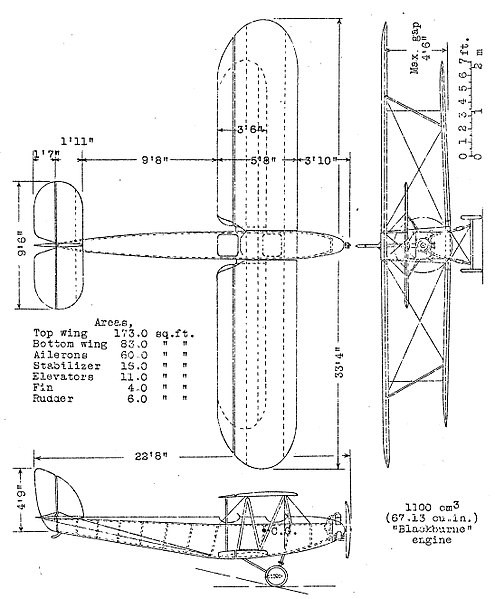
The Sparrow I was designed by R.J. Mitchell and built by Supermarine at Woolston, Southampton, for the 1924 Lympne light aircraft trials. It was a two-seat biplane powered by a 35 hp (26 kW) Blackburne Thrush piston engine, with dual controls.
The Sparrow I (registered G-EBJP) first flew on 11 September 1924. The Thrush, a three-cylinder radial engine proved to be extremely unreliable and the Sparrow was eliminated from the light aircraft trial due to engine failure. In the Grosvenor Trophy Race at Lympne Aerodrome on 14 October 1924, it came fourth with a speed of 62.08 mph (99.91 km/h).
The aircraft was rebuilt for the 1926 Lympne Trials as a parasol monoplane (and redesignated the Sparrow II) and re-engined with a 32 hp (24 kW) Bristol Cherub III engine. During the trials the Sparrow force landed near Beachy Head on 12 September 1926, again being eliminated from the competition, which was won by the Hawker Cygnet.
After use for testing wing sections, the aircraft was sold to the Halton Aero Club, remaining in existence until 1933.
Sparrow I Powerplant: 1 × Blackburne Thrush, 35 hp (26 kW) Propeller: 2-bladed fixed-pitch Wingspan: 33 ft 4 in (10.16 m) Wing area: 256 sq ft (23.8 m2) Airfoil: root: NACA; tip: NACA Length: 22 ft 8 in (6.91 m) Height: 7 ft 5 in (2.26 m) Empty weight: 215 lb (98 kg) Gross weight: 390 lb (177 kg) Maximum speed: 116 mph (187 km/h, 101 kn) Service ceiling: 3,350 ft (1,020 m) Seats: 2
Supermarine Sparrow I 3-view drawing from NACA-TM-289
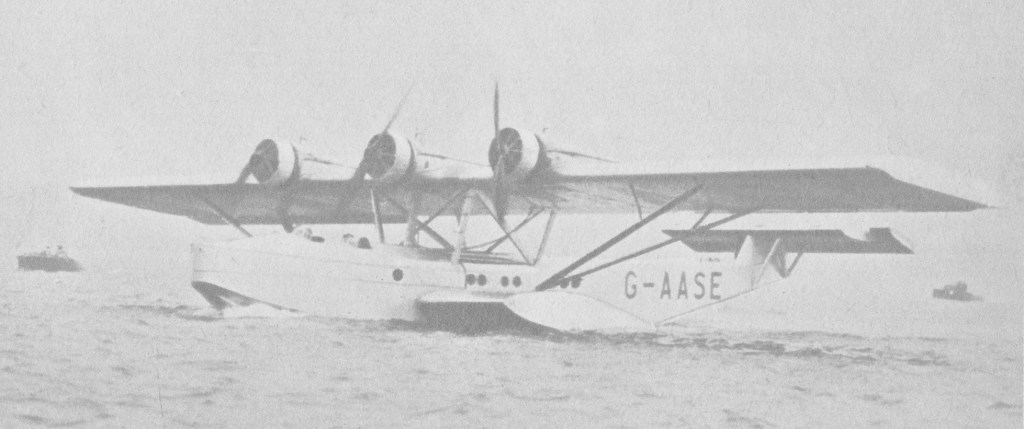
The Supermarine Air Yacht was a three Jaguar engines, all metal luxury passenger carrying flying boat designed and built in 1930 for the Hon. Arthur Guinness for pleasure flights around the Mediterranean. It carried a crew of four and six passengers, and was to replace his Supermarine Solent, but was rejected by Guinness.
The Air Yacht was first flown in February 1930. The only one built, G-AASE, was then sold to Mrs J.J.James who named it ‘Windward III’.
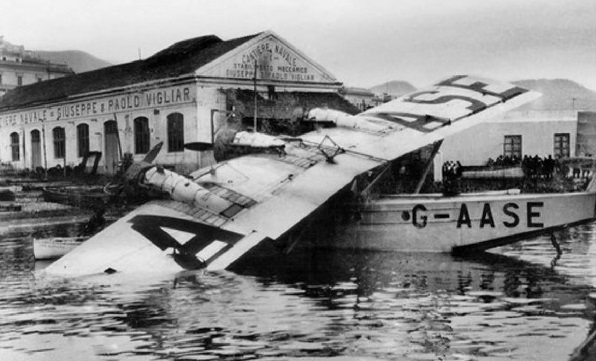
The aircraft crashed on 25 January 1933 near Positano in the Gulf of Salerno with no casualties, The wreckage was taken to Giuseppe & Paolo Vigliar shipyard, Salerno. and was later scrapped.