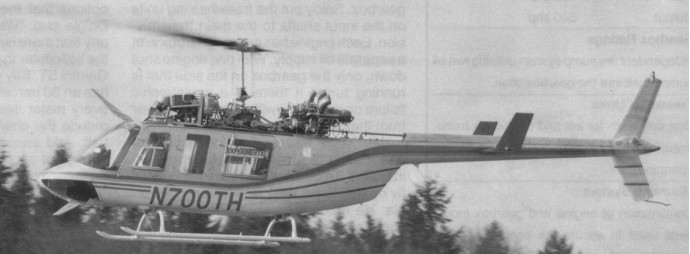
On 17 January 1991, the Tridair Gemini ST twin engine conversion of the Bell 206L LongRanger took to the air for the first time. The Gemini ST was designed to take off and hover at gross weight at sea level on one engine; the only twin engine helicopter that will have no written procedures for a single engine failure on takeoff.
The inspiration for the Gemini ST came to Doug Daigle, president of Tridair Heli¬copters in Costa Mesa, California, in 1986 when he successfully bid on a US Forest Service contract for a Bell LongRanger to be used as a rappelling platform for fire¬fighters.
This was the first time a single engine helicopter had been awarded this contract. The work had previously been done by a Bell 212, but this aircraft had become very expensive to contract, leading the Forest Service to look at the safety records of single engine helicopters and find the Bell LongRanger’s to be outstanding.
After Doug Daigle rappelled out of the helicopter to see what the fire crew would experience (an act he regrets to this day), he concluded that if the engine failed while the crew was rappelling, they would prob¬ably die. Even using a 212, the crew on the rope would be severely injured or killed. The 212 might be able to recover, but the team on the rope would be dragged through the trees or rocks. Mr Daigle then decided to try to design a twin engine conversion for the Bell LongRanger. While several people, includ¬ing from Bell Helicopter, had the same idea in the past, he took a different approach in wanting to design a helicopter that would take off on one engine at sea level at gross weight. The Bell TwinRanger project in¬volved a complete redesign that would weigh almost 1,500 lb more than the LongRanger, weight that caused the project to be shelved.
The first major obstacle overcome for the project was in 1988 when the FAA awarded the programme a grant of exemption. FAA regulations state that any time the number of engines or rotors is changed a new Type Certificate must be obtained. This would have cost many millions of dollars. The only time an exemption can be issued is for public safety and/or public economics. The Gemini qualified on both grounds.
Internally, the Soloy Dual Pac gearboxs have independent dry sump system utilising two oil pumps built into the gearbox case. Freewheel Units One unit each for left and right drive trains, ensuring minimum drag during single engine operation. Mounting System Combination of engine and gearbox mount pads used to secure the engines/gearbox assembly to the airframe. With one engine shut down, only the gearbox on the side that is running turns. If there is a catastrophic failure on one side it will not interrupt power from the good side.
Separate fuel systems for each engine had to be installed. The conversion also demanded a new cowling that incorporates dual oil coolers, blowers, and oil reservoirs.
The flight testing process began in February 1991.
The Gemini ST was certified by the US FAA to operate on one or both engines in all phases of flight.
206L-3ST Gemini ST
Engine: 2 x Allison 250-C20R
Instant pwr: 335 kW
Rotor dia: 11.3 m
MTOW: 1820 kg
Payload: 570 kg
Max speed: 130 kts
Max cruise: 110 kts
Max range: 745 km
HIGE: 10,000 ft
HOGE: 6,900 ft
Service ceiling: 10,000 ft
Crew: 2
Pax: 6
Seats: 8
206L-3ST Gemini ST
Engine: 2 x Allison 250-C20R
Instant pwr: 335 kW
Rotor dia: 11.3 m
MTOW: 2020 kg
Payload: 770 kg
Max speed: 130 kts
Max cruise: 110 kts
Max range: 465 km
HIGE: 20,000 ft
HOGE: 16,400 ft
Service ceiling: 20,000 ft
Crew: 2
Pax: 6
Seats: 8
BELL SDP H500A 206L 3ST
Engines: 2 x Allison 250 C20R, 435 shp each
Gearbox ratings Input (each side) 450 shp, Output 500 shp
Seating: 7
Fuselage Length: 33ft 2.6in
Overall Length: 42ft 8.5in
Overall Height: 10ft 3.8in
Rotor Diameter: 37ft
Blades: 2 x semi rigid teetering all metal
Max. Gross Weight: 4,450 lb
Empty Weight: 2,590 lb
Useful Load: 1,860 lb
W/full fuel: 1,110 lb
Max External Load: 2,000 lb
Vne: 150 mph
Cruise: 135 mph
Max. Rate of Climb: 1,340 fpm
Fuel Capacity: 750 lb 110 USgal
Avg. Fuel Consumption: Single Engine 26 USgph, Twin Engine 42 USgph
HIGE: 16,500 ft
HOGE: 7,500 ft
Service Ceiling: 20,000 ft