In 1932 Sukhoi was responsible for the design of a single-seat low-wing cantilever monoplane fighter, incorporating an enclosed cockpit and retractable undercarriage. This aircraft, the ANT-31 or I-14, flew in October 1933, and series production of an improved version, the I-14bis which first flew on 14 February 1934, was ordered but cancelled two years later when it was found impossible to eradicate some of the fighter’s shortcomings.
Engines – Power
TsAGI 11-EA / Bratukhin 11-EA PV
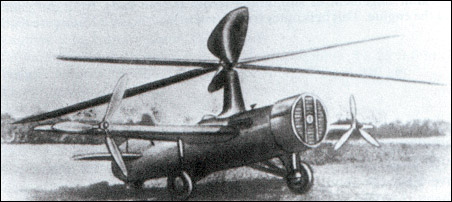
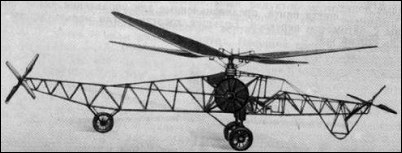
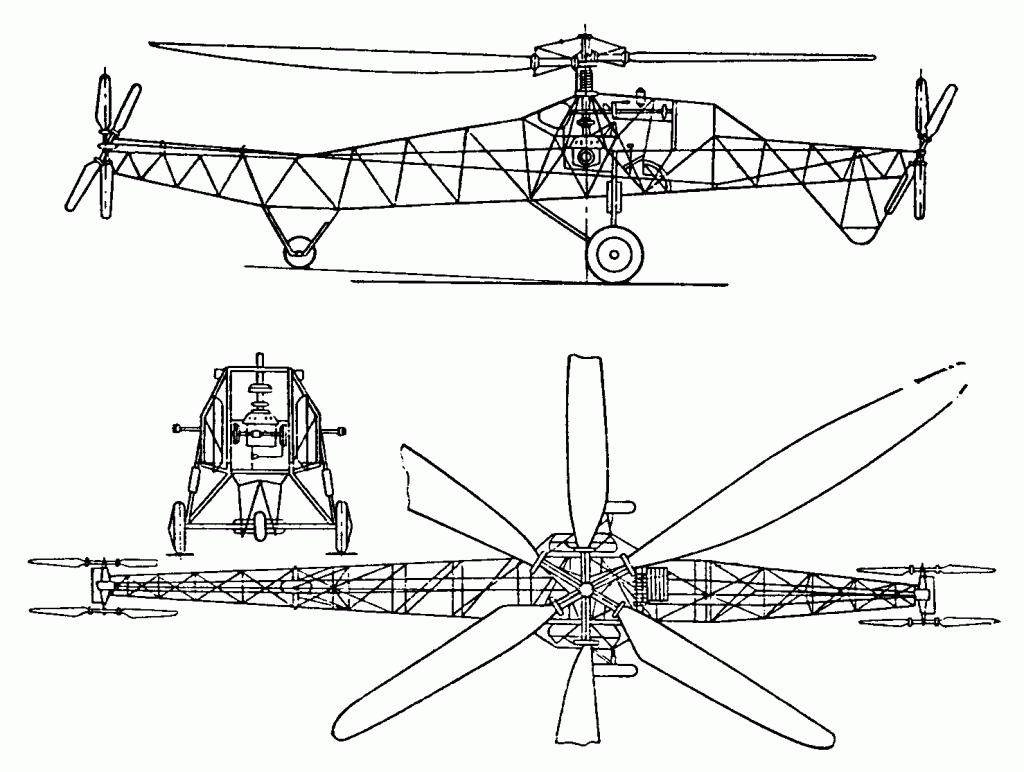
Experiments with 5-EA rotor allowed I.P.Bratukhin to build substantially bigger and heavier aircraft. Designed 1934, this used Bratukhin’s rotor with alternate large articulated blades and small rigid blades but sealed up to absorb power of large US water-cooled V-12 engine. Latter mounted in nose of steel-tube fuselage covered in fabric for streamlining, with tandem cockpits at rear behind main rotor pylons. Main rotor was same as on the 5-EA. Engine arranged facing to rear with reduction gear driving second reduction gearbox at foot of rotor shaft. Auxiliary drive from rear wheelcase to three-blade cooling fan drawing air through main radiator on nose. Rotor torque reacted by two 2250mm three-blade propellers near tips of small fixed wing. Complete aeroplane flght controls – ailerons, elevators, rudder – in addition to improved cyclic/collective controls on main rotor. Intention was to test as helicopter and later arrange for drive to main rotor to be disconnected and aircraft flown as autogyro, with all power used for forward populsion via propellers, with aeroplane flight control.
11-EA was completed summer 1936 and completed tethered testing on a platform, using front cockpit as observer and rear as pilot, though dual controls provided. Considerable difficulties with distribution of power, main blade construction and maintenance of steady height whilst varying pull power of propellers. Late 1937 wave of arrests removed Chyeremukhin, Izakson and many other helicopter engineers and virtually halted further work through fear of accusation of sabotage.
Bratukhin began alterations and in spring 1938 the aircraft emerged as 11-EA PV (Propulsivnyi Variant). The main rotor hub fitted with improved blades entirely dural with better profile. Auxiliary propellers replaced by pairs of anti-torque rotors from 5-EA mounted at tips of outriggers of welded steel tube, borrowed temporarily from older models 1-EA and 3-EA, increasing distance between there axes from 8.0 to 11.0m. Removal of wing improved vertical performance, and smaller screws at greater distance from fuselage reduced power loss in countering torque. Idea of making convertible helicopter autogyro abandoned. The main rotor blades were of all metal construction.
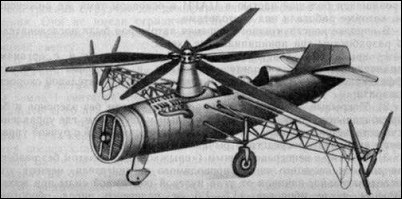
The PV was ready late 1939 and in Chyeremukhin’s absence, D.I.Savelyev took over flight test, making tethered flights early 1940 and free flights from October. Under test director V.P.Lapisov reconstructed machine demonstrated excellent lifting power and good control, but ancient engine no longer ran well (no spares for many years) and the programme halted early 1941 due to worn engine. It never flew again.
Only the one was built.
11-EA
Engine: 1 x Curtiss Conqueror, 630hp
Rotor diameter: 15.4m and 9.2m
Length: 8.5m
Height: 3.5m
Wingspan: 10.6m
Wing area: 11.3sq.m
Max take-off weight: 2600kg
Ceiling: 40m
Crew: 2
TsAGI 5-EA
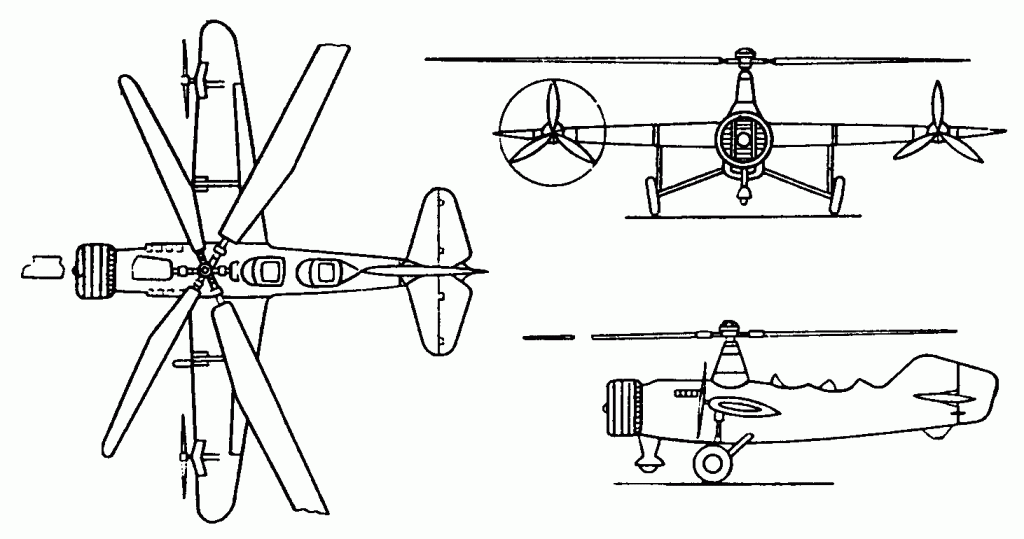
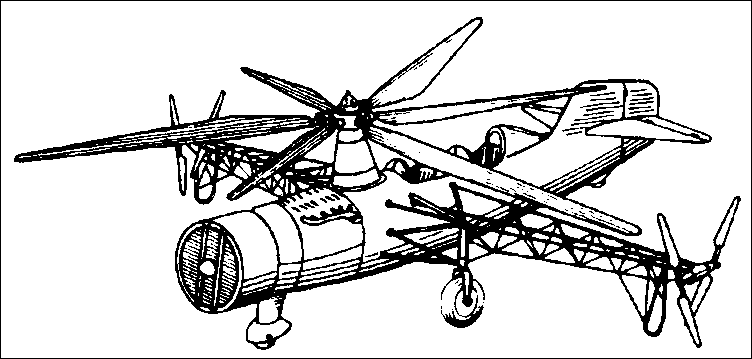
Broadly similar to predecessors, incorporated new rotor proposed by I.P.Bratukhin with three large blades with articulated roots which provided lift, and three smaller blades with rigid attachment which provided control. Some accounts incorrectly state large and small rotors superimposed; all blades were in same plane, large and small alternating. This rotor worked, yet 5-EA appears not to have reached any considerable height or endurance (Western figures 13 miles and 1200 feet not confirmed in Soviet accounts). 5-EA flew from 1933 until late 1935 and was instrumental in providing research basis for machine with more powerful and more modern engine.
5-EA
Engine: 2 x M-2 piston, 120hp
Rotor diameter: 12.0m and 7.8m
Max take-off weight: 1210kg
Empty weight: 1047kg
Max speed: 20km/h
Ceiling: 40m
Endurance: 0.7h
Crew: 1
TsAGI 3-EA
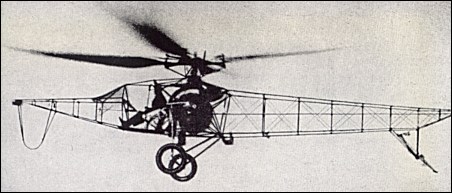
A second helicopter built in 1933 for training pilots. Similar to the 1-EA, it was never flown except on tethers. Instead of having tricycle landing gear, the rear wheel was replaced by a strut.
The 3-EA successfully performed a number of flights, each lasting some ten minutes.
TsAGI 2-EA
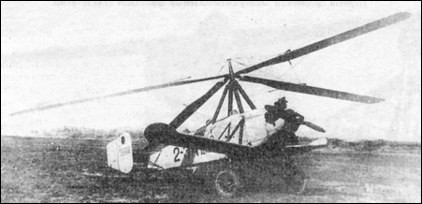
An experimental winged autogiro, and the first Soviet autogiro testbed used for systematic study of all construction elements on the design stage, as well as flight performance. It was built in the beginning of 1931. Designed by V. A. Kuznetsov, heading a group of engineers. It had a four-bladed rotor and the engine drove a two-bladed airscrew.
Chrome-molibdenium steel tubes were used for the kingpost and rotor blades spars. Fuselage frame and engine cradle – steel tube frame, wing – wooden. Cover of EA-2 was all-over fabric.
2-EA was a successful aircraft, and after fulfilling the trial program it was transferred to special propaganda aviagroup named after writer Maxim Gorkij.
TsAGI 1-EA
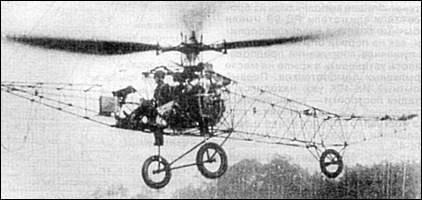
Ivan P. Bratukhin, one of the pioneer figures in Soviet rotorcraft development, was a senior member of the division formed under Boris N. Yuriev at the TsAGI (Central Aero and Hydrodynamic Institute) to carry out research into problems associated with rotary-winged flight. In 1925 Boris Nikolayevich Yur’yev organised a vertolyet (helicopter) group and in 1927 tested a 6m two-blade rotor driven by 120hp M-2. In 1928, from at least four project studies, design picked for 1-EA (Eksperimentalnii Apparat) and machine built at ZOK under G.Kh.Sabinin. Chief designer Aleksei Mikhailovich Cheryemukhin and Aleksandr Mikhailovich Izakson. The TsAGI’s first helicopter, begun in 1928, was the 1-EA, which made its first tethered flights in August 1930.
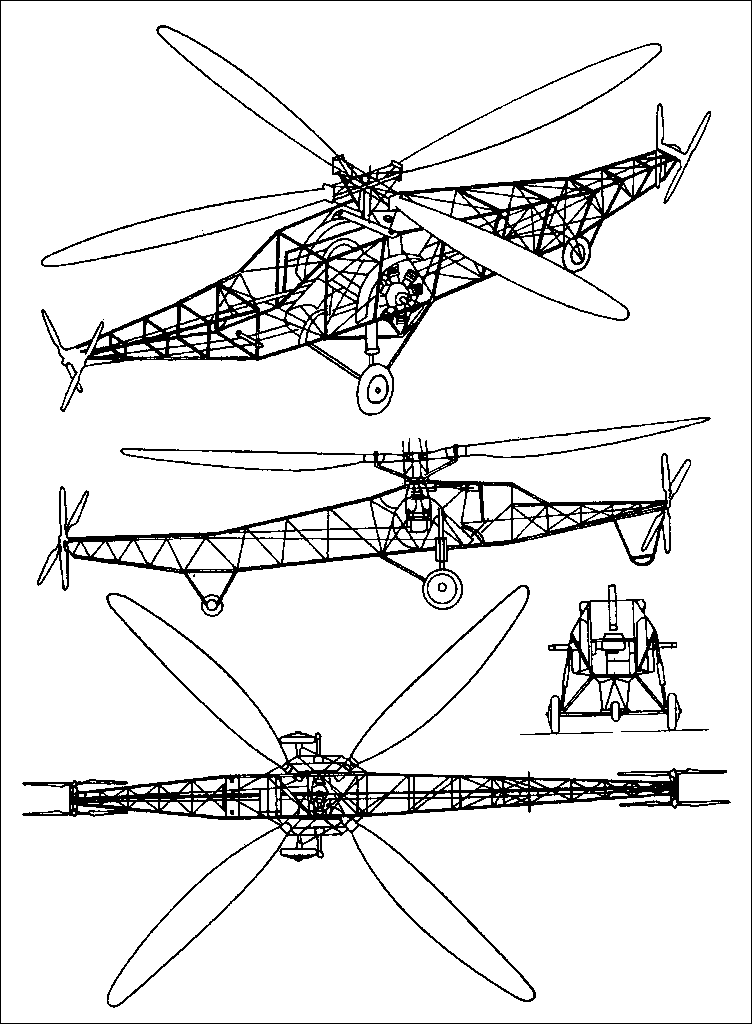
An open framework machine, the 1-EA was powered by two 120hp M-2 rotary engines, driving a single 4-blade lifting rotor and small 2-blade (with variable pitch) steering rotors at the nose and tail. The anti-torque rotors turned in the opposite direction from the other.
Fuselage welded from M1 mild-steel tube forming spaceframe resting on tailwheel landing gear with rubber springing. Twin engines at centre with reduction and bevel gears to vertical shaft to main rotor and side-by-side pairs of 1.8m anti-torque rotors at nose and tail. Chief development task was finding best structure for main rotor blades, an all-metal blade being rejected in favour of one with dural spar, wood ribs and stringers and ply/fabric skin. Four-blade main rotor with 5 degree coning angle driven at 153 rpm.
The single-seater helicopter had a four-bladed rotor with cyclic and collective pitch control operated by means of a hanging stick directly connected with the swash-plate, and pedal control of nose/tail rotors from pilot seat just ahead of engines. Flight testes began on June 26, 1932. In July-August 1-EA was demonstrated to M.N.Tukhachevskij and Ya.I.Alksnis.
M.N.Tukhachevskij suggested small series production, but A.M.Izakson (one of designers) insisted that more development is needed and resources should not be dispersed on production of ‘raw’ machine.
Fuselage was simple frame made of steel tubes, its construction was optimized during tests. Original rectangular structure with tension wires was replaced by more solid triangular without wires.
M-2 engines were selected because they did not require any special cooling in hovering regime. Because main rotor had solid blades, no special clutch was required and rotor started to spin once engines started (with compressed air).
Cheryemukhin elected to fly 1-EA himself, making first tethered run Aug 1930. No disasters and by 1932 reliable flights of up to 12 min. 1 Aug 1932 Cheremukhin reached 160m, 3 Aug 230m, 5 Aug 285m and on 1932 14 Aug 605m. The USSR at the time was not a member of an International Aviation Federation (plus secrecy), and this record could not be formally registered, the world record remaining 18m (d’Ascanio).
The 1-EA story was flown safely mostly due to well designed control system and pilot’s skills of A.M.Cheremukhin. Simple straight link of main rotor to the power plant does not provide enough stability. Smallest variations in engine regime caused aircraft to move up or down, and required full attention of a pilot.
One built, and the 1-EA continued to fly until at least 1934.
TsAGI 1-EA
Engine: 2 x M-2 rotary, 120hp
Main rotor diameter: 11.0m
Max take-off weight: 1145kg
Max speed: 20-30km/h
Hovering ceiling: 605m
Trump Model 1
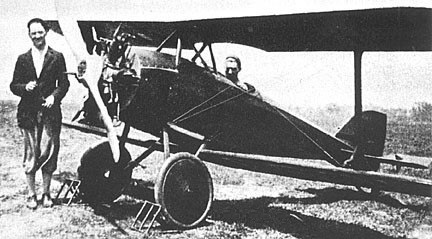
The Trump Model 1 of 1927 appears to be a Lincoln Sport kitplane renamed by its builder, Frederick L Trump, an engineering student at Univ of Minnesota. Ewgistered N6635, test flying was reportedly by Charles “Speed” Holman.
Engine: 28hp Lawrance (later with Salmson)
Wingspan: 19’0″
Gross wt: 300 lb
Seats: 1
Truman 33
In 1932 John R Truman built the Truman model 44 single place open monoplane registered N12730. Power was from a 35hp Cleone engine and the registration was canceled by the CAA on 15 May 1936 on lapse of the license.
True Sport
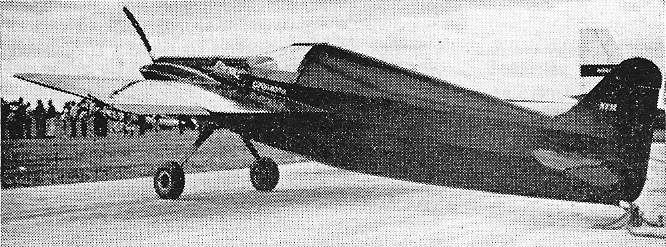
The 1953 Sport N7M, built by Roy True, was conceived as a racer ‘Slow Poke’, but was used only for sport flying. It was a mid-wing monoplane.
Engine: Continental C-85, 85hp
Wingspan: 15’6″
Length: 17’6″
Useful load: 180 lb
Max speed: 210 mph
Cruise speed: 165 mph
Stall: 65 mph
Range: 450 mi
Seats: 1
Troyer Sportplane VX
Originally built by Kermit R Troyer in 1940, the Troyer Sportplane N18471 has a welded steel tube fuselage and tail assembly. Its wings use spruce spars and ribs built from ¼-inch square spruce, ply gusseted. Steel tubing also forms the flying struts for the wing, but here a little balsa wood does creep in. It is used for fairing.
Originally power was a Heath B-4 engine but plans provided for a converted VW engine.
Gross Wt. 456 lb
Empty Wt. 306 lb
Fuel capacity 5 USG
Wingspan 23’9”
Length 15’9”
Top speed 95 mph
Cruise 85 mph
Stall 34 mph
Climb rate 600 fpm
Takeoff run 195 ft
Landing roll 150 ft
Range 200 miles

