A 36hp 5 cylinder air-cooled rotary of 248.25ci. The engine was built with steel cylinders with no cooling vanes.
Engines – Power
Adams-Farwell Rotary

Like another builder of rotary engined road vehicles, Stephen Marius Balzer of New York, the Adams Company offered light gyrocopter engines which successfully powered experimental flying machines by Emile Berliner in 1909-1910 and J. Newton Williams in 1909. A modified 1907 Adams-Farwell engine powered three man-lifting experimental helicopters designed by Emile Berliner.
Cylinders: 5
Cooling: air
Capacity: 621 cu.in
Output: 63 hp
Dry weight: 250 lb
Adams-Farwell 1896
A 3 air-cooled radial, the world’s first successful rotary engine first became a 1903 bus motor. The theory and design was in turn copied liberally by French engineers attending the 1913 Chicago Auto Show, appearing later as the Gnöme rotary.
Adams-Farwell
Adams-(F O) Farwell Co
21 Athol St
Dubuque IA
USA
The Roberts & Langworthy Iron Works, located at 57 South Main Street in Dubuque, were manufacturers of “fine light castings” like grave crosses and park benches. Eugene Adams invested in the company in June, 1883 when Roberts decided to retire, and Adams took the position of a secretary and manager. A change of the company name to Langworthy and Adams Iron Works followed in 1885. When Langworthy retired in 1892, Eugene’s brother Herbert bought his share and the company was re-organized as The Adams Company, foundry and machine shop. The plant burnt down the same year in a disastrous fire, and the company opened new facilities at East Fourth Street. Now, machine castings and household devices like a patented floor heating vent with inner rotating portion that distributed warm air in upper level rooms, or laundry stoves were added. In 1895, Fay Oliver Farwell (1859-1935) became manager of the company.
Also about 1895, Farwell begann experimenting with an internal combustion engined automobile, for which he conceived a horizontally mounted rotary engine with three cylinders. The vertically standing crank shaft was fixed in the chassis. Farwell felt this configuration was lighter than conventional engines as it used neither a flywheel nor radiator. He completed the first prototype in 1898. Basically a horse drawn carriage, he mounted his engine between the front wheels.
Like another builder of rotary engined road vehicles, Stephen Marius Balzer of New York, the Adams Company offered light gyrocopter engines which successfully powered experimental flying machines by Emile Berliner in 1909-1910 and J. Newton Williams in 1909. A modified 1907 Adams-Farwell engine powered three man-lifting experimental helicopters designed by Emile Berliner.
Engine production lasted longer than automobile manufacture although it is not clear when this stopped, too. The Adams Company then relied on their iron foundry and manufacture of gears, shafts and parts for power transmissions which it does until today.
When F. Oliver Farwell left the company in 1921, he had about 20 patents on his name and tried to build up a business on one he held for a novel transmission for merry-go-rounds. Later, he worked again in a gear-cutting company in Toledo, Ohio.
Adams-Wilson Model 101 Hobbycopter / Model 102 Hobbycopter / XH-1 Hobbycopter
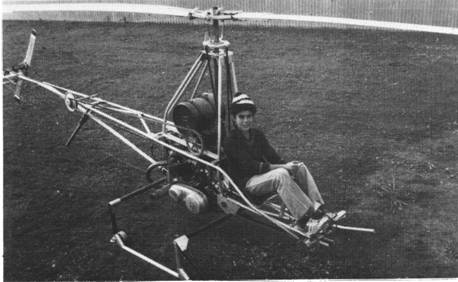
This company was formed by Mr. T.G.Adams and Mr. Paul Wilson to market plans the single-seat helicopter named the HobbyCopter, of which they have built a prototype, N23P, with a 34 hp engine.
The company also supplies kits of parts for the Hobby-Copter sold as a kit to amateurs as the Model 101 Hobbycopter, offered in kit (US$900) or plan (US$35) The subsequent Model 102 had a strengthened structure, 50hp Triumph engine and fibreglass cockpit shell.
First flown in November 1958, this single seat fully fledged helicopter was powered by a motor cycle engine, rubber mounted and fitting into the frame with no modifications – including starting procedures.
Powered by a 40-46hp Triumph 650cc motorcycle engine, the engine, as in its original mount, is kick-started. Fuel is in a single tank above engine with a capacity of 11.4 litres. Oil capacity is 3.8 litres.
When the run-up is complete and ready for takeoff, the pilot engages gear through the motorcycle gearbox — the power being transmitted through a one-way drive to the main rotors and by a vee-belt to the tail rotor.
An open air machine, the helicopter utilises skids and features a 22 foot laminated spruce wooden main rotor of NACA 0012 aerofoil section (chord 0.20m) and a formed aluminium two ¬bladed tail rotor.
Cyclic and collective pitch are controlled by a swash-plate.
The rotor drive involves engine-to-gearbox by chain; gearbox-to-main rotor by direct shaft; gearbox-to-tail rotor by belt. The main rotor rpm in flight is 360, and tail rotor rpm in flight 1,800.
The fuselage is all aluminium tube structure, bolted together, with tubular skids, with retractable ground-handling wheels. A single fiberglass bucket seat is ahead of the rotor drive shaft.
The plans are all to aircraft specifications and the structure is bolted together. The main lift bearing is designed to take six tons.
XH-1 HobbyCopter
Engine: 850cc Norton
Main rotor dia: 22 ft / 6.55m
Tail rotor dia: 0.94 m
Fuselage length: 4.27 m
Width: 1.52m
Height: 1.83m
Empty wt: 335 lb
MAUW: 600 lb / 252kg
Weight empty, equipped: 161kg
Max speed: 72 mph / 96km/h
Max cruise: 72km/h
Econ cruising speed: 64km/h
Service ceiling: 2440m
Max range: 193km
Fuel burn: 1.5 USG/hr
Seats: 1
Adams-Toman Aircaft Co ATA Cruiser
The 1928 Adams-Toman Aircaft Co ATA Cruiser was a high wing, cabin monoplane with a semi-cantilever wing.
Only the one was built, NX14M s/n 100, and the registration noted: “May be entered in National Air Races.”
The registration was reassigned in 1952.
Engine: 110hp Warner Scarab
Wingspan: 38’3″
Length: 25’0″
Empty wt: 1200 lb
Useful load: 800 lb
Seats: 3
Adamoli-Cattani Fighter
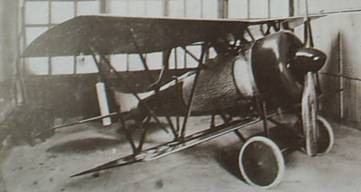
In 1918, Adamoli and Cattani designed the smallest possible single-engine seat fighter around the most powerful rotary engine available, the 200-hp (149-kW) Le Rhone. With conventional wooden construction and fabric covering, the fighter was unequal-span unstaggered biplane with Warren truss-type interplane bracing. Lateral control was by interlinked and hinged wing leading edges varing the wing’s camber tip. Rigid tubes were used to actuate the movable tail surfaces. Construction of the prototype Fighter began at the Farina works in Turin, but was then transferred to the Officine Moncenisio in Condove for completion. Initial static testing revealed that the engine only developed 160hp (119 kW) and the fighter would be seriously underpowered. These limited trails took place at the end of WW1 and further development of the fighter was abandoned after the Armistice.
Adamoli-Cattani fighter (estimated for fully-rated engine)
Type: single-seat biplane fighter
Engine: 160-hp (149-Kw) Le Rhone rotary
Maximum level speed: 186mph (300 kmh)
Endurance: 2 hr 30 min
Empty weight: 1,035 lb (470 kg)
Loaded weight: 1,488 lb (675 kg
Wing span: 28 ft 2 ½ in (8.6 m)
Length: 20 ft 1/8in (6.1 m)
Armament: 2 x 0.303-in (7.7mm) machine guns
Adams B-4
The 1930 B-4 of J.Adams was a single place overhead wing monoplane powered by a Henderson motorcycle engine. Registered N742Y, it was possibly a modified Pietenpol.
Adams Industries Inc
In 1981 Adams Industries Incorporated produced the T211 two-seat lightplane, designed by John Thorpe from the original T-11 Sky Scooter of 1946.
Adams Aeronautics T-100D
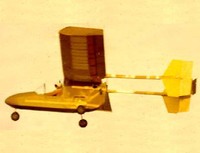
The T-100D was available as a plans only design.
T-100D
Stall: 23 kt / 26 mph / 42 kph
Cruise: 55 kt / 63 mph / 101 kph
Vne: 70 kt / 80 mph / 129 kph
Empty Weight: 115 kg / 254 lbs
MTOW: 229 kg / 504 lbs
Climb Ratio: 600 ft/min / 3 m/s
TO distance (50ft): 350 ft / 107 m
Ldg dist (50ft): 300 ft / 91 m

