A roadable monoplane designed by Ing. Pellarini powered by a Lycoming flat-four engine, the prototype made its first flight on 9 May 1948.
Engines – Power
Aeronix Airelle
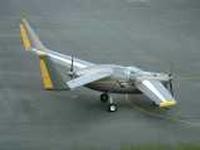
A three-axis ULM, two-seater with side by side seating. With a mid-wing, twin-engine push-pull, canard formula, tricycle landing gear, and composites construction.
Stall: 31 kt / 36 mph / 58 kmh
Cruise: 127 kt / 146 mph / 235 kmh
VNE: 157 kt / 180 mph / 290 kmh
Empty Weight: 295 kg / 650 lbs
MTOW: 472 kg / 1041 lbs
Climb Ratio: 2000 ft/min / 10 m/s
Glide Ratio: 15:1
Aeromot Ximango AMT
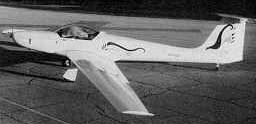
Aeronaves e Motores (Aeromot) acquired the production right to the Aerostructures (Fournier) RF 10 side-by-side two-place self-launching sailplane and built a slightly modified version under the name AMT 100 Ximango with a 80 BHP / 60 kW Limbach L 2000 E01 engine driving a Hoffmann 2 blade 3 position propellor with electric starter. The first AMT 100 flew in 1986. The AMT 200 is a development using the liquid cooled Rotax engine also with a Hoffmann propeller, but of larger diameter. The double main wheel landing gear is manually retractable. The outboard section of the wing folds for hangering. Both are air transport certified.
The Aeromot AMT-200S Ximango is powered by a Rotax 912 engine. The 57 foot wing span can be shortened by folding the outer panels of the wings, which saves hangar space. Since its first flight around 1995, it has proved very popular, with more than 135 sold.
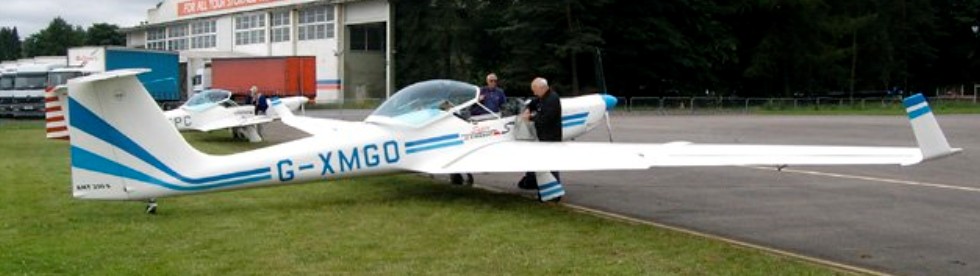
AMT 100
Engine: Limbach L 2000 E01, 80 BHP / 60 kW
Prop: Hoffmann 2 blade 3 position
AMT 200
Engine: Rotax 912A, 81 bhp / 60 kW
Propeller: Hoffman two-blade
Wing Span: 17.47m / 57.3ft
Wing Area: 18.7sq.m / 201.28 sq.ft
Overall length: 26 ft
Height: 5 ft
Empty Weight: 605kg / 1334lb
Payload: 245kg / 540lb
Gross Weight: 850kg / 1874lb
Max ramp weight: 1874 lb
Payload, full fuel: 405 lb
Max landing weight: 1874 lb
Usable fuel: 23 USG
Power loading: 23.1 lb/hp
Baggage capacity: 22 lb
Oil capacity: 3.1 qts
Wheel track: 9 ft
Wing Load: 45.45kg/sq.m / 9.31lb/sq.ft
Cruise 75% pwr: 110 kt
Max range (w/ res) 55% pwr: 650 nm
Fuel burn 75%: 4.5USG/h
Stall speed (flaps, gear down): 39 kt
Best rate of climb: 512 fpm
Takeoff ground roll: 738 ft
Seats: 2
Aspect ratio: 16.1
L/D Max: 42
Airfoil: NACA 64(3)618
Structure: Glass fiber and carbon fiber
AMT 200 Super Ximango
Engine: Limbach L 2000 EO1, 79 hp
Length: 25.886 ft / 7.89 m
Wingspan: 57.316 ft / 17.47 m
Aspect ratio: 16.32
Wing area: 201.287 sq.ft / 18.7 sq.m
MTOW: 1764.0 lb / 800.0 kg
Weight empty: 1323.0 lb / 600.0 kg
Max speed: 132 kt / 245 km/h
Stall: 42 kt / 48 mph / 78 kmh
Cruising speed: 103 kt / 190 km/h
VNE: 132 kt / 152 mph / 245 kmh
Climb Ratio: 550 ft/min / 3 m/s
Wing load: 8.82 lb/sq.ft / 43.0 kg/sq.m
Glide ratio: 30.0
Crew: 2
Take-off distance (50ft obstacle): 1060 ft / 323 m
Landing distance (50ft obstacle): 950 ft / 290 m
AMT-200S Ximango
Engine: Rotax 912
Top speed: 120mph
Range: 550 miles
wing span: 57 ft
Aeronef Montreal Delta
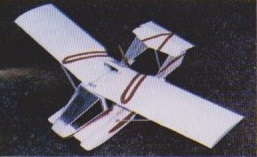
Created by Claude Guilbault, the Delta is an amphibious pusher with retractable undercarriage. The cabin is carbonfibre, and the floats and tail are aluminium. Wings are fabric covered aluminium. The Delte was in the experimental stage in 1998.
Engine: Arrow 1000, 100 hp
Wing span: 9.75 m
Wing area: 16 sq.m
MAUW: 610 kg
Empty weight: 390 kg
Fuel capacity: 136 lt
Max speed: 195 kph
Cruise speed: 180 kph
Climb rate: 3 m/s
Seats: 2
Plan price (1998): Can$200
Kit price (1998): Can$18,000
Aeronef Montreal Crystal
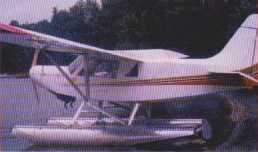
Following on from the Krate, the Crystal was available in microlight or homebuilt form. The Crystal is of riveted sheet dural.
Empty weight: 300 kg
Wing span: 10.35 m
Wing area: 17 sq.m
Fuel capacity: 68 lt
Engine: Arrow, 100 hp
MAUW: 450 kg
Seats: 2
Max speed: 130 kph
Cruise speed: 125 kph
Minimum speed: 59 kph
Climb rate: 3 m/s
Plan price (1998): Can$200
Kit price (1998): Can$13,125
Aeronautical Syndicate Viking
Early in 1912 the twin-propeller Viking biplane was built. This was the last of Barber’s designs.
Aeronautical Syndicate Valkyrie
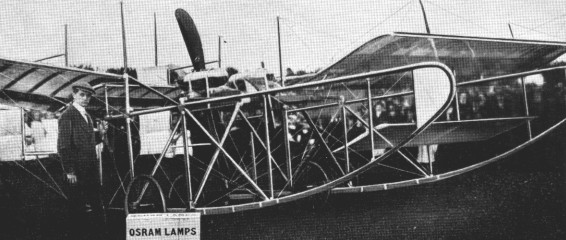
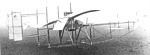
The Aeronautical Syndicate Ltd constructed Horatio Barber’s Valkyrie, tail first, monoplane circa 1911.
Horatio Barber’s Aeronautical Syndicate Limited’s Valkyrie B became the first aircraft to transport aerial cargo in Britain on 4 July 1911, when it flew a box of lightbulbs from Shoreham to Hove in Sussex.
Several Valkyrie canard pushers were built. Not easy to fly, but used successfully for training.
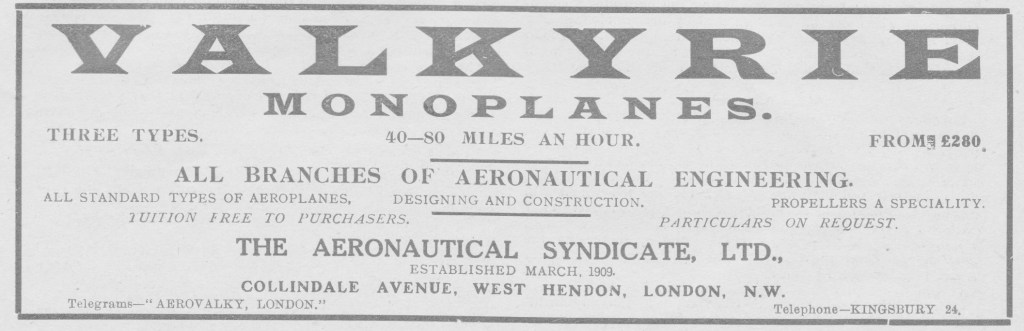
Aeronautical Syndicate Valkyrie Article

Designed by Horatio Barber and powered by a Green 35 hp engine, the type A was the second of the successful Valkyrie type machines.
The 1911 ASL Valkyrie monoplane Type B – two-seater was designed and built by Aeronautical Syndicate Ltd.

Type A
Engine: Green 35 hp
Propellor: Mahogany
Span: 34 ft 0 in / 10.36 m
Length: 22 ft 0 in / 6.71 m
Height: 8 ft 6 in / 2.59 m
Wing area: 190 sq.ft / 17.65 sq.m
Loaded weight without pilot: 520 lb / 230 kg
Speed: 45 mph / 72 kph
Seats: 1
Airframe: Honduras mahogany and ash
Fabric: un-proofed Egyptian cotton
Type B
Span: 31′
Length: 26′
Weight: 550 lb
Speed: 70 mph
Price: £920
Type C
Span: 39′
Length: 29’9″
Weight: 800 lb
Speed: 70 mph
Seats: 3

Aeronautical Products Corp Scorpion
A 100hp 336ci four cylinder, inline, air cooled engine.
Aeronautical Products Corp / Aero Products
Naugatuck CT.
USA
Engine builder circa 1928.
Aeronautical Products A-3
The NX1272 Model 3 of 1944 fuselage was of fabric-covered welded steel tubing, and resembled that of a light aircraft with the engine located in the forward section and placed horizontally forward of the cabin.
Power from the engine, cooled by a fan mounted directly above it, was transmitted by pulleys and vee belts to a horizontal main drive shaft, then through a bevel gear drive to the main rotor shaft which passed between the pilot’s and the passenger’s seats.
Mounted on the vertical rotor drive shaft was the main gearbox for the tail shaft operating the two-bladed anti-torque rotor, with a diameter of 1.71 metres, the pitch of which was controlled by rudder pedals. This rotor’s maximum rotational speed was 1200 r.p.m.
The three blades of the main rotor were made with tapered tubular spars and also connected to the root spars by a double-action hydraulic shock absorber.
Cyclic pitch control was obtained by a hanging stick while on the engine throttle support was the collective pitch control.
The A-3 was tested in 1945.
A-3
Engine: 1 x Franklin 6AC-298, 165hp
Number of Seats: 2
Rotor Diameter: 9.14m
Weight Fully Loaded: 544kg
Tail rotor diameter: 1.71 m
Tail rotor speed: 1200 rpm

