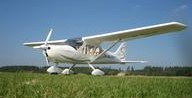
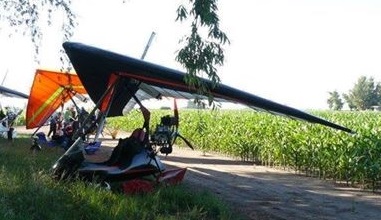
A single-engine all-composite high-wing side-by-side two-seater with a fixed tricycle landing gear (a steerable nose wheel included). Equipped with fully adjustable seats and a baggage compartment behind. Price 2009: 48500 EURO
Stall: 35 kt / 40 mph / 65 kmh Cruise: 103 kt / 118 mph / 190 kmh VNE: 130 kt / 149 mph / 240 kmh Empty Weight: 285 kg / 628 lb MTOW: 472 kg / 1041 lbs Climb Rate: 1200 fpm / 6 m/s Take-off distance (50ft obstacle): 580 ft / 178 m Landing distance (50ft obstacle): 630 ft / 192 m
Aeros del Sur is the importer of Aeros products for Argentina. The Manta was designed by mating the Aeros Profi trike wing with a new, locally designed carriage. The Manta was designed to comply with the Fédération Aéronautique Internationale microlight category, including the category’s maximum gross weight of 472.5 kg (1,042 lb), with a ballistic parachute.
The aircraft is made from a mix of bolted-together aluminum and steel tubing, with its double surface wing covered in Dacron sailcloth. Its 10 m (32.8 ft) span wing is supported by a single tube-type kingpost and uses an “A” frame weight-shift control bar.
It features a cable-braced hang glider-style high-wing, weight-shift controls, a two-seats-in-tandem, open cockpit, tricycle landing gear with wheel pants and a single engine in pusher configuration.
The standard powerplant is a twin cylinder, liquid-cooled, two-stroke, dual-ignition 64 hp (48 kW) Rotax 582 engine, but the HKS 700E four-stroke, dual-ignition 60 hp (45 kW) engine is optional, as are Hirth and Simonini powerplants.
In production in 2013, the aircraft was supplied as a complete ready-to-fly-aircraft.
Engine: 1 × Rotax 582, 48 kW (64 hp) Propeller: 3-bladed composite Wingspan: 10 m (32 ft 10 in) Wing area: 15.4 m2 (166 sq ft) Gross weight: 472.5 kg (1,042 lb) Fuel capacity: 50 litres (11 imp gal; 13 US gal) Wing loading: 30.68 kg/m2 (6.28 lb/sq ft) Crew: one Capacity: one passenger
Aeroric Science and Production Enterprise has developed the Dingo passenger (up to nine seats) or cargo amphibious lightplane of unusual design, featuring an air cushion landing system which enables it to land on any surface; has twin-boom tail unit and single turboprop engine with pusher propeller. Mock-up displayed 1992, and prototype displayed in 1995 in incomplete form but not flown by 1998.
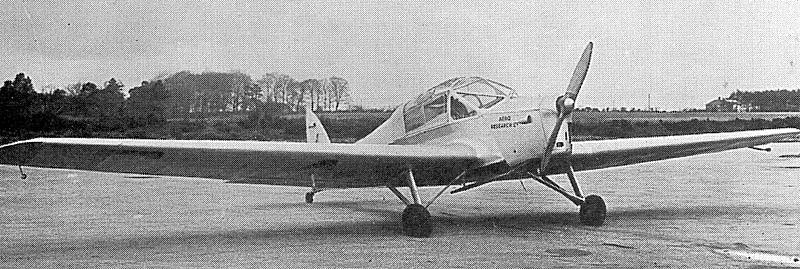
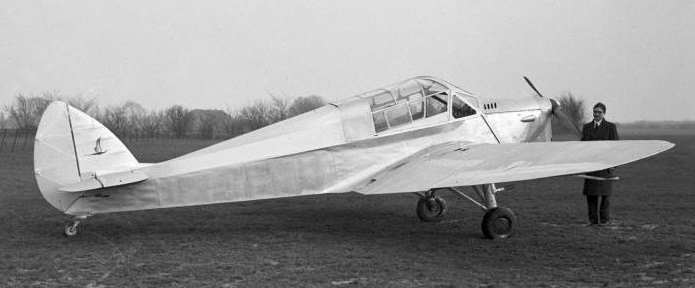
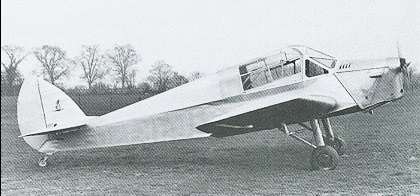
The Snark research aircraft G-ADDL c/ DB.2 was designed by Dr. N.A. de Bruyne and built by Aero Research Ltd in 1934. It was built to test low weight, bakelite-bonded plywood, stressed skin wing and fuselage structures
Apart from the structure the Snark was a conventional looking low-wing four-seat cabin monoplane, powered by a nose-mounted 130 hp (97 kW) de Havilland Gipsy Major piston engine. Registered G-ADDL the Snark first flew from Cambridge on 16 December 1934 flown by de Bruyne.
In May 1936 the Snark was transferred to the Royal Aircraft Establishment at Farnborough for research into the aerodynamics of thick wing monoplanes, with serial number L6103. The aircraft was sold by the RAE on 8 June 1938 but was destroyed by German bombing at Croydon Airport in 1940.
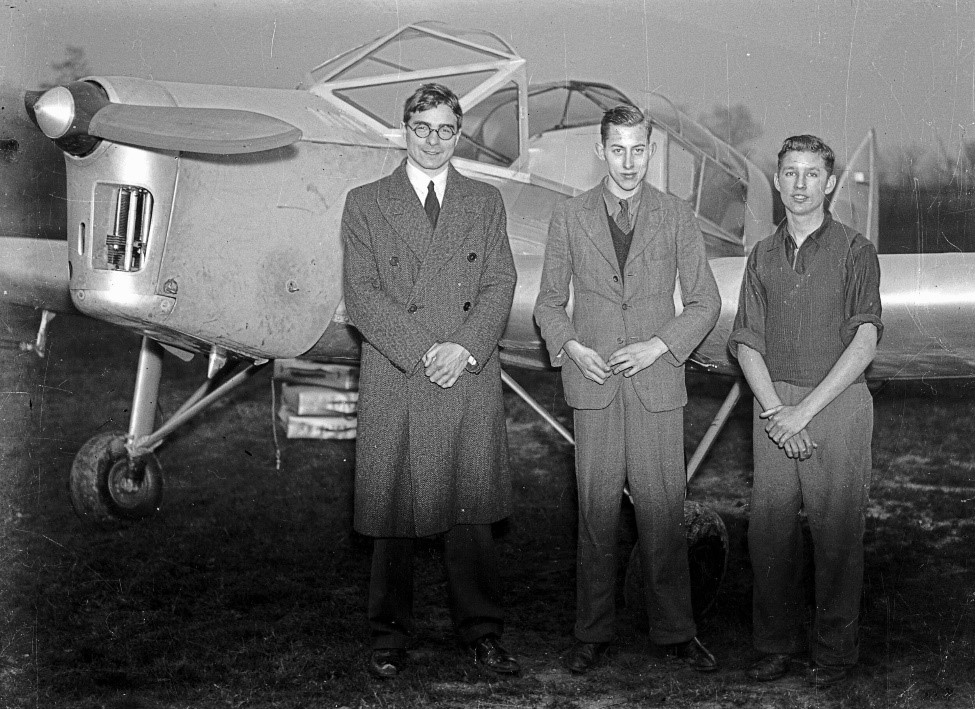
Dr Norman de Bruyne (left) with two of Aero Research’s staff members
Powerplant: 1 × de Havilland Gipsy Major, 130 hp (97 kW) Wingspan: 42 ft 6 in (12.95 m) Length: 24 ft 7 in (7.49 m) Empty weight: 1,200 lb (544 kg) Gross weight: 2,200 lb (998 kg) Maximum speed: 123 mph (198 km/h, 107 kn) Cruise speed: 110 mph (177 km/h, 96 kn) Range: 450 mi (724 km, 390 nmi) Service ceiling: 15,500 ft (4,725 m) Rate of climb: 600 ft/min (3.0 m/s) Crew: 1 Capacity: 3
The third design of Dr. N.A. de Bruyne, the Ladybird was a single seat, shoulder wing monoplane, powered by a Scott Squirrel.
It was started in 1936 at Duxford by Aero Research Ltd as c/n DB.3 G-AFEG. It was not finished and taken over for competition by J.N.Maas in 1937 and redesignated de Bruyne-Maas Ladybird and given a new c/n, M.1.
It first flew at Cambridge in 1937 but was re-engined in 1938 with a Bristol Cherub. It apparently spent most of its time flying as DB.3/M1.
It survives somewhere in the Peterborough area.
Engine: Bristol Cherub, 30 hp Wingspan: 32.021 ft / 9.76 m Wing area: 106.241 sq.ft / 9.87 sq.m MTOW: 800.4 lb / 363.0 kg Weight empty: 421.2 lb / 191.0 kg Wing load: 7.59 lb/sq.ft / 37.0 kg/sq.m Crew: 1
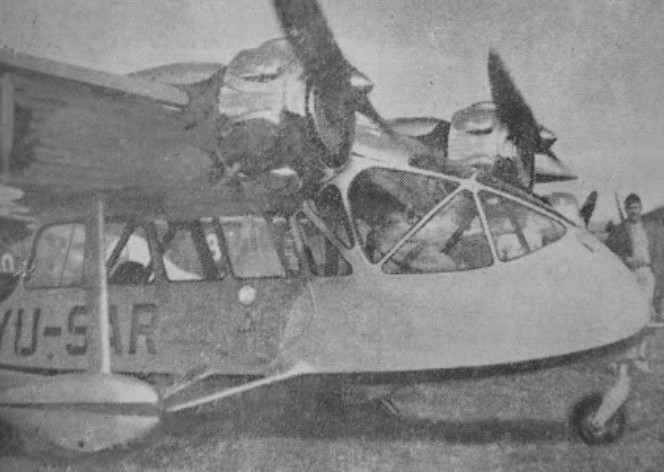
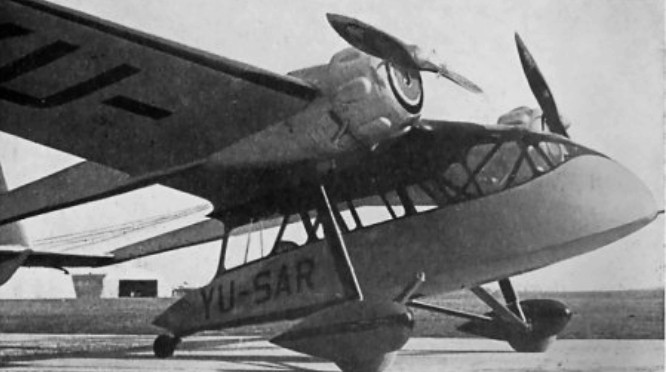
Work on the design of aircraft Aeroput MMS-3 (Serbian Cyrillic: Аеропут ММС-3) was conducted in 1934, the sole designer was aeronautical engineer Milenko Mitrović – Spirta, whose initials are on the plane as the MMS label. The number on the label represents a 3-seater passenger plane. Mr Milenko Mitrović – Spirta was then technical director of Aeroput and suggested that the Board of Directors on the basis of his project, which was in March 1934 tested in the Eiffel wind tunnel in Paris, made for Aeroput in his workshop for repairing aircraft an airplane which would be used as aviotaxi, for whom he felt a great need. The constructor then tried several configurations, including inline and stellar engines, without guards and shields, placed at different distances from the gondola hull. Finally, selected system characterized by aerodynamic perfection of Class 12, in those years achieved only by a very good gliders.
The MMS-3 was a twin-engine high wing monoplane of wooden construction with the fuselage covered with plywood, and the wings with fabric, intended primarily for avio taxiing. It was powered by two 88 hp (66 kW; 90 PS) Pobjoy Niagara III the 7-cylinder piston radial engines. These engines were characterized by low fuel consumption and very quiet operation allowing greater passenger comfort. The aircraft flew with two bifurcated wooden propeller with fixed steps. The wooden wing consisted of a double box-shaped wing-spar with a leading edge covered with birch wood. Rest of the wing was covered with plywood covered with doped fabric. The fuselage section including the pilot /passenger cabin had a rounded well streamlined nose and ended at the rear with a small conical tail section. The fuselage had inside three seats placed on a row with two doors on each side that could be opened upwards. The elevator at the tail was fitted with small so-called ‘Flettner’-flaps. The single vertical tail was centrally placed on the horizontal tail section. For that time the plane had unusual concept, instead of conventional fuselage, in the extension of the engine carrier had two tail fins (bi-fuselage). Fuel tanks were located in the wing between the two engines with fuel capacity of 265 l (70 US gal). The cabins for pilots and passengers was one unit, which like gondola is located below the airplane wings. The cabin had a large window area that provided excellent visibility to the pilot and passengers. This made him an extraordinary airplane for panorama flights. It had a fixed landing gear of a conventional type, tail wheel was located at the rear of the gondola fuselage and the main gondola wheels were mounted on one side of the gondola fuselage and on the other side to engine mount. The main wheels have aerodynamic fairings. In 1940 the MMS-3 was used to test the tricycle undercarriage with the front wheel and served as a test basis for a hypothetical bomber version called NEMI, but the project never materialized.
During 1935 the prototype was built, and flew the first time in January 1936. The first flight and test of aircraft conducted by pilot Vladimir Striževski – Striž head of Aeroput transport pilots. The plane showed good performance.
The appearance of the MMS-3, because of its outstanding aerodynamic characteristics, caused interest in France, United Kingdom, Germany and Czechoslovakia. Negotiations for the sale of the license were started, but were not concluded, and production did not take place.
In the summer of 1936 the MMS-3 received a certificate and was registered as YU-SAR. It was used on passenger routes from Belgrade to Sarajevo, Podgorica and Skoplje, also carrying mail and newspapers. During the flight Belgrade – Podujevo – Skoplje on 15 September 1936 it made a forced landing due to an engine failure and was damaged slightly. The damage was quickly repaired so that by the end of 1937 the aircraft had 65 hours of flight time, 1938 – 79 hours, 1939– 102 hours. In addition, it was used for Aeroput’s pilots training. It was also used for publicity purposes, taking the visitors of aero-meetings at the minimum prices which contributed to the popularization of aviation and air transport in Yugoslavia. The passenger seats could be easily remove and the plane turned into the cargo airplane (the first Yugoslav cargo plane).
Just before the April War in 1941 the aircraft was used by the 603rd training squadron of the Royal Yugoslav Air Force (JKRV) which was located at Grab Airport near Trebinje and it was destroyed during withdrawal from the airport. According to other sources, in March 1941, ahead of the tense of international situation around Yugoslavia, the MMS-3 was taken over by the Royal Yugoslav Air Force (JKRV) and placed him in the 603rd Auxiliary Squadron, where it was to be used as a liaison aircraft, deployment and courier needs. According to eyewitness reports, after the German invasion of Yugoslavia in April 1941, the aircraft was destroyed by the crew at the airport near the village of Divci in Valjevo region so that it would not fall into enemy hands. The constructor Milenko Mitrović – Spirta (15 Febtuary 1905 Novi Sad, Serbia – 23 August 1986 Peterborough, NH, USA) in April 1941 photographed the plane before it was destroyed.
Engines: 2 × Pobjoy Niagara III, 88 hp (66 kW; 90 PS) each Wingspan: 11.56 m (37 ft 11.1 in) Length: 7.42 m (24 ft 4.1 in) Wing area: 16 sq.m (172 sq.ft) Height: 2.25 m (7 ft 4.6 in) Empty weight: 630 kg (1,389 lb) Loaded weight: 1,030 kg (2,271 lb) Wing loading: 64.38 kg/sq.m (13.04 lb/sq.ft) Power/mass: 128 W/kg (0.078 hp/lb) Maximum speed: 235 km/h, 127 kn (146 mph) Cruise speed: 215 km/h (134 mph) Landing speed: 75 km/h Range: 600 km (373 mi) Endurance 3 pob: 3 hr Endurance 2 pob: 5 hr Service ceiling: 6,000 m (19,685 ft) SE service ceiling: 1800 m Rate of climb: 6.5 m/s (1,278 ft/min) Climb to 5000 m: 22 min Crew: 1 Capacity: 3 passengers
A twin-engined light aircraft with twin tail booms and an upward-lifting rear cabin door for cargo carrying. Aeroprogress in the USA offers the T-420 Strizh.