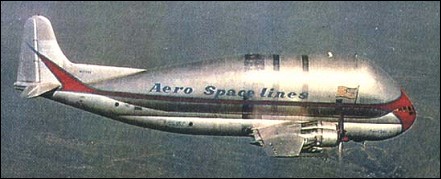
Aero Spacelines started work in 1961 on the conversion of a Boeing B-377 Stratocruiser to an outsize cargo aircraft able to airlift large booster rocket stages being employed in the American space programme, for the transport of aircraft assemblies, oil drilling equipment, and any other items too large to be carried by any then existing aircraft.
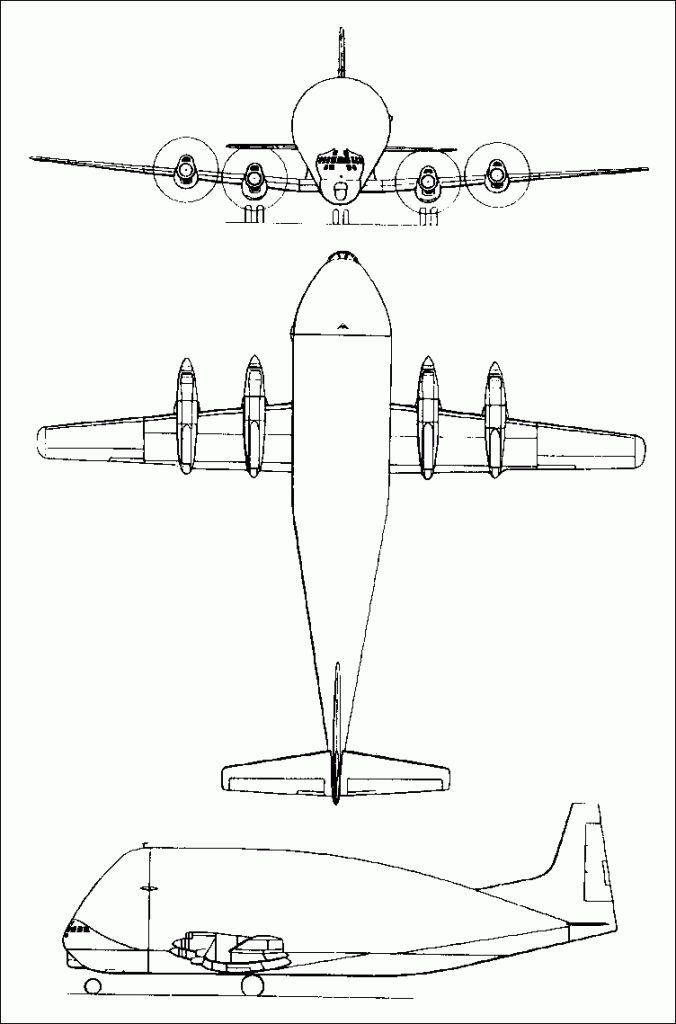
Designed by Jack Conroy, the fuselage of ex-airline Boeing 377 N1024V was extended by 5.08m aft of the wing, and a new ‘bubble’ structure was added over the top of the fuselage to allow the loading of items up to 6.02m in diameter. Capable of carrying 34,000 lb of cargo, the resulting B-377PG Pregnant Guppy was flown for the first time on 19 September 1962, and was used from the summer of 1963, under contract to NASA, for the transport of space programme hardware. Aircraft was loaded by removing the tail section just aft of the wing trailing edge.
377PG “Pregnant Guppy” Engines: 4 x Pratt-Whitney R-4360, 23500hp / 625kW Wingspan: 43.05 m / 141 ft 3 in Length: 38.71 m / 127 ft 0 in Take-off weight: 60200 kg / 132719 lb Empty weight: 41200 kg / 90831 lb Payload: 13100kg / 28881 lb Speed: 240 mph
The Guppy 201 utilizes the lower fuselage, wings, tail unit and cockpit of a Boeing 377/C 97, with portions of the lower fuselage of several aircraft being joined to provide a larger cabin with interior diameter of 25′. Upper fuselage lobe added to stretched C-97 fuselage, plus parts from Airbus, Concorde, DC-10, and TriStar; engines from retired Lockheed Electras.
Although this Super Guppy is very close in dimensions to the original Super Guppy, the shape of the fuselage has a smoother flow and engine nacelles are completely different.
The first 377SGT Super Guppy Turbine flew on August 24, 1970. After success with the first of the 377SGTs, Aero Spacelines built a second 377SGT and it flew exactly two years later on August 24, 1972.
Aero Spacelines originally planned to build and operate the MGT and SGT aircraft but after the company got into serious financial trouble a decision was made to sell the SGT to Airbus Industrie.
Two were built by Aero Spacelines in early 1970s, N211AS and N212AS, and sold to Airbus Industrie/Aérospatiale to haul components of A300Bs and Concordes.
Two were built in early 1980s for Airbus by UTA Industries in France. Retired by Airbus in early ’90s; reportedly three went to European museums, and the last one was bought by NASA.
The Super Guppy Turbine (NASA’s B377SGT), super-sized cargo plane flown since 1980 was acquired by NASA in 1997. Its home base, was the Ellington Field, near the Johnson Space Center in Lancaster, California.
Guppy 201 Engines: 4 x Allison 501-D22C, 3663kW / 4912shp Take-Off Weight: 77111 kg / 170002 lb Empty Weight: 45359 kg / 100000 lb Payload: 25000kg / 55116 lb Wingspan: 47.63 m / 156 ft 3 in Length: 43.84 m / 143 ft 10 in Height: 14.78 m / 48 ft 6 in Wing Area: 182.51 sq.m / 1964.52 sq.ft Max. Speed: 460 km/h / 286 mph Cruise Speed: 407 km/h / 253 mph Ceiling: 7620 m / 25000 ft Range W/Max.Payload: 813 km / 505 miles
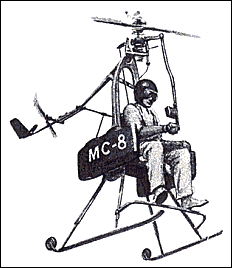
Aerospace General Corp announced their Mini Copter with an optional landing skid. Two small rocket motors powered the Mini Copter, converting hydrogen peroxide fuel into superheated steam which was released through rotor tip nozzles, providing equivalent to a 90 hp engine. Fuel was carried in two tanks each side of the pilot. The entire machine fitted into a cylindrical container no larger than a jet fighter’s droptank. The Mini-Copter was first flown in 1973.
The Mini-Copter was intended originally for air-dropping to a pilot who had been forced down behind enemy lines or in terrain unsuited to conventional rescue. It was evaluated by the US Army in an Individual Tactical Air Vehicle (ITAV) role in three configurations:
1: is the basic version with no landing gear and the fuel tanks and control/rotor unit strapped to the pilot;
2: consists of a welded steel tube structure carrying the control/ rotor unit and fuel tanks, and providing a seat for the pilot;
3: is generally similar to version 2 but has the addition of a 67kW McCulloch flat-four engine. This model takes off as a helicopter using its two 19kg Aerospace General rocket motors (one on the tip of each main rotor blade) but at 48kph forward speed the tip units are turned off and the aircraft flies as an autogyro using the McCulloch engine.
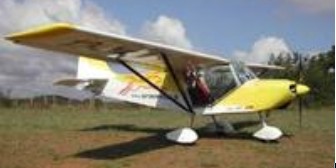
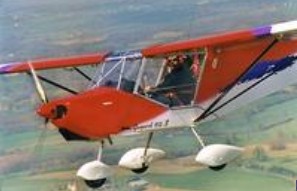
A side by side two seat single engined high-wing monoplane with conventional three axis control. Wing has unswept leading and trailing edges, and constant chord; conventional tail. Pitch control by elevator on tail; yaw control by fin mounted rudder; roll control by one third span ailerons; control inputs through stick for pitch/roll and pedals for yaw. Cantilever wing; wing profile NACA 23012; double surface. Undercarriage has three wheels in tail dragger formation; rubber suspension on all wheels. No ground steering (optional ground steering by differential braking). Optional brakes on main wheels. Aluminium tube framework, with optional pod. Engine mounted above wing driving pusher propeller. Wing and tail are made with stratified glass ribre/epoxy, vacuum molded; spar in carbon fibre. Designed by Alain Erval, the prototype of the two seater Intermezzo made its first flight on the 14 August 1982 and went on next to a test flight programme and detail modification, leading to sales in April 1983. This very original machine is a mixture of proven and classical solutions (NACA 23012 profiles for the wing and 0012 for the tail), combined with materials which are more common in gliding than in ultralights, such as layers of carbon fibre. The central section of the Intermezzo wing has no dihedral and the outer sections of the wing set at 8 degrees. To make garaging easy, this wing demounts like a glider wing into three 13.2 ft (4.0 m) sections and the empennage can be removed from the two spars which carry it. They come off in two parts, the horizontal section being a unit and the vertical another. Thanks to these arrangements, the structure is completely foldable to ease towing on a trailer. Production Intermezzos are supplied with dual controls. Another original point is that this machine is equipped as standard with fabric seats adjustable for the height of their occupants by laces; bucket seats are optional. It is fitted with a Hirth 493 cc engine (with electric start as an option), mounted by four bolts and with all electrical connections made via a single plug. This two seater is fitted with a tail dragger undercarriage. Production versions have an instrument panel with ASI, altimeter and rev counter. Options include a pod with windscreen, an integral canopy with this assembly, the glide ratio increases from 12 to 15/1 at 37 mph (60 kph) and air brakes.
Engine: Hirth 2701RR 179, 45 hp at 3600 rpm Propeller dia: 39 in, 1.0 m. Reduction ratio: 1.8/1 Max static thrust: 265 lb, 120 kg Power per unit area: 0.2 hp/sq.ft, 2.3 hp/sq.m Fuel capacity mains: 10.6 USG, 8.8 Imp gal, 40.0 lt Fuel capacity res: 5.3 US gal, 4.4 Imp gal, 20.0 lt Length overall: 19.8ft, 6.0 m Height overall: 7.2ft, 2.2m Wing span: 41.0ft, 12.5m Constant chord: 4.3ft, 1.3m. Dihedral: 8 degs Sweepback: 0 degs Tailplane span: 13.1 ft, 4.0 m Total wing area: 216 sq.ft, 20.0 sq.m Total aileron area: 8.6 sq.ft, 0.8 sq.m Fin area: 9.7 sq.ft, 0.9 sq.m Rudder area: 3.2 sq.ft, 0.3 sq.m Tailplane area: 43.2 sq.ft, 4.0 sq.m Total elevator area: 12.9 sq.ft, 1.2 sq.m Wing aspect ratio: 10.2/1 Wheel track: 6.7 ft, 2.0 m Tailwheel dia. Overall: 4 in, 10 cm Main wheels dia. Overall: 16 in, 40 cm Empty weight: 287 lb, 130kg Max take off weight: 662 lb, 300kg Payload: 375 lb, 170kg Max wing loading: 3.07 lb/sq.ft, 15.0 kg/sq.m Max power loading: 4.7 lb/hp, 6.7kg/hp Load factors: +6.6, 3.3 design Max level speed: 87 mph, 140 kph Never exceed speed: 124mph, 200kph Max cruising speed: 81mph, 130kph Econ. cruise speed: 71mph, 115kph Stalling speed: 28mph, 45 kph Max climb rate SL: 500 ft/min, 2.5 m/s Min sink speed: 31 mph, 50 kph Min sink rate: 240 ft/min, 1.2 m/s Best glide ratio: 12/1 at 37 mph, 60 kph Take off distance: 165ft, 50m Landing distance: 165ft, 50m Service ceiling: 12,500ft, 3800m Range at ave. cruise: 311 mile, 500km
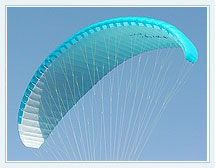
The Vitamin is a paraglider for beginners and weekend pilots. Long brake travel helps beginners to sense the canopy. All sizes are – Lines: Cousin Trestec; upper dia. 1.1 Superaram 80 kg; lower dia. 2.2 Superaram 240 kg; med dia. 1.7 Superaram 155 kg; brake upper dia. 1.1 Dyanema 85 kg; brake lower dia. 2.0 Polyester 80 kg. Sail Cloth: Gelvenor/Porcher Marine
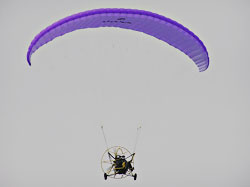
Vitamin power 38 moto
Vitamin 25 Cells: 31+ 8 Area: 25.0 sq.m Span: 10.97 m Aspect ratio: 4.81 Area projected: 21.87 sq.m Span projected: 8.32 m Aspect ratio projected: 3.56 Chord root: 2.765 m Chord tip: 0.6 m Total height: 6.91 m Take off weight: 60-80 kg Flight speed min: 21 km/h Flight speed trim: 36 km/h Flight speed max: 47 km/h Min.sink (opt. weight): < 1.2 m/s
Vitamin 27 Cells: 31+ 8 Area: 26.75 sq.m Span: 11.34 m Aspect ratio: 4.81 Area projected: 23.41 sq.m Span projected: 9.13 m Aspect ratio projected: 3.56 Chord root: 2.86 m Chord tip: 0.62 m Total height: 6.91 m Take off weight: 70-90 kg AFNOR: Standard Flight speed min: 21 km/h Flight speed trim: 36 km/h Flight speed max: 47 km/h Min.sink (opt. weight): < 1.2 m/s
Vitamin 30 Cells: 31+ 8 Area: 29.43 sq.m Span: 11.9 m Aspect ratio: 4.81 Area projected: 25.75 sq.m Span projected: 9.57 m Aspect ratio projected: 3.56 Chord root: 3.0 m Chord tip: 0.65 m Total height: 7.25 m Take off weight: 85-105 kg AFNOR: Standard Flight speed min: 21 km/h Flight speed trim: 36 km/h Flight speed max: 47 km/h Min.sink m/s (opt. wt): < 1.2 m/s
Vitamin 32 Cells: 31+ 8 Area: 32.0 sq.m Span: 12.41 m Aspect ratio: 4.81 Area projected: 28.0 sq.m Span projected: 9.98 m Aspect ratio projected: 3.56 Chord root: 3.13 m Chord tip: 0.68 m Total height: 7.56 m Take off weight: 100-125 kg AFNOR: Standard Flight speed min: 21 km/h Flight speed trim: 36 km/h Flight speed max: 47 km/h Min.sink m/s (opt. wt): < 1.2 m/s
Vitamin 38 Cells: 31+ 8 Area: 38.0 sq.m Span: 13.52 m Aspect ratio: 4.81 Area projected: 33.25 sq.m Span projected: 10.88 m Aspect ratio projected: 3.56 Chord root: 3.41 m Chord tip: 0.74 m Total height: 8.24 m Take off weight: 130-180 kg Flight speed min: 21 km/h Flight speed trim: 36 km/h Flight speed max: 47 km/h Min.sink m/s (opt. wt): < 1.2 m/s
Vitamin power 38 moto Cells: 31+8 Area: 38 sq.m Span: 13.52 m Aspect ratio: 4.81 Area projected: 33.25 sq.m Span projected: 10.88 m Aspect ratio projected: 3.56 m Total height: 8.24 m Take off weight: 130-350 kg Flight speed min: 21 km/h Flight speed trim: 36 km/h Flight speed max: 47 km/h Min.sink m/s (opt. wt): <1.2 m/s
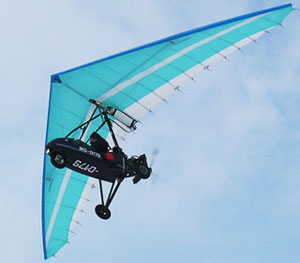
In 1995 the Graffiti trike with the Stranger wing was certified. The wing has successfully undergone strength and aerodynamic testing in the course of the certification at DULV and within a year 80 Stranger wings had been sold.
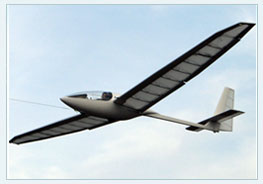
The AC-21 powered sailplane is an evolution of AL-12 design that was developed in Ukraine during 2000 – 2005 as a joint project by Aeros and Aerola. In 2006 it was decided to make a next step in the development of the sailplane, splitting the project and leaving production of AL-12 (now Alatus) in Aerola. AC-21 joins unique features of AL-12 incorporated in the new design. The AC-21 is all about maximum enjoyment of free flight. Sweet handling, slow flight capabilities and low sink rate allows exploring “microlift” conditions, when most other gliders are unable to stay in the air. AC-21 can turn really tight. AC-21 structural capacity has been increased keeping an aim to meet actual sailplane standards (+5.3 -2.65 G load factors). It gives us a chance of wider margin over current DULV and DAeC requirements for ultra light aircraft (+4/-2 G). Specifically the wing leading edge D-spar had to get stronger by 25%; the ribs structural capacity and rigidity was greatly increased and the ribs are now made of carbon. Powered by a Hirth F33 BS delivering 28 hp, it has a factory recommended TBO of 1000 hours at 75 % power. A newly designed fuselage insures laminar flow over its front, makes room for the engine and allows full enclosure of the propeller when in glider mode. There has also been an increase in the transparent part of the canopy, improving forward visibility.
AC-21 Engine: Hirth F33 BS, 28 hp Empty weight: 135 kg Мах. takeoff weight: 264 kg Wing span: 13.3 m Sail area: 13.5 sq.m Pilot weight: 60-110 kg Stall speed: 52-56 km/h Vne: 140 km/h Best glide ratio: 27 at 70 km/h Min. sink rate: 0.6 m/s at 67 km/h Climb w. Engine: 2.5 m/s
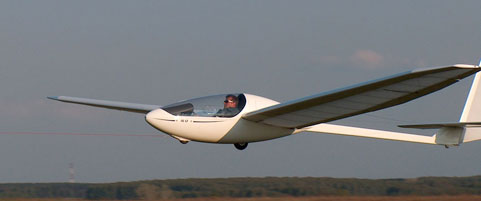
In 2005 the Aeros team took part in designing an entirely new product: the AL-12 ultralight sailplane and its powered version AL-12 M with a retractable power-unit. The idea of a sailplane that could have some of the positive features of hang gliders and rigid wing gliders, and the possibility of soaring flight while using narrow thermals and “microlift”, to takeoff from hang gliding sites, and the simplicity of quick rigging and ease of transportation appealed. The sailplane offered by Aeros takes off by air towing or winch towing, andallows mounting a retractable engine for autonomous takeoff and climb. The cockpit is equipped with adjustable pedals and seat back that can be adjusted to the pilot’s height up to 195 cm. There is a space for a backpack parachute. The sailplane can come complete with an optional rescue system. For transportation purposes all control and stabilizing surfaces are removed, the cabin is detached, the wing with the tail beam is put into a package 0,2 x 0,58 x 5,7 m. The 0,6 x 0,86 x 3 m cockpit can be transported either as a whole assembly or in parts (cockpit, fuselage spine fairing, cockpit enclosure). The rigging takes around 40 minutes.
AL12M -Powered version ultralight sailplane
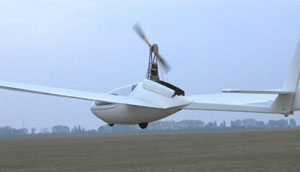
On October, 8, 2005 the first flight of a powered sailplane AL-12M with a retractable power-unit took place. The sailplane was piloted by its chief design engineer and the Aerola company top-pilot Nikolay Kononenko. The AL-12M had been brought to the take-off field on a car roof rack and within an hour and a half the sailplane was rigged up and prepared for tests. The power-unit is based on Solo-210 engine (16 hp) and provides for self-taxiing, take-off and acceptable climb rate.During the first day six flights were performed and included air restarts.
AL-12 Empty weight: 80 kg Мах. takeoff weight: 185 kg Wing span: 13.3 m Sail area: 13 sq.m Pilot weight: 60-110 kg Stall speed: 34-40 km/h Мах. Airspeed: 140 km/h Best glide ratio: 27 (at 60 km/h) Min. sink rate: 0.5-0.6 m/s (at 45 km/h)
AL-12M Engine: Corsair Solo-210, 16 hp Empty weight: 120 kg Мах. takeoff weight: 220 kg Wing span: 13.3 m Sail area: 13 sq.m Pilot weight: 60-100 kg Stall speed: 39-45 km/h Мах. Airspeed: 140 km/h Best glide ratio: 27 (at 65 km/h) Min. sink rate: 0.8 m/s (at 45 km/h)