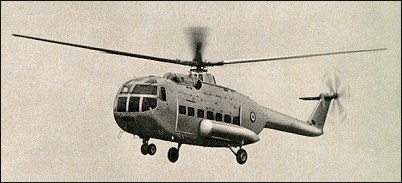
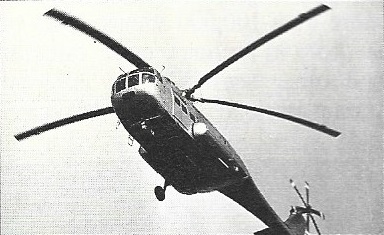
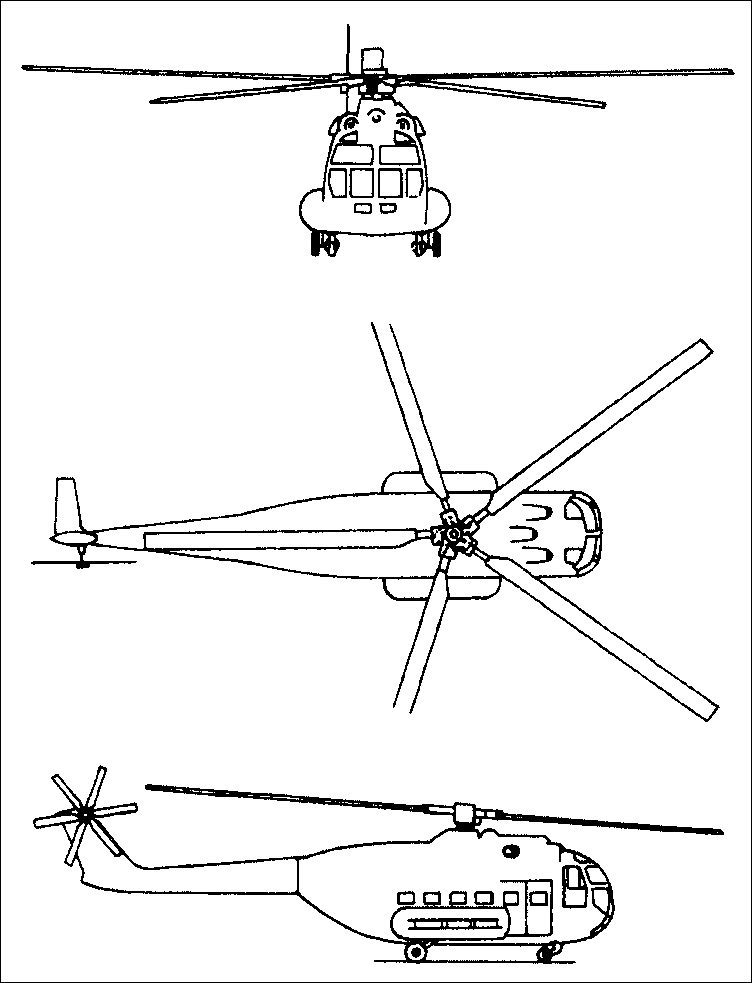
Filippo Zappata’s Agusta A.101D project was introduced at the Milan Trade Fair in April 1958, in the form of a model. The prototype was first flown on 19 October 1964 by test pilot Ottorino Lancia. The single prototype underwent visible external modifications during development under the direction of engineers Bellavita and Lovera and was fitted with a twin nose wheel assembly and longer fairings on each side of the fuselage, which was also extended by grafting in a new section. The helicopter performed service trials involving rapid embarkation and disembarkation through the two lateral sliding doors and tail ramp. It could carry two pilots and 35 equipped troops, or a 5000kg load. The development period involved over 400 flying hours in addition to those on the rotor test rig. The first prototype was fitted with three Rolls-Royce Bristol-Gnome H.1200 turbine engines of 1250shp, and later Gnome H-1400s of 1400shp. The airframe, with a gross weight of 12800kg and a length of sixty-six feet, had a rear ramp and twin sliding troop doors. The A.101 was examined by interested foreign parties visiting Cascina Costa and was displayed at the Turin Air Show in June 1966.
By autumn 1966 the A.101 was ready for large-scale production, but no decision was made by the authorities. In 1968 the helicopter appeared at the Turin Air Show in camouflage finish and was tested at an all-up weight of 13500kg. At the end of autumn 1968 the A.101G was transferred to Praticadi Mare military airport outside Rome for a series of trials which were completed in summer 1971. The aircraft made a few more flights, but was considered out-of-date. The A.101G was originally designated AZ.101G, the second initial denoting the responsibility of Ing. Filippo Zappata. Agusta had reworked the A.101H by redesigning the fuselage and some basic dynamic components. The fuselage was extended by 3 metre and more powerful General Electric T58 turbine engines were installed. This programme was cancelled in 1971 in favour of production under license of foreign aircraft such as Sikorsky and Boeing-Vertol helicopters.
AZ-101G Engine: 3 x Bristol-Siddley “Gnome H. 1400” turboshaft, 1030kW Main rotor diameter: 19.8m Length: 20.2m Height: 6.6m Take-off weight: 11500kg Empty weight: 6400kg Max speed: 225km/h Cruising speed: 203km/h Rate of climb: 12.3m/s Service ceiling: 3950m Range max fuel: 383km Crew: 3 Passengers: 35
AZ.101G Engines: 3 x Bristol-Siddeley Gnome, 1250 shp Main rotors: 5 blades Tail rotor: 6 blades Max gross weight: 24,900 lb Empty weight: 12,566 lb Top speed: 160 mph Cruise speed: 140 mph Range: 1270 mi
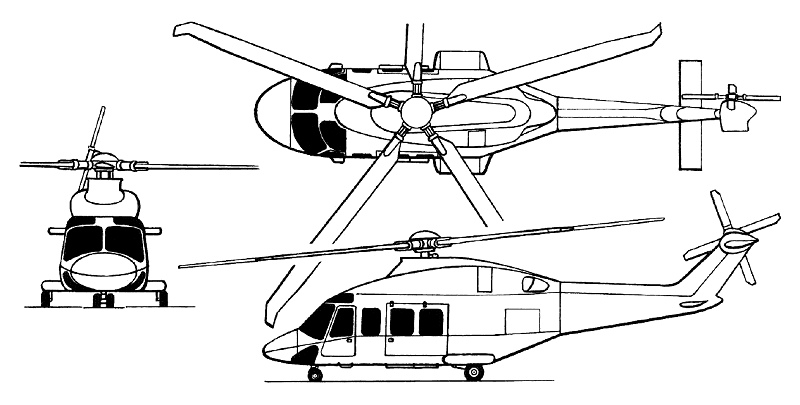
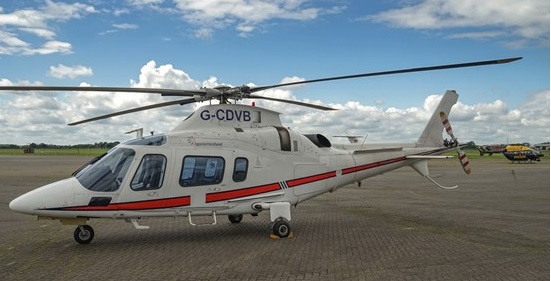
Bell and Agusta announced at Farnborough Air Show on 8 September 1998 that they had agreed to establish a joint venture to manage development of two new aircraft: the BA609 tiltrotor, previously a Bell and Boeing programme, and the AB139, a new helicopter announced on the same day. Following approval of both boards, a definitive agreement was signed on 6 November 1998. A full-scale mockup was unveiled at the Paris Air Show 12 June 1999. Agusta is responsible for the AB139’s development and certification to JAR/FAR 29 and transition to production, with participation by Bell on a 75:25% work-share basis; final assembly by Agusta at Vergiate, and by Bell (possibly at Mirabel, Canada). A military version was revealed in July 2000, and flight testing of the AB139 began in February 2001. Risk-sharing collaborators include GKN Westland (tail rotor drive train), Honeywell (avionics), Kawasaki (transmission input module), Liebherr Germany (landing gear and air conditioning system), Pratt & Whitney Canada (power plant) and PZL Swidnik (airframe components). PZL in Poland were making all the fuselages for the Agusta A109, AW119 and AW139, before shipping them to Brindisi, Italy, for customer fit-out. PZL also manufactured the A109 and A139 tail booms. With no designated prototype, the first preproduction aircraft (01, later I-ACOI) first flew on 3 February 2001 followed by second aircraft (02, later I-ATWO) on 4 June 2001 and third (03, later I-EPIC) on 22 October 2001. The first preproduction aircraft crashed on 22 April 2002. Assembly of first production aircraft began in late November 2001 and this aircraft, I-ANEW, was demonstrated at Farnborough in July 2002. Three preproduction aircraft and one tie-down helicopter (TDH) undertook the flight test programme and the AB139 achieved Italian IFR Type Certification on June 18, 2003 after 1,600hr of ground and flight testing. 750 hours was completed on the TDH.
Featuring a five-blade, fully articulated, ballistic tolerant main rotor and four-blade tail rotor, some of the transmission and rotor elements are based on Agusta A129 Mangusta. The AB139 has four-axis, digital AFCS flight controls and heavy-duty, retractable tricycle landing gear with twin wheels on the nose unit and single wheels on the main units, which retract into side sponsons. Powered by two Pratt & Whitney Canada PT6C-67C turboshafts, with FADEC, each rated is at 1,252kW for T-O and 1,142kW maximum continuous; OEI ratings 1,286kW for two minutes and 1,252kW maximum continuous. Fuel tanks are behind the main cabin. The main transmission can run for up to 30 minutes without oil. Up to 15 passengers are accomodated on crashworthy seats in three rows of five, two forward facing, one rearward facing, in an unobstructed cabin with a flat floor and a flight-accessible baggage compartment at the rear of cabin, or alternatively, six stretchers and four attendants in medevac configuration. Plug-type sliding door are on each side of cabin, with separate crew doors. The commercial version was priced at US$7 million in 2002. More than 80 had been ordered by 25 customers by June 2003. Launch customer Bristow Helicopters of UK announced order for two on 26 September 2000 for delivery in 2003. The AB 139 is operated by the US Coast Guard for recovery and surveillance.
Engine: 2 x Pratt & Whitney Canada PT6C-67C turboshafts Take-off power capacity: 1250kW Max continous power capacity: 1140kW Main rotor diameter: 13.80m Length with rotors turning: 16.65m Fuselage length: 13.53m Width: 3.2m Height: 4.95m Max take-off weight: 6000kg Internal payload: 2500kg External payload: 2700kg Max cruising speed: 290km/h Economic cruising speed: 278km/h Hovering ceiling, OGE: 3600m Endurance: 3.9h
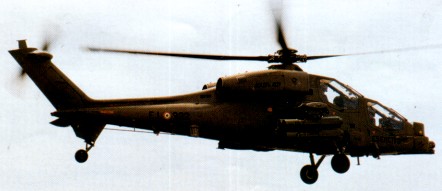
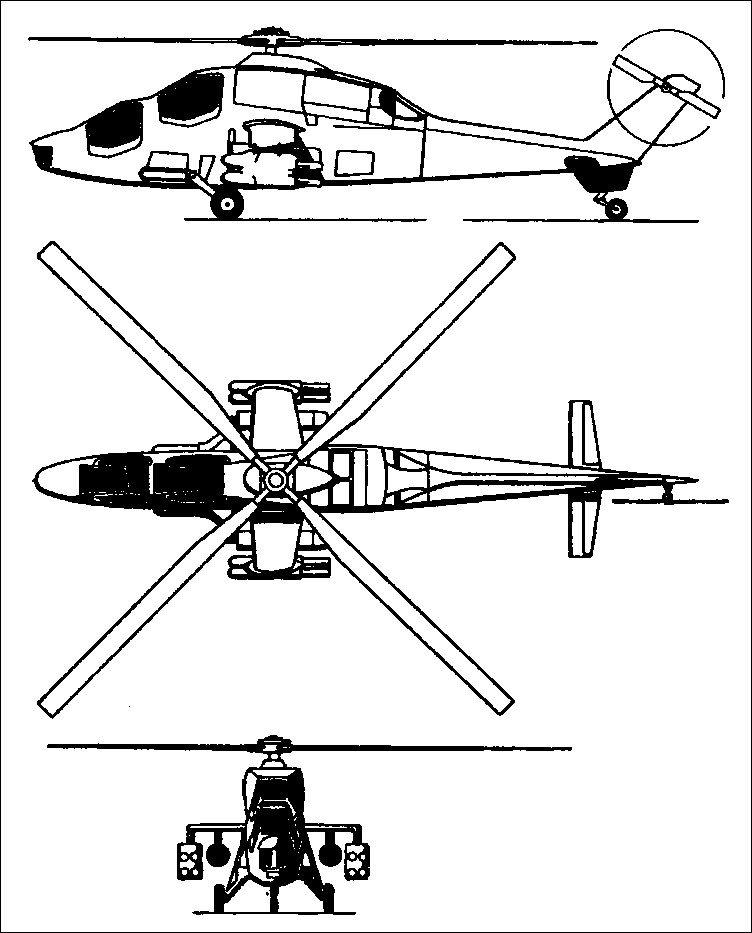
The A.129 Mangusta (Mongoose) is a day/ night military scout/antiarmour helicopter, which preliminary design began in 1978, and the first of four flying prototypes made its initial flight on 15 September 1983 powered by two 800 shp Avco Lycoming LTS101 850 turboshaft engines. The development programme was jointly funded by the Ital¬ian Army and Agusta.
The A.129 uses a fully-articulated fiberglass four-blade main rotor system with elastomeric bearings and low-noise profile tips. The transmission has a run-dry capability. A Harris digital integrated multiplex system controls communication, navigation, engine, armament, power distribution and utility systems. The avionics include active and passive self-protection systems, and the 70 percent composite-built airframe is designed to provide protection against 12.7mm rounds and partial protection against 23mm rounds and meets crashworthiness standards. The main and tail rotors are also designed for 12.7mm ballistic tolerance. The two crew are seated in a tandem cockpit, fitted with a low-glint canopy and with a small frontal area to minimize visual and radar detection. They both use helmet-mounted displays which present targeting information and the imagery from infra-red sensors for operations at night. They also have fly-by-wire controls and multi-function displays showing all flight data.
The powerplant is two Rolls-Royce Gem 2 turbines, license-built in Italy by Piaggio.
Offensive armament can be carried by the A.129 on four stub-wing attachment points, the inner pair being stressed for loads up to 300kg. All four pylons can be elevated 3° and depressed 12°. The standard Mangusta (Mongoose) is armed with eight TOW anti¬tank missiles, with Flir-augmented nose sight and pilot’s night vision sensor linked to helmet display sights. Other equipment includes passive and active infrared and electronic counter measures. Provision is made for the later installation of a mast mounted target acquisition system.
A total of 66 A.129s were ordered by the Italian Army by early 1984 and the first entered service in 1989. Offered to Australia, the cost was around $9 million per aircraft.
In August 1990 Agusta delivered the first production A 129 Mangusta anti-armour helicopter to the Aviazione Leggera de;’Esercito at Viterbo, where the initioan batch of 15 were to be based.
Agusta has test flown an improved development of its Mangusta attack helicopter (the A.129 International) which features a number of improvements to enhance performance and payload, and improved avionics capabilities. The major change is the substitution of the Rolls-Royce Gem 1004 turboshafts with more modern and more powerful LHTEC T800s. The T800s output 30 to 40% more power over the operational range of the engines compared with the Gems, while the transmission rating has been increased to 1795shp (1340kW). Further performance improvements are courtesy of a five bladed, instead of four, main rotor system. The A 129 International’s armament has also been expanded to include a three barrelled M-197 20mm cannon mounted in a nose mounted Martin Marietta/GIAT turret, plus TOW and Hellfire anti tank missile capability, Stinger air-to-air missiles and 70mm and 81mm rockets. Improvements to the avionics include FLIR and CCD television.
The Turkish Aerospace Industries T129 ATAK Helicopter program started in 2007 for development and production of 91 helicopters, as a Joint Collaboration of TAI and AgustaWestland also known as the “ATAK Team”. Within the scope of program, the first T129 ATAK Helicopter was delivered to the Turkish Armed Forces on 22nd of April 2014.
Turkish Aerospace Industries T129 ATAK
Agusta A-129 Mangusta Engine: 2 x Rolls-Royce Gem 2 Mk. 1004D turboshaft, 750 shp / 615kW Main rotor diameter: 39.042 ft / 11.9m Wingspan: 3.20m Length rotors turning: 14.29m Fuselage length: 40.354 ft / 12.28m Height: 3.35m Weight empty: 5576.4 lb / 2529.0 kg MTOW: 9040.5 lb / 4100kg Loaded weight: 2529kg Fuel capacity: 246 gal / 930 lt Max speed: 140 kts / 259km/h Cruising speed: 130 kts / 240 km/h Rate of climb: 2145.67 ft/min / 10.9m/s HOGE: 3105m Service ceiling: 16076 ft / 4900 m Range: 378 nm / 700 km Endurance: 3hr Crew: 2 Armament: 8 Tows or 6 Hellfires
A.129 Mangusta Engine: 2 x R-R Gem 2 Mk 1004D turboshafts, 1,035 shp (772 kW) Installed pwr: 1230 kW Rotor dia: 11.9 m Fuselage length: 12.3 m No. Blades: 4 Empty wt: 2529 kg MTOW: 4100 kg Payload: 1750 kg Max speed: 135 kt ROC: 2000 fpm HIGE: 3290 m HOGE: 2390 m Range: 3 hr Crew: 2
A.129 International Engine: 2 x LHTEC T800-800 Instant pwr: 1044 shp Rotor dia: 11.9 m MTOW: 4113 kg Payload: 1200 kg Max speed: 159 kt Max cruise: 124 kt Max range: 527 km ROC: 2360 fpm HIGE: 10,300 ft HOGE: 6200 ft Crew: 2.
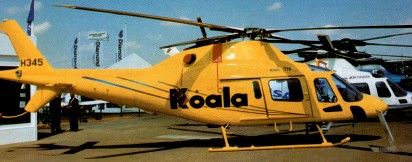
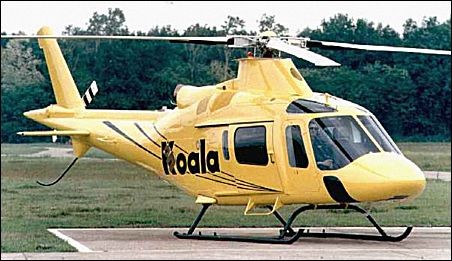
Developed from the A.109 is the single-engined A.119 Koala, the prototype, I-KOAL, with one Pratt & Whitney PT6B-37/1 turboshaft engine and fixed skid u/c, first flew on February 1995. The US Coast Guard operated the A.119 Powers as the MH-68A. PZL in Poland were making all the fuselages for the Agusta A109, AW119 and AW139, before shipping them to Brindisi, Italy, for customer fit-out.
Agusta A119 Engine: 1 x Pratt & Whitney Canada PT6B-37 turboshaft Take-off power capacity: 747kW Max continuous: 650kW / 735 shp Main rotor diameter: 36.089 ft / 11.0m Length rotors turning: 13.10m Fuselage length: 36.319 ft / 11.07m Height: 10.827 ft / 3.3m Max take off weight: 5997.6 lb / 2720.0 kg Internal payload: 1200kg External payload: 1320kg Max speed: 150 kts / 278km/h Cruising speed: 140 kts / 260km/h Service ceiling: 17913 ft / 5460m HOGE: 2450m HIGE: 3320m Range: 360 nm / 655km Endurance: 2h 45min Crew: 1 Passengers: 7
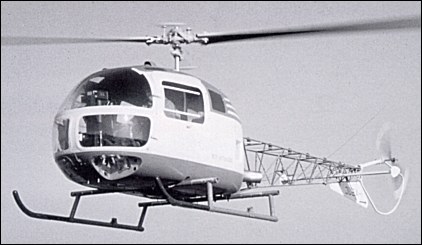
The A.115 was a developed version of the Bell 47J-3. Featuring an open rear fuselage structure and powered by a 480shp Turbomeca Astazou II turboshaft, one prototype, I-AGUC, was built.
The first mass-produced helicopter designed by Agusta, the A 109 Hirundo (Swallow), was originally intended to be powered by a single 740hp Turbomeca Astazou XII turboshaft but was redesigned in 1967 for two Allison 250-C14 engines.
Feasibility studies for a medium-capacity helicopter – the A.109 – began in 1969. Wind tunnel tests, lasting almost a year, enabled the characteristics of the new helicopter to be greatly refined. Once the basic project had been drawn up, final design work of parts and equipment began in spring 1970, and in the summer, detailed construction work was started. The aircraft was assembled in spring 1971 and the prototype (NC7101) made its first flight on 4 August 1971 from the Cascina Costa plant. It was piloted by Ottorino Lancia, accompanied by Paolo Bellavita, who had developed the aircraft together with Bruno Lovera. Owing to a minor accident, testing was resumed some time later, in 1972, using the second prototype, as well as a special static test rig for the dynamic components. In 1973 a third prototype in military configuration was developed, together with a fourth model for civil use and an airframe for static tests. The A.109 has a four-blade articulated rotor, especially designed for fast flight. The rotor blades are honeycomb structure with a light alloy skin and extensive structural bonding. The fuselage is a metal honeycomb with light alloy panels. The cabin can have various internal layouts, with pilot and crew seated side-by-side, two bench seats for two-three people, and a baggage compartment. Behind the cabin is the rear fuselage section, which carries the landing gear units and fuel tanks. The fuel is distributed by electric pumps from two tanks with a total capacity of 550 litres. The two turbine engines are mounted side-by-side but are fully independent. The five prototypes of the A.109 were certified on 30 May 1975. American approval followed two days later on 1 June. Production had already begun with five aircraft for evaluation by the Italian Army. Atlantic Aviation, then the American distributors of the Agusta 109, took out an option on 100 aircraft for the civil market at the same time. The first A 109 pre-production aircraft was not completed until April 1975. Delivery of production machines, designated A 109A, started in 1976. The Agusta 109A has been certi¬ficated for single pilot IFR; 20 January 1977 (Italy); 22 December 1977 (USA). A specialised military utility model, the A 109B, was proposed, but in 1969 this was abandoned in favour of the eight-seat A 109C civil version certificated in early 1989. The A.109C (civil) version had the same four-blade rotor but a completely new fuselage, with cleaner lines and a retractable undercarriage. The hi-tech maritime A 109A ECM (electronic countermeasures) variant has a radar display, direction finder, electromagnetic emission analyser and jamming equipment. Agusta introduced the general purpose Model A.109A Mk.II derivative, which has been modified to improve engine-out performance at high altitudes, and in hot climates. This features an uprated transmission, two 400 shp (276 kW) Allison 250-C20B turboshafts and seating for seven passengers. First delivered in 1981, nearly 200 had been built by 1989, following on from the 150 or so of the original model. From 1985 the Mk II has been available in a ‘wide-body’ configuration with bulged fuselage sides for greater comfort.
A.109 II ZK-HXI
Belgium has ordered 46 Mk II-Plus versions for Army use. Several military versions of the A.109A Mk.II are offered for armed scout, light-attack, command and control, utility, ESM/ECM, and naval roles. The A.109 MAX is a wide-body medevac variant of the A109 Mk II. The naval variant may be configured for ASW/ASV with a long-range search radar, as well as for SAR, utility, and medevac. It may also be employed, with suitable systems installed, for over-the-horizon guidance of ship-launched Otomat missiles. The Mirach version of the A.109A carries two Mirach 100 battlefield surveillance RPVs, while other reconnaissance/surveillance models can carry Flir equipment.
Developed for multirole hot-and-high missions, particularly in the Middle East and Africa, the A.109K is powered by two 539kW Turbomeca Arriel 1K turboshafts each rated at 575kW for 2.5 minutes, 550kW for take-off (30 minutes) and 471kW maximum continuous power, has a length¬ened nose for additional avionics, and a taller fixed tricycle landing gear. A new composite main rotor hub is resistant to abrasion by sand and dust. The A.109K flew in April 1983, and is primarily intended for two-crew combat missions armed with TOW anti-tank missiles and gun pods. The first flight of the production representative second aircraft took place in March 1984. Main transmission uprated to 671kW for take-off and maximum continuous twin-engined operation; single-engine rating is 477kW for 2.5 minutes and 418kW maximum continuous. Main rotor rpm 384, tail rotor 2,085. Standard usable fuel capacity 750 litres, with optional 150 litre auxiliary tank for EMS operations, or 200 litre auxiliary tank in the A109KM. Self-sealing fuel tanks optional. Independent fuel and oil system for each engine.
The Italian Army’s advanced observation helicopter, the A.109EOA, is similar in configuration to the A.109K but is powered by twin uprated Allison 250-C20R engines giving better performance than the standard -C20Bs of the A.109A.
Both the A 109 EOA and A 109K feature fixed undercarriage and a lengthened nose. PZL in Poland were making all the fuselages for the Agusta A109, AW119 and AW139, before shipping them to Brindisi, Italy, for customour fit-out. PZL also manufactured the A109 and A139 tail booms. Total of all versions delivered by 1 January 1999 was 621, of which 513 civil and 108 military. The Power has two Allison 250-C20R/1 turboshafts, each rated at 335kW for 5 minutes for T-O and 283kW maximum continuous; flat rated at 258kW for twin- engine operation; engines mounted side by side in upper rear fuselage and separated from passenger cabin and from each other by firewalls. Transmission ratings 589kW for take-off and 567kW for maximum continuous twin-engined operation, with maximum contingency rating of 607kW for 6 seconds. Rating for single-engined operation is 336kW for take-off (5 minutes limit). Two bladder fuel tanks in lower rear fuselage, combined capacity 560 litres, of which 550 litres are usable. Refuelling point in each side of fuselage, near top of each tank. Oil capacity 7.7 litres for each engine and 12 litres for transmission. Provision for internal auxiliary tank containing up to 150 litres of fuel.
Two of Argentina’s four A 109As were captured during the 1982 Falklands War and were used by the British.
Variants:
A.109 Hirundo Eight-seat executive helicopter with streamlined fuselage incorporating vertical fin and tailplane, 4-blade main rotor, retractable tricycle u/c, 2345kg TOGW and powered by two 420shp Allison 250-C20B turboshafts. Prot. NC7101 FF 4 Aug. 1971.
A.109A A.109 with additional ventral fin, structural strengthening and 2585kg TOGW. Initial production model, powered by twin 313kW Allison 250-C20B turboshaft engines. Replaced by A 109C Mk II from September 1981.
A.109A Mk.II Single-pilot IFR certificated version of A.109A with two 450shp Allison 250 C20R/1 engines, increase in transmission rating; new tail rotor driveshaft with two-point suspension; increased tail rotor blade life and reliability through use of Nomex core material and improved bonding techniques; new self- damping engine mounts; new integral-design oil coolers and blowers; redesigned tailboom; higher-pressure hydraulic system; improved avionics and instrument layout; additional access panels; and removable floor in baggage compartment. A utility version with less sophisticated interior and instrumentation was also available from 1983.
A 109A Mk II Plus Special law enforcement model.
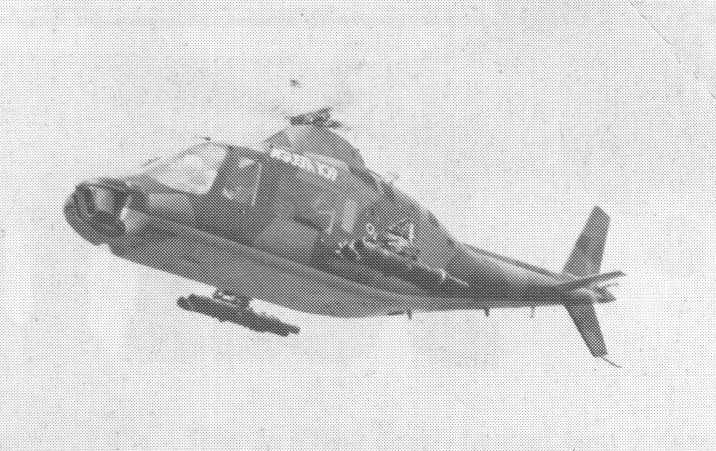
A.109A TOW Military A.109A with externally mounted Hughes TOW missile tubes and nose-mounted ranging module.
A. 109BA Anti-tank version for Belgian Army.
A 109C Certificated in USA by Agusta Aerospace Corporation in early 1989; approved for single-pilot IFR operation; transmission uprated from 552kW to 589kW; ‘wide-body’ cabin; new composites main rotor blades; Wortmann aerofoil on tail rotor; strengthened landing gear; maximum T-O weight raised to 2,720kg, affording 109kg increase in payload. Other civil/public service roles include law enforcement and coastal patrol with 360° radar. Military version A.109CM.
A 109CM Military version of civil A 109C powered by two 335.6kW Allison 250-C20R/1; can have sliding doors and fixed landing gear; ventral fin removed; first customer Belgian Army (Agusta designation 109BA) with 18 scout versions and 28 anti-tank versions designated 109HO and 109HA respectively by customer; ordered 1988; first delivery, from offset supplier Sabca, February 1992; first 109BA with equipped weight reduced to originally specified 1,944kg delivered 25 November 1992; maximum T-O weight increased to 2,850kg; this was 11th of 46 109BAs; composites sliding doors, relocated batteries and custom Collins/Alcatel Bell avionics; scouts have roof-mounted Saab Helios stabilised observation sight; anti-tank system has roof-mounted Saab/ESCO HeliTOW 2 sight and TOW-2A missiles on lateral pylons; firing trials completed in Sardinia late 1992. Last Belgian aircraft delivered 4 February 1994.
A.109D Experimental A.109K-2 with retractable u/c, new rotor head with titanium hub and Allison 250-C22 turboshaft.
A.109 EOA Military A.109A for Italian Army with sliding doors, fixed u/c, external ordnance points and two 450shp Allison 250 C20R/1 turboshafts. 24 (16 EOA-1 and eight EOA-2) delivered in 1988 as Elicottero d’Osservazione Avanzata to Aviazione dell’Esercito; fitted with sliding doors, roof-mounted SFIM M334-25 daytime sight with CILAS laser ranger, variety of armament options, fixed landing gear, crashworthy fuel tanks and ECM. Maximum flight weight with slung load 2,850kg.
A.109E Power A.109D with fixed u/c, wider cabin, redesigned instrument panel and controls, modified tailfin and two 732shp Pratt & Whitney PW206C turboshafts. Prototype registered I-EPWR.
A 109 G di F Special version for coastal patrol, equipped with an integrated Mission Equipment Package (MEP) including various communication and navigation systems, 360° search radar RDR-1500, and searchlight, FLIR, and weapon systems such as pintle-mounted MG-3 machine gun.
A. 109K Military version of A.109A with revised nose profile, redesigned engine compartment and uprated transmission, external stores hardpoints, optional fixed u/c, composite main-rotor head with elastomeric bearings and composite blades with hard surface coating; new tail rotor of Wortman blade section; longer nose-to-house additional avionics and 722shp Turbomeca Arriel 1K turboshafts for enhanced hot & high operations. Also known as A.109KM and A.109KN (Naval version).
A.109K2 Civil hot and high rescue version with special avionics, fixed u/c, new fuel tanks. Tail skid replacing ventral fin, 771shp Arriel 1K1 engines, rescue hoist etc. Prototype registered HB-XWA.
A 109K2 Law Enforcement Dedicated police version; optional equipment includes 907kg cargo hook, 204kg capacity variable speed rescue hoist with 50m of cable, rappelling kit, wire-strike protection, SX-16 searchlight, MA3 retractable light, external loudspeakers, emergency floats, GPS, FM tactical communications, weather radar, LLTV and FLIR.
A.109KM Military version of A.109K2 with external braced hardpoints, fixed landing gear and sliding side doors.
A 109KN Shipboard version with equivalent roles to A 109KM, including anti-ship, over-the-horizon surveillance and targeting and vertical replenishment.
A 109 LUH Light utility version for the South African Air Force (SAAF) with Turbomeca Arrius 2K2 engines; production and final assembly by Denel. Orders placed for 30 aircraft, plus 10 options.
A.109 MAX Medevac version certificated in USA by Agusta Aerospace Corporation early 1989 with large upward-opening bulged doors and fairings give 3.96cu.m cabin volume and allow for two stretchers across main cabin and three sitting attendants/patients
Agusta 109 Engines: 2 x Allison 250 C20B, 420 shp TBO: 1,500 hrs Main rotor dia: 36 ft. 1 in Length: 36 ft. 7 in Height: 9 ft. 6 in Disc loading: 5.3 lb/sq.ft Empty wt: 3,224 lb Useful load: 2,176 lb Payload with full fuel: 1,233 lb Gross weight: 5,400 lb Power loading: 6.4 lb/hp Fuel cap: 146 USG/986 lb Baggage capacity: 330 lb Baggage area: 18.4 cu.ft ROC: 1,620 fpm SE ROC: 300fpm Service ceiling: 15,000 ft SE service ceiling: 2,625 ft VNE: 167 kt Max cruise: 150 kt Economy cruise: 129 kt Range @ max cruise (45 min res): 193 nm Range @ economy cruise (45 min res): 238 nm Duration @ max cruise (no res, std tanks): 2.2 hr HIGE: 9,800 ft HOGE: 6,700 ft Seats: 8
A.109A Engine: 2 x Allison 250-C14, 370shp
A.109B Engine: 2 x Allison 250-C14, 370shp
A.109A Mk.II Engine: 2 x Allison 250-C20B, 420 shp / 298kW TBO: 3500 hr Main rotor: 36.1 ft No. Blades: 4 Fuselage length: 10.7 m Crew: 2 Pax: 6 Seats: 8 Length: 45.2 ft Height: 11 ft Max ramp weight: 5730 lb Max takeoff weight: 5730 lb Standard empty weight: 3640 lb Max useful load: 2090 lb Max landing weight: 5730 lb Max sling load: 2000 lb Disc loading: 5.6 lb/sq.ft Power loading: 6.8 lb/hp Max usable fuel: 978 lb Max rate of climb: 1620 fpm Service ceiling: 15,000 ft Hover in ground effect: 9800 ft Hover out of ground effect: 6700 ft Max speed: 147 kt ROC: 515 m/min Normal cruise @ 3000 ft: 142 kt Fuel flow @ normal cruise: 355 pph Endurance @ normal cruise: 2.6 hr Fuel cap: 560 lt
A109-Mk.II Plus Engines: 2 x Allison 250-C20B Cruise: 150 kt Fuel cap: 191 USG Range incl res: 440 nm Max endurance: 4:35 hr Useful load 1 hr fuel: 1168 kg.
A.109C Hirondo Engines 2 x Allison 250-C20R/1 Rotor dia. 11.0 m Max T/O weight 2,720 kg Max payload 907 kg Max useful load 1,110 kg Max cruise 150 kt Max range 780 km HIGE 11,398 ft HOGE 8,000 ft Service ceiling 15,000 ft Seats: 8
A.109E Power Engines: 2 x P&W PW-206C / Turbomeca Arrius 2K1, 631 shp Weight empty: 1590 kg / 3,505 lb Internal load: 2850 kg External load: 3000 kg Max take off weight: 6284.3 lb / 2850.0 kg Rotor Diameter: 36.089 ft / 11 m Length: 13.04 m Height: 11.483 ft / 3.5 m Maximum Rate of Climb: 9.8 m/s Service ceiling: 13301 ft / 4054 m Cruising altitude: 4987 ft / 1520 m Max. speed: 168 kt / 311 km/h Cruising speed: 162 kt / 300 km/h Range: 948 km Endurance: 4 h
A.109 EOA Engine: 2 x Allison 250-C20R
A.109K/KM Engine: 2 x Turbomeca Arriel 1K1, 722 shp (538 kW) Rotor dia: 11.0 m Max T/O weight: 2,850 kg Max payload: 1,197 kg Max speed: 142 kt Max range: 580 km HIGE: 18,600 ft HOGE: 15,190 ft Crew: 1 Passengers: 7
A.109K2 Engine: 2 x Turbomeca Arriel 1K1, 550 kW Rotor dia: 11 m MTOW: 2720 kg Useful load: 1100 kg Max speed: 152 kt Max cruise: 145 k Max range (max payload): 543 km HIGE: 18,602 ft HOGE: 15,190 ft Service ceiling: 20,000 ft Crew: 1 Pax: 7
A.109KN Engine: 2 x Turbomeca Arriel 1K1, 575 kW MTOW: 2850 kg Max speed: 142 kt Max range: 543 km HIGE: 18,600 ft HOGE: 15,1900 ft Crew: 2
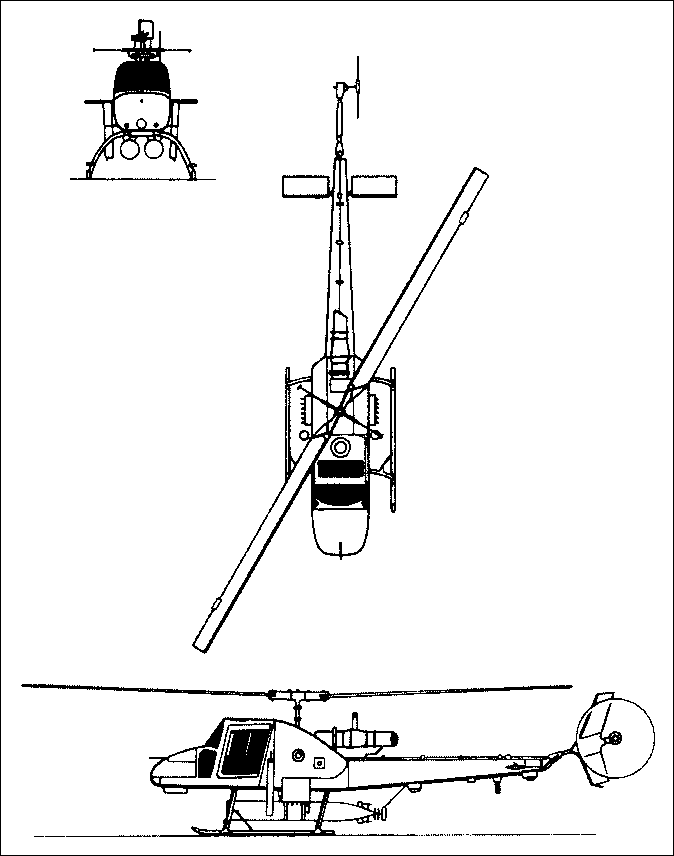
Flown in prototype form early in November 1965, the Agusta A.106 is a small lightweight armed helicopter designed initially in an antisubmarine role. The single-seater had a Turbomeca-Agusta TAA-230 turbine behind the cockpit, and the 2-blade main rotor, and the tail section including the 2-blade tail rotor, can be folded for stowage on board ship. With a standard skid landing gear, an auxiliary fuel tank may be carried externally. Systems included an autostabilizing device, an acoustic submarine detector and armament of two Mk.44 torpedoes. The Ferranti company developed an electronic three-axis stability augmentation system for the A 106, providing a stable firing platform and damping out external disturbances. The Italian Navy ordered two prototypes and five production aircraft, but construction of the production aircraft was suspended in 1973.
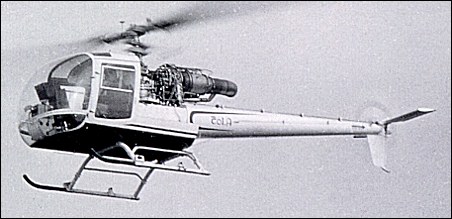
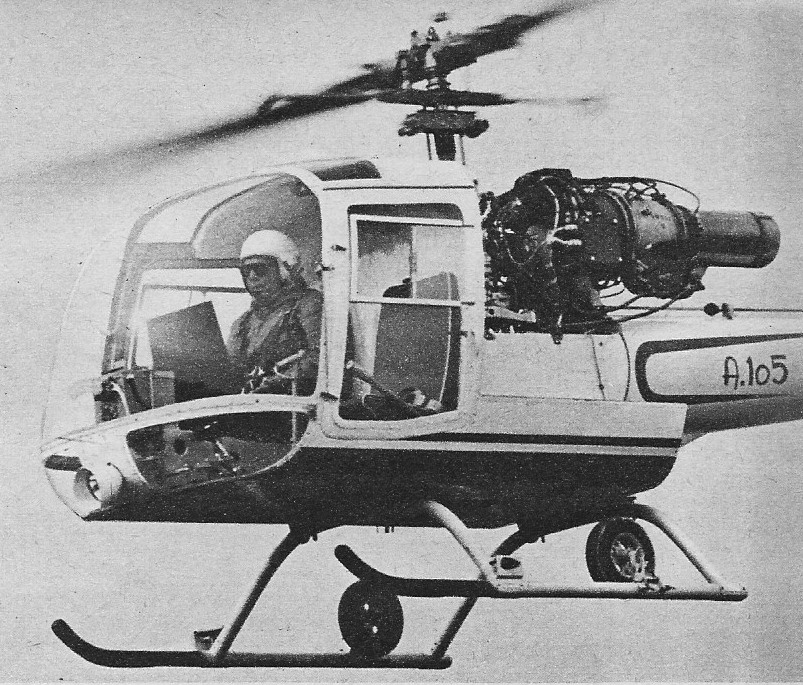
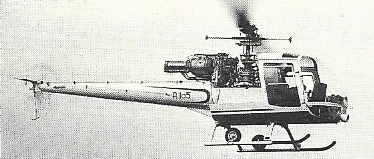
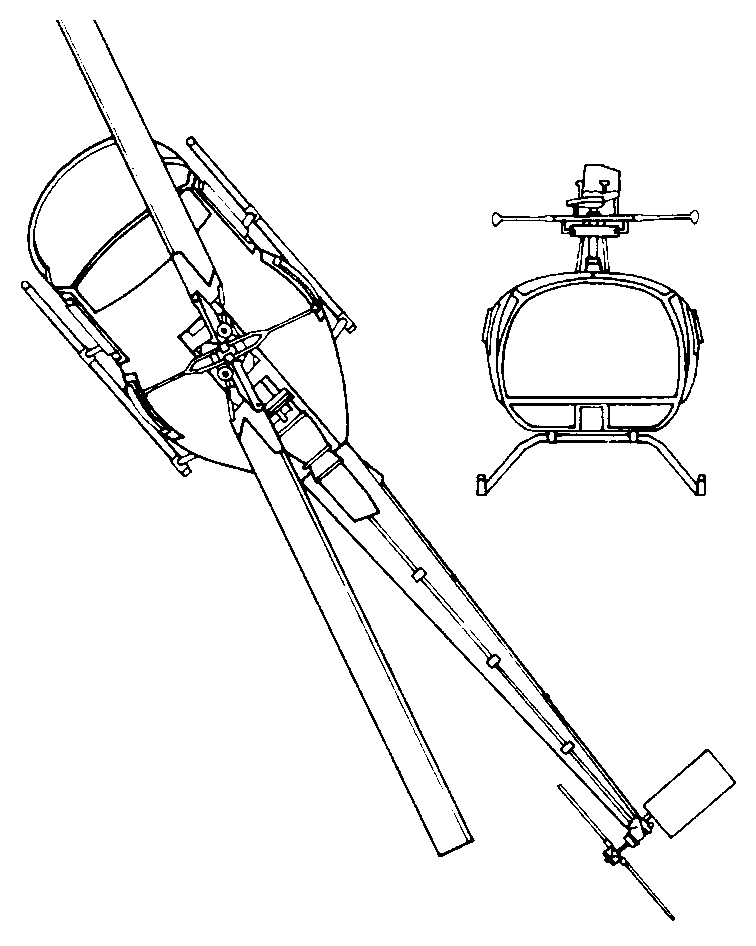
The A.105 small helicopter was designed from the start to simplify the manufacturing process and was powered by a Turbomeca-Agusta TA-230 turbine engine developing 350shp. The design also incorporated an Agusta-designed transmission.
First flown in April 1964 the A.105 was built in two models – the A.105 two-seater and the A.105B four-seat variant. Cruising speed was around 210kph with a range of 320km. The four-seat variant, the A.105B, was displayed at the 1965 Paris Air Show. It had the same mechanical and structural parts as the two-seater, but a bigger cabin. Both helicopters never progressed beyond the prototype stage.
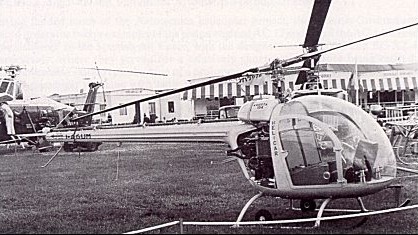
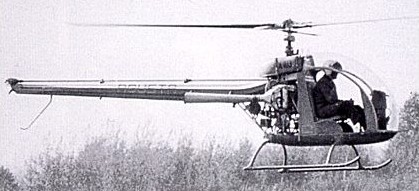
The all-metal two-seat A.104 developed from the A.103 was produced by the Cascina Costa works. With a single stabilised rotor, skid udercarriage and powered by one 140hp Agusta MV-A120 piston engine, the first of two prototype, I-AGUM, first flew in December 1960. One A.104BT was built; an A.104 with a 270shp Agusta A.270 turboshaft engine.
The single-seat A.103 and two-seat A.104 were produced by the Cascina Costa works with a 120hp Agusta 1MV-GA70 piston powerplant. A light single-seat single rotor ‘pod & boom’ helicopter, one prototype first flew in October 1959.