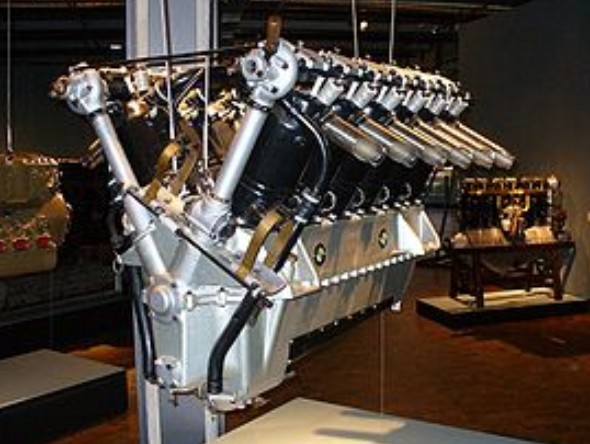
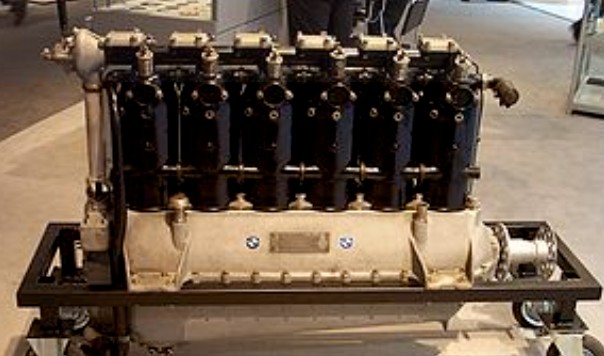
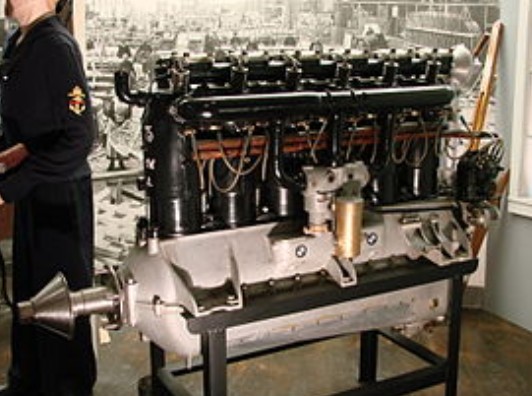
The first twelve-cylinder engine built by the Bayerische Motorenwerke AG, with a 60-degree included angle between the cylinder banks. The BMW VI was developed from the BMW IV by doubling the number of cylinders, through the additional cylinder bank. Series production commenced in 1926 after type approval had been granted. From 1930 on, after 1000 engines of the BMW VI type had already been delivered, Germany was again permitted to construct military aircraft. The sudden additional demand resulted in the production figures increasing rapidly. In 1933 the BMW VI was used for BMW’s first experiments with direct fuel injection.
The BMW VI was the chosen source of power for numerous record-breaking and long-distance flights, including an east-to-west crossing of the Atlantic in 1930 and a round-the world flight in 1932, both by Wolfgang von Gronau in an open Dornier Wal flying boat powered by two BMW VI engines.
The BMW VI was put to unusual use as a power unit for the “Rail Zeppelin” high-speed railcar. Many versions of the BMW VI engine were developed, and it was built under license in Japan and the Soviet Union. This was further evidence of the reliability of an engine with which BMW made a fundamental contribution to the build-up of German air transport. At least 9,200 were built between 1926 and 1938.
The engine was license-built in the Soviet Union under the supervision of Mikulin, who then further developed it as the M-17. More license built engines were produced by Kawasaki Heavy Industries in Japan as the Kawasaki Ha-9.
Applications: Albatros L 77 Arado Ar 64 Arado Ar 65 Arado Ar 68 Arado SSD I Dornier Do 10 Dornier Do 17 Focke-Wulf Fw 42 Heinkel He 45 Heinkel He 51 Heinkel He 59 Heinkel He 60 Heinkel He 70 Kawasaki Type 92 Tupolev TB-3 Mikulin M-17
BMW VI Type: V-12 Bore: 160 mm (6.3 in) Stroke: 190 mm (7.48 in) Displacement: 45.84 L (2,797.5 cuin) Length: 1810 mm (71.26 in) Width: 859 mm (33.82 in) Height: 1103 mm (43.43 in) Dry weight: 510 kg (1124 lb) Fuel system: 2 x Zenith 60 DCL Fuel type: min. 87 octane gasoline Cooling system: Liquid-cooled Power output: 650 HP 641 hp Compression ratio: 5.50
The BMW V was a water-cooled V-12 Aircraft engine built in Germany in the 1920s. Effectively two BMW III engines sharing a common crankshaft, power was in the 270 kW – 310 kW (360 hp – 420 hp) range.
Applications: Albatros L 73
Specifications: Bore: 150 mm (5.9 in) Stroke: 180 mm (7.1 in) Displacement: 38.2 L (2,330 cu in)
The BMW IV was a six-cylinder, water-cooled inline aircraft engine built in Germany in the 1920s. Power was in the 180 kW (250 hp) range. The IV was also produced under license by Junkers as the L2 which spawned the L5.
On June 17, 1919, the pioneering aviator Franz Zeno Diemer sets the airplane altitude record with a 32,000 ft (9760 m) flight. It was a significant technical and competitive accomplishment for the day. This historic flight was achieved only through the BMW IIIa engine, from which the BMW IV was based. Diemer stated at the time, “I could have gone much higher, but I didn’t have enough oxygen.”
Applications: Arado SC I Albatros L 72 Junkers A 35 Junkers F 13
BMW IIIa was an inline six-cylinder, water-cooled aircraft engine, the first-ever product from BMW GmbH. Its success laid the foundation for future BMW success.
On 20 May 1917, Rapp Motorenwerke (which later that year became BMW GmbH) registered the documentation for the construction design for the new engine, dubbed BMW III. Designed by Max Friz and based on the Rapp III engine, it was an SOHC in-line six-cylinder, just as the earlier Mercedes D.III was, which guaranteed optimum balance, therefore few, small vibrations. It was designed with a high (for the era) compression ratio of 6.4:1.
The military authorities were also responsible for the fact that the first BMW product, due to its power output, was designated with a three instead of a one. At the beginning of 1917 the IdFlieg introduced uniform model designations for aeroengines. The Roman numeral referred to the performance class. IdFlieg’s Class 0 engine power category was for engines of up to 100 bhp (75 kW), such as the Gnôme Lamba-clone 80 hp (60 kW) Oberursel U.0 rotary engine, Class I was reserved for engines from 100 to 120 bhp (89 kW), with Class II for engines of between 120 and 150 hp (110 kW). The BMW engine was 185 bhp (138 kW) and was assigned to category III.
The engine was successful, but the real breakthrough came in 1917, when Friz integrated a basically simple throttle butterfly into the “high-altitude carburettor”, enabling the engine to develop its full power high above the ground. Burning a special high octane fuel of gasoline blended with Benzole, the carburettor adjusted the richness of the fuel-air mixture according to the aircraft’s altitude. It enabled the engine, now dubbed BMW IIIa, to develop a constant 200 horsepower (150 kW) up to an altitude of 2000 meters -a decisive advantage over competitors’ engines.
German and British horsepower ratings apparently differed. Postwar British tests put the rating of the BMW IIIa at 230 hp. This corresponds to British ratings of the Mercedes DIIIa engine being rated by the British as 180 hp (German rating of 170 hp) and the DIIIau at 200 hp (German-180 hp). This discrepancy may explain the significant difference in performance of the BMW IIIa equipped Fokker D.VIIF both against Mercedes powered D.VII’s and their Allied opponents. The standard German Pferdstärke metric horsepower unit was expressed in the early 20th century as being a unit of almost exactly 735.5 watts, while the British unit for mechanical horsepower was based on the older 33,000 ft-lb/min figure, which translates to 745.7 watts instead.
The first design drawings were available in May, and on 17 September the engine was on the test rig. After a successful maiden flight for the IIIa in December 1917, volume production started up at the beginning of 1918. The ability to gain power at higher altitudes was why this engine had unique superiority in air combat. It was primarily used in the Fokker D VII and in the Junkers Ju A 20 and Ju F 13. When equipped with the BMW IIIa engine, the Fokker D VII could outclimb any Allied opponent it encountered in combat. Highly maneuverable at all speeds and altitudes, it proved to be more than a match for any of the British or French fighter planes of 1918. The water-cooled in-line 6-cylinder engine’s reputation grew very quickly after is abilities were proven in air combat by Jasta 11, the “Red Baron’s” squadron. Ernst Udet, squadron leader of Jasta 11 in WWI, acknowledged the outstanding performance of the BMW IIIa engine:
“There can be no doubt that the BMW engine was the absolute highlight in power unit development towards the end of the war. The only bad thing was that it came too late.”
About 700 engines were built by BMW, however, a large demand for the new BMW IIIa aircraft engine in Munich (coupled with a lack of production capacity) caused part of the production to be transferred to the Opel factory in Rüsselsheim.
On September 13, 1919, Franz Zeno Diemer set up a world altitude record for a passenger aircraft (eight people on board, 6750 meters) in a Ju F-13 powered by a BMW IIIa aircraft engine.
The Military monoplane designed by Ing. Philipp Enders [System Enders] was announced in Flugsport 1911 to be constructed by the Flug Technische Gesellschaft Nürnberg-Fürth E.V., yet in the same issue a drawing infers that it was to be constructed by the Nürnberger Motoren und Maschinenfabrik. In the end the steel-constructed machine was exposited in the Berlin ALA (Algemeinen Luftfahrt Ausstellung) 1912 as a finished machine of the Bayerische Motoren- und Flugzeugwerke Nürnberg.
The third monoplane of the BMFW, it was powered by a 50/55 hp BMFW Sylphe engine of own design.
The first design of Enders dated from 1910 and had steel tube holding the elevator / rudder and the pilot sitting Grade-wise beneath the wing in a sort of bathtub construction.
This simple high-wing monoplane with its characteristic tuning-fork like steel-tube fuselage was the first aircraft built by the BMFW (Bayerische Motoren- und Flugzeugwerke) in Nürnberg. It is also known as Philipp Enders monoplane. Enders was manager of the BMFW and equipped his first monoplane with a three-cylinder engine of own design.
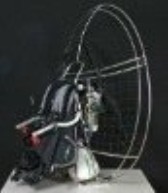
A paramotor with a Kobra Tuned 28hp Simonini MINI 2 Plus engine in a 145cm Stainless Steel, 4 section frame.
Engine: Kobra Tuned Simonini Mini2 Plus Propeller: 130cm 3 Blade Helix Carbon Frame: 145cm Stainless Steel, 4 section Fuel Tank: 14 Litre Max endurance: 4 hr Dry Weight: 32.5 kg Thrust: 85 kg Pilot weight range: 80-150 kg pilot or tandem