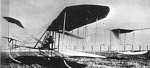
Designed and built by Bobenreith in France circa 1909.
Designed and built by Bobenreith in France circa 1909.
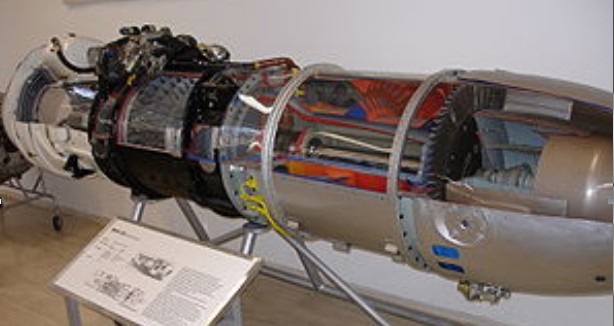
The practicality of jet propulsion had been demonstrated in Germany in early 1937 by Hans von Ohain working with the Heinkel company. Recognising the potential of the invention, the Reich Air Ministry (German: Reichsluftfahrtministerium, abbreviated RLM) encouraged Germany’s aero engine manufacturers to begin their own programmes of jet engine development.
The BMW 003 began development as a project of the Brandenburgische Motorenwerke (The Brandenburg Motor Works, known as “Bramo “) under the direction of Hermann Östrich and assigned the RLM designation 109-003 (using the RLM’s “109-” prefix, common to all jet and rocket engine projects). Bramo was also developing another axial-flow turbojet, the 109-002. In 1939, BMW bought out Bramo, and in the acquisition, obtained both engine projects. The 109-002 had a very sophisticated contra-rotating compressor design intended to eliminate torque, but was abandoned in favour of the simpler engine, which in the end proved to have enough development problems of its own.
Construction began late in the same year and the engine ran for the first time in August 1940, but produced less than half of the thrust expected, 2.5 kN instead of 6.3 kN. The first flight test took place in mid-1941, mounted underneath a Messerschmitt Bf 110. Problems continued, however, so delaying the program that while the Me 262 (the first aircraft intended to use the engine) was ready for flight-testing, there were no power plants available for it and it actually began flight tests with a conventional Junkers Jumo 210 piston engine in the nose. It was not until November 1941 that the Me 262 V1 was flown with BMW engines, which both failed during the test. The prototype aircraft had to return to the airfield on the power of the piston engine, which was still fitted.
The general usage of the BMW powerplant was abandoned for the Me 262, except for two experimental examples of the plane known as the Me 262 A-1b. The Me 262 A-1a production version used the competing Jumo 004 whose heavier weight required the wings to be swept back in order to move the center of gravity into the correct position. Work on the 003 continued anyway, and by late 1942 it had been made far more powerful and reliable. The improved engine was flight tested under a Junkers Ju 88 in October 1943 and was finally ready for mass production in August 1944.
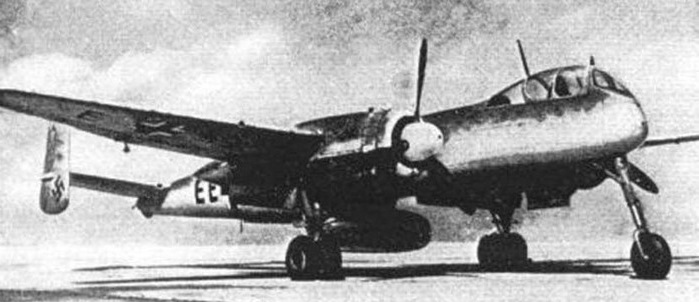
The only production aircraft to use the 003 was the Heinkel He 162, which fitted a modified “E” version of the engine. This version was modified with ventral mounting points to allow it to be mounted atop the fuselage of an aircraft.
One late version of the engine added a small rocket motor (BMW 109-718) at the rear and usually just above the exhaust of the engine, which added some 9.8 kN (2,200 lbs/f) of thrust for take off and short dashes. In this configuration, it was known as the BMW-003R and was tested, albeit with some serious reliability problems, on single prototypes for advanced models of the Me 262 (Me 262 C-2b Heimatschützer II), and He 162 (He 162 E). Both prototypes flew under hybrid jet/rocket power during March 1945, though records do not indicate the results of testing with the 162 E.
The BMW-003 was intended for export to Japan, but working examples of the engine were never supplied. Instead, Japanese engineers used drawings and photos of the engine to design an indigenous turbojet, the Ishikawajima Ne-20.
Following the war, two captured BMW-003s powered the prototype of the first Soviet jet, the Mikoyan-Gurevich MiG-9. Blueprints for BMW engines had been seized by Soviet forces from the Basdorf-Zühlsdorf plant near Berlin and from the Central Works near Nordhausen. Production of the BMW 003 was set up at the “Red October” GAZ 466 (Gorkovsky Avtomobilny Zavod, or “Gorky Automobile Plant”) in Leningrad, where the engine was mass produced from 1947 under the designation RD-20 (reactivnyi dvigatel, or “jet drive”).
Herman Östrich’s team in charge of the development of the BMW 003 engine had moved to the town of Stassfurt, near Magdeburg, in February 1945. An underground production factory was being set up in a salt mine outside town by C.G. Rheinhardt in a desperate attempt to continue engine production in face of the now overwhelming Allied air campaign. This mine is well known historically as it was also being used for the storage of uranium compounds as part of the Nazi atomic bomb program.
The town of Stassfurt surrendered to US forces on 12 April 1945, and Östrich hid much of the technical data in a local cemetery. The next day a ten-man team made up primarily of engineers from Pratt & Whitney arrived, and he handed the data over to them. Production restarted for US use while the war ground to a close, and the US forces cleared out the factory while they waited to turn the area over to the Soviets.
Östrich had by this time moved to Munich for further interrogation, and from there to England at the request of Roy Fedden. He had them work on the design of a turboprop engine for a proposed C-54 Skymaster-class four-engine transport. While working on this design, Őstrich was secretly approached by French DGER agents with an offer to take up further design of the 003 in France. The French forces had found a number of 003 engines in their occupation zone after the war, and were interested in setting up a production line. These discussions had not progressed very far when Őstrich was allowed to return to Munich, only to be brought back to England in late August, then returned to Munich again where the US offered him and a hand-selected team jobs in the US, but without their families.
Östrich instead accepted the French invitation, and by September had been set up at the former Dornier factories in Rickenbach in the French Zone. Here they were soon joined by other former BMW engineers, as well as those from a number of other German firms, bringing the team to about 200 members. The group was named the Atelier Technique Aéronautique Rickenbach, or ATAR. They worked on a new design that was based on the BMW layout, but considerably larger and more powerful. They completed the preliminary design of the ATAR 101 (model R.101) in October, and granted a production contract on the proviso that actual production would be carried out in France.
Some 500 BMW 003 engines were built in Germany, but very few were ever installed in aircraft.
Variants:
BMW 003 A1 (TL 109-003)
Prototype, 5.87 kN (1,320 lbf) / 8,000 rpm / sea level.
BMW 003 A2 (TL 109-003)
Initial production variant, 7.83 kN (1,760 lbf) / 9,500 rpm / sea level.
BMW 003 C (TL 109-003)
Improved design, reduced weight A2, 8.81 kN (1,980 lbf) / 9,500 rpm / sea level
BMW 003 D (TL 109-003)
Improved design C, 8.81 kN (1,980 lbf) / 9,500 rpm / sea level.
BMW 003 E
With ventral mounting points for use on the Heinkel He 162 and Henschel Hs 132.
BMW 003 R (TLR 109-003)
An A2 with a BMW 718 (R 109-718) booster fixed permanently above the jetpipe, running on R-stoff (a.k.a. Tonka or TONKA-250, 50% triethylamine and 50% xylidine) and SV-Stoff (aka RFNA: 94% HNO3, 6% N2O4). The R delivered a combined thrust of 20.06 kN (4,510 lbf) for 3 minutes.
Applications:
Arado Ar 234
Heinkel He 162
Messerschmitt Me 262 (A-1b test version, and Heimatschützer II experimental interceptor only)
Specifications:
BMW 003A-2
Type: Axial flow turbojet
Length: 3,632.2 mm (143 in)
Diameter: 690.9 mm (27.2 in)
Dry weight: 623.7 kg (1,375 lb)
Compressor: 7-stage axial compressor
Combustors: 1 annular combustion chamber
Turbine: Single-stage axial
Fuel type: J-2 diesel fuel or gasoline
Oil system: Pressure feed at 586 kPa (85 psi), dry sump with 4 scavenge pumps with annular tank and cooler, using oil grade 163 S.U. secs (35 cs) (D.T.D 44D) at 38 °C (100 °F)
Maximum thrust: 7.83 kN (1,760 lbf) at 9,500 rpm at sea level for take-off
Overall pressure ratio: 3.1:1
Turbine inlet temperature: 770 °C (1,418 °F)
Specific fuel consumption: 142.694 kg/kN/hr (1.4 lb/lbf/hr)
Thrust-to-weight ratio: 0.0125 kN/kg (1.282 lbf/lb)
Normal, static: 6.89 kN (1,550 lbf) / 9,000 rpm / sea level
Military flight: 6.23 kN (1,400 lbf) / 9.500 rpm / 2,500 m (8,202 ft) / 900 km/h (559 mph; 486 kn)
Normal, flight: 2.85 kN (640 lbf) / 11,500 rpm / 11,000 m (36,089 ft) / 900 km/h (559 mph; 486 kn)
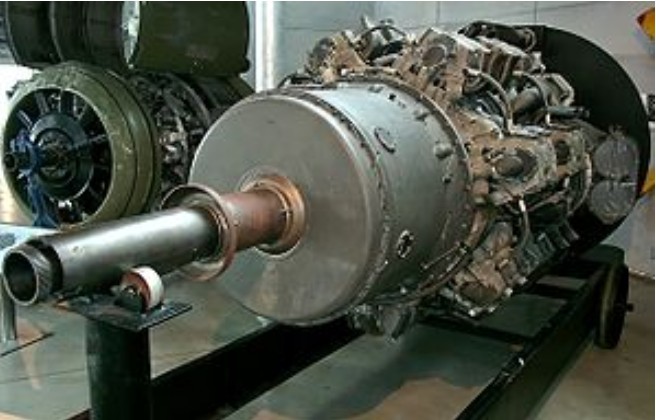
One problem with scaling up any piston engine design is that eventually a point is reached where the crankshaft becomes a major engineering challenge. This was a problem that affected almost all engines of the 2,500 hp (1,900 kW) class, including BMW’s own 18-cylinder BMW 802 project. For the 803 the engineers decided to avoid this problem by simply not using a common crankshaft, and driving a set of independent contra-rotating propellers. The front engine drove the front propeller directly, while the rear engine drove a number of smaller shafts that passed between the cylinders of the front engine before being geared back together to drive the rear prop. This layout resulted in a rather large gearbox on the front of the engine, and the front engine needing an extended shaft to “clear” the gearbox.
With no common crankshaft it became more practical for all of the accessories to be powered by one engine alone, in this case the rear engine. The supercharger itself used up several hundred horsepower, so the rear propeller delivered considerably less power than the front one.
The engine weighed 2,950 kg (6,490 lb) dry, and 4,130 kg (9,086 lb) fully loaded, displacing 83.5 litres. It delivered 3,900 PS (Pferdstärke) (2,868 kW). Although this made it the most powerful German engine design, its power-to-weight ratio was not impressive, at about 0.60 hp/lb, compared to other large designs like the Junkers Jumo 222 at 1.04 hp/lb. Specific power was likewise poor, at about 34.4 kW/l, compared to the 222’s 40 kW/l, as was specific fuel consumption, at 380 g/kWh (0.63 lb/hp·h).
As with most coupled engines, the 803 was not a success on the test-bed, and did not enter production.
The engine was intended to be used only on the largest of designs, notably the Focke-Wulf Fw 238, the Focke-Wulf Ta 400 six-engined Amerika Bomber design competition competitor, and other large bombers. The May 1942-approved Amerika Bomber contract was for a trans-Atlantic range strategic bomber designed to attack New York City from European bases. A single example remains in the Deutsches Museum.
BMW 803
Type: 28-cylinder 7-bank liquid-cooled coupled inline radial engine
Bore: 156 mm (6.14 in)
Stroke: 156 mm (6.14 in)
Displacement: 83.5 L (5,095 in³)
Diameter: 160 cm (63 inches)
Dry weight: 4 130 kg (9,100 lbs)
Valvetrain: One intake and one sodium-cooled exhaust valve per cylinder
Fuel system: Fuel injection
Cooling system: Liquid-cooled
Power output: 2 940 kW (3,950 hp)
Specific power: 34.3 kW/L (0.75 hp/in³)
Compression ratio: 6.5:1
Specific fuel consumption: 380 g/kWh (0.63 lb/hp·h)
Power-to-weight ratio: 970 W/kg (0.59 hp/lb)
Soon after the 801 entered testing, BMW engineers turned to building much larger versions. One idea was to “simply” bolt two 801’s back to back. Although seemingly simple, the resulting BMW 803 was in fact fantastically complicated, even giving up on air cooling to be liquid-cooled instead, and generally proved that piston engines of this size were unworkable. Another idea was to simply add more cylinders to the 801 design, and since radials need to have an odd number of cylinders per row, the next “size up” was a two-row 9-cylinder design, the 802, which emerged having an almost identical displacement to the Wright R-3350 Duplex Cyclone American 18-cylinder twin-row air-cooled radial aviation engine.
One problem with the 801 was its poor altitude performance, due almost entirely to the simple single-stage two-speed mechanical supercharger it used. Since the 802 was not a necessity given the success and emerging flexibility of the 801’s basic design, the engineers decided to take the time needed to address this problem by including an improved three-speed supercharger. The lowest-speed setting would not “rob” as much power at low altitudes, allowing the engine to produce 2,600 PS (1,912 kW) for takeoff, and still produce 1,600 PS (1,176 kW) at 39,000 ft (12,000 m). This was a dramatic improvement on the 801A’s 1,600 PS (1,176 kW) for takeoff and 1,380 PS (1,015 kW) maximum at 15,100 ft (4,600 m), especially notable considering the engine was less than 30% larger in displacement.
Development was still underway in late 1943 when BMW decided the project simply wasn’t worthwhile. With their BMW 003 axial-flow turbojet engine finally maturing and considerably larger models of turbojet and even turboprop powerplants entering the prototype phase from both BMW and their competitors, it appeared that large piston engines simply weren’t worth building.
A further improvement led to P.8011, which replaced the supercharger with two smaller turbochargers, driving contra-rotating propellers. This raised the takeoff power to about 2,800 PS (2,059 kW), (some report 2,900 PS (2,133 kW)) and dramatically improved altitude performance. As with most German turbocharger projects, the lack of quality high-temperature alloys meant the project was never able to enter production.
BMW 802
Type: 18-cylinder supercharged two-row radial engine
Bore: 156 mm (6.142 in)
Stroke: 156 mm (6.142 in)
Displacement: 53.671 L (3,275.2 in³)
Valvetrain: One intake and one sodium-cooled exhaust valve per cylinder
Supercharger: Gear-driven single-stage three-speed
Fuel system: Fuel injection
Cooling system: Air-cooled
Power output:
1,912 kW (2,563 hp) for takeoff
1,176 kW (1,575 hp) at 12,000 m (39,000 ft)
Specific power: 35.6 kW/L (0.78 hp/in³)
Compression ratio: 6.5:1
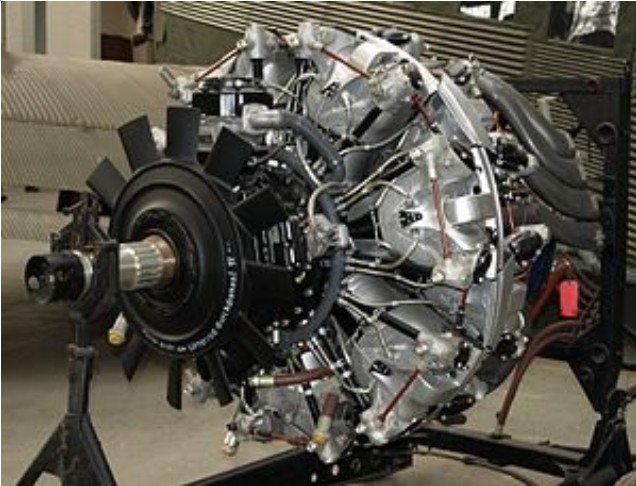
In the 1930s, BMW took out a license to build the Pratt & Whitney Hornet engines. By the mid-30s they had introduced an improved version, the BMW 132. The BMW 132 was widely used, most notably on the Junkers Ju 52, which it powered for much of that design’s lifetime.
In 1935 the RLM funded prototypes of two much larger radial designs, one from Bramo, the Bramo 329, and another from BMW, the BMW 139. BMW bought Bramo soon after the projects started; unsurprisingly BMW folded the Bramo engineers into the BMW project, cancelling the Bramo design. The resulting proposal was essentially a two-row version of the BMW 132, the 1,550 PS (1,529 hp, 1,140 kW) BMW 139.
The BMW 139 was originally intended to be used in roles similar to those of the other German radials, namely bombers and transport aircraft, but mid-way through the program Kurt Tank suggested it for use in the Focke-Wulf Fw 190 fighter project. Radial engines were rare in European designs as they were considered to have too large an area for good streamlining and would not be suitable for high speed aircraft. However, radials were often used in American and Japanese fighters at the end of the 1930s, and improvements in the cowlings for radial engines were reducing the concerns about drag. Tank felt that attention to detail could result in a streamlined radial that would not suffer undue drag, and would be competitive with inlines.
The main concern was providing cooling air over the cylinder heads, which generally required a very large opening at the front of the aircraft. Tank’s solution for the BMW 139 was to use an engine-driven fan behind an oversized prop-spinner, blowing air past the engine cylinders, with some of it being drawn through S-shaped ducts over a radiator for oil cooling. However this system proved almost impossible to operate properly with the BMW 139; early prototypes of the Fw 190 demonstrated terrible cooling problems. Although the problems appeared to be fixable, since the engine was already fairly dated in terms of design, in 1938 BMW proposed an entirely new engine designed specifically for fan-cooling that could be brought to production quickly.
The BMW 801 would eventually be fitted with a magnesium alloy cooling fan that rotated at 1.72 times the crankshaft speed (3.17 times the propeller speed). This provided effective cooling although at the cost of about 70 PS (69 hp, 51.5 kW) required to drive the fan when the aircraft was at low speed. Above 170 miles per hour (270 km/h), the fan absorbed little power directly.
The cowling used for the BMW 801 was generally identical for almost every aircraft it was fitted onto, as it was designed and supplied by the BMW firm itself. The oil cooling provision existed within the curved forward section of the cowl, just aft of a 360º perimeter armored metal ring forming the cowl’s extreme forward component, and had airflow directed to flow from the inside of the cowl, over the oil-cooling core block and drawn out into the cooling fan’s slipstream within the cowl and over the engine cylinders. Integrating the oil cooling provision within the cowling’s sheet metal made it more possible to “unitize” a powerplant installation, with minimal exterior fluid and mechanical mounting and control linkage connections – the ideas behind it were inspired by the Kraftei standardized format engine mounting, possibly first done on the liquid-cooled Junkers Jumo 211 inverted V12 liquid-cooled engine. The Jumo 211 most often used an integrated annular radiator for both the engine coolant and motor oil just behind the prop for a unitized installation, as used for the many examples of the Junkers Ju 88 built, an airframe that just as easily could take a pair of BMW 801 radial engines with minimal design changes.
Differences between the BMW 139 and the new design were fairly minor and limited primarily to details except for the use of fourteen larger cylinders instead of eighteen smaller ones. The engine’s cylinders were in two rows of seven, the bore and stroke were both 156 millimetres (6.1 in), giving a total capacity of 41.8 litres (2,550 cu in). The unit (including mounts) weighed from 1,010 to 1,250 kg and was about 1.29 m (51 in) across, depending on the model.
The new design was given the name BMW 801 after BMW was given a new block of “109-800” engine numbers by the RLM to use after their merger with Bramo. The BMW 801 retained the BMW 139’s older-style single-valve intake and exhaust, while most engines of the era had moved to four valves per cylinder, or in British use, sleeve valves. Several advances were worked into the design, including the use of sodium-cooled valves and a fuel injection system. The supercharger was rather basic in the early models, using a single-stage two-speed design directly geared to the engine (unlike the DB 601’s hydraulically clutched version) which led to rather limited altitude performance, in keeping with its intended medium-altitude usage. One key advancement was the Kommandogerät (command-device), a mechanical-hydraulic unit that automatically adjusted engine fuel flow, propeller pitch, supercharger setting, mixture and ignition timing in response to a single throttle lever, dramatically simplifying engine control.
The first BMW 801A’s ran in April 1939, only six months after starting work on the design, with production commencing in 1940. The 801B was to be identical to the 801A except turning the airscrew in the opposite direction (counterclockwise, as seen from behind the engine) using a different gearbox. The A and B models were intended to be used in pairs on twin-engine designs, cancelling out net torque and making the plane easier to handle. There’s no confirmation the 801B ever left the prototype stage.The initial BMW 801 series had a lot of overheating problems especially with cylinders in the rear cylinder row and a number of efforts were improvised in an attempt to cure them. The BMW 801A/B/C/L engines delivered 1,560 PS (1,539 hp, 1,147 kW) for takeoff. Major applications of the 801A/L engines include multiple variants of the Junkers Ju 88 and Dornier Do 217.
The BMW 801C was developed for use in single- or multi-engined fighters and included a new hydraulic prop control and various changes intended to improve cooling, including cooling “gills” on the cowling behind the engine. The BMW 801L was an A model with the hydraulic prop control mechanism introduced with the 801C engine. The 801C was almost exclusively used used in early variants of the Focke-Wulf Fw 190A.
The 801C was replaced with the BMW 801 D-2 series engines in early 1942, which ran on C2/C3 100 octane fuel instead of the A/B/C/L’s B4 87 octane, boosting takeoff power to 1,700 PS (1,677 hp, 1,250 kW). The D-2 models were tested with a system for injecting a 50-50 water-methanol mixture known as MW50 into the supercharger output to cool the charge, and thereby reduce backpressure. Some performance was gained but at the cost of engine service life and other boost systems, using fuel for charge cooling (known as C3-injection), were developed and used until 1944. The serious fuel shortage in 1944 forced re-evaluating the MW50 system which was then installed instead of the C3-injection. With MW50 boosting takeoff power increased to 2,000 PS (1,470 kW), the C3-injection was initially only permitted for low altitude use and raised take-off power to 1870 PS. Later C3-injection systems were permitted for low-to-medium altitude use and raised take-off power to more than 1900 PS. The BMW 801G-2 and H-2 models were D-2 engines modified for use in bomber roles with lower gear ratios for driving larger propellers, clockwise and counterclockwise respectively. Just like the 801B engine the 801H-2 engine did not leave the prototype stage
With the engine now being used in higher-altitude fighter roles, a number of attempts were made to address the limited performance of the original supercharger. The BMW 801E was a modification of the D-2 using supercharger gear ratios tuned to higher altitudes. Although takeoff power was unaffected, cruise power increased over 100 hp (75 kW) and “high power” modes for climb and combat were likewise improved by up to 150 hp (110 kW), with the possibility of turning up to a four meter diameter, three-blade propeller for multi-engined use, such as on the proposed Heinkel He 277 Amerika Bomber four engined strategic bomber design. The E model was also used as the basis for the BMW 801R, which included a much more complex and powerful two-stage four-speed supercharger. Continued improvements to the basic E model led to the BMW 801F, which dramatically improved performance across the board, with takeoff power increasing to 2,400 hp (1,790 kW). It was planned to use the F on all late-model Fw 190’s, but the war ended before production started.
A number of attempts were made to use turbochargers on the BMW 801 series as well. The first used a modified BMW 801D to create the BMW 801J, delivering 1,810 PS (1,785 hp, 1,331 kW) at takeoff and 1,500 hp (1,103 kW) at 40,000 ft (12,200 m), an altitude where the D was struggling to produce 630 hp (463 kW). The BMW 801E was likewise modified to create the BMW 801Q, delivering a superb 1,715 hp (1,261 kW) at 40,000 ft (12,200 m), power ratings no existing Allied radial engine of a similar displacement could touch. However none of these engines ever entered production due to high costs, and the various high-altitude designs based on them were forced to turn to other engines entirely, typically the Junkers Jumo 213.
Engines were typically delivered from BMW complete in their cowling, ready to be bolted to the front of the aircraft, since 1942 as Motoranlage (M) and 1944/1945 as Triebwerksanlage (T). The Motoranlage was the original form of the interchangeable Kraftei, or “power-egg”, unitized powerplant installation concept used in many German wartime aircraft. It was most often used with twin and multi-engined designs, with some need for external add-ons, and the Triebwerksanlage was the Motoranlage plus some external mountings, such as exhaust pipes, as a completely interchangeable unit, still within the Kraftei definition. Both M and T formats were also used with various inline engines, like the Daimler-Benz DB 603 used for both the inline-engined versions of the Do 217 and the enormous Bv 238 flying boat, and the Junkers Jumo 213 powerplants used for later marks of the Ju 88 multirole aircraft.
The M and T unitized engine formats added secondary designator suffixes, which confuse the naming considerably, as they initially referred to these complete kits and their “bare” engine counterparts almost interchangeably. The A, B and L models were known (logically) as Motoranlage style MA, MB and ML engines in this form, but the common D-2 apparently initiated the “differing” second suffix letter usage when unitized into a Motoranlage powerplant unit, and was instead known as the MG. Deepening the confusion, the E model was delivered as the Triebwerksanlage style TG or TH, seemingly suggesting a relation to the G and H engines, but in fact those were delivered as the TL and TP. It is rather common to see the turbocharged versions referred to only with the T as Triebwerksanlage installations, notably the (most notoriously of all) TJ, and the TQ models, further confusing the issue.
Production versions of the engine generated between 1,560 and 2,000 PS (1,540-1,970 hp, or 1,150-1,470 kW). It was the most produced radial engine of Germany in World War II with more than 28,000 built.
Variants:
BMW 801 A, C, L (B)
1,560 PS (1,539 hp, 1,147 kW)
BMW 801 D-2, Q-2, G-2, (H-2)
1,700 PS (1,677 hp, 1,250 kW)
BMW 801 E,S
2,000 PS (1,973 hp, 1,471 kW)
BMW 801 F
2,400 PS (2,367 hp, 1,765 kW), development halted by the end of the war
Applications:
Blohm & Voss BV 141
Blohm & Voss BV 144
Dornier Do 217
Focke-Wulf Fw 190
Focke-Wulf Fw 191
Heinkel He 277
Junkers Ju 88
Junkers Ju 188
Junkers Ju 288
Junkers Ju 388
Junkers Ju 290
Junkers Ju 390
Messerschmitt Me 264
BMW 801 C
Type: 14-cylinder supercharged two-row air-cooled radial engine
Bore: 156 mm (6.15 in)
Stroke: 156 mm (6.15 in)
Displacement: 41.8 litres (2,560 in³)
Length: 2,006 mm (79 in)
Diameter: 1,290 mm (51 in)
Dry weight: 1,012 kg (2,226 lb)
Valvetrain: One intake and one sodium-cooled exhaust valve per cylinder
Supercharger: Gear-driven single-stage two-speed
Fuel system: Fuel injection
Cooling system: Air-cooled
Power output: 1,560 PS (1,539 hp, 1,147 kW) at 2,700 rpm for takeoff at sea level
Specific power: 27.44 kW/L (0.60 hp/in³)
Compression ratio: 6.5:1
Specific fuel consumption: 0.308 kg/(kW·h) (0.506 lb/(hp·h))
Power-to-weight ratio: 1.13 kW/kg (0.69 hp/lb)
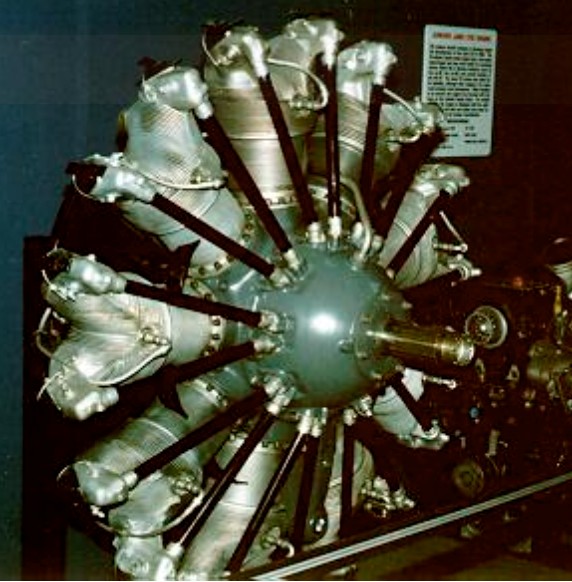
BMW took over the license for manufacturing air-cooled radial engines from US aircraft manufacturer Pratt & Whitney Aircraft Company on 3 January 1928. The nine-cylinder model Pratt & Whitney Hornet was initially manufactured virtually unchanged under the designation BMW Hornet. Soon BMW embarked on its own development. The result was the BMW 132 that went into production in 1933, which was essentially an improved version of the Hornet engine. A number of different versions were built. Aside from the carburetor designs used mainly in civilian aircraft, versions with direct fuel injection were manufactured for the German Luftwaffe. The engines had a displacement of 27.7 liters and generated up to 1,200 PS (880 kW)[citation needed], depending on model.
The 132 found widespread use in the transport role, remaining the primary powerplant of the Junkers Ju 52 for much of its life, turning the BMW 132 into one of the most important aero-engines for civilian aircraft during the 1930s.
Numerous pioneering flights were undertaken with the BMW 132. The most impressive was the first direct flight from Berlin to New York in a Fw 200 S-1 Condor equipped with four BMW 132 engines. It covered the distance to New York in 24 hours and 57 minutes on 10 August 1938.
Over 21,000 were built.
Applications:
Arado Ar 196
Arado Ar 197
Blohm & Voss Ha 140
Blohm & Voss BV 141
Blohm & Voss BV 142
Fieseler Fi 98
Heinkel He 114
Heinkel He 115
Henschel Hs 123
Junkers Ju 160
Junkers Ju 52
Junkers Ju 86
Junkers W34
Specifications:
132A
725 PS (715 hp, 533 kW)
132 Dc
Type: Nine-cylinder single-row supercharged air-cooled radial engine
Bore: 155.6 mm (6 1⁄8 in)
Stroke: 161.9 mm (6 3⁄8 in)
Displacement: 27.7 l (1,690 in³)
Length: 1,411 mm (55.55 in)
Diameter: 1,380 mm (54.33 in)
Dry weight: 525 kg (1,157 lb)
Valvetrain: Two overhead valves per cylinder
Supercharger: Single-speed centrifugal type supercharger
Fuel system: Hobson carburetor
Fuel type: 87 octane rating gasoline
Cooling system: Air-cooled
Reduction gear: Farman epicyclic gearing, 1.61:1
Power output:
589 kW (789 hp) for takeoff
581 kW (779 hp) at 2,290 rpm at 2,900 m (9,515 ft)
Specific power: 21.26 kW/l (0.47 hp/in³)
Compression ratio: 6.5:1
Specific fuel consumption: 322 g/(kW•h) (0.53 lb/(hp•h))
Oil consumption: 8-11 g/(kW•h) (0.21-0.28 oz/(hp•h))
Power-to-weight ratio: 1.12 kW/kg (0.68 hp/lb)
132De
880 PS (868 hp, 647 kW)
132J/K
960 PS (947 hp, 706 kW)
132N
865 PS (853 hp, 636 kW)
132T
730 PS (720 hp, 537 kW)
The BMW 116 and BMW 117 were piston aircraft engines derveloped by BMW in the 1930s. Development work stopped in 1937. The BMW 116 engine was initially known as the BMW XII and the BMW 117 engine was initially known as the BMW XV/.
BMW 116
Type: V-12
Bore: 130 mm
Stroke: 130 mm
Displacement: 20.7 L
Length: 1637 mm
Width: 740 mm
Height: 915 mm
Dry weight: 470kg
Supercharger: radial supercharger
Fuel system: carburettor
Cooling system: Liquid cooled
Power output: 620 HP
Compression ratio: 6.50
BMW 117
Type: V-12
Bore: 155.6 mm
Stroke: 158 mm
Displacement: 36.0 L
Length: 1809 mm
Width: 740 mm
Height: 985 mm
Dry weight: 525kg
Supercharger: radial supercharger
Fuel system: injection
Cooling system: Liquid cooled
Power output: 905 HP at 2320 rpm
Compression ratio: 6.50
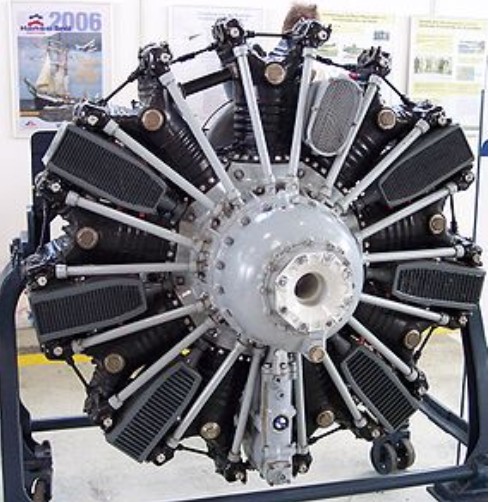
The BMW 114 was a nine-cylinder air-cooled diesel radial engine intended for military aircraft use. Developed in 1935 from the BMW 132, with which it could be interchanged, work did not progress beyond experimental prototype engines.
The supercharged BMW-Lanova 114 V-4 was a liquid-cooled diesel engine variant which was also not produced in numbers.
BMW 114
Type: 9-cylinder radial engine
Bore: 155.5 mm
Stroke: 162 mm
Displacement: 27.7 L
Supercharger: single speed supercharger
Cooling system: Air- and Liquid-cooled
Power output: 510 HP
The BMW X was a small five-cylinder radial engine for sport and training aircraft first run in 1927. Although this engine proved successful at several large-scale events in 1930, including that year’s round-Europe flight, only a few were built.
The successor model to the BMW X five-cylinder radial engine, the BMW Xa, was introduced in 1931, with the swept volume increased from 2.2 to 2.9 liters. Power output went up from 50 to 68 hp. The Xa was also not built in any quantity either, and was mainly installed in training and sports aircraft.
Applications:
BFW M.23
BFW M.31
Klemm L25
BMW Xa
Type: 5 cylinder radial engine
Bore: 90 mm (3.54 in)
Stroke: 92.5 mm (3.64 in)
Displacement: 2.94 L (179.6 cuin)
Diameter: 740mm
Dry weight: 73kg
Fuel system: carburettor
Cooling system: Air cooled
Power output: 51 kW (68 hp)
Compression ratio: 5.7:1
The BMW VIIa was a water-cooled Vee twelve-cylinder engine derived from the successful BMW VI.
Unlike the BMW VI unit, it had the magnetos arranged in front of the cylinder banks in order to simplify maintenance. The BMW was employed for the first forced-aspiration experiments with a “mixture blower” (a radial fan located behind the carburettor); this led in due course to the development of the BMW IX aircraft engine. Only a few examples of the BMW VII went into operation, in the single-engined version of the Junkers Ju 52, for example, and in the Dornier Wal which Wolfgang von Gronau flew around the world in 1932.

