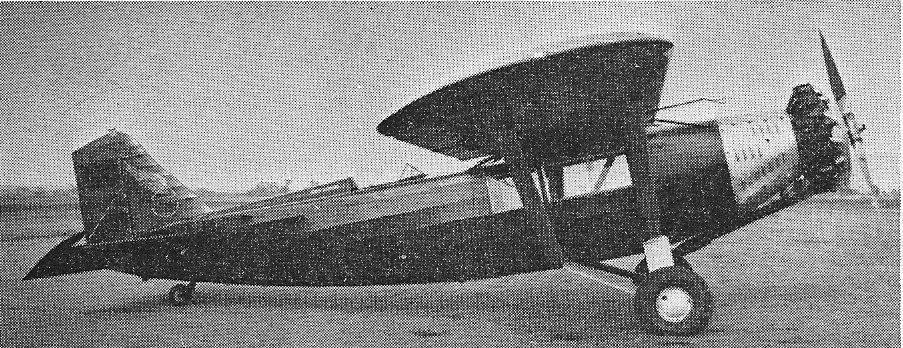
The early 1930s Breese Aircraft Model R-6-C was re-modelled by Russel H. Lawson of Portland, carrying four passengers in the cabin, with the pilot in the open, rear cockpit.
Engine: Wright R-975 Whirlwind, 330 hp
The early 1930s Breese Aircraft Model R-6-C was re-modelled by Russel H. Lawson of Portland, carrying four passengers in the cabin, with the pilot in the open, rear cockpit.
Engine: Wright R-975 Whirlwind, 330 hp
Circa 1920, Breese built a 226.19 cu.in three-cylinder radial air-cooled aero engine. The engine produced 40hp@1400rpm and had a dry weight of 163 lb.
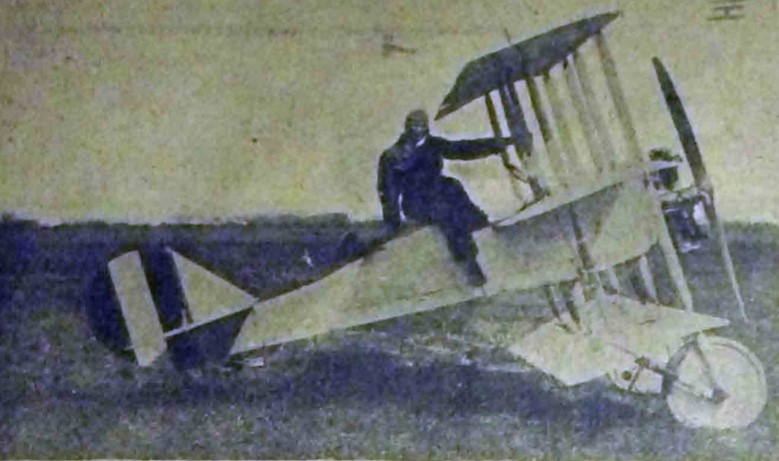
The Pensuti 2 was a very compact, low-powered triplane flown in about 1918. Its first flight, piloted by Lt. Lodovico Montegani, was delayed by the death of its designer and Caproni test pilot Emilio Pensuti in an unrelated aircraft crash. Designed to do in the air “what bicycle [sic] does for the man on the road”, it was categorised post-World War I as a small sporting aeroplane.
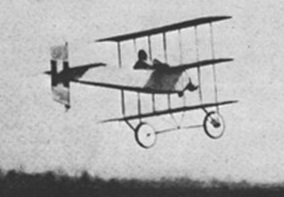
The single-seat triplane had unswept rectangular wings, each with a full span of only 4 m (13 ft 1 in). These were mounted without stagger, each wing braced to the one below by two pairs of vertical, parallel interplane struts, one pair out beyond mid-span and the other from the fuselage sides. The central wing was attached to the upper fuselage and the other two held well clear of it by the struts. There were ailerons on each wing.
The Pensuti had a simple rectangular cross-section fuselage, with the open cockpit at the wing trailing edge. A three cylinder, inverted Y configuration Anzani air-cooled engine of 26 kW (35 hp) in the nose drove a two-blade propeller. The triplane had a fixed undercarriage of wide track, with a single wheel at each end of a single axle with its extremities attached to extensions of the outer interplane struts. Its cruciform tail had horizontal surfaces mounted on the top of the fuselage; the vertical surface was trapezoidal and extended equally above and below the fuselage. A small tailskid was carried on its lower tip.
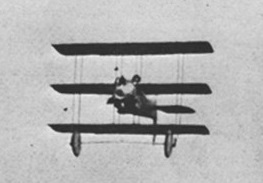
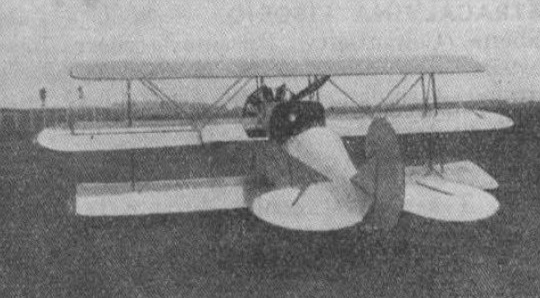
A second aircraft with a redesigned tail, Anzani 10-cylinder radial engine and other modifications was built at the Breda factory in Milan as the Breda-Pensuti B.2, (regn. I-BADZ). It gained the second prize at the Italian low-powered aircraft competition held in the summer of 1920 in Milan.
The Italian Air Force used them for quick recon flights for the infantry. The Pensuti 2 remained in service until 1923.
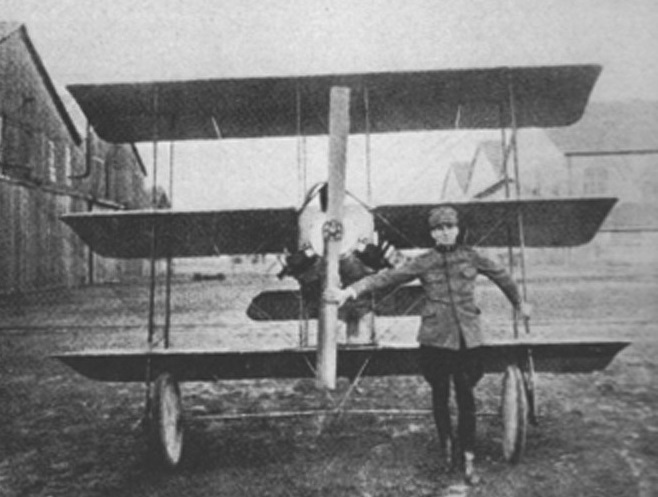
‘Ba.1’ has been applied to the B.2.
Possibly a variant with an 80 hp Breda V-8 was also built.
Powerplant: 1 × Anzani Y 3-cylinder, 26 kW (35 hp)
Propeller: 2-bladed
Wingspan: 4.0 m (13 ft 1 in) all wings
Length: 3.80 m (12 ft 6 in)
Height: 2.40 m (7 ft 10 in)
Gross weight: 230 kg (507 lb) in flight with pilot
Maximum speed: 95 km/h (59 mph, 51 kn)
Stall speed: 40 km/h (25 mph, 22 kn)
Rate of climb: 1.1 m/s (220 ft/min)
Take-off and landing distances: 20 m (65 ft).
Crew: one
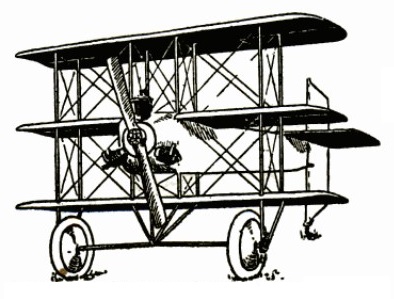
A 1918 single-seat recce triplane
Engine: 6-cyl Anzani
Wingspan: 4,00m
Length: 4,40m
Height: 2,90m
Empty weight: 180kg
TO weight: 290kg
Max speed: 120km/h
Stall speed: 60km/h
Designed by Ing Generale Gaetano Arturo Crocco and Ing Giulio Cesare Costanzi who worked for the Italian military the 1929 Breda CC.20 trimotor monoplane bomber had a 42m span and IF Asso A.500 power. One prototype was built.
CC.2000 was an alternative designation for the CC.20 (based on total installed horsepower).
Built in the 1930s, the Breda CC.3000 trimotor monoplane was a more powerful derivative of the CC.20.
A 1922 modification to the original Tebaldi-Zari fighter prototype.
Modifications were a long span/narrow chord upper wing, different stagger, and removable lower wings.
Engine: Hispano-Suiza HS 42 V-8, 1300 hp
Armament: 2 x 7.7mm Vickers
The 1919 Breda M.1 was an enclosed-cabin airliner conversion of surplus Ca.44 bomber, aka Ca.57.
A twin-engined, twin-boomed biplane 8 passenger airliner, with a 23.40m span.
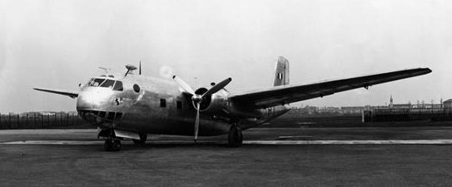
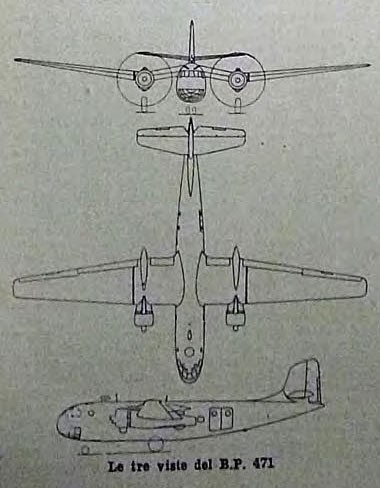
As part of its efforts to get back into aircraft manufacturing following the war, Breda commissioned Mario Pittoni to develop a twin-engine medium transport designated the Breda-Pittoni B.P.471. The prototype first flew in 1950. It was an all-metal twin-engine monoplane of stressed-skin construction. It had a retractable tricycle undercarriage and wings were of an inverted-gull configuration, this allowed the main landing gear to be short and light. The cabin had room for 18-passengers or freight. The company proposed many uses for the aircraft including a civil airliner and freighter, military navigation trainer or utility freighter. With no interest from buyers the prototype was operated by the Italian Air Ministry as a staff transport until retired in 1954.
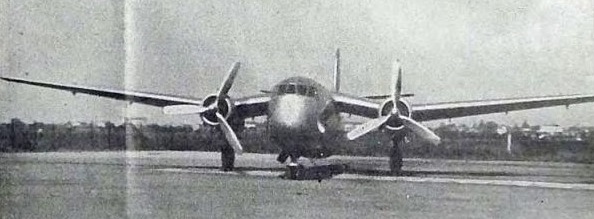
B.P.471
Engines: 2 × Pratt & Whitney R-1830-92 Twin Wasp, 890 kW (1,200 hp) each (take off power), 780 kW (1,050 hp) at 2,300 m (7,500 ft)
Length: 17.5 m (57 ft 5 in)
Wingspan: 23.0 m (75 ft 6 in)
Height: 5.75 m (18 ft 10 in)
Empty weight: 5400 kg
Gross weight: 10,000 kg (22,046 lb)
Maximum speed: 473 km/h (294 mph; 255 kn) at 3000 m
Cruising speed: 412 km/h (256 mph; 222 kn)
Range: 2,000 km (1,243 mi; 1,080 nmi) at 395 km/h (245 mph; 213 kn)
Service ceiling: 7,500 m (24,606 ft)
Time to altitude: 9 min 39 sec to 4,000 m (13,100 ft)
Crew: 2
Capacity: 18 passengers
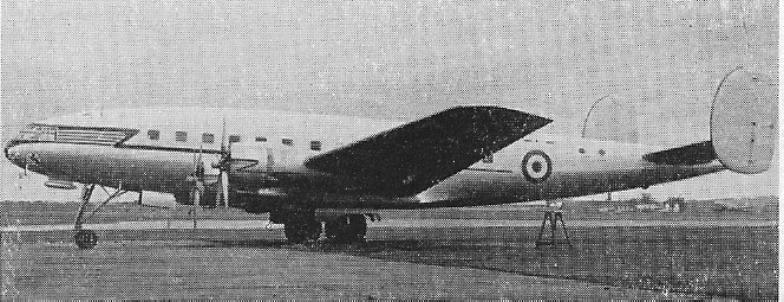
Designed by Filippo Zappata, the 1948 Breda-Zappata BZ.308 was a four engined airliner evolved from the Zappata Z.511/BZ.305. The BZ.308 was designed primarily for trans-Atlantic services between Italy and the Latin American countries, and four were ordered by Argentina.
Powered by four 1750 hp Bristol Centaurus 568 radials, one prototype was built, employed by the Italian Air Ministry.
Engines: four 1750 hp Bristol Centaurus 568
Wing span: 138 ft 2 in / 33.50m
Length: 110 ft
Empty weight: 50,706 lb
Loaded weight: 79,366 lb
M ax speed: 311 mph
Cruise: 262 mph
Crew: 5
Passengers: 55
Filippo Zappata, responsible for the C.R.D.A. Cant series of bombers, joined the Breda design staff in 1941, and was subsequently responsible for several interesting projects, few of which were actually built.
The Breda- Zappata BZ.301 was a projected medium bomber derived from the Cant Z.1018 Leone. It was accepted for production but none were completed.
The Breda BZ.303 was a projected night fighter derived from the Cant Z.1018 bomber. The Bz 303 was a sleek two-seat, low-wing monoplane of mixed construction with twin fins and rudders. Power was provided by two 1,450-h.p. Piaggio P.XV R.C.60j2V radials, and the exceptionally heavy armament of eight 20-mm. Mauser cannon (four firing forwards and four firing to the rear) and a 12.7-mm. machine gun in a dorsal position. Maximum speed was 360 m.p.h., and range was 963 miles. The sole prototype was under construction in 1943 but was scrapped after the armistice.
BZ.303
Engines: 2 x 1,450 hp Piaggio P.XV R.C.60
Armament: 8 x 20 mm + 1 x 12.7 mm

