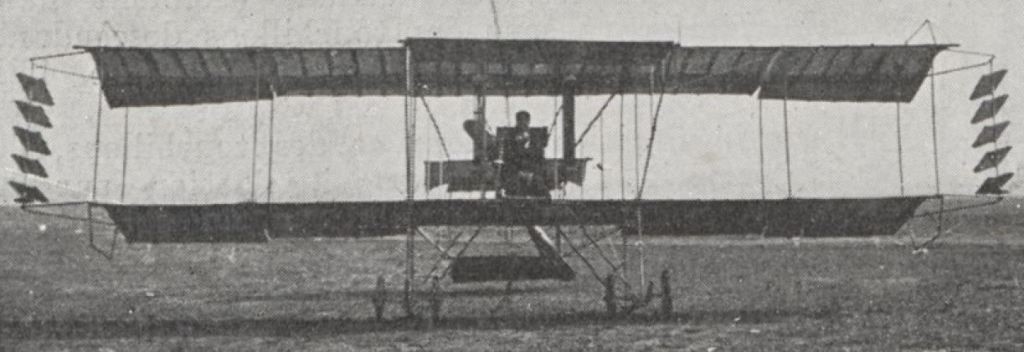
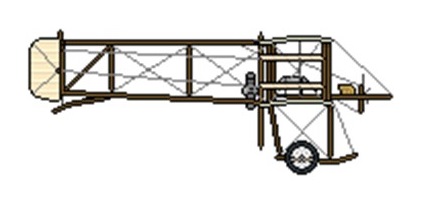
A standard Farman with the ailerons locked (otherwise they would be hanging down on stationary plane) and replaced by a system of five stabilizing surfaces at each wing tip, invented by Boleslaw Bronislawski, a Polish doctor of science working in France. The plane was tested at Port-Aviation in late 1911 by Florentin Champel, who might also have been the owner of the Farman.
In 1910-1911 dr.eng. Bolesław Bronisławski developed in France the original system of the airplane steering in longitudinal axis by other means than conventional ailerons or by twisting the wingtips. His design utilized vertical axis on wingtips which had several surfaces mounted diagonally to the flight level and were rotated to achieve roll movement. Initial trials were conducted on modified Farman III aircraft. After relatively successful trials the system was further refined and installed on a new aircraft that was built utilizing large parts of Farman and tested 1911-1912.
Dr. D.F. Brokaw, with the aeronautical engineering help of Dr. Ernest R. Jones, has developed a high-speed homebuilt with good cross country capability, comfortable seating for two in tandem fashion, retractable gear, full FR capability and the ability to perform aerobatics. While the prototype took Brokaw seven years to build, offspring can be built in about three years working from plans.
At the 1983 Oshkosh Brokaw had re-engined the prototype and extended the wings.
The original powerplant was a 285-hp Continental, but the most common options are a 310-hp Continental or the 380-hp Lycoming turning a Sensenich three-blade propeller. The fuselage, wings, tail and all control surfaces are built from light alloy, while the tricycle landing gear are retractable. Stressed to 6G for aerobatics, with 322 mph top speed and a service ceiling of 28,000 feet, the Bullet ranks as a high performance homebuilt.
Engine: 380-hp Lycoming Gross Wt. 3142 lb Empty Wt. 2033 lb Fuel capacity 47-92 USG Wingspan 24 ft 4 in Length 23 ft l0 in Top speed 322 mph Cruise 293 mph. Stall 86 mph. Climb rate 2100 fpm Ceiling 28,000 ft Takeoff run (50 ft) 2000 ft Landing run (50 ft) 1300 ft Range 1323 miles.
In 1863 Jacob Brodbeck built a small model with a rudder, wings, and a propeller powered by coiled springs. Encouraged by the success of his model at various local fairs, Brodbeck set about raising more funds to build a full-sized version of his craft. On September 20, 1865, a small crowd gathered in a field near Luckenbach to see if the spring coil air ship could actually fly. The airship featured an enclosed space for the “aeronaut,” a water propeller in case of accidental landings on water, a compass, and a barometer. According to published accounts, Brodbeck’s air ship managed to lift off from the ground above 12 feet and fly a distance of about 100 feet before the coil came unwound and the ship crashed into a chicken coup injuring the inventor.
The Brochet MB.120 two-seater light touring monoplane has the airframe of the three-seat MB.100 remodelled as a two-seater, lighter wings, the landing flaps of the MB.80 and a 90 hp Continental C90 engine.
Flown for the first time on 5 April 1954, the MB.120 has a steel-tube fuselage and a spring-steel cantilever undercarriage. The cabin seats two side-by-side and dual controls can be fitted.
Two prototypes were built.
Engine: 90 hp Continental C90 Wingspan: 34 ft 11 in Length: 21 ft 3.75 in Height: 6 ft 6.75 in Empty weight: 1113 lb Loaded weight: 1686 lb Max speed: 121 mph Cruise: 105.6 mph Ceiling: 16,404 ft Range: 497 mi Seats: 2
The M.B.100 three seat cabin monoplane was developed from the earlier M.B.70 and M.B.80. The M.B.101 is identical to the M.B.100 apart from the addition of an air filter and tropical finish to suit it for service in North Africa.
An initial order for eight M.B.100s and twelve M.B.101s was placed by the French Service de l’Aviation Legere Sportive which were distributed to flying clubs in France and Norg Africa.
Engine: Hirth H.M.504A-2, 100 hp Wing span: 34 ft 11 in Wing area: 153 sq.ft Length: 21 ft 4 in Height: 6 ft 7 in Empty weight: 1023 lb Loaded weight: 1716 lb Max speed: 112 mph Cruise: 102 mph ROC: 590 fpm Service ceiling: 11,480 ft Range: 375 mi Seats: 3
The MB.80 was a derivative of the Brochet MB.71, using essentially the same wood airframe, but with a redesigned wider fuselage, balanced control surfaces, and revised, spring steel undercarriage.
The MB.80 No.1 F-BGLA first flew on 4 October 1951 (or 15 November) with André Deschamps at controls. The Certificat de Navigabilite was obtained on 6 June 1952.
The Service de l’Aviation Légère et Sportive purchased ten examples for distribution to French aeroclubs. Most examples were operated in France, but one example was later sold privately to the United Kingdom.
MB.80 Engine: Minie 4DC-32B, 56 kW (75 hp Wingspan: 10.45 m (34 ft 3 in) Wing area: 14.2 m2 (153 ft2) Length: 6.58 m (21 ft 7 in) Height: 2.55 m (8 ft 4 in) Empty weight: 385 kg (849 lb) Gross weight: 615 kg (1,356 lb) Maximum speed: 158 km/h (99 mph) Range: 500 km (310 miles) Rate of climb: 3.5 m/s (690 ft/min) Crew: One pilot Capacity: 1 passenger 10 built
MB.81 Engine: Hirth HM 500B-2 1 built
MB.83 Engine: Continental C90 1 converted from MB.80
MB.84 Engine: Continental A65 1 converted from MB.80 F-BGLI
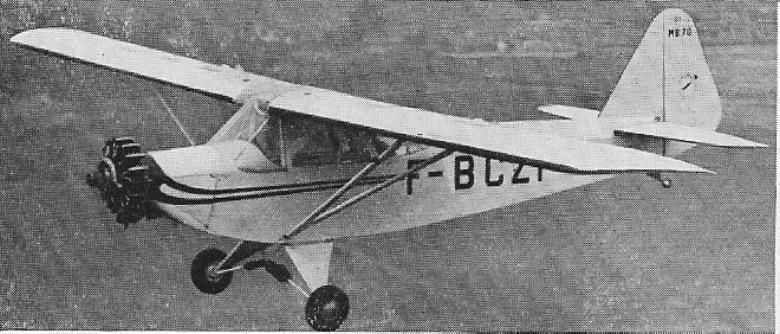
Derived from the MB.50 Pipistrelle and MB.60 Barbastrelle, the two-seat cabin MB.70 was built to meet the requirements of the Service de l’Aviation Legere et Sportive.
It obtained its Certificat de Navigabilite in July 1950.
Prototypes of three versions were built, differing only in the type of engine installed.
MB.70 Engine: Salmson 9ADB, 45 hp Wing span: 33 ft 11 in Seats: 2
MB.71 Engine: Minie 4 DC32, 75 hp Wing span: 33 ft 11 in Length: 21 ft 4 in Height: 8 ft 2 in Empty weight: 765 lb Loaded weight: 1212 lb Max speed: 101 mph Cruise: 89 mph ROC: 787 fpm Seats: 2
MB.72 Engine: Continental A65, 65 hp Wing span: 33 ft 11 in Seats: 2
Maurice Brochet formed Constructions Aeronautiques Maurice Brochet and designed the MB.60 Barbastrelle tandem two-seat high-wing monoplane which first flew in June 1949.
Brochet MB.50 Pipistrelle at Chavenay airfield near Paris in May 1957
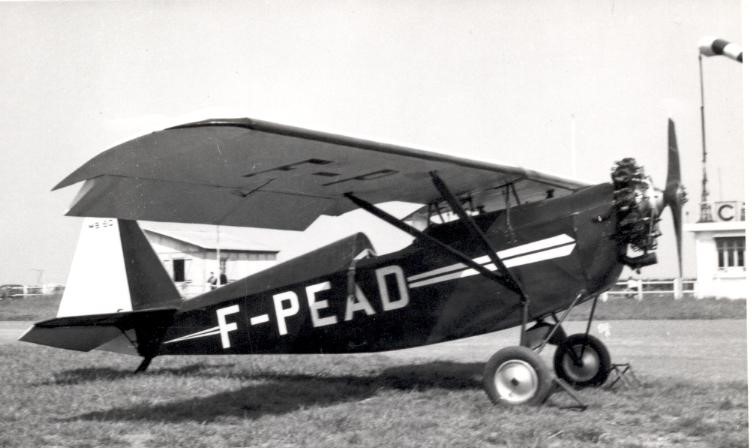
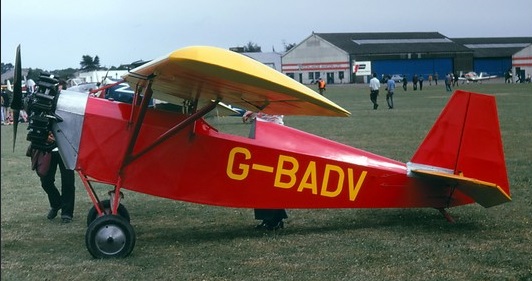
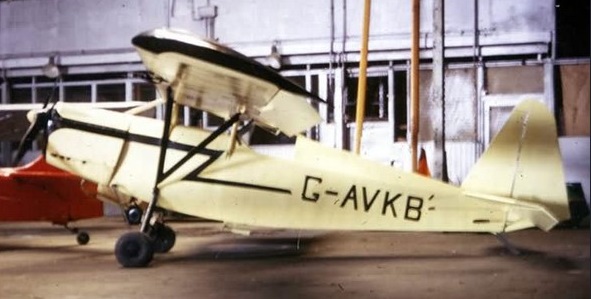
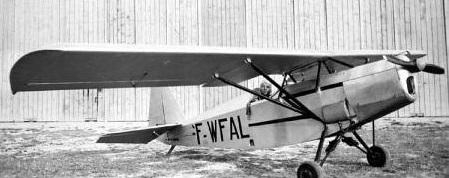
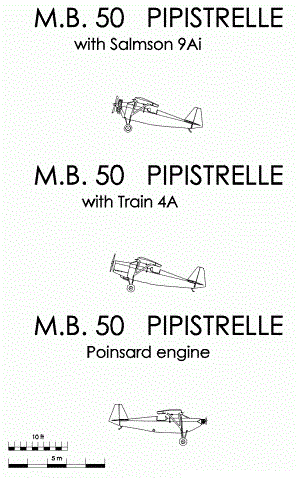
The first postwar design of Maurice Brochet was the MB.50 Pipistrelle (“Bat”) of 1947, which first flew that year. It is a single-seat open-cockpit ultra-light aircraft with a pylon-mounted high wing, wooden fuselage frame and fabric covering. The design was kept simple with the amateur-built market, using factory working drawings, in mind.
The first MB.50 was built in 1947 by Maurice Brochet and was powered by a Salmson 9ADb 45 h.p. radial engine. The subsequent Pipistrelles were all built by amateur constructors. In 1965, six were active, three powered by the Salmson, two by the Beaussier 4Bm O2 of 45 h.p. and one fitted with a Zlín Persy II.
Pipistrelle F-PEBZ was still active in 2005. Another was held in the collection of Ailes Ancienne Toulouse, near Toulouse Blagnac International Airport, during 2006.
Engine: 1 × Salmson 9ADb, 30 kW (45 hp) Wingspan: 8.00 m (26 ft 3 in) Length: 5.80 m (16 ft 0 in) Empty weight: 240 kg (529 lb) Gross weight: 351 kg (772 lb) Maximum speed: 140 km/h (87 mph) Cruising speed: 115 km/h (72 mph) Crew: One pilot