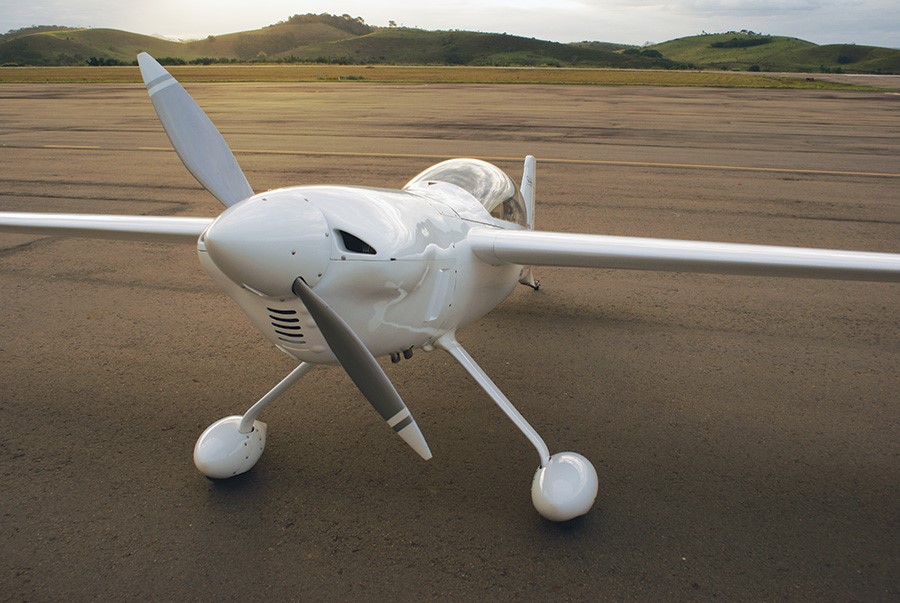
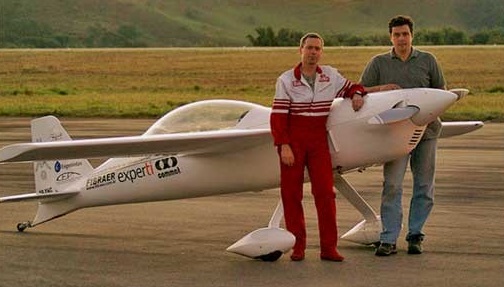
The CEA-UFMG CEA-311 Anequim was built by students of the Center for the study of Aeronautical Engineering at the Federal University of Minas Gerais in Belo Horizonte, Brazil, directed by Professor Paulo Iscold.
CEA-311 Anequim is a Brazilian experimental single-engine plane, designed and built by a team of students and researchers from the Center for Aeronautical Studies at the Federal University of Minas Gerais. The project started in March 2011 and the first flight took place in November 2014 with Gunar Armin in command.
The Portuguese word for the Mako Shark is Anequim, a name adopted for a single-engine speedster designed by a team of professors and students at the Center for Aeronautical Studies at the Federal University of Minas Gerais (CEA-UFMG) in Belo Horizonte, Brazil. With lines similar to those of a Mako’s body, Anequim CEA-311 is a light-composite airplane powered by a four-cylinder Lycoming IO-360 (albeit modified for Anequim). Anequim has been clocked at 282 knots (324 mph) and achieved five speed records. In August 2015, the single engine entered the world history of aviation by breaking 5 international speed records of the International Aeronautical Federation for airplanes from 300 to 500 kilos.
The design phase of the CEA-308 started in 1999 as Paulo Iscold’s undergraduate project. The construction of the design started in 2000 and used wood and steel for the fuselage with white foam formed in between bulkheads and stringers which was carved to shape and covered with fiberglass. The wing is built-up wood ribs and a wood spar; like the fuselage the spaces between the wood parts were filled with white foam which was carved to shape and covered with fiberglass.
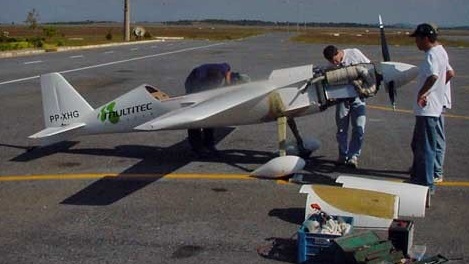
Early CEA-308 2 cycle engine installation
The first flight was flown in 2002, powered by a Rotax 532. The intention was to do initial flight test with the 532 and install a 100hp Hirth 3701 (3 cylinder, 2 cycle) for the records. Early in the flight test program the Rotax 532 failed, while the pilot was able to save the airplane, the engine was lost. As a result, the project was shelved from 2002 until 2005 when Gúnar Armin (former Brazilian Aerobatic Champion) took interest in the project. At this time, the Hirth was still the engine of choice, but an undisclosed problem procuring a suitable engine forced the team to look into other engines. The Jabiru 2200 was selected and one was bought used, and installed in the airplane.
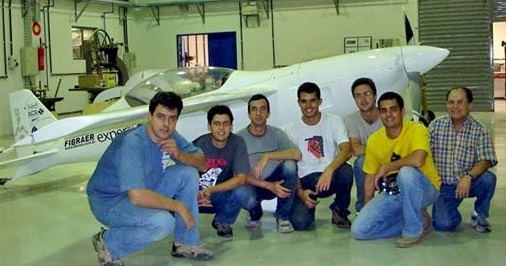
Professor Paulo Iscold and several of the students that helped build the CEA-308
Catto props are also a favorite for absolute speed and other records, where the prop can be optimized for a single flight condition. “Catto has been very supportive of our projects,” says Dr. Paulo Iscold, professor of aerodynamics at UFMG in Brazil, consultant to several Red Bull and Reno air race teams, and holder of four world records with his CEA-308. “The first prop that he sent for our 308 was almost perfect, and the second prop was better than perfect. I’m not afraid to say that Catto’s props are the best aerodynamic setup in the world today. He has been trying many different ideas through the years, and his propellers incorporate many features that are not listed in the usual literature. On the 308 I must remind you that we set the 3 km absolute speed record and the 3000 m time-to-climb record with the same prop!”
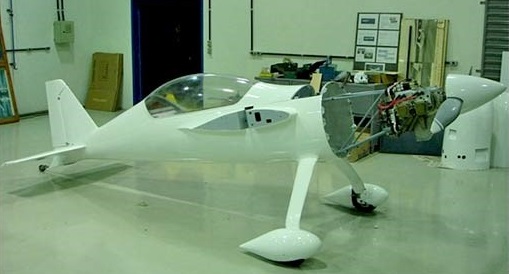
The Jabiru 2200 80 hp engine installation in the CEA-308
The Jabiru installation has been on the airplane ever since. Paulo did not say what happened to the exotic custom three bladed propeller they had designed and built for the Hirth. The records (all of which were in the C-1.a/0 weight class) were set on the 1st and 3rd of December 2010 and all attempts were flown by Gúnar on Craig Catto 58×69 propellers. The first flight of the day was the time to climb to 3000m. This was a Russian record and it stood at 13min 40 sec held by Mikhail Markov in a MAI-89 (Rotax 532 USSR 8/6/90). Mr. Armin’s attempt was successful (8 min 15sec), his record also eclipsed the American record (9 min 36 sec) held by Brian Dempsey in a Sonerai (VW 1600 Easton MD 2/19/89). The second record was the 15 km speed record which Gúnar set at 204 mph, previously 181 mph also held by Brian Dempsey in his same Sonerai on the same date and location. The final record set on the 1st of December was the 100 km speed record set at 202 mph, previously 184 mph set by Charles Andrews in the Monex (Aero Vee, Fond du Lac, WI 8/3/82).
The CEA-308, Pilot Gúnar Armin, and Professor Paulo Iscold
The most impressive record setting attempt was on the second day of flying. On the 3rd of December the team tackled the 3km speed record. The record stood at 218 mph set by a BD-5B in Zeltweg Austria (8/28/99). The American record is slower still at 213 mph set by Mike Arnold’s AR-5 (now hanging in the Hiller museum). The CEA-308 took the record at 223 mph, thereby setting four records in two days of attempts.
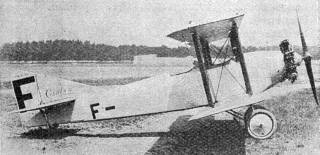
The Caudron C.161 was a lightweight French two-seat biplane designed by Caudron for sport or flight training use. A conventional biplane with a square fuselage powered by a 65 hp Salmson radial engine. It had two cockpits in tandem with dual controls in both, when not used as a trainer the controls could be removed from the rear cockpit.
A variant, the C.168, with a more powerful 70 hp Anzani radial engine was also available.
C.168 Engine: 1 × Anzani 6-cyl, 52 kW 70 hp Wingspan: 9 m / 29 ft 6 in Wing area: 20 sq.m / 220 sq ft Length: 6.13 m / 20 ft 1 in Height: 2.42 m / 7 ft 11 in Empty weight: 342 kg / 754 lb Gross weight: 572 kg / 1.261 lb Power / mass: 0.0912 kW / kg / 0.0555 hp / lb Wing loading: 28.6 kg / sq.m / 5.9 lb / sq ft Maximum speed: 150 km / h / 93 mph / 81 kn Crew: 2
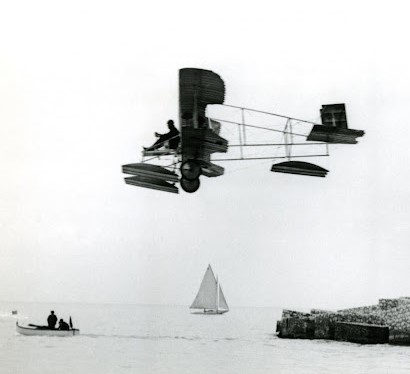
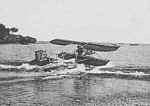
The Caudron pusher seaplane entered in the 1912 Monaco seaplane meeting featured three, big, flat-bottomed Fabre floats fitted in front of the wheels and one under the tail, a 60 hp six-cylinder Anzani engine. The pilot sat on a forward outrigger. In France it was referred to as a true “aero-amphibian” by virtue of its combined wheel-and-float undercarriage, because it could take off from and land on both land and water.
The Caudron 760 was a fighter, first flown in 1939 but in 1940 the entire production line was deliberately set on fire to prevent the type falling into German hands.
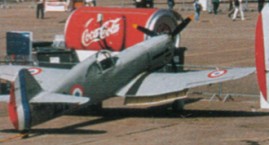
Marcel Riffard, who joined the French company Societe Anonyme des Avions Caudron as chief designer in 1932, developed his racing aircraft design into a lightweight fighter aircraft as the Caudron C.710. The prototype flew for the first time on 18 July 1936. The C.713 Cyclone, first flown in December 1937, which was generally similar in overall design and 336kW Renault 12Ro1 powerplant, but introduced retractable tailwheel type landing gear and redesigned vertical tail surfaces. Final evolution of Riffard’s design was the C.714.01 prototype, first flown in the summer of 1938, which differed by having some structural strengthening and a wing of improved profile. The factory testing of this prototype confirmed Riffard’s performance estimates, and it was handed over to the CEMA for trials in September 1938.
In November 1938 100 C.714 production aircraft were ordered which were required to have four 7.5mm wing-mounted machine-guns. Of low-wing cantilever monoplane configuration, the C.714 was an all-wood construction, except that all control surfaces had light alloy framework and fabric covering. The wing section was so shallow that it was not possible to mount machine-guns conventionally, within the wing structure, and special streamlined pods were designed, these carrying a pair of guns beneath each wing.
Production began in the summer of 1939, and 50 of the aircraft which had been intended to serve with the Armee de I’Air were diverted to the assistance of Finland, but only six had been received by 12 March 1940, the balance being presumed to have been lost en route. It is believed that about 40 C.714s were delivered to the French air force, which, after some 90 had been built, cancelled production because of dissatisfaction with the type’s rate of climb. They were used to equip an all-Polish squadron which became known as the ‘Warsaw Group’ (GC 1/145), this unit seeing action against the Germans between 2-13 June 1940. Following the collapse of France, a small number were used by the Vichy French air force, and about 20 were confiscated by the Germans for use by the Luftwaffe.
Derived from the C-714, the C-714-R was built specially for racing and fitted with a 900 hp Renault 12 R Special. This version was designed by Marcel Riffard and was to be piloted by Raymond Delmotte for an attempt at the world speed record. World War II stopped all that.
Caudron C 714 Cyclone Engine: Renault 12Ro1, 444 hp Wingspan: 29 ft 5 in / 8.97 m Wing area: 134.550 sqft / 12.5 sq.m Length: 27.986 ft / 8.53 m Height: 9 ft 5 in / 2.87 m Max take off weight: 3858.8 lb / 1750.0 kg Weight empty: 3087.0 lb / 1400.0 kg Max. speed: 262 kts / 485 km/h / 301 mph Cruising speed: 173 kts / 320 km/h / 199 mph Service ceiling: 29856 ft / 9100 m Wing load: 28.70 lb/sq.ft / 140.00 kg/sq.m Range: 486 nm / 900 km Crew: 1 Armament: 4x MG 7,5mm
C-714-R Engine: Renault 12 R Special, 900 hp Wingspan: 22.14 ft Length: 28.57 ft Design speed: 412 mph
Competing with the ANF-Mureaux 190 to meet a Service Technique de l’Aeronautique specification for a lightweight fighter, the C 710 Cyclone, designed by Marcel Riffard, was developed from the Coupe Deutsch de la Meurthe racing monoplanes. It was of wooden stressed-skin construction with a 500hp Renault 12R 01 12-cylinder inverted-Vee air-cooled engine. First flown on 18 July 1936, the C 710-01 was subsequently fitted with two drum-fed 20mm HS-9 cannon in the wings, and was tested at Guyancourt and Villacoublay throughout 1937. On 1 February 1938 it crashed in the Verrieres forest. Two additional airframes had been built, the second of these being completed as the C 710-02 which differed from the first prototype in having redesigned vertical tail surfaces, taller and more angular. Further development of the basic design concentrated on derivatives embodying retractable undercarriages (C 713, C 714) but were brought to a halt by the German occupation of France in 1940
Engine: 500hp Renault 12R 01 12-cylinder inverted-Vee air-cooled Take-off weight: 1 645 kg Empty weight: 1243 kg / 2740 lb Wingspan: 8.97 m / 29 ft 5 in Length: 8.53 m / 27 ft 12 in Height: 2.47 m / 8 ft 1 in Wing area: 12.50 sq.m / 134.55 sq ft Max. speed: 455 km/h / 283 mph Range: 825 km / 513 miles