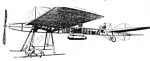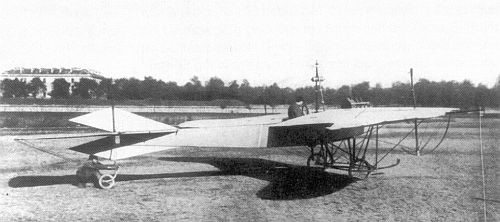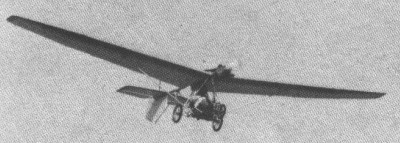
Single seat single engined high wing monoplane with conventional three axis control. Wing has unswept leading edge, swept forward trailing edge and tapering chord; cruciform tail. Pitch control by elevator on tail; yaw control by fin mounted rudder; roll control by one third span ailerons; control inputs through stick for pitch/roll and pedals for yaw. Wing braced from below by struts; wing profile; double surface. Undercarriage has three wheels in tricycle formation; steel ¬spring suspension on nosewheel and steel spring suspension on main wheels. Nosewheel steering connected to yaw control. Brake on nosewheel. Aluminium tube 6063-T6 framework, without pod. Engine mounted at wing height driving tractor propeller. Wing spar strut braced to the cage, ribs made of foam and unidirectional glass fibre and epoxy.
Cloudbuster Ultralights Cloudbuster Article
The Cloudbuster made its appearance in 1981. It is fitted with a rigid wing with duralumin tube spars and ribs of high density polyurethane foam, reinforced by a layer of unidirectional glass fibre and epoxy. Wing and tail surface covering is 1.7-ounce Dacron. The leading edge is vinyl and the trailing edge is aluminium sheet bonded to the back of the spars with epoxy. At the wing tips there are semi elliptic saumons and the ailerons are hinged from a false spar.
Undecarriage was tricycle with coil-spring independent suspension and a steerable nosewheel. The main wheels are 20”, and the nose wheel is 16”. A hand-operated bicycle-type brake is fitted to the nosewheel.
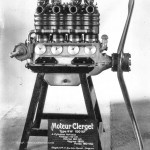
The prototype Cloudbuster was equipped with a Skylark Ultra 342 motor and a 2.0 reduction gear turning a two-blade Woody’s prop measuring 58×27”, which was dropped on the initial production models in favour of the Zenoah G25B developing 20 hp at 6500 rpm. Two other options were offered for this machine; the Cuyuna 215R (20hp at 5500 rpm) with a 2.5/1 reduction drive, or the Cuyuna 430R (30 hp at 5500 rpm).
Transport by road requires a trailer, the two half wings and the horizontal tail surfaces being de mounted.
The Cloudbuster is sold as a kit at various stages of finish with or without motor at the choice of the customer. The price was dependent on the kit chosen.
Engine displacement 430 Cuyuna or 342 Ultra (rated 35 and 30 hp).
Wingspan 36 ft.
Wing area 150 sq.ft.
Overall length 15 ft 6 in
Engine: Zenoah G25B, 20 hp at 6500 rpm.
Belt reduction, ratio 2.5/1.
Power per unit area 0.13 hp/sq.ft, 1.40 hp/sq.m.
Fuel capacity 3.5 US gal, 2.9 Imp gal, 13 litre.
Length overall 15.6 ft, 4.72 m.
Height overall 7.4 ft, 2.23 m.
Wing span 37 ft, 11.28 m.
Mean chord 4.1ft, 1.24 m.
Total wing area l53sq.ft, 14.2 sq.m.
Wing aspect ratio 8.9/1.
Nosewheel diameter overall 16 inch, 40 cm.
Main wheels diameter overall 20 inch, 50 cm.
Empty weight 248 lb, 112kg.
Max take off weight 532 lb, 241kg.
Payload 284 lb, 129kg.
Max wing loading 3.48 lb/sq.ft, 17.0kg/sq.m.
Max power loading 26.6 lb/hp, 12.0kg/hp.
Load factors; +4.5, 2.25 ultimate.
Max level speed 60 mph, 97 kph.
Never exceed speed 65 mph, 105kph.
Economic cruising speed 45 mph, 72 kph.
Stalling speed 25 mph, 40 kph.
Max climb rate at sea level 650 ft/min, 3.3 m/s.
Min sink rate 260 ft/min, 1.3 m/s.
Best glide ratio with power off 13/1 at 32 mph, 51 kph.
Take off distance 80 ft, 25 m.
Landing distance 100 ft, 30 m.
Service ceiling 10,000ft, 3050 m.
Range at average cruising speed 135 mile, 217 km.