A pressurized business and commuter rear-winged turbojet aircraft, as triple-engined 11 to 19 passenger Contender 303
Engines – Power
Contender 202
A pressurized business and commuter rear-winged turbojet aircraft, as twin-jet Contender 202 for seven to 19 passengers, triple-engined 11 to 19 passenger Contender 303
Constantin et d’Astanières No2 biplane
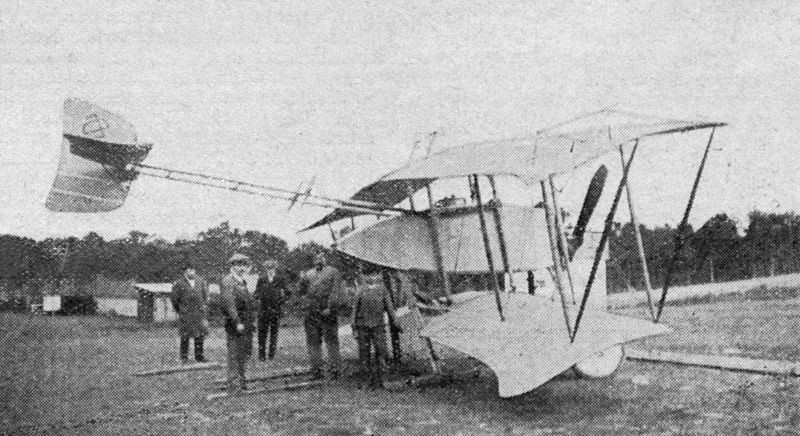
This second design of the duo Louis Constantin (designer) and M. d’Astanières (sponsor) never participated in the Concours de la sécurité (1914) for which it was intended, because it was not ready and still had problems that needed to be fixed. The machine was claimed to have three special features: A special design of the leading edges of the wings to improve their efficiency, automatic lateral stability by negative dihedral wings, and improved longitudinal stability by minimal its longitudinal moment of inertia. The last two of these appear rather counterintuitive, but perhaps… It was first tested only days before the outbreak of WW1, which stopped any further experimenting.
Constantin et d’Astanières No.1
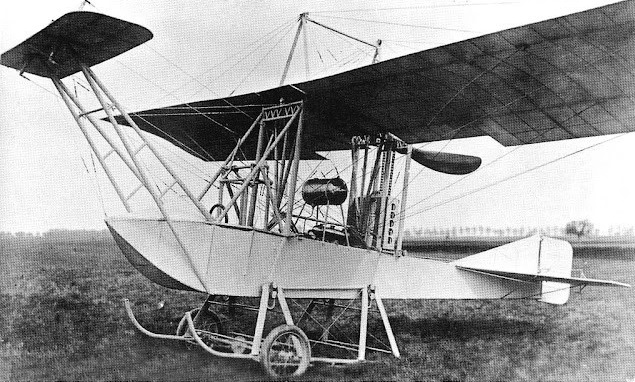
An aircraft designed following the ideas a patent of Francois d’Astanières about an automatically-stable monoplane. Built by Louis Clement, it was tested initially in 1913. The aircraft was later modified with some safety features patented by Louis Costantin (concave leading-edge flaps and modified elevators), the then called Constantin-d’Astanieres monoplane took part in the 1914 Concours de Sécurité.
Powered by a fuselage-mounted car engine that drove, via chains, a pusher propeller. The Constantin-d’Astanieres has a fairly orthodox rear fuselage and tail feathers, sles conventional was its additional front elevator on outriggers. The icing in the cake was its “slighty flexible” wings intended to absorb wind gusts.
The d’Astanières autostable in its second configuration, was under test at Bois d’Arcey in May 1913.
Contal 1910 monoplane
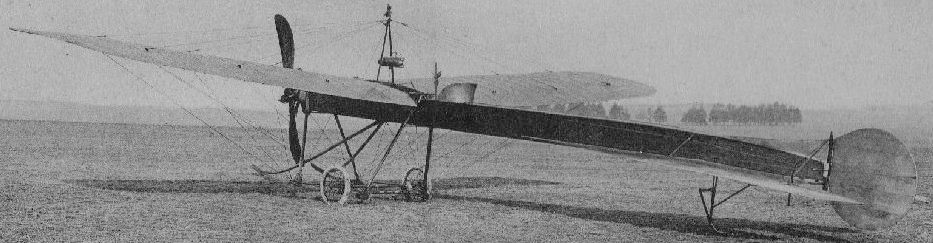
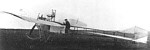
During 1909 and 1910 Camille Contal of Mourmelon, France, the inventor of a three-wheeled car called the Mototri, built several monoplanes. The 1910 machine had a narrow triangular fuselage was covered with sheets of mahogany with a 50 hp Gnome overhung at the nose. The rectangular wings could be warped, with the front spars fixed through steel fittings to the top two ash longerons, and the rear spars hinged. The pilot sat with his legs extended so that he could set his back easily against the seat without having to be strapped in.

Consolidated 37 / XC-99
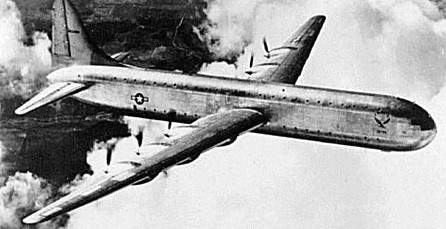
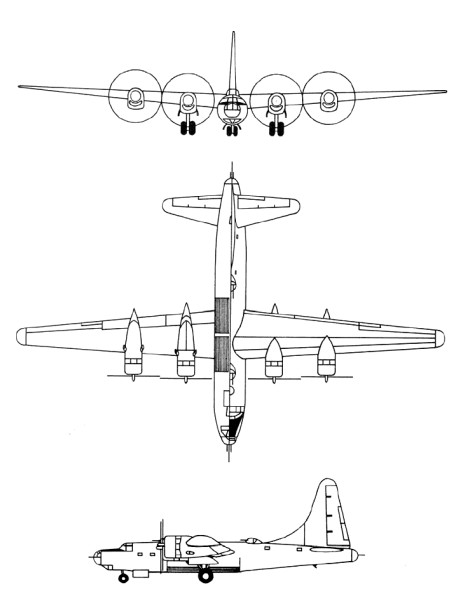
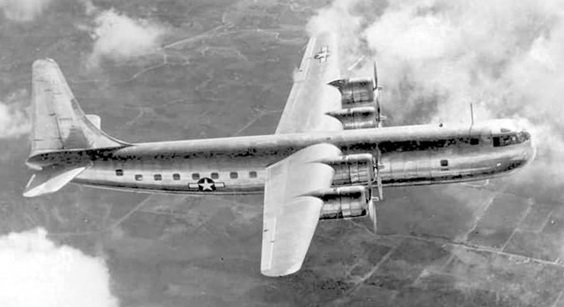
Shortly after starting to develop the B-36 bomber, Convair began the parallel design of a transport late in 1942 (Model 37). The XC-99 used the same wings, empennage, landing gear, and six 3,500hp (2,600kW) Pratt & Whitney Wasp Major engines as in the ‘Peacemaker’, but it had a large pressurized, double-decked fuselage capable of carrying 400 troops or more than 100,000lb (45,350kg) of cargo.
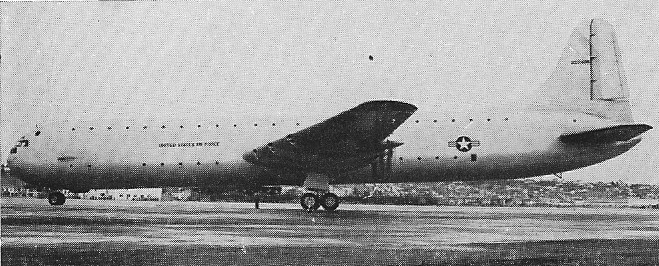
Only a single aircraft was built which flew on 23 November 1947, it subsequently acquired bogie main wheel units and weather radar. By 1955 it had carried 35 million pounds of freight in 4,000 flying hours. It was used successfully by the US Air Force for special transport operations until retired in 1957.

Engines: 6 x Pratt & Whitney R4360-41 Wasp Major, 3,500hp (2,600kW).
Span: 230 ft
Length: 182 ft 6 in
Height: 57 ft 6 in
Empty weight: 132,000 lb
Loaded weight: 265,000 lb
Max. Speed: over 300 m.p.h.
Service ceiling: 30,000 ft
Payload: 400 troops or 100,000+lb (45,350kg) of cargo.
Maximum range w/10,000 lb: 8100 miles
Consolidated 39 Liberator Liner
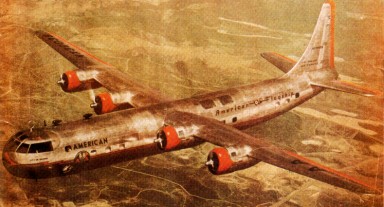
The Model 39 Liberator Liner was derived from the B-24 Liberator bomber via the PB4Y-2 Privateer patrol bomber and RY-3 Liberator Express transport. The design Model 39 started in early 1943.It retained the basic wing, landing gear, empennage, and engine nacelles of the Privateer; however, the fuselage was completely redesigned to carry 48 passengers in a day-time configuration or 24 at night. Like the Privateer, the Liberator Liner had four 1,350hp (1,000kW) Pratt & Whitney R-1830-94 Twin Wasp engines.
After the merger of Consolidated and Vultee the type was continued as the Convair Model 104. Convair was the trade name of Consolidated Vultee after the 1943 merger.
The US Navy became interested and signed a letter of intent for 253 aircraft in March 1944. The first prototype NX30039 (c/n 1) was flown for the first time on 15 April 1944 piloted by Phil Prophett and his crew. Due to design deficiencies the Navy cancelled its order but Convair received permission to purchase and complete the second prototype in Navy colours. Thus the second aircraft was completed as the Convair 104 XR2Y-1 and fitted with R-1830-65 engines NX3939 (c/n 2) and made it first flight on 29 September 1944. Eventually this aircraft was given the US Navy registration 09803.
In a demonstration five jeeps were flown from Detroit to Los Angeles in 10 hours. A full cargo of fruit and vegetables made up the return load.
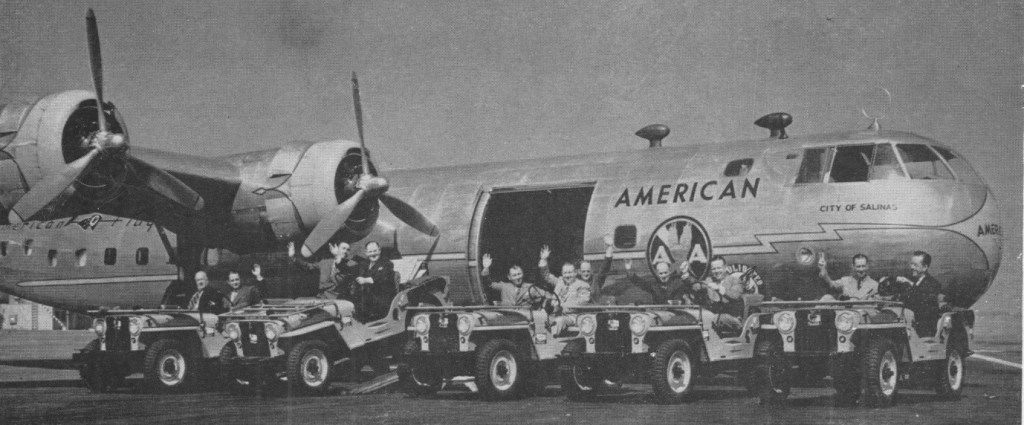
American Airlines operated the first aircraft, named City of Salinas (top), with the support of Convair for three months transporting fresh fruits between Salinas and El Centro, California and cities in the east like Boston and New York. A cargo of 18,500 lb (8,392 kg) could be loaded straight from flat trucks into the aircraft through large fuselage doors.
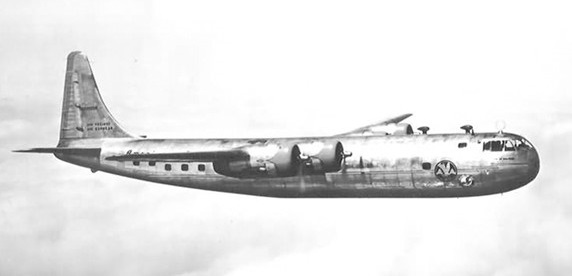
The Liberator Liner never really had a chance because of the many Douglas C-54s that were about to be released for civilian use. Both were scrapped late in 1945 after it became obvious that the design had no potential.
Engines: 4 x Pratt & Whitney R-1830-94 Twin Wasp, 1,350hp (1,000kW).
Cruise: 240mph (385km/h).
Max range: 4,000ml (6,400km).
Payload: 12,000 lb+
Consolidated XP-81
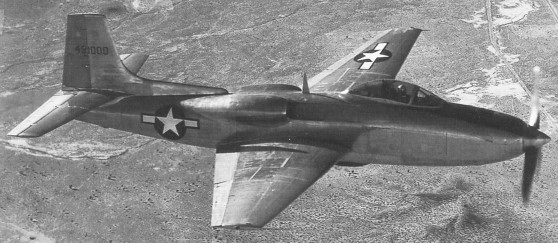
The Consolidated Vultee XP-81 (its newly-merged builder soon to be better known as Convair) was the first American aircraft powered by a turboprop engine. Ordered by the USAAF on 11 February 1944, the XP-81 was intended as a long-range escort fighter using compound power, with one 1230kW General Electric TG-100 turbo-prop and one 1701kg thrust Allison I-40 jet engine, eventually designated J33-A-5. When delays with the turboprop powerplant were encountered, the prototype XP-81 was flown on 11 February 1945 with a Packard V-1650-7 Merlin installed temporarily in the nose.
The first flight with the intended turboprop engine followed on 21 December 1945 and the turboprop provided no advantage in performance over the Merlin. A second XP-81 flew in early 1946 to join the first machine in testing, but war’s end, the disappointing results with the TG-100, and the superiority of pure jet designs resulted in cancellation of an order for 13 YP-81 service-test aircraft.
Both XF-81 airframes have survived derelict on a test range at Edwards AFB, California.
Wingspan: 15.39 m / 50 ft 6 in
Length: 13.67 m / 44 ft 10 in
Height: 4.27 m / 14 ft 0 in
Wing area: 139.48 sq.m / 1501.35 sq ft
Max take-off weight: 12700 kg / 27999 lb
Empty weight: 5785 kg / 12754 lb
Max. speed: 815 km/h / 506 mph
Cruise speed: 442 km/h / 275 mph
Ceiling: 10800 m / 35450 ft
Range: 4000 km / 2486 miles
Armament: 6 x 12.7mm guns or 6 x 20mm cannon planned, 1450kg underwing bombs
Consolidated XP-54

The Consolidated Vultee XP-54 “Swoose Goose” was a twin boomed pusher fighter that featured a powered lift to get the pilot to the cockpit, downward ejection seat, and upward tilting cannon.
Consolidated B-32 Dominator
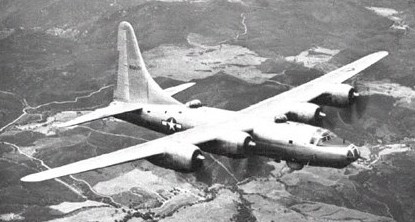
The B-32 was initially intended as insurance against failure of the B-29 program.
Consolidated were awarded a contract for the XB 32 at the same time as Boeing were given the XB 29, but the first prototype, (Model 33) did not fly for two years, the first XB 32 taking the air on September 7, 1942. In configuration a much bigger development of the Model 32 Liberator, the Model 33 had four 2200 hp Wright R 3350 23 Duplex Cyclone engines, each with two GE turbo-superchargers, driving four blade Curtiss Electric propellers. The fuselage was of more circular section than that of the Liberator, and all crew compartments were pressurized. The nose was like that of the B 29, and the tail had twin fins similar in shape to the Liberator. Unlike the Liberator, the main gears had twin wheels and retracted forward into the inner nacelles (the four nacelles were large and extended aft of the trailing edge). Armament comprised two 20 mm (0.79 in) cannon and 14 03 in (12.7 mm) guns in remote control barbettes.
However, the success of B-29 development and operational deployment made cancellation of the Dominator a very real possibility at several points in its development. Because the B-32 test program was so far behind schedule, not a single B-32 was ever sent to the Mediterranean or European Theaters of Operation.
Technical difficulties were severe. The second XB, flown on July 2, 1943, had a conventional nose with stepped pilot windscreens. The third, flown on November 9, 1943, followed the late model Liberators in switching to an extremely large single fin and rudder. Large scale production was planned, and orders were placed for 1700 production B 32 Dominators. However, technical difficulties continued, and to get the programme moving the pressurization and complex remote control armament were abandoned at a late stage. The B 32 was produced as a strategic bomber cast in the mould of the B 24 Liberator with a typical over target height of not above 8534 m (28 000 ft).
In December 1944, the B-32 program was almost canceled again. This time it was saved pending completion of a service test program. As put into production in the spring of 1944, the B 32 had five turrets, each housing a gunner and mounting twin .03 in (12.7 mm). Internal bomb bays under the wing spans carried 9072 kg (20 000 lb) of bombs.
Up to ten 12.7mm (.50 caliber) M2 heavy machine guns were provided for self-defense and mounted in pairs in turrets. A Sperry electric-hydraulic ball turret was mounted in the nose along with two Martin electrically-operated dorsal fuselage turret positions and a Sperry retractable turret in a ventral position. A Sperry tail ball turret protected the rear.
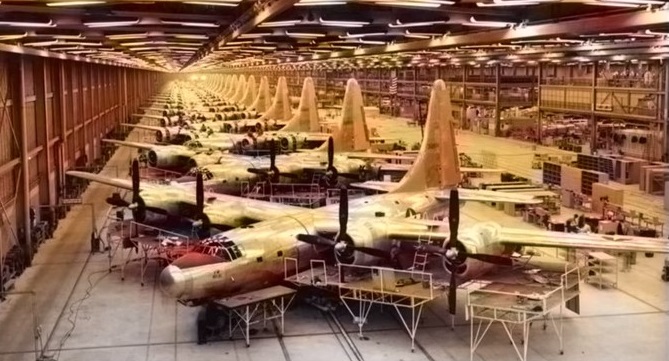
Deliveries began in November 1944, 40 TB¬-32 crew trainers were used to train crews. While the service test proceeded, combat crew training was started in preparation for deployment to the Pacific (pending a successful service test.) The service test revealed several minor and a few major problems and the program was near cancellation once again in the spring of 1945.
In March 1945, General George Kenney, Commander of the Far Eastern Air Forces (5th AF), traveled to Washington D.C. to ask for B-32s. He wanted B-29s but was turned down because of higher priority needs elsewhere in the PTO. After demonstrations in Washington, General Kenney convinced the Army General Staff to allow him to conduct a combat evaluation of the Dominator. A combat test plan of eleven missions was planned and if successful, the B-32 was scheduled to replace all the B-24 groups in the Pacific Theater. Three B-32s were assigned to the 386th Bomb Squadron, 312th Bomb Group, 5th Air Force. The first combat test mission was flown against a supply depot at Antatet, Luzon, Philippines on 29 May 1945. The last mission of the generally successful combat test was flown on 25 June 1945 against bridges near Kiirun on the island of Formosa (Taiwan).
The 386th Bomb Squadron completed B-32 transition in July 1945 and flew six operational combat missions before the end of the war. The most used Consolidated B-32 Dominator aircraft operationally were three B-32-20-CF’s (Serial Nos 42-108528, 42-108529 ‘The Lady is Fresh’ and 42-108532 ‘Hobo Queen II’). These machines were assigned to the 386th Bombardment Squadron, 312th Bombardment Group (Light) and operated from Clark Field and Floridablanca in the Philippines from May 29th to July 6th, 1945. During this period they undertook twelve bombing missions and dropped 134 tons of bombs on enemy positions. On the 11th August 42-108528 and 42-108532 moved to Yontan Air Base on Okinawa and in so doing joined another five B-32s that were already stationed there.
Following the 9 August 1945 bombing of Nagasaki, the 386th conducted photo reconnaissance missions and during a photo-reconnaissance sortie near Tokyo on the 17th August ‘Hobo Queen II’ and three other B-32s were attacked by ten Japanese fighters. The quartette defended themselves well and one Japanese fighter was shot down with another two claimed as probables. Furthermore, on the 18th August the ‘Hobo Queen II’ and 42-108578 shot down two Japanese aircraft over Tokyo and claimed two more as probables. Although no Dominator was lost in combat, at least two were damaged. Sergeant Marchione, a photographer aboard one of the B-32s on the photo reconnaissance mission of 18 August 1945, was killed when his bomber was attacked by fighters.
The last B-32 combat mission (also photo recon) was completed on 28 August 1945. The 386th BS was ordered to cease combat operations two days later. Cancellation of the B-32 program came on 8 September 1945 and production of Dominators was halted on 12 October.
By VJ Day 115 B 32s had been delivered, 1588 being cancelled and the type withdrawn from service.
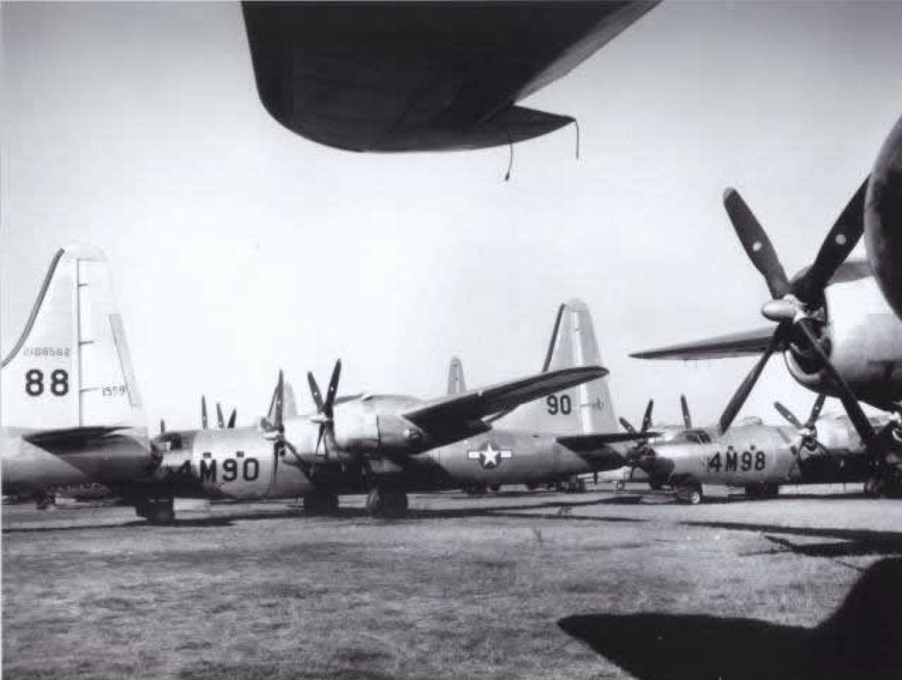
Flyable aircraft at Consolidated factories were flown directly to the scrap yard and all partially built B-32s were scrapped at the factory. The last remaining B-32 was scrapped in the summer of 1949.
Number Built: 75
Serial numbers: 42-108471 to 42-10884; 42-108525 to 42-108584; 44-90486
74 B-32s built at the Consolidated Fort Worth, Texas plant.
1 B-32 built at the Consolidated San Diego, California plant.
3 XB-32s and 40 TB-32s were built
A total of 118 B-32 built of all types
Consolidated B-32 Dominator
Engines: 4 x Wright R-3350-23 Duplex Cyclone 18-cylinder air-cooled turbocharged radial, 2,200hp, 1641kW
Propellers: Curtiss Electric reversible-pitch four-blade
Length: 83 ft 1 in (25.3m)
Wingspan: 135.17ft (41.20m)
Wing area: 132.1 sq.m / 1421.91 sq ft
Wing load : 78.52 lb/sq.ft / 383.0 kg/sq.m
Height: 33.14ft (10.10m)
Empty Weight: 59,525lbs (27,000kg)
Maximum Take-Off Weight: 50576 kg / 111502 lb
Maximum Speed: 357mph (575kmh; 310kts) at 30,000 ft
Cruising speed: 290 mph
Maximum Range: 2,992miles (4,815km)
Range: 3,000 miles w/ 10,000 lb bomb load
Range w/max.payload: 1287 km / 800 miles
Rate-of-Climb: 658ft/min (201m/min)
Service Ceiling: 36,089ft (11,000m; 6.8miles)
Armament:
2 x 12.7mm M2 machine guns in nose turret
2 x 12.7mm M2 machine guns in forward dorsal turret
2 x 12.7mm M2 machine guns in rearward dorsal turret
2 x 12.7mm M2 machine guns in tail position
2 x 12.7mm M2 machine guns in ventral turret position
Up to 20,000lbs of internal ordnance
Accommodation: 10