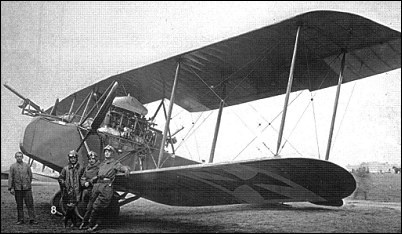
A development of the AEG G.I and powered by 112kW Benz Bz.III engines, the G.II of mid-1915 was a slightly larger version of the G.I, armed with up to three machine-guns and 200kg of bombs. A number of these aircraft had at various stages, single or triple vertical tail surface on each side of the fin and rudder. About 15 G.Is were built before the type was superceeded by the G.III.
Engines: 2 x Benz Bz.III, 150 hp. Crew: 3 Armament: 3 x 7.92mm mg Bomb load: 441 lb / 200 kg
Eight-seat piston-engined Explorer 350 and ten-seat turboprop-powered Explorer 500 light aircraft, for delivery from the year 2001 (first flown January 1998).
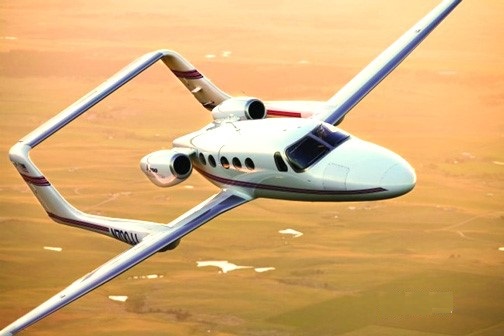
Derived from the A500, the A700 twin-jet (two Williams FJ33, 1700 lb) began testing on 27 July 2003. The Adam 700 flew into AirVenture on a Thursday in 2003 after only a few test flights. The pilot never retracted the gear in flight from Denver to Oshkosh. The airfoil is the NASA LS(1)-0417 from root to tip.
The Model 309 was a Proof-of-Concept aircraft built for Adam Aircraft Industries of Denver, Colorado, by Scaled Composites. To provide a safe twin-engine aircraft, the centerline thrust configuration was chosen and the cabin was designed to carry a pilot and five passengers in pressurized comfort with an unpressurized baggage space in the nose, and the remainder of baggage stowed in the cabin aft of the rear seats. The tricycle landing gear was retractable with the trailing-link mains folding into the booms.
The outboard wings, horizontal tail, elevator, rudders and flaperons had no secondary bonds in their primary structure being produced as single cure parts. This allowed lighter, stronger and safer structure due to the significant elimination of fasteners and secondary bonds.
Conceptual design started in May of 1999, the first tool was cut late in August, and the first flight was on March 21, 2000. The aircraft was unveiled to a small group of guests on April 5, 2000. After a flight test and refinement program, the aircraft was delivered to Adam.
Adam M-309 N309A
The M309 can now be viewed on display at the Wings Over the Rockies Air and Space Museum.
Engines: 2 x Continental TSIO-550-G Wingspan: 42’0″ Length: 34’6″ Useful load: 2300 lb Max speed: 288 mph Cruise speed: 253 mph Ceiling: 25,000 ft Seats: 6
The Air Craft Marine Engineering Co was a four place cabin, mid-wing monoplane amphibian twin-jet prototype fighter was reported under construction in 1958, but never completed. Assigned RS-695B project number by the Army Air Forces Air Materiel Command. “Anser” was acronymic for “Analytical Service Inc,” involved in the project to an unknown degree. The COIN fighter selected at the time was North American OV-10A.
Air Craft Marine Engineering Company, formed in Los Angeles, California, in September 1954 to build a prototype of the Anser four-seat twin-jet amphibian.
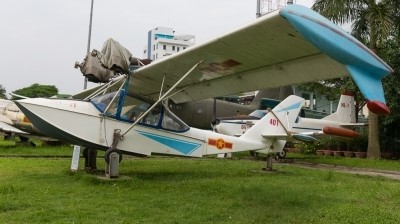
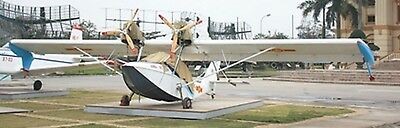
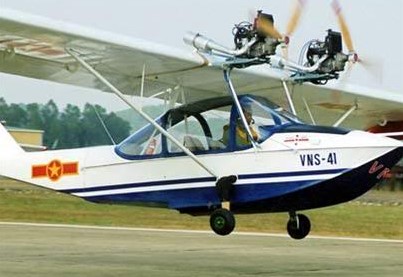
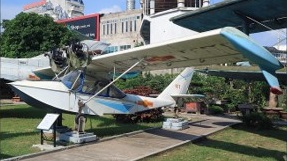
The VNS-41 is the first amphibious microlight aircraft made in Vietnam. The A41 Factory (officially Aircraft Repair Company A-41) under the Air Force and Air Defense Department (Ministry of Defense) manufactured the aircraft based on the Russian Che-22 Korvet design by Boris Chernov and E.Yungerov. A Che-22 was acquired by Vietnam in the late 1990s from the Philippines. Technicians began developing the VNS-41 in June 2003. Its entire hull, tail and middle wing are made of high-quality composite materials. The proportion of locally-made parts in the hydroplanes is 70 percent.
On September 12, 2005, the prototype took off for its testing before being produced for the market. The selling price was to be less than 2 billion Vietnamese dong (some 126,000 US dollar) per unit.
The A41 Factory under the Air force and Air Defense Department has just produced three hydroplanes. The VNS-41 was to be initially be used in forestry (forest patrol) and agriculture but will also be marketed for sport, travel and commercial applications. The first amphibious microlight aircraft made in Vietnam is preserved at the “Bao Tang Phong Khong – Khong Quan”, the Vietnam Air Force Museum.
Engines: 2 x Rotax 582, 65 hp Wingspan: 11.65 m (38 ft 3 in) Length: 6.98 m (22 ft 11 in) Height: 2.535 m (8 ft 3.8 in) MTOW: 780 kg (1,720 lb) Fuel capacity: 80-litre (21-gallon) Speed: 120–135 km/h (75–84 mph) Endurance: 4 hr Max range: 300 km (190 mi) Ceiling: 3,000 m (9,800 ft) TO run land: 50–70 m (160–230 ft) TO run water: 200–300 m (660–980 ft) Fuel burn: 38-44 lt/hr Seats: 2-3
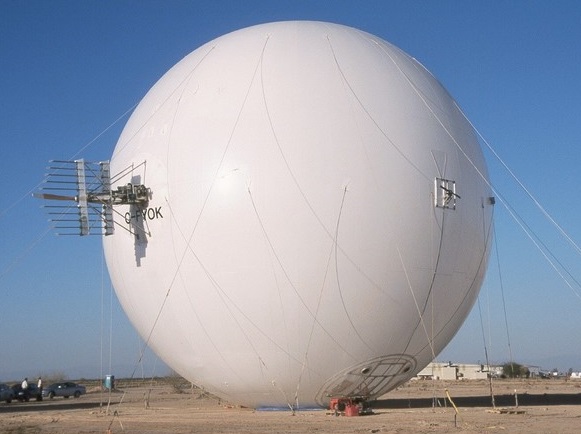
The semi-rigid helium SPAS 13 was a development of the earlier SPAS 1 and was designed to demonstrate the advantages of a spherical airship. The 43 ft (13.11 m) diameter spherical envelope is made of Spectra fabric with an inner helium containing envelope of Mylar film reinforced with Kevlar. The two-seat cockpit is internal to the envelope with panoramic windows in the envelope to provide an external view.
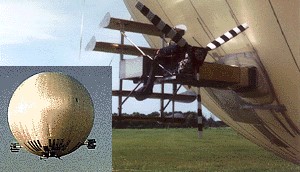
The SPAS 13 is powered by two 50 hp (37 kW) Rotax 503 piston engines on external struts, four vanes behind each engine are used to provide control by deflecting the thrust.
The first flight was on 13 May 1994.
Engines: 2 × Rotax 503, 50 hp (37 kW) each Propellers: 3-bladed, 6 ft 0 in (1.83 m) diameter Diameter: 43 ft 0 in (13.11 m) Height: 45 ft 0 in (13.72 m) includes landing gear Empty weight: 1,596 lb (724 kg) Max takeoff weight: 2,403 lb (1,090 kg) Maximum speed: 30 mph; 48 km/h (26 kn) Cruise speed: 19 mph; 31 km/h (16.5 kn) Crew: 1 pilot Capacity: 1 passenger
A manned prototype, the SPAS-4 demonstrator (C-FRLM, named ‘Face’) has a volume of 41,500 cu.ft. (1,180 cu.m.). It is a 43′ (13.1 m.) diameter sphere and seats the pilot and one passenger. The SPAS-4 airship is powered by two 50 hp. engines.