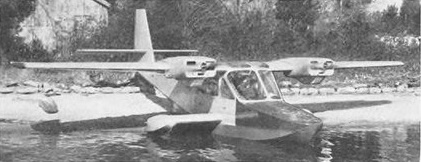
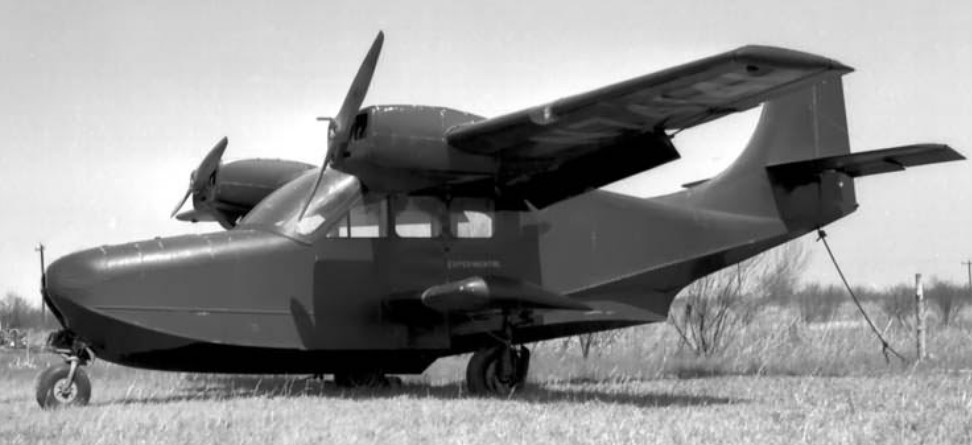
The Aqua was an original design developed by Aquaflight, Inc, a company founded in 1946 by Meredith C. Wardle. The type was only produced in prototype form and possibly the prototype was flown in two versions.
The W-6 Aqua I was the first version, a 4-6 seat utility flying boat which had two 125 hp Lycoming O-290-A series engines. Registered NX74141 it made the first flight during 1946 and was extensively tested at the Philadelphia Seaplane Base. Aqua I had an all metal fuselage, with a wooden hull and had a claimed cruise of 125 mph.
The W-6A Aqua II was possibly modified from the Aqua I, and had several major changes such as re-contoured nose section, a modified vertical tail and fin assembly and a tricycle landing gear, making it an amphibious flying boat. The Aqua II was powered by two 225 hp Lycoming O-435 engines and it made the first flight in 1949. No further work on either the Aqua I or II was undertaken.
Reports that later the boat hull of the Aqua II was used in the homebuilt Collins W-7 Dipper are incorrect.
The Aqua II was tested as landplane also.
W-6A Aqua II
W-6 Aqua I Engines: 2 x Lycoming O-290, 125 hp (93 kW) Wingspan: 36 ft 6 in (11.13 m) Wing area: 215 sq ft (20.0 m2) Airfoil: NACA 23012-16 Height (on land): 12 ft 0 in (3.66 m) Length: 29 ft 6 in (8.99 m) Empty weight: 2,200 lb (998 kg) Gross weight: 3,600 lb (1,633 kg) Fuel capacity: 100 US gal (83 imp gal; 380 L) Max speed: 135 mph (217 kmh) Cruise speed: 125 mph (201 km/h, 109 kn) Stall speed: 40 mph (64 km/h, 35 kn) (half load) Rate of climb: 1,250 ft/min (6.4 m/s) Crew: one pilot Capacity: 5 passengers
W-6A Aqua II Engines: 2 x Lycoming O-360, 125 hp (93 kW)
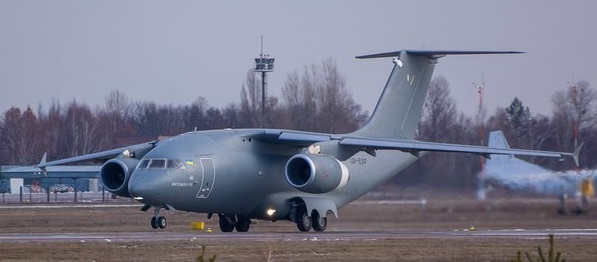
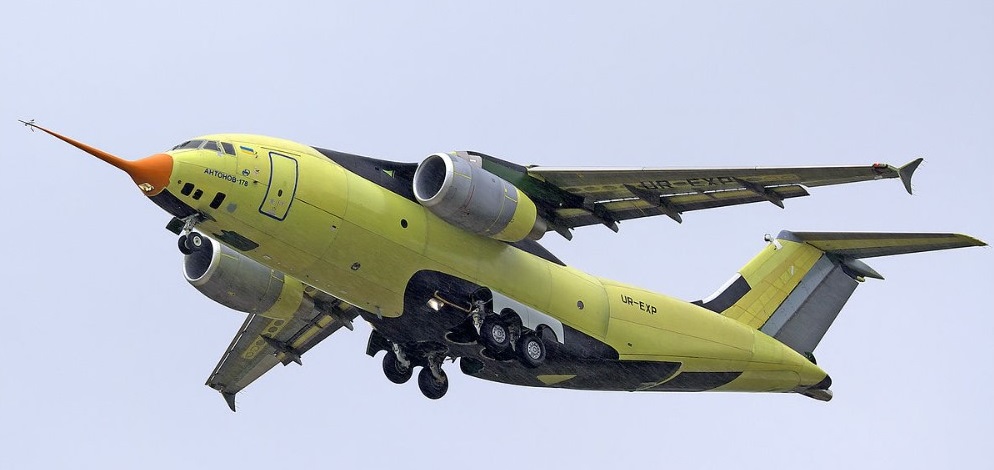
The Antonov An-178 (Ukrainian: Антонов Ан-178) is a short-range medium-airlift military transport aircraft designed by the Ukrainian Antonov company and based on the Antonov An-158 (An-148-200).
An-178 is a high-wing transport aircraft with moderately swept wing, winglets and a T-tail. The wing outer panels (including winglets), front fuselage with cockpit and nosewheel leg come from the An-158. The cargo hold is slightly enlarged, and there is an extra pair of main-wheels on each side. The airframe is made of aluminium alloys and composite materials. The fuselage is semi-monocoque with a circular cross-section. The retractable landing gear consists of two main wheel bogies and a dual nose wheel. The flight control system is dual duplex fly-by-wire system, consisting of two parts: FCS-A and FCS-B, each of which is responsible for two control channels. The flight control surfaces include ailerons near the wing tips, four control spoilers, six lift-dump/speed-brake spoilers, rudder and elevators, with an emergency mechanical cable back-up system. The powerplant consists of two Progress D-436-148FM turbofan engines, mounted on pylons under the wings and an auxiliary power unit. It can shift 18 tonnes over 1,000 km, or 10 tonnes over 4,000 km.
The aircraft was derived from the 99-seat An-158 regional airliner and was fitted with the commonized F1 fuselage nose section with the identical flight deck, wing panels, empennage and most of the onboard systems. The fuselage however was newly created with an enlarged diameter that had grown from 3.35 m to 3.9 m, which has resulted in an enlarged cargo hold – the cargo cabin cross section increased to 2.75 m by 2.75 m. Aside from the wing structure, outer panels (including winglets), front fuselage nose, cockpit and nose landing gear which come from the An-158, there is an extra pair of tandem main-wheels on each side.
The An-178 was previously known as the An-148T. The aircraft made its Western debut at the 2015 Paris Air Show.
It was announced on 5 February 2010, rolled out on 16 April 2015 and the maiden flight was on 7 May 2015.
There are reports that future production-standard aircraft will have a longer wingspan while retaining the organic wing panels of the An-158. Its maximal take-off weight would increase to an estimated 56 tons. Later production variants would need turbofan engines with a thrust of about 9,500 kgf to have the characteristics required. The planned engine may be the new-generation in-development Ivchenko-Progress AI-28 turbofan. The decision was made to fit the An-178 prototype with less powerful D-436-148FM engines in the interim. The D-436-148FM is a derivative of the production-standard D-436-148 with an upgraded fan, which boosted the takeoff thrust to 7,800 kgf and at emergency power rating to 8,580 kgf.
Powerplant: 2 × Progress D-436-148FM Turbofan, 73.55 kN (16,534 lbf) Wingspan: 30.57 m (100 ft 4 in) Length: 32.23 m (105 ft 9 in) Height: 9.57 m (31 ft 5 in) Max takeoff weight: 51,000 kg (112,436 lb) Fuel capacity: 14,650 kg (32,298 lb) Max landing weight: 47,000 kg (103,617 lb) Maximum speed: 990 km/h (620 mph, 530 kn) Cruise speed: 825 km/h (513 mph, 445 kn) Range: 4,700 km (2,900 mi, 2,500 nmi) Ferry range: 5,300 km (3,300 mi, 2,900 nmi) Service ceiling: 12,000 m (39,000 ft) Landing distance: 2,500 m (8,200 ft) Crew: 2 Capacity: 90 soldiers, 70 paratroopers, 48 on stretchers +15 seated, 8 medical modules and 12, or 16 tons of cargo, overload variant 18 tons.
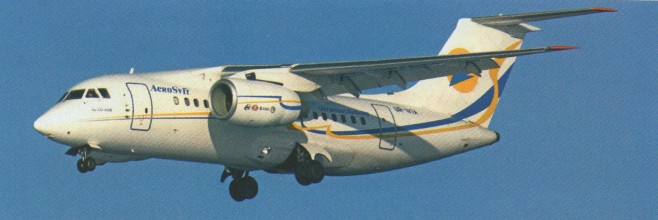
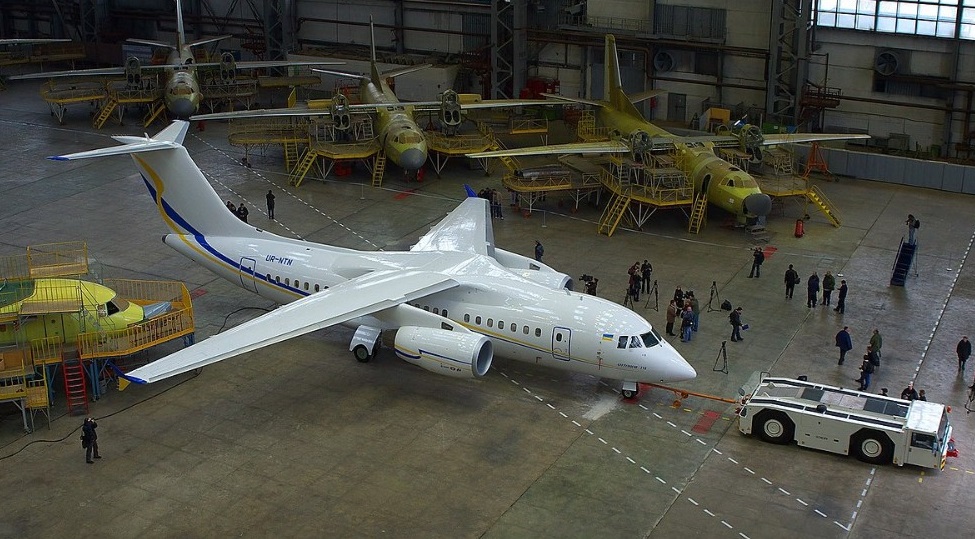
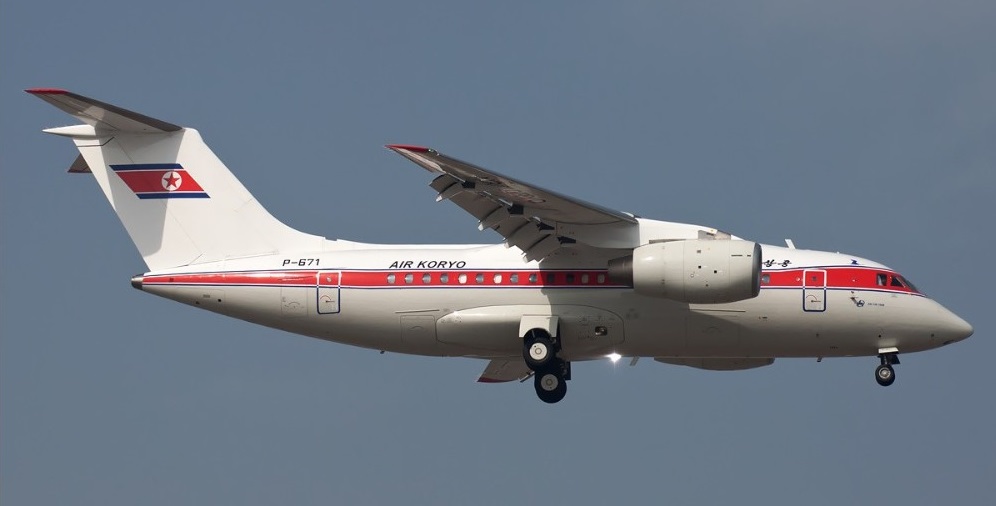
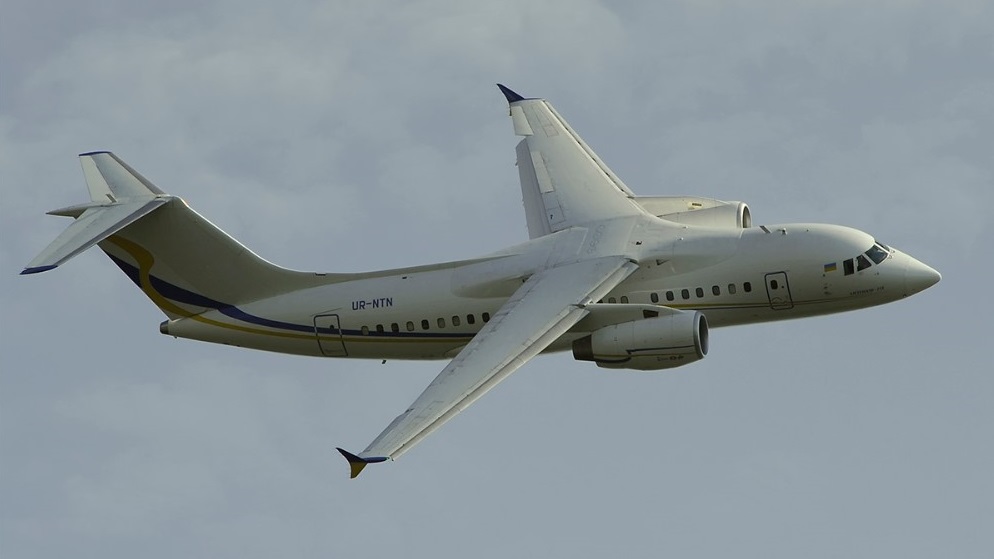
The Antonov An-148 (Ukrainian: Антонов Ан-148) is a regional jet designed and built by Antonov of Ukraine.
The beginning of the An-148 project dates to the early 1990s, when work on the Antonov An-74 passenger modification started, headed by Petro Balabuev. In 2001, the project was renamed An-148. The An-74 fuselage was extended and the new aircraft’s wing design was created from scratch. The developers initially used Motor Sich D-436-148 engines.
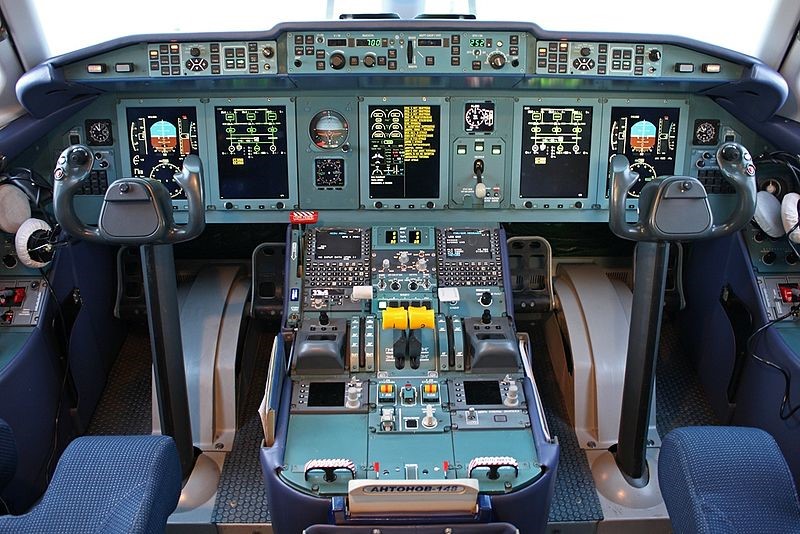
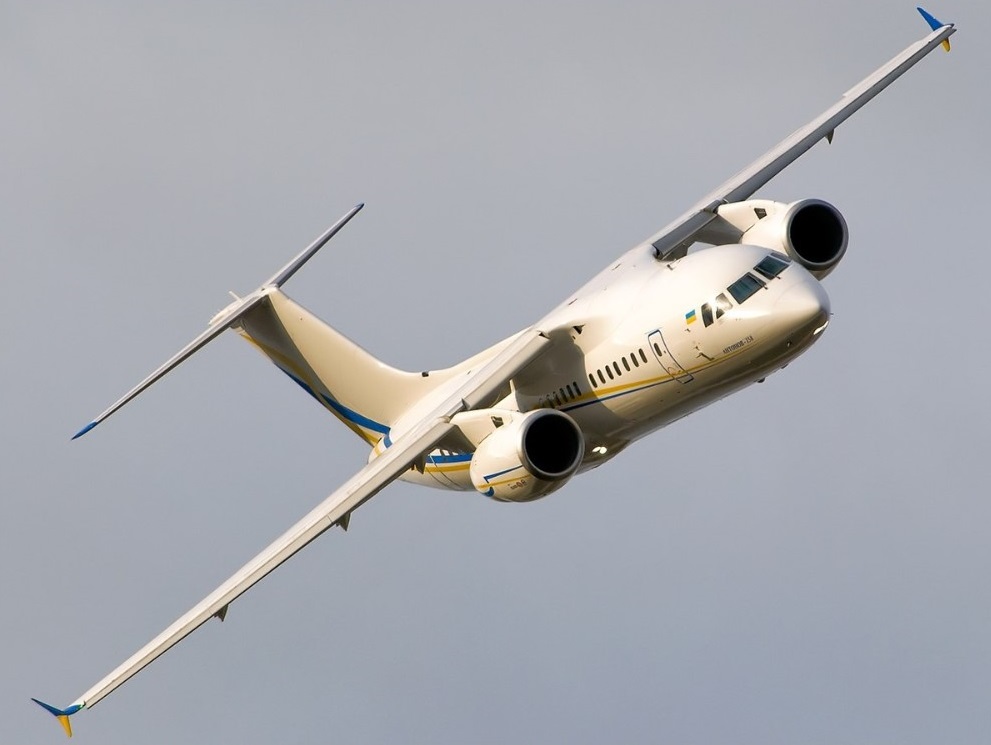
The An-148 aircraft is a high-wing monoplane with two turbofan jet engines mounted in pods under the wing. This arrangement protects the engines and wing structure against foreign object damage. A built-in autodiagnosis system, auxiliary power unit, and the wing configuration allow the An-148 to be used at poorly equipped airfields. Flight and navigation equipment features five 15 by 20 cm (5.9 by 7.9 in) liquid crystal display panels built by Russia’s Aviapribor and a fly-by-wire system.
The main landing gear rotates into the belly of the aircraft when in flight, with partial doors covering the legs, and the sides of the tires remaining exposed. Built-in entrance stairs enable boarding and disembarking the aircraft without extra ground equipment.
The An-148-100 regional aircraft is the main model of the An-148. It seats 70 passengers at 864 mm (34.0 in) or up to 80 passengers at 762 mm (30.0 in) pitch in a one-class 2+3 seating layout. The aircraft is also configurable in a multiple-class layout which can carry fewer passengers, typically with four abreast business class.
In 2002, production of the first three prototypes was begun at AVIANT. On 17 December 2004, the first prototype completed its maiden flight. The second prototype joined the testing programme in April 2005. During the certification programme, the two prototypes performed about 600 flights in total. On 26 February 2007, the aircraft, its D-436-148 engine and the AI-450-МS auxiliary power unit were certified by the Interstate Aviation Committee of Russia and the State Aviation Administration of Ukraine.
The first prototype. It made its maiden flight on 17 December 2004.
The aircraft completed its certification programme on 26 February 2007. The An-148 has a maximum range of 2,100–4,400 km (1,100–2,400 nmi; 1,300–2,700 mi) and is able to carry 68–85 passengers, depending on the configuration.
The An-148 was manufactured by the Ukrainian Kyiv AVIANT plant (now Antonov Serial Production Plant) and Russia’s Voronezh Aircraft Production Association (VASO). On 28 June 2009, the first serially produced An-148, manufactured at VASO in Voronezh, took to the skies. Although numerous companies are involved in the project, at least 70% of the aircraft’s hardware is made by Russian manufacturers. The An-148’s list price is about $24–30 million. The main problem with the project has been increasing the aircraft’s sluggish production rate. The then-independent AVIANT plant initially failed to satisfy to growing orders, leading to VASO’s growing involvement in the aircraft’s assembly. VASO announced in June 2017 that the two final Russian-assembled An-148s would be delivered, and the project would not see further development.
In April 2005, the Ilyushin Finance Leasing Company ordered the first series of An-148 for the Krasair airline. Lease agreement calls for ten aircraft with an option for five units valued at $270 million.
The Antonov An-158 is a stretched fuselage version of the aircraft, accommodating up to 100 passengers.
An-158
The An-158 is a 1.7m stretched fuselage version for 99 passengers in a one-class standard configuration. Other changes include the installation of wingtip fences. The airplane successfully completed its first flight on 28 April 2010, with flight certification tests were planned to be completed before the end of 2010; on 3 March 2011, it was given Russian certification.
After flight and land test in night lands airports of Ecuador (Latacunga / Cotopaxi International Airport, 2806 m AMSL) and Bolivia (La Paz / El Alto International Airport, 4061 m AMSL) in November 2013 prepare documentation for obtaining correspondent supplements to the type certificate of this airplane.
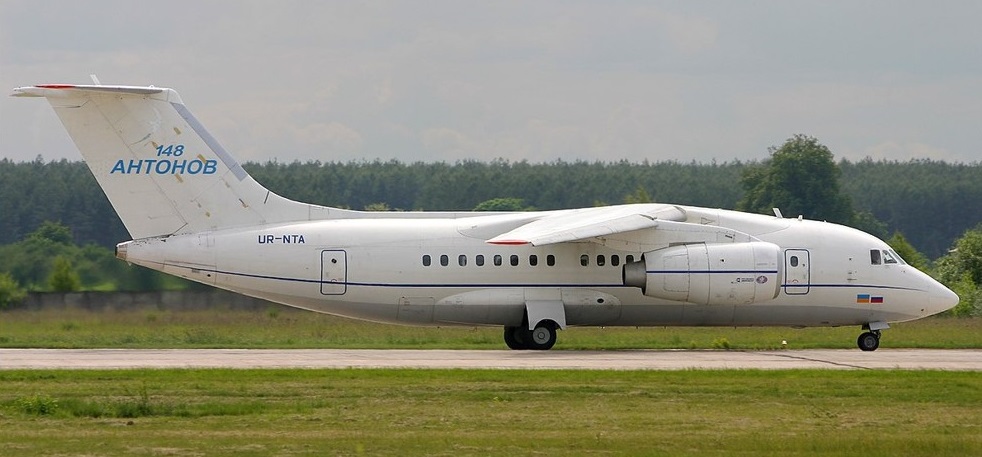
On 2 June 2009, the first An-148 entered commercial service with the Ukrainian carrier Aerosvit. The first passenger flight was from Kharkiv to Kyiv; the aircraft had the civilian registration UR-NTA. By November 2009, Aerosvit was operating the An-148 on the Kyiv–Odessa and Simferopol–Lviv routes, performing two flights a day with the average flight time of 4–5 hours.
On 21 December 2009, the An-148 was put into service in Russia with Rossiya airline. The first passenger flight was FV135 from Pulkovo Airport in Saint Petersburg to Sheremetyevo International Airport in Moscow. By 20 May 2010, Rossiya’s An-148 fleet had accumulated a total of 915 flight hours and performed 710 landings. Rossiya complained that the aircraft experienced some reliability problems. There were some technical problems with the aircraft, and pilot training could not be ramped up fast enough, leading to pilot shortages. However, by 2011 the situation had improved.
On 15 February 2010, the An-148 started international flights to the European Union (Poland) with the Aerosvit airline.
The first An-158 in April 2010
On 18 April 2013, the first serial An-158 version was delivered to the Cuban flagship airline Cubana de Aviación. According to Antonov, Cubana additionally ordered two more aircraft, while other sources report this order to be for ten aircraft. On 28 April 2013, Ukraine’s Antonov aircraft maker handed over a third An-158 passenger airliner to Cuba and signed a contract for the delivery of three more.
Following a crash in February 2018, all An-148 and An-158 in Russia were grounded by the Russian Ministry of Transport. In addition, Cubana grounded its An-158 fleet as of May 2018 due to several technical issues with the aircraft. Until late 2018, the Antonov An-148 aircraft was also being produced in Russia by Voronezh Aircraft Production Association; however, due to the souring political relationship between Ukraine and Russia, production in Russia was discontinued. The last Russian-built An-148 was completed in October 2018.
In April 2016, Indian company Reliance defense limited and Antonov entered into an agreement to construct an aircraft based on An 148/ An 158 for defense and commercial purposes.
In April 2017, Cubana de Aviación suspended its flights between Havana and Guantánamo due to “technical problems” with its An-158 fleet. The route from Havana to Holguín also had problems: of 116 planned flights in the first months of 2017, 38 were cancelled and 36 suffered significant delays. Yoanka Acosta, head of Cubana’s commercial division, explained that the planes were leased from Ukraine but spare parts were sourced from Russia, so the state of conflict between the two countries had affected the supply of parts, making maintenance difficult. In late April, however, representatives from Antonov and Cubana met and signed a service agreement that extended the aircraft’s navigation directives to 3,600 flights and guaranteed the supply of spare parts, although it did not specify a date for normalization.
In March 2018 Rostransnadzor suspended all flights of An-148 in Russia after crash on 11 February 2018.
In May 2018, Cubana de Aviación grounded its An-158 fleet after it received an order from the Cuban National Aviation Authority. The official reason given by the Cuban National Aviation Authority was “multiple and repeating failures have been found in complex systems, built by mechanical, hydraulic and electrical components, as well as computer performance algorithms”, in addition to “evidence of design and manufacturing flaws, serious issues in flight control system, cracks in the structure and engine temperature increase above normal parameters”.
On 5 March 2011, an Antonov An-148 (assembled by VASO) carrying test registration 61708 crashed during a test flight in Russia’s Belgorod Oblast after an inflight breakup, killing all six crew members on board. An investigation commission found that the crew permitted the aircraft to accelerate more than 60 knots above its “Never Exceed” speed in an emergency descent, which led to the inflight breakup. Witnesses on the ground reported a wing had separated from the aircraft in flight. The aircraft was due to be delivered to Myanmar.
On 11 February 2018, an Antonov An-148 operating as Saratov Airlines Flight 703, crashed shortly after takeoff near Ramenskoye, outside of Moscow. The aircraft was carrying 65 passengers and six crew members. There were no survivors. This is the first fatal commercial accident for this aircraft type.
At least 47 were built.
An-148-100B
An-158
Versions
An-148-100A main version of the An-148. It has a passenger capacity of 85 in a one-class dense configuration or 68 in a two-class configuration, and a range of 2,100 km (1,100 nmi; 1,300 mi)
An-148-100B extended-range version, up to 3,500 km (1,900 nmi; 2,200 mi)
An-148-100E extended-range version, up to 4,400 km (2,400 nmi; 2,700 mi) and a maximum takeoff weight (MTOW) of 43.7 t (43,700 kg; 96,000 lb)
An-148-200 unified with An-158 by the rear part of the fuselage. Hence maximum seating capacity is increased to 89 passengers in dense configuration, comparing to 85 for An-148-100. Planned for production in Kyiv with An-158.
An-148-300 previously called An-168, business variant, seating 8-40 passengers, with a range up to 7,000 km (3,800 nmi; 4,300 mi)
Specifications:
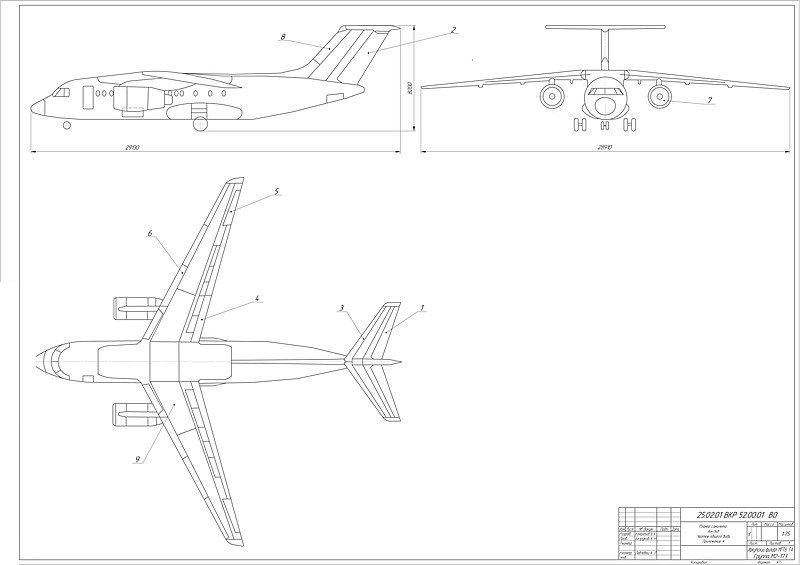
148-100E Engines: 2 x Progress D-436-148, 14,000 lbf; 63 kN Wingspan: 28.91 m (94 ft 10 in) Wing area: 87.32 m2 (939.9 sq ft) Length: 29.13 m (95 ft 7 in) Height: 8.19 m (26 ft 10 in) MTOW: 43,700 kg (96,300 lb) Max. payload: 9,000 kg (20,000 lb) OEW: 22,000 kg (49,000 lb) Max. fuel: 12,050 kg (26,570 lb) Ceiling: 12,200 m (40,000 ft) Cruise: 800 to 870 km/h (430 to 470 kn) Range (75 pax/max): 4,400 km (2,400 nmi) Fuel burn: 1,650 kg/h (3,600 lb/h) Take off run (MTOW): 1,885 m (6,184 ft) Seats: 68–85 Seat pitch: 30–35 in Cargo: 14.60 m3 (516 cu ft) Cabin: 3.15 m (10 ft 4 in) width × 2.00 m (6 ft 7 in) height Cockpit crew: 2
An-158 Engines: 2 x Progress D-436, 15,100 lbf; 67.0 kN Wingspan: 28.91 m (94 ft 10 in) Wing area: 87.32 m2 (939.9 sq ft) Length: 30.83 m (101 ft 2 in) Height: 8.19 m (26 ft 10 in) MTOW: 43,700 kg (96,300 lb) Max. payload: 5,000 kg (11,000 lb) OEW: 22,000 kg (49,000 lb) Max. fuel: 12,050 kg (26,570 lb) Ceiling: 12,200 m (40,000 ft) Cruise: 800 to 870 km/h (430 to 470 kn) Range (75 pax/max): 2,500 km (1,300 nmi) Fuel burn: 1,800 kg/h (4,000 lb/h) Take off run (MTOW): 1,900 m (6,200 ft) Cockpit crew: 2 Seats: 86–99 Seat pitch: 30–34 in Cabin: 3.15 m (10 ft 4 in) width × 2.00 m (6 ft 7 in) height
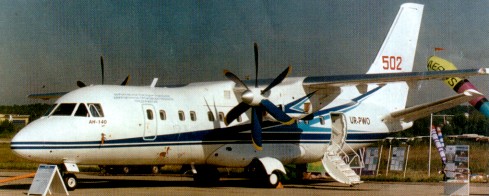
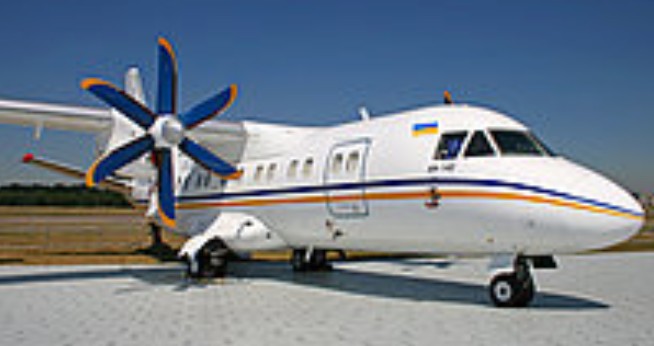
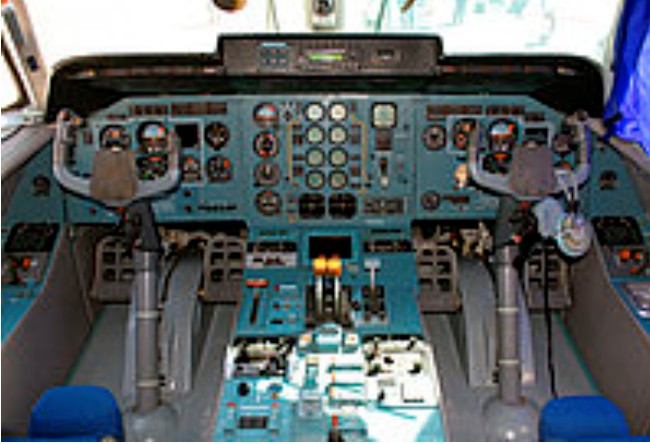
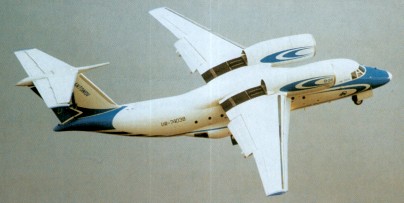
The An-140 (first flown September 1997) short-haul regional airliner was planned to supersede the An-24. An agreement for licence production by Iranian Aviation called ‘Iran-140’ was signed in 1993. The first aircraft, supplied as a kit, flew on 7 February 2001.
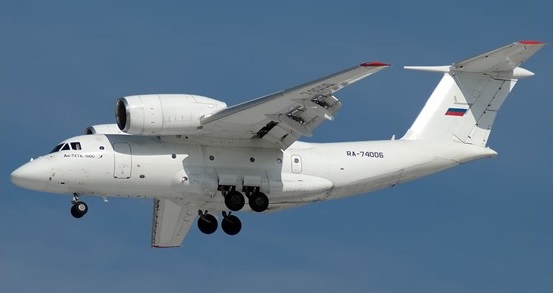
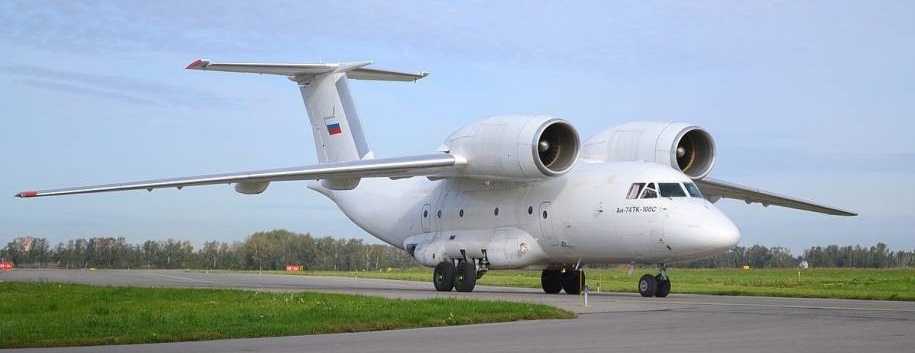
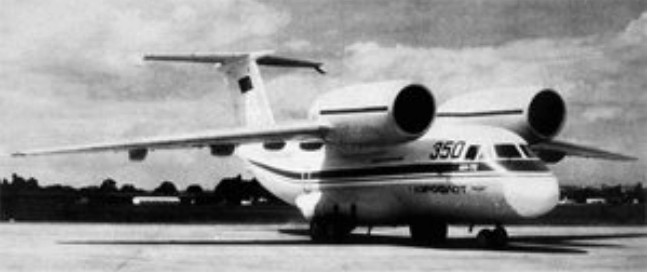
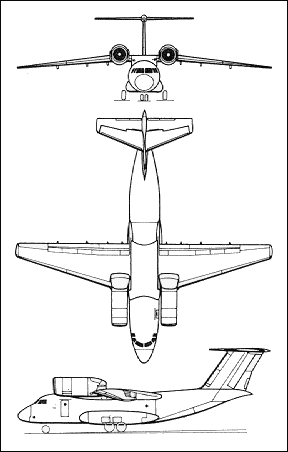
Flight testing of an An-74 develop¬ment of the An-72 Coaler twin-turbofan Stol transport was announced early in February 1984. The An-74 has been developed specifically for use in the Arctic and Antarctic, and may be equipped with an interchangeable landing gear, with skis available for operations from ice and snow. Principal differences apparent in the An-74 are a longer fuselage with a nose-mounted radar, and a redesigned wing. First flown in 1977, the An-72, and the related An-74, only received its airworthiness certificate when the An-74TK was certified by Aeronautical Register on 2 August 1991. The An-74 was also produced at Kharkov from December 1989.
Antonov An-74TK-100C RA-74006
Production of An-74 also started by Polyot Industrial Association at Omsk, Russia, in 1993 (assisted by Progress at Arsenyev); first Polyot aircraft (RA-74050) was flown 25 December 1993.
An An-72P maritime patrol version was demonstrated 1992 and development of the An-74-200 and An-74TK-200 by Antonov started 1995. The An-74TK-300 is basically an An-74TK-200 with underslung engines. The An-88 is a tactical battlefield surveillance aircraft based on An-72 (also known as An-72R).
An-74 Coaler Engine: 2 x Lotarev D-36 turbofan. Installed thrust: 127.4 kN. Span: 31.9 m. Length: 28.7 m. MTOW: 34,500 kg. Payload: 10,000 kg. Cruise speed: 550 kph. Ceiling: 10,500 m. T/O run: 470 m. Range/payload: 3300 km with 5000 kg.
Originating as private venture military transport based on stillborn An-60 64-73 seat civil airliner designed to meet 1967 specification, the revised design, following issue of military requirement in 1968, included relocation of engines above wings.
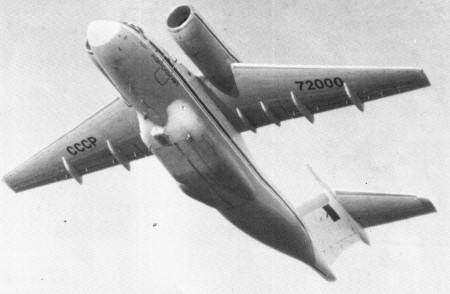
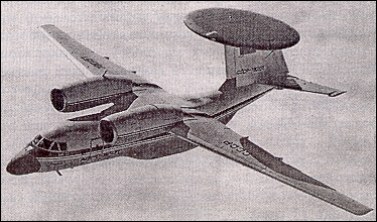
Two static test airframes, and two prototype An-72 were built at Kiev. The first (SSSR-197744) flew on 31 August 1977. Intended to replace the turboprop powered An 26 in Aeroflot service, its high lift devices and multi wheel landing gear make it suitable for operation from unprepared airfields with snow or ice covering and accommodate about 52 passengers. Overwing engines exhaust over the wing and trailing edge devices, to increase lift at low airspeeds. The NATO named Coaler is designed for rough-field operations and has a rear cargo door/ramp. A production order was placed in December 1980 for an improved An-72A version, when manufacture was transferred to Kharkov, Ukraine, where first production An-72 flew 22 December 1985. The An-72, and the related An-74, only received its airworthiness certificate in 1991. By mid-1992, about 50 were in industrial service, although none with Aeroflot. The An-72 platform went on to spawn other variants that included maritime surveillance An-72P model, the An-71 “Madcap” AEW model and the An-74 “improved Coaler” upgraded engines and a conventional engine mounting. The An-72P armed surveillance and maritime patrol aircraft was developed in conjunction with Israeli Aircraft Industries and featured revised cockpit glass design, specialized Elta radar, electronic warfare systems and long range day/night observation equipment and systems.
The An-74 is a civil development of the An-72.
Engine: 2 x turbo-jet Lotarev D-30, 62.8kN Length: 26.6 m / 87 ft 3 in Height: 8.2 m / 26 ft 11 in Take-off weight: 26500-30500 kg / 58423 – 67241 lb MTOW increased: 72,751 lb (33 000 kg) Max useful load: 22,046 lb (10 000 kg) Wingspan: 25.8 m / 84 ft 8 in Cruise speed: 720 km/h / 447 mph Ceiling: 11000 m / 36100 ft Range w/max.fuel: 3200 km / 1988 miles Range w/max.payload: 1000 km / 621 miles Range 16,534 lb (7500 kg) useful load: 1,243 mls (2000 km) Crew: 2-3 Passengers: 32
An-72 (Coaler-C) Engines: 2 x Lotarev D-36 turbofan, 14,330lbs thrust Length: 94.16ft (28.7m) Wingspan: 104.66ft (31.90m) Height: 28.38ft (8.65m) Empty Weight:41,998lbs (19,050kg) Maximum Take-Off Weight:76,059lbs (34,500kg) Maximum Speed: 438mph (705kmh; 381kts) Maximum Range: 497miles (800km) Service Ceiling: 125,246ft (38,175m)
An-72P Armament: 1 x 23mm gun pod, 2 x UB-23M rocket launcher system 4 x 220lb internally-held bombs Accommodation: 3
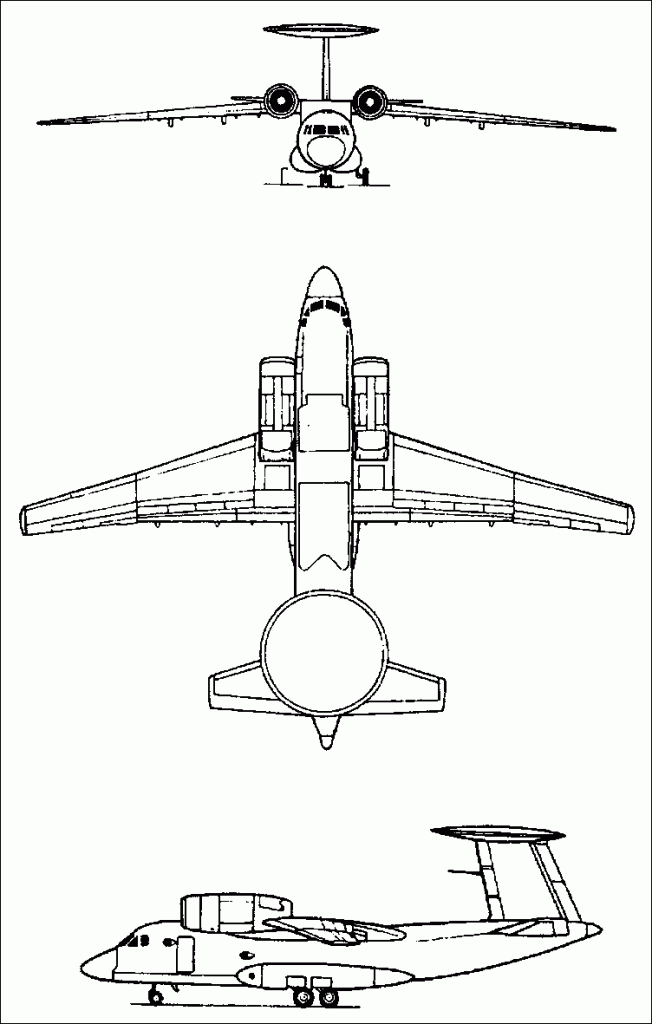
An AEW plane based on An-72 transport plane, the first prototype flew on July 12, 1985. A small tactical airborne early warning and control aircraft with rotating radome above tailfin, the program was canceled with no production orders. NATO reporting name ‘Madcap’.
An-71 Engine: 2 x D-436K turbofans, 7500kg + 1 x RD-38A, 2900kg Wingspan: 31.89 m / 104 ft 8 in Length: 23.50 m / 77 ft 1 in Height: 9.20 m / 30 ft 2 in Max. Speed: 650 km/h / 404 mph Cruise Speed: 530 km/h / 329 mph Ceiling: 10800 m / 35450 ft Crew: 6
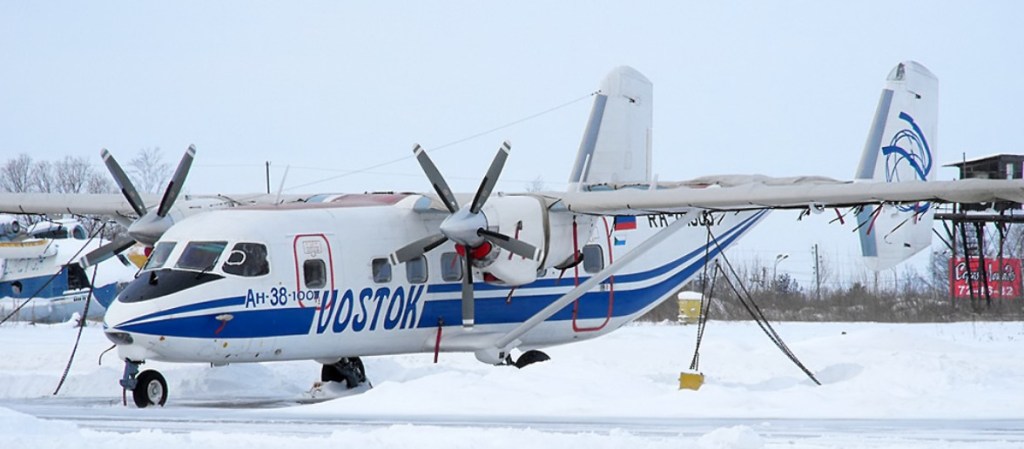
The Antonov An-38 is a stretched and upgraded version of Antonov’s earlier An-28. It is a twin-engined turboprop transport aircraft, designed by the Antonov Design Bureau in Kyiv, Ukraine. Production is in Novosibirsk, Russia, but some crucial parts are also made in Ukraine and Belarus. It first flew in 1994, and received international flight certification in April 2000. A total of 11 were built and 2 remain in airline service as of August 2019.
Impetus for a stretch of the Antonov An-28 design began with a 1989 sales tour in India, where it became clear that a significant market existed for an aircraft similar to the An-28, but with seating in the 25–30 seat range. The design was approved a year later, and was displayed at the 1991 Paris Air Show as a model.
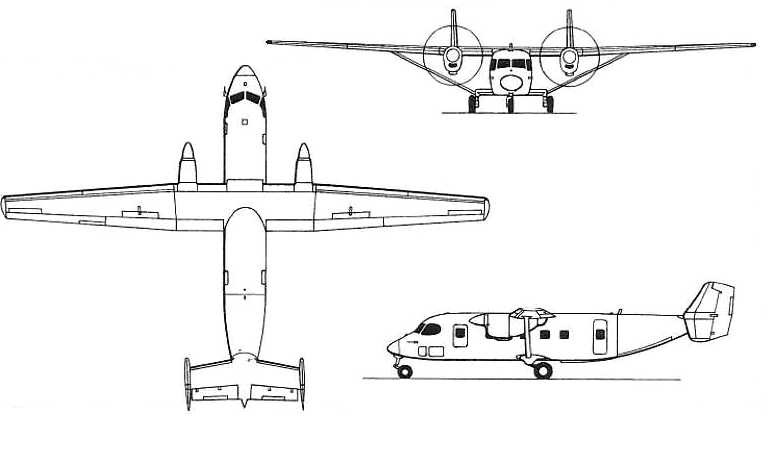
The An-38 is of a similar design to the older An-28, featuring the same wings and tail; but it has a longer fuselage and includes several enhancements, such as higher fuel efficiency, increased comfort (cabin and cockpit), and decreased internal noise, coupled with better sound insulation. Other improvements include an increase in passengers to 27, thanks to an increase in maximum payload to 2,500 kg (5,500 lbs), as well as a maximum speed of 405 km/h (250 mph). Its design also enables it to operate in adverse conditions—it is equipped with weather radar, sophisticated navigational systems, and low pressure tires that allow it to operate from primitive, unpaved and icy airfields. Furthermore, the aircraft is more resistant to stalling at high angles of attack and is stable and maneuverable with ice on the wing and tail assembly.
As of August 2019, 2 Antonov An-38 aircraft remain in airline service with ALROSA. Recent reviews suggest only one remains in service in 2021.
An-38-100 Powerplant: 2 × Honeywell TPE331-14GR-801E turboprop, 1,118 kW (1,499 hp) each Propellers: 5-bladed Hartzell Propeller HC-B5MA, 2.85 m (9 ft 4 in) diameter constant-speed fully-feathering reversible-pitch propellers (or 2x 1,029 kW (1,380 shp) Omsk MKB Mars TVD-20 turboprop engines driving AV-36 propellers) Wingspan: 22.06 m (72 ft 5 in) Length: 15.67 m (51 ft 5 in) Height: 4.6 m (15 ft 1 in) Airfoil: TsAGI R-II-14 (14%) Empty weight: 5,300 kg (11,684 lb) Max takeoff weight: 8,800 kg (19,401 lb) Fuel capacity: 2,210 kg (4,872 lb) Maximum speed: 405 km/h (252 mph, 219 kn) Cruise speed: 380 km/h (240 mph, 210 kn) at 4,200 m (13,800 ft) Range: 1,650 km (1,030 mi, 890 nmi) with 9 passengers + 45 minutes reserve 1,450 km (900 mi; 780 nmi) with 17 passengers + 45 minutes reserve 600 km (370 mi; 320 nmi) with 27 passengers + 45 minutes reserve Take-off run: 350 m (1,150 ft) Landing run: 270 m (890 ft) Balanced field length: 900 m (3,000 ft) Crew: 2 Capacity: 26-27 passengers / 2,500 kg (5,512 lb) max payload
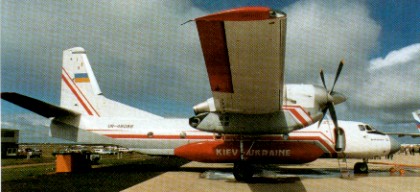
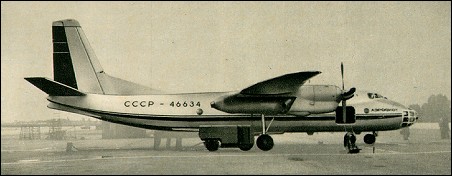
The An-24 was developed into the An-26 (freighter), the An-30 (survey/photo) and the An-32 (hot and high version). A short/medium-range twin-turboprop transport first flown July 1976, the An-32 has almost twice the installed power of the An-24.
Delivery of 95 An-32s to India, where it is known as the Sutlej, began in July 1984, to replace C-47 Dakotas and C-119 Packets. Peru became the third customer for the An-32, placing an order for 22 to replace its fleet of An-26s. Deliveries began with the first five aircraft in May 1987.
Engine: 2 x Ivchenko AI-20DM turboprop. Installed pwr: 7720 kW. Span: 29.2 m. Length: 23.7 m. Wing area: 75 sq.m. MTOW: 27,000 kg. Payload: 6700 kg. Cruise speed: 530 kph. Ceiling: 9000 m. T/O run: 760 m. Ldg run: 470 m. Fuel internal: 5500 lt. Range/payload: 800 km with 6700 kg. Capacity: 39 pax.
Engine: 2 x Iwtshenko AI-20M, 4133 shp Length: 78.084 ft / 23.8 m Height: 28.15 ft / 8.58 m Wingspan: 95.801 ft / 29.2 m Wing area: 807.3 sqft / 75.0 sq.m Max take off weight: 57330.0 lb / 26000.0 kg Cruising speed: 275 kts / 510 km/h Service ceiling: 31168 ft / 9500 m Wing load: 71.14 lb/sq.ft / 347.00 kg/sq.m Range: 1188 nm / 2200 km Range (max. weight): 432 nm / 800 km Crew: 5 Payload: 39 Pax
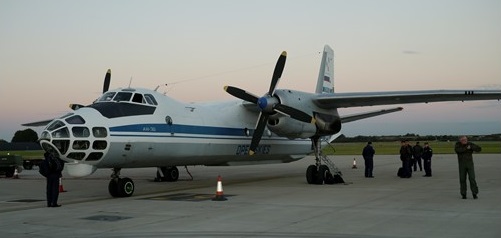
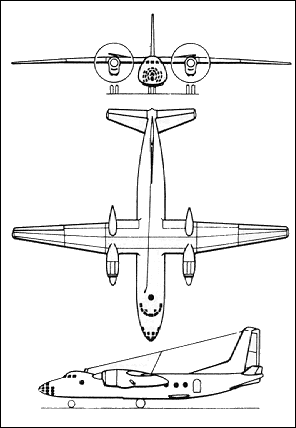
The Antonov An-24 was developed into the An-26 (freighter), the An-30 (survey/photo) and the An-32 (hot and high version). First flown 1974 with distinctive glazing around the nose, the An-30 Clank was built specifically for aerial survey work. The An-30 is essentially an Ant-24RT or an An-26 with mission related equipment fitted.
Aside from the dozen or so in service with Aeroflot, examples of the An-30 have been bought by Balkan Bulgarian Airlines, CAAC of China and the Romanian Air Force.
Engine: 2 x turbo prop AI-24VT, 2075 kW and turbo-jet RU-19A, 7.8kN Take-Off Weight: 23000 kg / 50707 lb Empty Weight: 15950 kg / 35164 lb Wingspan: 29.2 m / 95 ft 10 in Length: 24.3 m / 79 ft 9 in Height: 8.3 m / 27 ft 3 in Wing Area: 75.0 sq.m / 807.29 sq ft Max. Speed: 540 km/h / 336 mph Cruise Speed: 430 km/h / 267 mph Range: 2600 km / 1616 miles Crew: 6-7