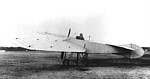
The 1913 Badaire monoplane was designed and built by Maurice Badaire in France.
The 1913 Badaire monoplane was designed and built by Maurice Badaire in France.
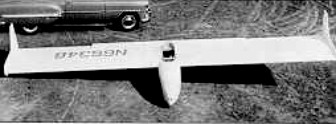
The Flying Plank was developed in 1954 by Al Backstrom, assisted by Phil Easley and Jack Powell. The prototype EPB-1 was used for drag reduction tests at the Mississippi State College, using a modified Abrial reflex airfoil.
Plans for the -1A development were sold and a number built, most with twin wingtip rudders, but some were completed with a central fin and rudder at the end of a lengthened fuselage (EPB1-C) to improve performance and control. Span have varied up to 9.30 m / 30.5 ft. A self-launching model was developed later.
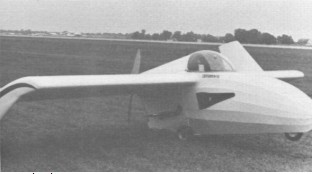
Except for the fiberglass nose cap for the fuselage, standard wood structure was used throughout, and construction time for an experience woodworker was in the neighborhood of 600 hours. More than 150 sets of plans were sold.

Construction of the powered Plank was begun in 1972, most of the work being done by Van White, a director of the EAA (Experimental Aircraft Association). It was intended originally to fit a Sachs Wanzel or OMC snowmobile Wankel engine, but as neither became available, a fan-cooled single-ignition Kiekhaefer Aeromarine 440 was installed, driving a two-bladed pusher propeller via belts.
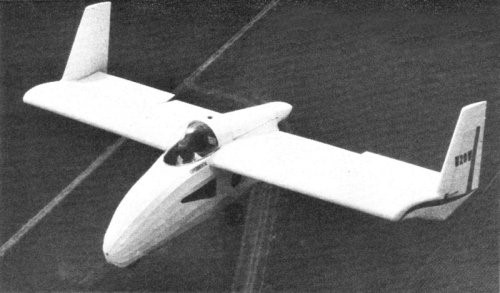
The original tandem-wheel/outrigger undercarriage was replaced by a more robust tricycle unit in 1976.
An improved version, the “Super Plank”, was under development in 1973. At least two of them were built, including N20WB, by Larry Linville and Dennis Harmon. Backstrom also built a motor glider light aircraft called WPB-1 Powered Plank in early 1970s.
The Backstrom WPB-1 is on display at the Airpower Museum in Blakesburg, IA. And the Vintage Sailplane Association has plans.
EPB-1A
Wing Span: 7.62m / 25ft
Wing Area: 9.29sq.m / 100sq.ft
Empty Weight: 68kg / 150lb
Payload: 91kg / 200lb
Gross Weight: 159kg / 350lb
Wing Load: 17.11kg/sq.m / 3.5lb/sq.ft
L/DMax: 20@ 97 kph / 52 kt / 60 mph
Seats: 1
MinSink: 1.07 m/s / 3.5 fps / 1.88 kt
Aspect ratio: 6.25
Airfoil: Abrial 15%
Structure: wood / fabric
WPB-1 N20WB
1975
Engine: 40hp Kiekhafer Aeromarine 440
Wingspan: 21’0″
Length: 11’0″
Useful load: 220 lb
Max speed: 106 mph
Stall: 55 mph
Seats: 1

The Bacon Super T-6 was a North American AT-6F Texan that was modified during the mid-1950s by the Erle L. Bacon Corporation in an attempt to interest foreign air forces in an upgrade for their T-6 fleets.
Produced in 1944 and operated by the United States Army Air Forces alongside its brethren, following the end of World War II AT-6F Texan 44-82028 was sold on the civilian market, operating in Iceland for a time before being acquired by Bacon for conversion.
Described as appearing “like an illicit hangar affair between a T-33 and a T-6”, the conversion consisted of adding the tip tanks ex-Cessna 310, canopy, and tricycle landing gear from a Lockheed T-33 Shooting Star; streamlining of the cowl and wings including jet stack exhaust, augmenter cooling, and a 4-foot (1.2 m) reduction in wingspan compared to the standard T-6; in addition, the cockpit was upgraded with a revised instrument panel and modernized avionics, and the aircraft’s brakes were upgraded.

Bacon hoped to sell the conversion to foreign air forces, many of which operated large fleets of T-6 aircraft; after taxi trials at the end of 1956, it first flew in April 1957, and flight testing was considered generally successful. No interest from its intended customers materialized and the aircraft was sold on the civilian market; it eventually received a paint scheme, believed to have been intended for a role in a movie, resembling that of a Russian fighter aircraft.

It was stored at Whiteman Air Park in California, and allowed to deteriorate in the elements, with its registration being cancelled in 2013.
Powerplant: 1 × Pratt & Whitney R-1340-AN-1 Wasp, 600 hp (450 kW)
Propeller: 2-bladed variable-pitch
Wingspan: 38 ft 6 in (11.73 m)
Length: 29 ft 6 in (8.99 m)
Height: 11 ft 8.5 in (3.569 m)
Fuel capacity: 100 US gal (83 imp gal; 379 L) in two tip tanks
Maximum speed: 225 mph (362 km/h, 196 kn)
Cruise speed: 215 mph (346 km/h, 187 kn) at 64% power
Rate of climb: 1,750 ft/min (8.9 m/s) at sea level
Crew: 2
Armament: .30-inch (7.6 mm) machine guns, underwing bomb racks or rocket launchers optional
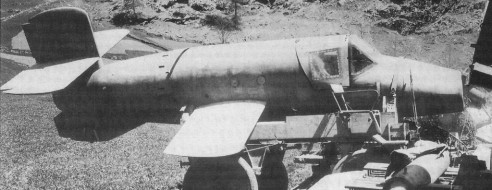
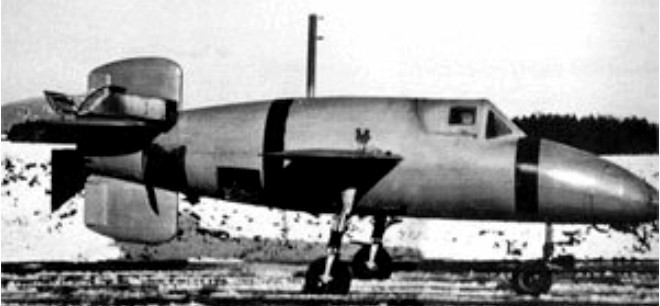
In August, 1944, that the idea of “Natter” (German for Viper) was conceived and four designers, Heinkel, Junkers, Messerschmitt and Bachem, were directed to submit plans. Diplomeur Ingenieur Erich Bachem who made his first appearance with his submission of the BP(Bachem Projekt)20 Natter (Adder). The BP-20 was envisioned as a small lightweight expendable interceptor, capable of destroying any enemy bomber using the least possible weapon expenditure. Dr. Bachem’s design was chosen and in November of that year Natter BP-20 was flown for the first time. Smaller than the Me-163 (span, 13 feet; length, 20 feet, 6 inches) and simpler to build (wooden airframe required only 600 man hours) it looks more like a mock-up than a full-fledged fighter. Because of the short take-off area required it was well suited to close defense of vital targets and pilots required very little training. Launched from a nearly vertical ramp, powered by a Walter rocket unit similar to that used in the Me-163, the initial rate of climb was calculated at 37,000 feet per minute, its top speed at more than 600 miles per hour. A controlled missile until within a mile of its target, the pilot then takes over, jettisons the nose cone exposing 24 Fohn 7.3 caliber rockets which are fired in one salvo. Protected by exceptionally heavy cockpit armor and presenting a small head-on target, the pilot is virtually invulnerable to enemy fire. His principal danger is in take-off and descent. Going into a dive after two minutes or less in the air he bails out and a section of the fuselage containing the rocket unit likewise descends by parachute. It was the first vertical-takeoff fighter ever built and certainly the first where the pilot was expected to bail out on every mission.

That project had its origin in a proposal in 1939 by rocket engineer Dr. Werner von Braun. This proposal was rejected as unworkable by the Reichluftfahrtministerium (RLM-German Air Ministry) but found an enthusiastic supporter in Bachem who tried, and failed, to generate interest in several different proposals for a rocket interceptor along the lines suggested by von Braun.
The airframe was comparatively crude, largely of wood construction and was to be built without the use of gluing presses or complex jigs. Most parts could be made in small woodworking shops through Germany, without interfering with the existing needs of the aircraft industry. According to Bachem, only 600 man-hours would be required for the production of one airframe, excluding the rocket motor, which was relatively simple to manufacture when compared to a sophisticated turbojet. This motor was the same basic engine used in the Me-163 Komet interceptor, a Walter 109-509A-1 that used the reaction between two chemicals, T-Stoff (a highly caustic solution of concentrated hydrogen peroxide and a stabilizer) and C-Stoff (a mixture of hydrazine hydrate, methanol alcohol, and water) to provide 3,740 lb (1,700 kg) of thrust. Extra power for lift-off was generated by four 1,102 lb thrust solid-fuel rocket boosters bolted to the rear fuselage giving a combined thrust of 4,800 kgf (47 kN or 10,600 lbf) for 10 seconds.

The short, untapered, stubby wings had no ailerons, lateral control being exercised by differential use of the elevators mounted on a cross-shaped tail augmented by guidel vanes positioned in the exhaust plume of the main rocket. The cockpit was armored and armament consisted of 24 unguided Henschel Hs 217 Föhn 73 mm rockets mounted in tubes in the nose of the aircraft and covered by a nose cone.
The cockpit was equipped with only basic instruments, the instrument panel actually serving as the pilot’s frontal armour. The pilot was protected by armour on each side of the seat, and a rear armoured bulkhead at his back separated the cockpit from the fuel tanks, which contained 6gal of a hydrogen peroxide and oxyquinoline stabiliser solution and 41.8gal of 30 per cent hydrazine hydrate solution in methanol.
In operation, the Natter would be launched from a 79 ft (24 meter) tower. Guide rails would stabilize the wingtips and lower tailfin until the tower was cleared. (Towards the end of the war, as steel became scarce, the tower was replaced with a simple 29 ft [9 meter] wooden pole with a pair of shortened launch rails bolted to it. There was the need for a solid concrete foundation into which the gantry could be secured, though the wood pole version could be quickly dismantled and removed from a mounting set into such a base.) Controls would be locked during launch. About 10 seconds after launch, the solid-fuel boosters would burn out and be detached by explosive bolts and the controls would become operational. The aircraft’s autopilot would be controlled from the ground by radio; the pilot could assume manual control at any time. The Natter would accelerate upward with a proposed climb rate of 37, 400 ft (11,563 meters) per minute until it reached the altitude of the Allied bomber formations which could range from 20,000 ft to 30,000 ft (6,250 meters to 9,375 meters). The pilot would then take control of the Natter, steer it in close, jettison the nose cone, and fire all 24 of the rockets simultaneously at the bomber. The rocket fuel would be exhausted by now and the pilot was to glide downward to about 4,500 ft(1,400 meters). He would then release his seat harness and fire a ring of explosive bolts to blow off the entire nose section. A parachute would simultaneously deploy from the rear fuselage and the sudden deceleration literally throw the pilot from his seat. The pilot would activate his own parachute after waiting a safe interval to clear the bits of falling Natter. Ground crews recovered the Walter motor to use again but the airframe was now scrap. It was also envisioned that the Natter could be used on the remaining surface fleet with an air defense capability previously denied to ships.
Bachem now pulled strings to get his proposal accepted. The strings that he pulled belonged to Reichsführer Heinrich Himmler, head of the Shutzstaffel (SS-Protective Staff). Himmler saw the possibility of establishing a fleet of aircraft beyond the control of the Luftwaffe and the RLM and signed an order for 150 of Bachem’s machines using SS funds. Alarmed, the RLM now approved Bachem’s design and placed their own order for 50 of the aircraft under the designation Ba-349 Natter (Adder).
With orders from both the Luftwaffe and the SS Führungshauptamt (Planning Office), Bachem set up a factory to design and build his dream at Waldsee in the Schwarzwald (Black Forest) about 25 miles (40 km) from the Bodensee (Lake Constance). Wind-tunnel models which were built early in the program were shipped off for testing and the only results returned to the Bachem designers were that it would be satisfactory up to speeds of about 685 mph (1,102 km/h).
An initial series of 50 Natters was built within three months of the launching of the project, and unpowered gliding trials began in November 1944.
The first successful pilotless launch was accomplished on December 22, 1944, with a dummy in the cockpit. A Heinkel He-111 bomber carried one to 18,000 ft (549 meters) and released it. The pilot found the aircraft easy to control. At 3,200 ft (1000 meters), he fired the explosive bolts and the escape sequence worked as designed.
A powered vertical launch failed on December 18 because of faulty ground equipment design. On December 22, the aircraft made its first successful launch with the solid fuel boosters only because the Walter motor was not ready. Ten more successful launches followed during the next several months. Early in 1945, the Walter engine arrived and the Natter launched successfully with a complete propulsion system on February 25, 1945, carrying a dummy pilot. The launch proved that the complete flight profile was workable. All went according to plan, including recovery of the pilot dummy and Walter rocket motor.
Although Bachem wanted to conduct more pilotless tests, he was ordered to begin full power piloted trials immediately. On February 28, 1945, a volunteer, Oberleutnant Lothar Siebert, attempted the first manned, full power Natter launch. However, the cockpit canopy detached itself at an altitude of 1,650 ft because of improper locking. Siebert was knocked unconscious as the Natter continued to climb to 4,800ft before nosing down and crashing, with fatal consequences. More pilots volunteered to fly and the Bachem team launched three flights in March.
Manned flights continued, seven of them, but only 36 of the 200 Natters ordered were completed.
Altogether 25 Natters actually flew, though only seven of the flights were piloted, in April 1945 ten Natters were set up at Kirchheim near Stuttgart to await a chance to intercept Allied bombers. However, Allied tanks arrived at the launching site before the bombers appeared, and the Natters were destroyed on their ramps to prevent their capture.
French tanks advanced into Waldsee on April 1945 and a great number of spare parts from the Bachem factory were captured. Only a few days before the French arrived, fifteen rocket engines destined for Nattern had been thrown into Lake Waldsee to prevent their capture. The secret was not well kept however and all were later recovered.
A B model Natter, with revised armament and an auxiliary cruise chamber in the engine to increase powered endurance from 2.23min to 4.36min, was in the works at the end of the war. Three Ba 349Bs were built before VE Day, but only one was test flown.
Only two authentic Nattern survive. One is at the Deutsches Museum in München (Munich), restored in the colors and markings of one of the unmanned test aircraft. The Smithsonian Institution’s National Air and Space Museum in Washington DC has the other Natter which was captured by U. S. forces at the war’s end and shipped it to Freeman Field, Indiana, for analysis. The captured equipment number T2-1 was assigned to the Natter and the US Air Force transferred it to the National Air Museum (now NASM) on May 1, 1949.
Ba 349
Engine: One Walter HWK 509A rocket + 4 solid rocket boosters, 16.7 kN (10,600 lbf)
Launch weight: 800 kg (1940 lb) (empty), 2,232 kg (4,920 lb) (full load)
Length: 6.02 m (19 ft 9 in)
Height: 7 ft 4.5 in
Wing span: 3.60 m (11 ft 10 in)
Wing area: 51.6 sq.ft
Speed: 1,000 km/h (620 mph)
Range: 6 min of flight
Flying altitude: 14,000 m (46,000 ft)
Warhead: 24x 73 mm Hs 217 Föhn rockets or 33x 55 mm R4M rockets
Ba 349A
Powerplant: one 1700 kg (3,748 1b) thrust Walter 109 509A 2 liquid fuel rocket motor (of 70 sec power duration) and four 1200 kg (2,646 lb) thrust Schmidding 109 533 solid fuel jettisonable booster rockets (of 10 sec power duration).
Max speed: 800 km/h (497 mph) at SL / 560 mph at 16,400ft
Service ceiling: 14000 m (45,930 ft)
Initial ROC: 11140 m (36,550 ft)/min.
Radius of action: 40 km (24.8 miles).
Launch Weight: 2200 kg (4,850 lb).
Wing span: 3.60 m (11 ft 9.75 in)
Length: 6.10 m (20 ft 0 in)
Wing area: 2.75 sq.m (29.6 sq.ft)
Armament: 24 Fohn 7.3 cm (2.87 in) unguided rocket projectiles in nose.
Ba 349B-1
Engine: One 4,409 lb (2,000 kg) st Walter HWK 509C 1 bi fuel rocket motor, plus (for take off) four 1,102 lb(500kg) or two 2 205 lb (1,000 kg) Solid fuel rockets.
Wing span: 13 ft 1.5 in (4.00m).
Length: 19 ft 9in (6.02 m).
Wing area: 50.59 sq.ft (4.70sq.m)
Gross weight: 4,920 lb (2,232 kg).
Max endurance: approx 4 min.
Crew: 1
Initial ROC: over 37,000 ft (11,280 m)/min.
Max speed: 620 mph (1000 kph) at 16,400 ft (5,000 m).
The 1913 Bachelier-Dupont-Baudrin biplane flying-boat was designed and built by Bachelier, Dupont and Baudrin in France.
Span: upper 36’9″ lower 29’6″
Length: 26’3″
Weight empty: 836 lbs
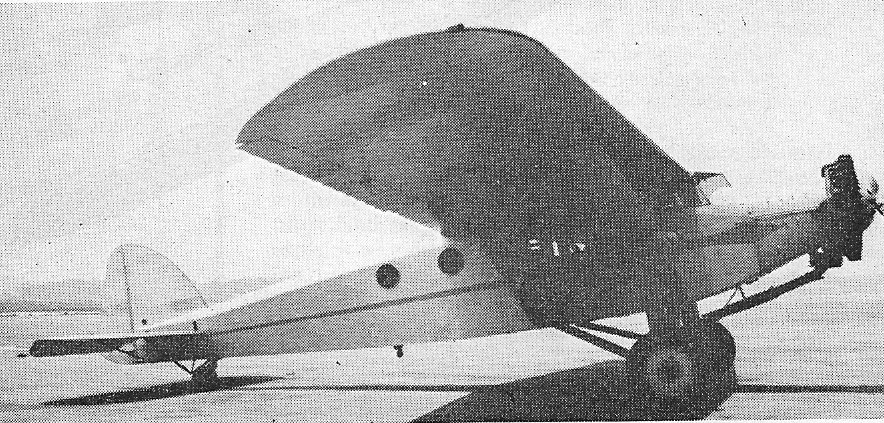
The Morton L. Bach Model T-11-P is believed to be the only one of the thirty tri-motor Model 3-CT-S/’5/’6/’8/’9/’9K and ‘9S six-ten-seaters converted (in the summer of 1934) to a single radial.
Engine: Pratt & Whitney Hornet A, 525 hp
AUW: 7000 lb
Empty weight: 4175 lb
Crew: 2
Passengers: 6-8
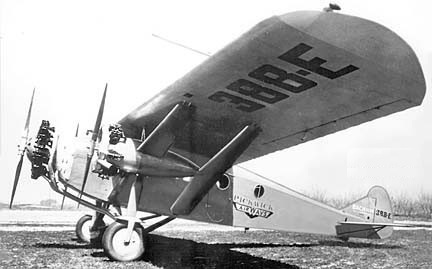
The Bach Air Yacht of 1928 was a three-engined commercial transport with a maximum capacity of two crew and ten passengers.
The first Air Yacht was the 1928 N5082 c/n 1. Three more in the registrations are identified only as Air Yacht with no model designation: N3534 c/n 1 had a J-5 + two Kinners; N3997 c/n 1 had one Wright J-5 + two Siemens; N4184 shows nothing but a c/n 2.
1928 3-CT-2 Air Yacht NC7065 c/n 1 was a 10-place powered by one Wright J-5 + two 100hp Ryan-Siemens.
In 1928 two 3-CT-4 Air Yacht were built; NC7657 c/n 3 and N7658 c/n 4. Powered by one P&W Wasp + two 100hp Ryan-Siemens, both were 10-place.
The sole 3-CT-5 Air Yacht, built in 1929, NC7092 c/n 2 received ATC 2-98 and was powered by one 450hp P&W Wasp + two 130hp Comet. It too was 10-place.
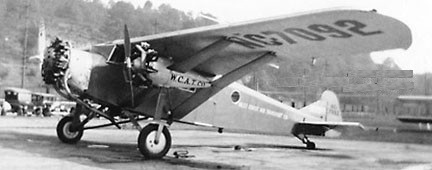
The 1929 3-CT-6 Air Yacht (ATC 114) sold for $39,500 powered by one 525hp P&W Hornet + two 130hp Comet. A 12-place, five were built for Pickwick Airways (N219H c/n 10, N302E c/n 6, N388 c/n 5, NC539E c/n 7, and NC850E c/n 8 c/ns.
N19H and N388 were rebuilt into a single-engine, the latter as a sesqui-wing banana-duster with an added smaller lower wing. Used in 1933 in Honduras by United Fruit Company, registered XH-TRA.
Interesting is that N388E, pictured at top and shown in Summer 1967 AAHS Journal, is not in the registers—that number is worn by an Arrow Sport.
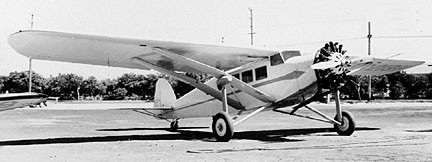
Four 10-place 3-CT-8 Air Yacht (ATC 172) were built in 1929 NC53M c/n 16, NC54M c/n 17, NC245K c/n 15, and NC8069 c/n 11. They were priced at $39,500.
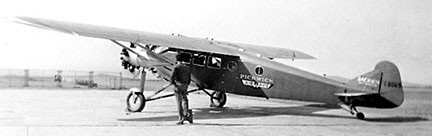
The 1929 10-place 3-CT-9 Air Yacht (ATC 271) was powered by one 450hp P&W Wasp + two 225hp Wright J-6-7 engines and priced at $39,500.
At least three were built; NC511V c/n 21, NC520M c/n 18, and NC809M c/n 19.
ATC 2-175 was for one conversion to 7-pace Special NC809M.
The 3-CT-8 set a new altitude record, and the first ever for tri-motors, on 26 July 1929, carrying a 1000-kilo load (2220 lb) to 20,820′ piloted by Waldo Waterman), and two CTs came in first and second in multi-engine speed competition at the 1929 Nationals, piloted by William Brock and Waldo Waterman.
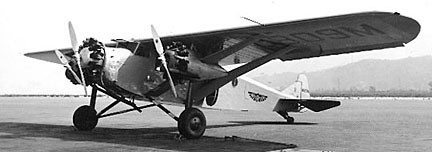
In 1931 two 3-CT-9K Air Yacht (ATC 2-376) were built; NC12206 c/n 22 and NC12297 c/n 23. 10-place, they were powered by one 420hp P&W Wasp B + two 210hp Kinner C-5.
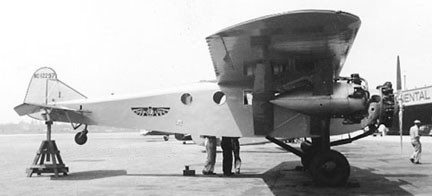
The 1930 3-CT-9S Air Yacht (ATC 299) was a Deluxe “executive” version of 3-CT-9 with cowled engines (PW Wasp + two Wright R-760), wheel pants, and customized interior, priced at $40,000+. ATC 2-179 was superseded by ATC 299. One was built; NC317V c/n 20.
One 3-CTS Air Yacht built in 1930 NC2830 c/n 8 (ATC 2-104), was a 3-CT-8 modified with 450hp P&W Wasp + two 220hp Wright J-5 engines.
Air Yacht
Engines: 1 x J-5 + two Kinners
Air Yacht
Engines: one Wright J-5 + two Siemens
3-CT-2 Air Yacht
Engines: one Wright J-5 + two 100hp Ryan-Siemens
Seats: 10
3-CT-4 Air Yacht
Engines: one P&W Wasp + two 100hp Ryan-Siemens
Seats: 10
3-CT-5 Air Yacht
Engines: one 450hp P&W Wasp + two 130hp Comet
Seats: 10
3-CT-6 Air Yacht
Engines: one 525hp P&W Hornet + two 130hp Comet
Wingspan: 58’5″
Length: 36’10”
Useful load: 3261 lb
Max speed: 154 mph
Cruise: 126 mph
Stall: 60 mph
Range: 600 mi
Seats: 12
Price: $39,500;
3-CT-8 Air Yacht
Engines: one 525hp P&W Hornet + two 165hp Wright J-6
Wingspan: 58’5″
Length: 36’10”
Useful load: 3195 lb
Max speed: 157 mph
Cruise: 133 mph
Stall: 60 mph
Range: 590 mi
Seats: 10
Price: $39,500
3-CT-9 Air Yacht
Engines: one 450hp P&W Wasp + two 225hp Wright J-6-7
Wingspan: 58’5″
Length: 36’10”
Useful load: 2990 lb
Max speed: 162 mph
Ceuise: 136 mph
Stall: 60 mph
Range: 525 mi
Price: $39,500
Seats: 10
3-CT-9K Air Yacht
Engines: one 420hp P&W Wasp B + two 210hp Kinner C-5
Seats: 10
3-CT-9S Air Yacht
Engines: PW Wasp + two Wright R-760
Useful load 2807 lb
Range: 600 mi
Price: $40,000+
3-CTS Air Yacht
Engines: one 450hp P&W Wasp + two 220hp Wright J-5
Wingspan: 58’5″
Length: 36’10”
Seats: 12
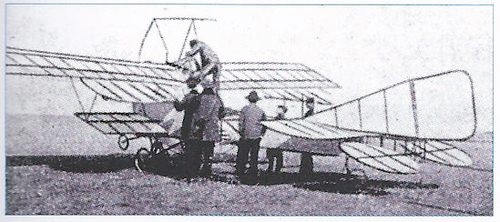
The 1910 Monoplano, designed by Ing. Omero Bacchiega of Tortona (midway between Genova and Milano), was constructed of beech and bamboo with metal rods for added strength. It was fitted with a 25 hp Anzani engine, driving a 2 meter diameter propeller.
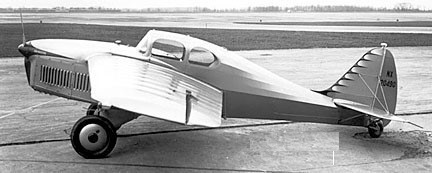
The 1928 LC-11 Cadet was developed by Verne Babcock from his original concept from 1921.
A single place, open cockpit, mid-wing monoplane, power was from a 55hp Clark engine.
Three were built: N551E / cn 502, N889E, and NX7997 / cn 501. Two were built by Taubman, possibly with 90hp LeBlond, the last was Babcock-built and possibly refitted with 90hp Franklin.
Engine: 55hp Clark
Wingspan: 30’0″
Length: 19’0″
Loaded weight: 500 lb
Speed: 100 mph

