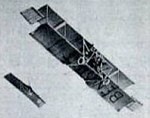
The 1911 Benoist Headless pusher biplane (land and seaplane) was designed by Thomas W. Benoist and built by Benoist Aircraft Co in St. Louis, USA. They were priced at US$ 3950- land; US$4150- with float.
Span: 30′
Length: 22’6″
Range: 180 miles
The 1911 Benoist Headless pusher biplane (land and seaplane) was designed by Thomas W. Benoist and built by Benoist Aircraft Co in St. Louis, USA. They were priced at US$ 3950- land; US$4150- with float.
Span: 30′
Length: 22’6″
Range: 180 miles
USA
Known originally as the Aeronautic Supply Company, and established at St Louis, Missouri; built in 1914 a small biplane flying-boat known as the Benoist XIV Air-Boat. Power plant comprised a 70 hp Sturtevant or 75 hp Roberts engine driving a pusher propeller.
The company ceased operations soon after Benoist’s death in 1917.
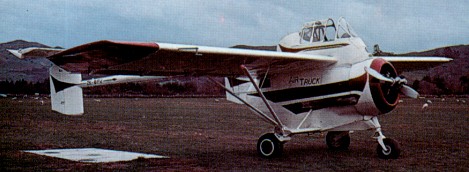
The Te Kuiti Airtruck project was a collaboration of ideas between Jack Worthington, owner of Northern Air Services, his engineer Snow Bennett and Australian aircraft designer Luigi Pellarini in early 1957.
Luigi Pellarini was familiar with the requirements of aerial topdressing operators and had worked on several designs, including the PL-7 Air Tanker.
Plans started arriving in Te Kuiti in early 1957 and construction of components began.
The idea was to build a hopper with a stub wing and attachment points for wings and the engine. The design was unusual in having no rear fuselage or conventional tailplane, the T-tail being mounted on booms attached to the wing and well away from the trail of corrosive superphosphate. To help reduce the cost, two retired Harvard trainers were bought from the Government Stores Board for component recovery.
It soon became apparent that a large number of Harvards would soon be up for tender and engines, propellers and various other items could be used in building a fleet of aircraft to replace the Cessna 180s then in service. The main wheels are from the Harvard and the separate tail units are interchangable. Pellarini then designed a larger aircraft powered by the 600hp Pratt & Whitney R 1340 radial as fitted to the Harvard. At this point the project became twin tailed.
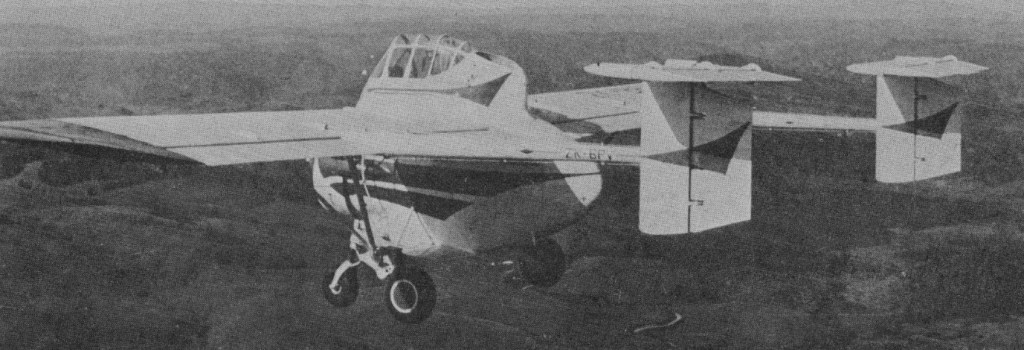
Work began in earnest in late 1957 and by October 1959 all major work had been completed. The aircraft was then disassembled at the airport and re-assembled upside down at a workshop in the town. The wings and tail components were loaded with bags of cement as part of the static load requirements and, once this test was passed, everything was returned to the airfield at Te Kuiti for reassembly and completion.
The civil aviation authorities placed many requirements on the builders Because Pellarini had been radical in his ideas and introduced some well thought out and well-designed parts, the Civil Aviation Department came up with equally novel ideas of testing them. One of the requirements was to taxi the aircraft at speed over railway sleepers.
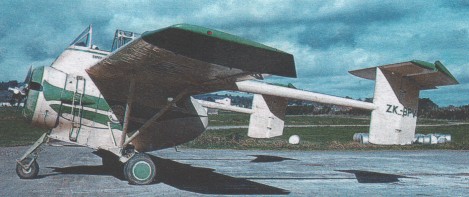
Throughout the construction the builders had the support of the NSW Branch of Civil Aviation in Australia, so the men from Te Kuiti knew they were on the right track.
On 27 April 1960 the PL-11 Airtruck took to the air, but just short hops as a test to see if there was any deflection in the tail booms. Again the aircraft passed the test and it finally flew as ZK-BPV on Tuesday 2 August with “Johnny” Johnstone at the controls. After a 35minute flight he returned and, with a thumbs up signal, shut the new topdresser down.
What he had flown was the first commercial aircraft to be built in New Zealand.
In 1959 Geoff Young joined the company and in October some of the staff travelled to Christchurch to dismantle and recover Harvard components.
By 1961 Pellarini had left the project and Geoff Young took over the design work in 1962. A number of components had to be redesigned and he took on this work. In the meantime, after a series of test flights at Ardmore, the Airtruck completed its first topdressing job at Te Kuiti in February 1961. Another eight hours of flight testing at Ardmore was completed in July and at the end of the year the aeroplane was taken out of service for modifications.
ZK-BPV didn’t fly again until April 1963, by which time Waitomo Aircraft had been formed. Considerable interest had been shown in the aircraft and the company started on component manufacture. What looked a bright future at last for the Airtruck came to a halt when Jack Worthington wrote off ZK-BPV at Ngapaenga on 8 October 1963. The aircraft was found not to be at fault and its unusual design probably saved Worthington’s life.
Waitorno Aircraft then set to work on a second aircraft and ZK-CKE was test flown by Jack Worthington on 9 February 1965. Other than cosmetic changes to the canopy and hopper mouth, the aircraft was the same as ZK-BPV but had to go through another series of test flights. By this stage Northern Air Services had sold out to Rural Aviation and with Geoff Young leaving at the end of 1964 the testing programme was taken on by Rex Aviation (NZ) Ltd.
ZK-CKE finally gained the Certificate of Type Approval on 17 February 1966. Leased to Rural Aviation (1963) Ltd, it was based in Te Kuiti, flown by Don Erceg, and at Taumarunui with pilot Peter Meek.
On 26 September 1966 a new company was formed, Commercial Aircraft Company (NZ) Ltd, with the idea of putting the Airtruck into production at Ardmore. An attempt to raise capital later in the year failed, mainly because of a serious downturn in wool receipts and the aerial ag industry suffering a serious slump.
In 1967 ZK-CKE was leased to Barr Bros Ltd and within a few weeks was written off at Mangakaramea, taking the life of Dick Tatham on 1 March 1967. For the second time, the accident cause was no fault of the aircraft.
It had been down to local business people of Te Kuiti – Jack Gardener who believed in the project and Jack Worthington and his pilots – who worked to fund the new aircraft. Engineers Snow Bennett, Geoff Young and later Jack Frost pushed on with the details and the hangar staff built the aircraft.
In the end both aircraft had flown a combined total of over 1000hr.
Engine: P&W R-1340-AN-1, 550 hp.
Wing span: 48 ft 0 in (16.3m)
Wing area: 369 sq.ft
Lower mainplane spanned: 11 ft 3in
Maximum height: 10 ft 10 in (3.3m)
Fuselage length: 14 ft 3in
Overall length: 25 ft 8 in (7.82m)
Height: 10 ft 10 in
Empty weight: 37001b (1678kg)
Maximum all-up takeoff weight: 72001b (3266 kg)
Max speed: 164 mph at SL
Econ cruise: 124 mph
Range: 450 miles

Replica Granville brothers’ R-2
Engine: P&W R-985 Wasp Jr, 450 hp
Span: 25 ft
Wing area: 102.2 sq.ft
Aspect ratio: 6.1:1
Length: 17 ft 9 in
Empty wt: 2150 lb
Gross wt: 3100 lb
Max level speed: 257 mph
Fuel cap: 66+38 USG
Root chord: 53 in
Wing incidence: 2.5 deg
Dihedral: 4-5 deg
Wheel tread: 76 in
Max fuse diameter: 61 in
Airfoil: 65% thick M-6
Tail span: 8 ft
Tail area: 15.5 sq.ft
Vertical tail area: 13.5 sq.ft
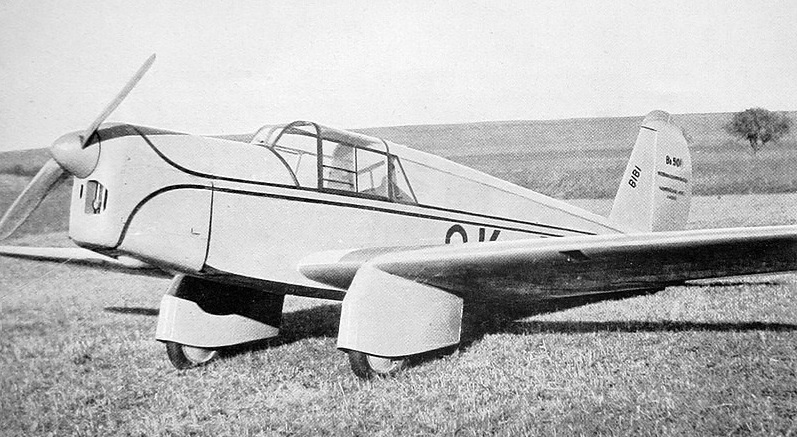
Designed by Pavel Beneš, the Beneš-Mráz Be-500 Bibi, Be-501 and Be-502 were Czechoslovak single-seater sports aircraft which were manufactured by Inž. P. Beneš et al. J. Mráz in 1936, at Choceň.
They were small single-seater aircraft with low fuel consumption. The dimensions differed minimally, and were equipped with different Walter engines. The Walter Atom engine was to be tested on the Be-500 prototype (but the prototype was not completed), the 20 cm longer Be-501 version had the Walter Mikron II engine (modified to fit a cylinder capacity of 2 l) and finally the Be-502 version. of the same length as the prototype Be-500, was equipped with the most powerful Walter Minor 4 engine. Both aircraft were specially built to participate in the 12-hour race in the city of Angers.
Shortly after the completion, the Be-501 and Be-502 successfully participated in the “12 heures d’Angers” race in France, when Josef Kalla and Karel Mareš won in their categories.
The aircraft was designed as a low-wing monoplane with a covered cabin. The self-supporting, wooden wings were complete and were inserted into the lower part of the fuselage. In the wooden, veneered fuselage, the cockpit was located in front of the main wing longitudinal. The cabin was accessible by opening most of the top cover and behind it was space for smaller luggage. The rudders were controlled by ropes, the ailerons by a rigid system of rods. The wide vertical tail surfaces were self-supporting, the rudder of which was somewhat cut above the continuous elliptical horizontal tail surface. The rudder with the keel surface has been moved forward to achieve favorable properties in the corkscrew.
The undercarriage with “trouser” covers, consisting of two separate parts, was fastened to the main wing side member and sprung with rubber cords. The spur was made of steel, leaf springs. Various motors with an output of 20-95 hp (15-70 kW) could be installed in the engine bed of steel tubes.
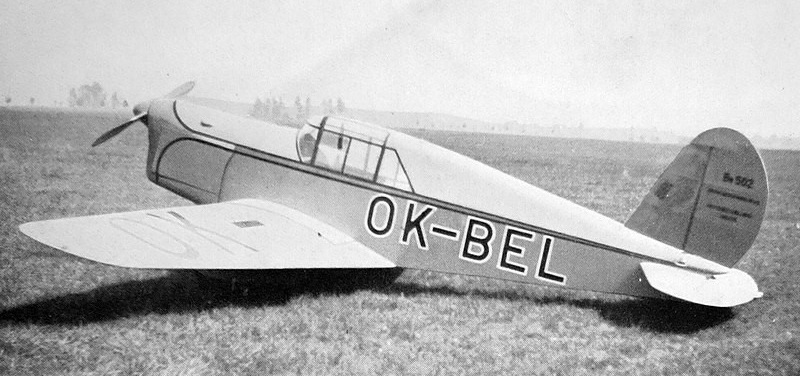
First flying in 1936, as of July 1, 1936, the Be-501 Bibi aircraft was assigned the registration mark OK-BEI and the Be-502 Bibi aircraft assigned the OK-BEL mark. In both cases, these were serial numbers 1. Both machines purchased by Aeroklub RČs. successfully participated in the race “12 hours of Angers” (12 heures d’Angers) in speed and reliability, organized by the West French Aeroclub in early July 1936. The machines and their pilots, Major Kalla and Lieutenant Colonel Mareš, gave their best, and they won in their categories. Major gen. no. Josef Kalla on the Be-502 Bibi won in the category of engine capacity up to 4 liters, when he flew 1229.04 km at an average speed of 204.04 km / h, and in the category up to 2 liters with a special Micron II Lt. Col. Karel Mareš on the Be-501 Bibi, when he flew 1001,968 at an average speed of 166,968 km / h. In the overall classification, regardless of the volume of engines, J. Kalla finished in 2nd place and K. Mareš in 6th place.
In May 1937, these aircraft completed high-speed flights of 100 and 1000 km. Pilot stkp. Štěpán with Be-501 on a shorter route reached a speed of 179.229 km / h and on a longer 170,809 km / h, on Be-502 a speed of 220.94 km / h was reached (ing. Šimůnek per 100 km) and 214.174 km / h (Capt. Pupil for 1000 km). In December 1937, Capt. Červinka on the Be-501 international altitude record 4658 m.
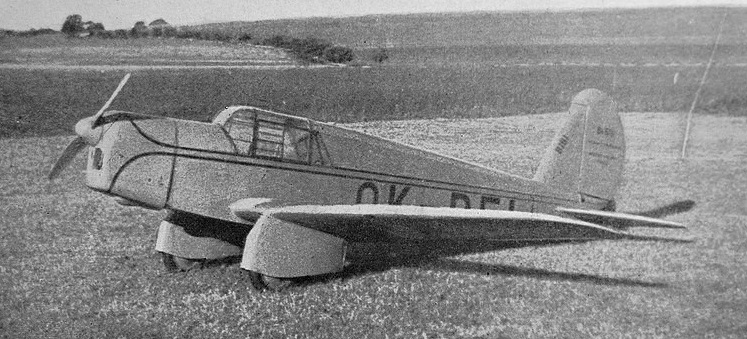
Further development of these aircraft did not continue, because the developers focused on the more advanced type Beneš-Mráz Be-550 Bibi, which was completed in late 1936. After the occupation of Czechoslovakia by Nazi Germany, the aircraft were used in Luftwaffe flight schools.
Be-500
Engine: Walter Atom, 18 kW / 25 hp
Propeller: two-bladed, wooden
Span: 8.5 m
Wing area: 9 m²
Length: 5.86 m
Height: 1.65 m
Empty weight: 170 kg
Max. takeoff weight: 285 kg
Wing load: 31.6 kg / sq.m
Cruising speed: 135 km / h
Max. ground speed: 155 km / h
Landing speed: 57 km / h
Range: 850 km
Ceiling: 4000 m
Climb to 1000 m: 9 min
Crew: 1
Be-501
Engine: Walter Mikron II, 33 kW / 45 hp
Propeller: two-bladed, wooden
Span: 8.5 m
Wing area: 9 m²
Length: 6.02 m
Height: 1.72 m
Empty weight: 340 kg
Max. takeoff weight: 600 kg
Wing load: 66.7 kg / sq.m
Cruising speed: 165 km / h
Max. ground speed: 190 km / h
Landing speed: 73 km / h
Range: 1700 km
Ceiling: 3300 m
Climb to 1000 m: 9 min
Crew: 1
Be-502
Engine: Walter Minor 4, 62 kW / 85 hp
Propeller: two-bladed, wooden
Span: 8.5 m
Wing area: 9 m²
Length: 5.86 m
Height: 1.65 m
Empty weight: 340 kg
Max. takeoff weight: 600 kg
Wing load: 66.7 kg / sq.m
Cruising speed: 200 km / h
Max. ground speed: 230 km / h
Landing speed: 87 km / h
Range: 1900 km
Access: 4000 m
Climb to 1000 m: 7 min
Crew: 1
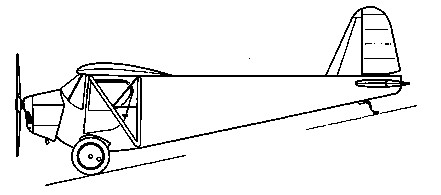
Sports Aircraft, Czech Republic, 1935
Engine: Walter Mikron II, 47 hp
Length: 21.818 ft / 6.65 m
Wingspan: 36.745 ft / 11.2 m
Wing area: 163.613 sqft / 15.2 sq.m
Max take off weight: 1080.5 lbs / 490.0 kg
Weight empty: 639.5 lbs / 290.0 kg
Max. speed: 81 kts / 150 km/h
Cruising speed: 67 kts / 125 km/h
Service ceiling: 11155 ft / 3400 m
Wing load: 6.56 lbs/sq.ft / 32.00 kg/sq.m
Range: 254 nm / 470 km
Crew: 2
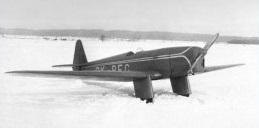
A 1936 aerobatic trainer
Aerobatics- and training aircraft, Czech Republic, 1936
Engine: Walter Major IV, 95 hp
Length: 23.163 ft / 7.06 m
Wingspan: 34.974 ft / 10.66 m
Wing area: 150.696 sqft / 14.0 sq.m
Max take off weight: 1808.1 lb / 820.0 kg
Weight empty: 1212.8 lb / 550.0 kg
Max. speed: 127 kts / 235 km/h
Cruising speed: 108 kts / 200 km/h
Service ceiling: 17060 ft / 5200 m
Wing load: 12.1 lb/sq.ft / 59.0 kg/sq.m
Range: 324 nm / 600 km
Crew: 2
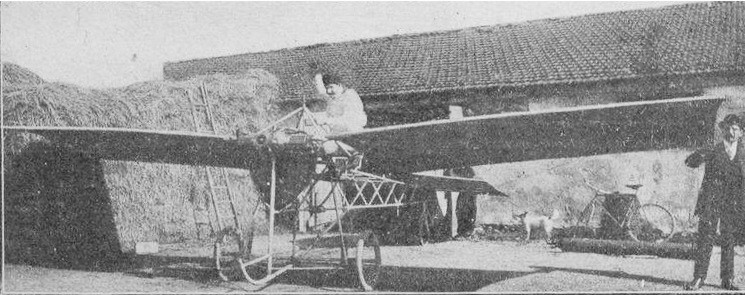
The Bénegent tractor monoplane had a triangular-section fuselage made of welded steel tubing, with the pilot seated on top. It was powered by a horizontally opposed two-cylinder water-cooled engine designed and built by the self-educated Joseph-Désiré Bénégent. The plane was tested at Courneuve outside Paris in late 1910.
Span: 26’3″
Length: 23′
Weight empty: 287 lbs
Speed: 56 mph
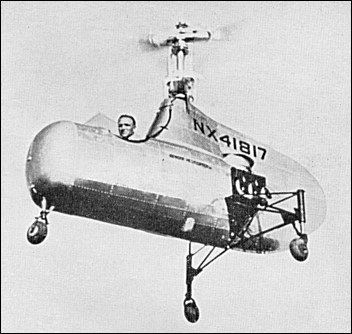
The Bendix Model J was followed by the Model K – with an enclosed tube and fabric fuselage but with a much smaller 100hp Continental C-100 engine. The Model K (NX41817) made its maiden flight in June 1945, but Bendix eventually ceased operations in 1949 without achieving certification.

