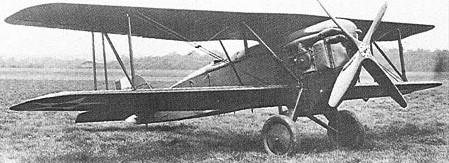
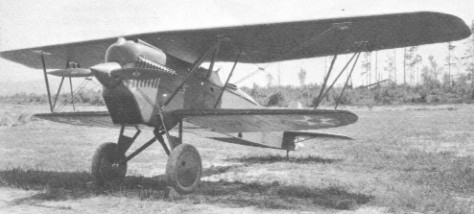
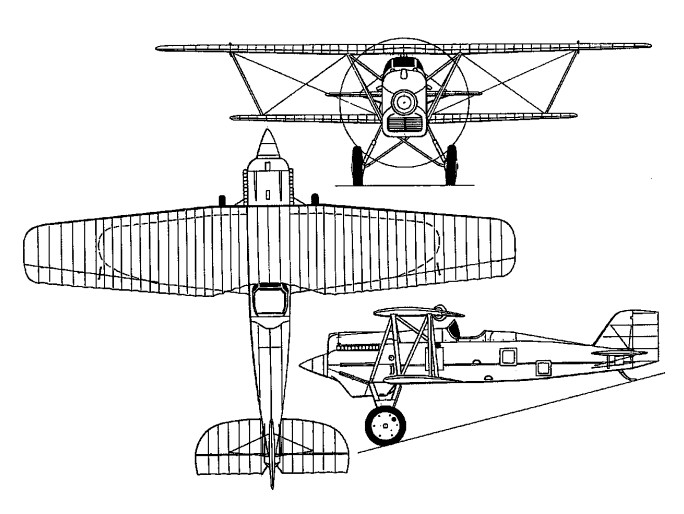
The last aircraft built by Boeing against an order for 30 PW-9 single-seat fighters was retained by the company at the request of the USAAC for trials with a turbo-supercharged version of the 510hp Packard 1A-1500 water-cooled engine (utilised by the FB-2). The USAAC also requested an increase in wing area, because of the higher weights involved, and while the standard PW-9 upper wing was retained, an enlarged lower wing was introduced, resulting in an equi-span biplane with vertical N-type interplane struts. The standard PW-9 armament of two 7.62mm synchronised machine guns was augmented by a pair of similar-calibre weapons mounted beneath the lower wing outside the propeller arc. With these changes the aircraft was designated XP-4 (Model 58), and delivered on 27 July 1926, but the 6.32sq.m increase in gross wing area by comparison with the PW-9 failed to compensate for the 370kg increase in loaded weight. The XP-4 proved to possess extremely unsatisfactory handling characteristics and after a few hours flying the test programme was abandoned.
Engine: turbo-supercharged Packard 1A-1500, 510hp Take-off weight: 1656 kg / 3651 lb Empty weight: 1262 kg / 2782 lb Wingspan: 9.75 m / 31 ft 12 in Length: 7.29 m / 23 ft 11 in Height: 2.69 m / 8 ft 10 in Wing area: 28.71 sq.m / 309.03 sq ft Max. speed: 259 km/h / 161 mph Range: 603 km / 375 miles
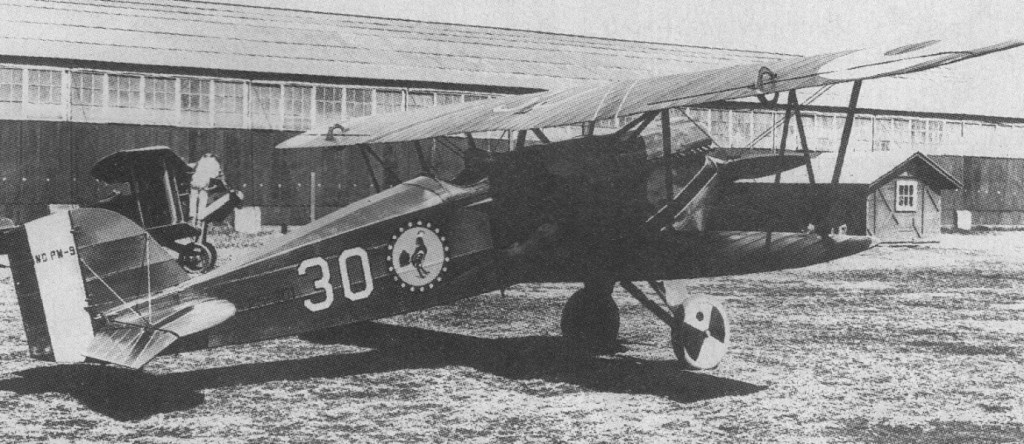
With experience gained from sub-contract production of a aircraft designed by other manufacturers, in particular, the Thomas-Morse MB-3A, Boeing began the private-venture development of a single-seat fighter under the designation Boeing Model 15. First flown on 2 June 1923, it was a single-bay biplane with wings of unequal span, the lower wing also being of reduced span and chord. The wings were of wooden construction, fabric-covered, but the fuselage was of welded steel tube. The braced tail unit was also of wood, and incorporated a variable-incidence tailplane that could be adjusted in flight. Landing gear was of fixed tailskid, with through-axle main units, and power was provided by a 324kW / 375 hp Curtiss D-12 inline engine. The design featured an underslung sloping core radiator with small frontal area, and an elliptical lower wing and tapered upper wing. The US Army became interested in the Model 15 before it was flown, and was evaluated by the US Army at McCook Field, under the designation XPW-9. It was flown in competition against a Fokker XPW-7 and Curtiss XPW-8A, wining an order for two extra XPW-9s for more extensive evaluation; these were delivered in May 1924. The third of the aircraft differed by having divided-axle instead of through-axle main landing gear units, and it was this type of landing gear that was chosen for the 30 examples of the production PW-9 ordered in two batches (12 and 18) in September and December 1925 respectively.
PW-9 25-301
The US Navy was as keen as the US Army to acquire examples of Boeing’s new fighter, and the first of an order of 14 for service with the US Marine Corps, under the designation FB-1, were delivered on 1 December 1925 to the shore-based fighter squadrons VF 1M, 2M and 3M. They were used in 1927 and 1928 by the US Expeditionary Force in China. Only 10 were produced as FB-1s, these being virtually identical to the US Army’s PW-9 (Boeing Model 15), having the same 435 hp Curtiss D 12 engine and two gun armament. The 11th and 12th aircraft on this order introduced the 380kW Packard 1A-1500 inline engine, and were equipped with through-axle landing gear and an arrester hook for operation from aircraft-carriers. The change resulted in redesignation by the US Navy to FB-2 (Boeing Model 53); the 13th aircraft was identical to the FB-2, except for twin, float landing gear, and was designated FB-3 (Boeing Model 55); and the 14th and last of the US Navy’s initial order also had twin floats, but introduced a 336kW Wright P-1 radial engine, becoming redesignated FB-4 (Boeing Model 54) or FB-6 with the 298kW Pratt & Whitney Wasp. The development ultimately led to the FB-5 produced during 1926-27. The FB 5 for the US Navy (Boeing Model 67), differed from the FB 1 in having a 520 hp Packard 2A 1500 engine, increased wing stagger, and a balanced rudder. Twenty seven were deli¬vered in January 1927 to Marine fighter squadrons VF 1B and VF 6B for service aboard the Langley.
Boeing Model 15 / XPW-9 Engine: 324kW / 375 hp Curtiss D-12 inline
Boeing Model 15 / PW-9 / FB-1 Engine: 435 hp Curtiss D 12 Span: 9.75 m (32 ft) Length: 7.14 m (23 ft 5 in) Empty Weight: 1,936lbs (878kg) Maximum Take-Off Weight: 3,120lbs (1,415kg) Maximum Speed: 159mph (256kmh; 138kts) Maximum Range: 390miles (628km) Service Ceiling: 18,924ft (5,768m) Armament: 1 x 7.62mm mg, 1 x 12.7mm machine gun Accommodation: 1
PW-9C Engine: One 400 h.p. Curtiss D.12 Length 23.6ft (7.2m) Wingspan 32ft (9.75m) Weight 3,043 lb (1,380 kg) Seats: 1 Max speed: 163 mph (262 kph) Ceiling: 20,000 ft (6,000m) fully loaded.
Boeing Model 53 / FB-2 Engine: 380kW Packard 1A-1500 inline Length 23.6ft (7.2m) Wingspan 32ft (9.75m) Seats: 1
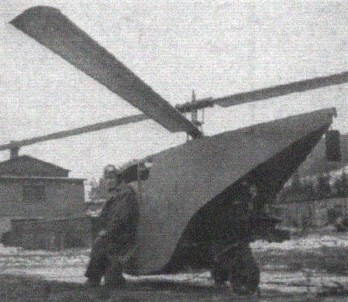
A coaxial-rotor light helicopter built by Bodo Franke of Cologne in 1958. A three-seater, it has a 105hp engine and was expected to sell for DM 65,000.
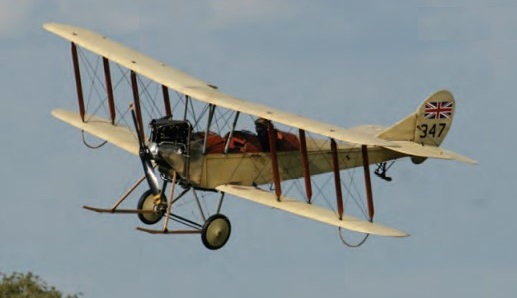
A full-size replica of the 1918 Royal Aircraft Factory BE.2c was built at Sywell, UK, for a ‘Biggles’ film in 1968 by Charles Boddington using Tiger Moth components and a Gipsy Major 10-1.
Registered G-AWYI cn 1 it flew with the serial 2984.
It was later sold in the USA as N1914B.
Engine: Gipsy Major 10-1 Wingspan: 37.00 ft Length: 27.03 ft
The Military monoplane designed by Ing. Philipp Enders [System Enders] was announced in Flugsport 1911 to be constructed by the Flug Technische Gesellschaft Nürnberg-Fürth E.V., yet in the same issue a drawing infers that it was to be constructed by the Nürnberger Motoren und Maschinenfabrik. In the end the steel-constructed machine was exposited in the Berlin ALA (Algemeinen Luftfahrt Ausstellung) 1912 as a finished machine of the Bayerische Motoren- und Flugzeugwerke Nürnberg.
The third monoplane of the BMFW, it was powered by a 50/55 hp BMFW Sylphe engine of own design.
The first design of Enders dated from 1910 and had steel tube holding the elevator / rudder and the pilot sitting Grade-wise beneath the wing in a sort of bathtub construction.
This simple high-wing monoplane with its characteristic tuning-fork like steel-tube fuselage was the first aircraft built by the BMFW (Bayerische Motoren- und Flugzeugwerke) in Nürnberg. It is also known as Philipp Enders monoplane. Enders was manager of the BMFW and equipped his first monoplane with a three-cylinder engine of own design.
In 1956 after restrictions on aircraft construction in Germany were lifted Walter Blume produced, a modernized version of the Ar 79. The canopy was extended rearward, the fin was replaced by a more modern form, the wing replaced by an all metal wing and the landing gear replaced by a tricycle undercarriage. The original Hirth engine Hirth being no longer available, was replaced by the Lycoming O-320.
A four-seater with straight-tapered flying surfaces, there are wingtip fairings to increase the effective aspect ratio and boundary-layer fences between the centre-section and outer wing panels. Two fuel tanks are in the wing centre section, one on each side of the fuselage.
Engine: Lycoming 150 hp Wingspan: 34 ft 5 in Length: 26 ft 9 in Height: 7 ft 10.5 in Empty weight: 1350 lb Loaded weight: 2337 lb Max speed: 149 mph at SL Cruise: 133 mph Range: 630 mph Prop: 2 blade variable pitch Seats: 4
In 1998 a retired Neurological-surgeon, Dr. Jack Barlass, approached Blue Yonder to build him a nostalgic War Bird. He had about 450 hours flying in the RCAF at the end of World War 11 and wanted to re-live some of those treasured flying memories. Our first reaction was to build something really different and suggested building a airplane that looked like the Japanese Zero. He thought that would be all right, however the next day he decided on making it look more like a North American Harvard (T6 Texan). A few days later he had second thoughts about having a tail dragger because at 72 years of age he was not sure he wanted the added pressures associated with tail dragger flying. Our new suggestion was to come up with something that looked like an Aerocoupe. It would not have the War Bird look but would be a very safe and stable cantilever wing airplane. He accepted the idea, but we could tell he was not thrilled. The next day, full of enthusiasm he said , “lets build a King Cobra.” Because of the success with the wing design and air foil of the Merlin and EZ Flyer it was decided that would be the air foil complete with yonkers ailerons, which work so well. The King Cobra look would come from the fin and rudder along with the canopy and to some extent the nose. Initially the engine to be used was the Rotax 503, 52 HP but when the time for fitting up the engine arrived Dr. Jack decided to put a new Rotax 618 in his EZ Flyer and move the Rotax 582 from his EZ Flyer to the new airplane. Hence, althought the craft was designed to fly on 52 HP it was now going to get 65. The C of G seemed to be moving further back, as design changes were being made. The day of final assembly came and a final Center of Gravity was determined. It was further back than liked, but on a prototype airplane and wing the only way to really tell how everything is going to work together is to wind tunnel test it or fly it. It was elected to fly it. With only 20 mph on the clock and some up elevator the nose wheel was comming off the ground. The large rudder gave very positive directional control with the nose wheel off the ground. With the nose wheel off the ground and about 35 mph on the dial it became airborne. The adjustable trim tab had enough allowance in it to allow hands off. True air speed at moderate cruise rpm was over 85 mph. The new airplane behaved normally in slow flight, as well as high speed flight of over 105 mph (TAS 112 mph). For the stall, at 30 mph the airplane burbled, broke and started flying again at about 35 mph. The airplane was handed over to its new owner, Dr. Jack, who several months later passed away with cancer after putting over 50 hours on his new airplane. Blue Yonder bought the airplane from the Estate and put it into full production. From date of order a kit can be available in ususlly 6 to 8 weeks. LSA legal.
Engine: Rotax 582, 65 hp Hp range: 65-100 Top Speed: 120 mph. Cruise Speed: 90 mph. Stall Speed: 30 mph. Rate of climb: 900 fpm Fuel Capacity: 24 USgal. Range: 620 sm. Takeoff Distance: 150 ft. Landing Distance: 225 ft. Service Ceiling: 14,000 ft. Empty Weight: 543 lbs. Gross Weight: 1200 lbs. Height: 6 ft. Length: 21 ft. Wingspan: 27 ft. Wing Area: 158 sq. ft. Number of Seats: 1 Cockpit width: 30 in