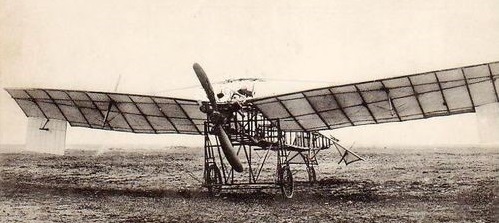
This monoplane was designed by Belgian engineer Albert Bracke, assisted by Monsieur Misson. The date is estimated as 1912-1913. Its engine was a 40 hp Anzani driving a 2.15 meter Chavière propeller
Built by Beech Engineer Jack W Bowyer who drew the plans and along with his wife who bucked a vast majority of the rivets. They built it in their shop on weekends and evening while he worked at Beech. He also designed and constructed the prop.
A pure flying wing design construction was completed in late 1963 or early 64.
It first flew during 1964 with the registration N5401E. It flew several times out of an airport in Newton, Kansas. The aircraft was damaged in a landing accident and not rebuilt.
It is now in a hanger in southwest Missouri where the original builder is working once again on restoring it to the original condition, although he has no plans to fly it.
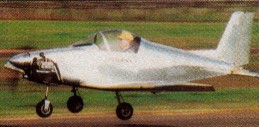
The X-Wind was a one-of-a-kind homebuilt of Mr. Jack Bowling and it first flew in 1974. The aircraft had a 80hp Continental A80 engine and featured a corrugated aluminum fuselage and tail covering, not unlike that of early Junkers. The aircraft had wings taken from a Luscombe 8. The registration N6379 was cancelled in 2012.
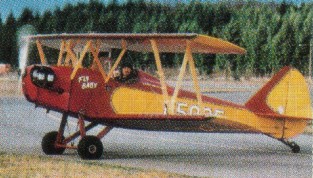
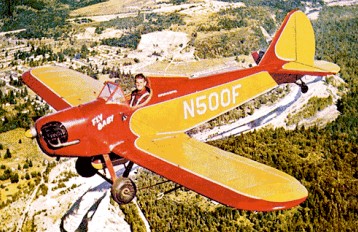
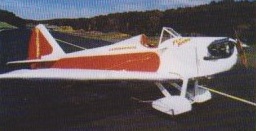
The prototype Fly Baby 1 B biplane, which first flew in 1969, could be converted from monoplane to biplane in around an hour. The two monoplane wing panels are replaced by four smaller ones, plus a center section for the top wing. The biplane wings take longer to build, since there are four panels and a center section, and they’re swept rather than straight. And there are some internal braces and external tangs that have to be added to the fuselage. This can be done after the fuselage is done (The prototype was converted after completion), but it is easier during construction. The biplane is slower, and the wings don’t fold.
In monoplane or biplane configuration, the Fly Baby does meet the US rules for Sport Pilot. In the United States, you do not need an FAA medical to fly a Fly Baby.
This plane is a structurally simple and easy-to-fly airplane designed to the requirements of the Experimental aircraft Association for home construction and storage in a space 7 x 8 x 20 feet, which is equivalent to the standard home garage. Great emphasis has been placed upon safe flight characteristics and good low speed performance for takeoff and landing at some sacrifice of high speed. The structure has been designed for standard airplane engines from 65 to 85 horsepower and the aerodynamic features are of sizes and proportions suited to obtaining the best all-around performance in this power range. Because of this, there is not enough advantage to be gained from using engines of significantly higher power to offset the cost and weight penalties. Increasing the power to increase the aerobatic capability is not recommended. Fly Baby will do simple recreational aerobatics very well but is not intended for rough air show or competition maneuvers.
Originally designed in 1960 by former Boeing engineer Peter Bowers to compete in the first EAA design competition, the Fly Baby is a single-seat, open cockpit, folding-wing monoplane powered by engines ranging from 65 to 100 hp. It is built primarily of wood, with fabric covering. It’s got a big cockpit as Peter Bowers is six feet two inches tall. First flown in 1960 the Fly Baby 1-A single place monoplane won the 1962 EAA competition for the best amateur plane with a C-85 engine. The Fly Baby has the distinction of being one of the most enduring designs in the homebuilt field. It has been tested with floats and in 1968 was fitted with biplane wings which were interchangeable with the single wings. The wings are a wooden structure covered with Dacron fabric, and the fuselage is a conventional plywood-covered wooden structure with a single open-cockpit seat. Plans were made available to amateur constructors.
Most are powered by Continental A-65, C-75, C-85, or O-200 engines. The 100 hp Continental is recommended over the 85 hp engine as it is only 13 pounds heavier, and gives a cruise speed of 92 knots with a two-blade fixed-pitch propeller. The fully aerobatic aircraft has a 22 foot wingspan and is 19 feet long. It will climb at 700 fpm and weighs 651 lbs empty with a MAUW of 972 lbs.
The prototype Fly Baby 1 B biplane, which first flew in 1969, could be converted from mono¬plane to biplane in around an hour. The two monoplane wing panels are replaced by four smaller ones, plus a center section for the top wing. The biplane wings take longer to build, since there are four panels and a center section, and they’re swept rather than straight. And there are some internal braces and external tangs that have to be added to the fuselage. This can be done after the fuselage is done (The prototype was converted after completion), but it is easier during construction. The biplane is slower, and the wings don’t fold.
In monoplane or biplane configuration, the Fly Baby does meet the US rules for Sport Pilot. In the United States, you do not need an FAA medical to fly a Fly Baby.
This plane is a structurally simple and easy-to-fly airplane designed to the requirements of the Experimental aircraft Association for home construction and storage in a space 7 x 8 x 20 feet, which is equivalent to the standard home garage. Great emphasis has been placed upon safe flight characteristics and good low speed performance for takeoff and landing at some sacrifice of high speed. The structure has been designed for standard airplane engines from 65 to 85 horsepower and the aerodynamic features are of sizes and proportions suited to obtaining the best all-around performance in this power range. Because of this, there is not enough advantage to be gained from using engines of significantly higher power to offset the cost and weight penalties. Increasing the power to increase the aerobatic capability is not recommended. Fly Baby will do simple recreational aerobatics very well but is not intended for rough air show or competition maneuvers.
Bowers recommends Continentals between 65 and 85 horsepower. The Fly Baby isn’t a fast airplane so bigger engines don’t really give much. A reported Fly Baby which replaced the A-65 with a C-85, increased the cruise from 80 to 95 mph and his rate of climb from 500 to 1000 fpm.
Peter Bowers designed and built the prototype of the Namu II two seat aircraft, which first flew on 2 July 1975. The Namu, named after the famous whale, first flew in 1975. The side-by-side two-seater features an enclosed canopy, dual controls and conventional tailwheel type gear. Its low-wing configuration is constructed from wood, with Dacron fabric covering the wings and tail section and plywood covering the fuselage except for the rear decking. Fuel is carried in one main tank just aft of the firewall, and baggage is carried under and behind the seats. The Namu II has a three piece single-spar with spruce flanges and plywood webs. The leading edge torsion box is a sandwich of two sheets of aluminium with glassfibre cloth between, epoxy-cemented together and formed over plywood nose ribs. With a fixed undercarriage and wooden tail unit, all fabric covered. Another Namu II, with a different canopy, has been completed by Richard Lower and Tom Godbey of Seattle.
Engine: Lycoming O-290G, 125 hp, 93 kW Wingspan: 33 ft / 10.06m Wing area: 150 sq.ft / 13.9 sq.m Length: 21 ft 6 in / 6.55m Max tak off weight: 1850 lb / 839 kg Empty weight: 1200 lb / 544 kg Fuel capacity 32 USG. Max level speed: 140 mph / 225 kph / 122 kt Cruise speed: 126 mph / 225 kph / 109 kt Stall: 50 mph. Climb rate 950 fpm Service ceiling: 15,000 ft / 4570m Range max fuel: 500 miles / 434 nm / 804 km Baggage capacity: 45 kg / 100 lb
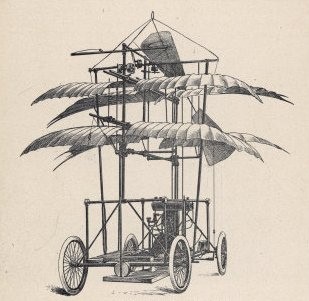
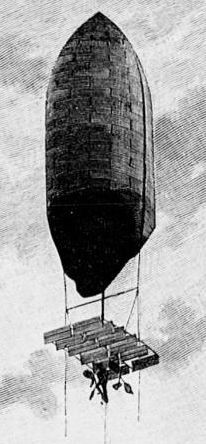
A Mr. Danilewsky hoped, thanks to a thorough study and to progressive improvements of his apparatus, to manage to do without the help of the balloon. It was also the hope of Mr. Firmin Bousson, who built and tested in 1900 an airplane suspended under an elongated cylindrical balloon, mounted on four wheels and operated by a petrol engine, is intended to roll on land like an automobile, or to fly in the air. Wheel tests were conducted at the Avron plateau in October 1900; hindered by bad weather they did not give positive and complete results.