The CM-44 was designed and built by Scaled Composites for California Microwave (CMI). The aircraft was a canard pusher which carried 700 lbs of electronic gear for surveillance. It was test flown by Michael Melvill in April 1987 and found to have a several winglet induced yaw problem that Scaled could not fix. Hollmann contacted CMI and promised to fix it. Dr. Ilan Kroo from Stanford, set up a lattice element model of the CM-44 and fixed the problem and improved the design. Hollmann at ADI designed new wings, winglets and canard for the CM-44. High Tech Composites built the molds and parts. It was test flown by CMI and found to be significantly better than the original design.
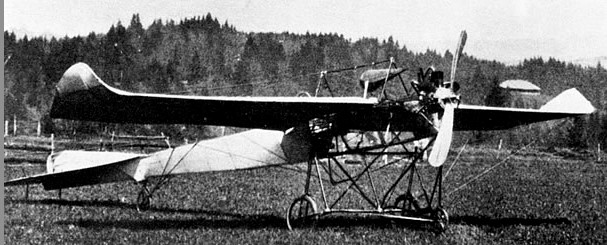
Georges Cailler, born in Vevey, Switzerland as the eldest son of Alexandre Cailler, founder of the well-known chocolate factory in Broc. He built four aeroplanes and flew them between Broc and Epagny. The parts of flying machines of Cailler were built by workers of the the chocolate factory. At the age of 18, he began construction of a biplane with the help of his friend Henri Magnenat from Lausanne, but their machine did not bring expected satisfaction. The trials with the new monoplane took eight days in spring 1910. The boys flew several hundred meters to a height of about 8 meters. They are believed to be the first Swiss aviators to fly a monoplane built entirely in Switzerland by Swiss. The machine is often attributed to Cailler alone.
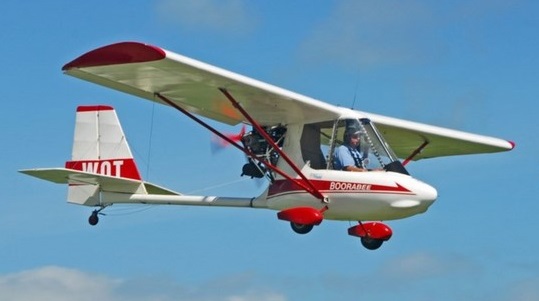
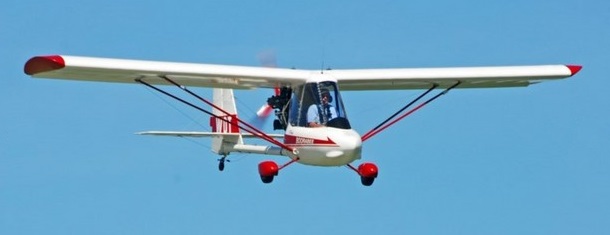
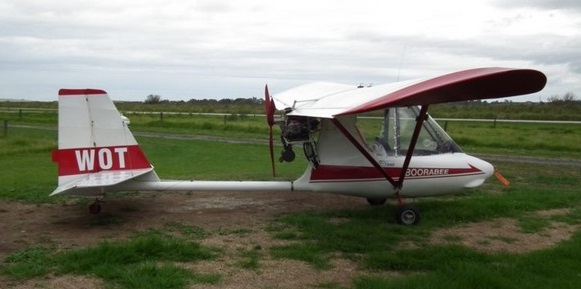
Tom Cadet designed and built the Mk1 Boorabee in 1992. The Mk1 Boorabees flew with a Rotax 503and the first aircraft has had at least 3 different engines including an HKS fitted in 2010.
The original fuselage pod mould for the Boorabee was made from the two halves taken from a crashed Rotec Panther, then modified by making the front more pointed and taking the aft section up to the wing. Tom also added a sheet alloy floor pan. A Maxair Drifter contributed the aluminium tube boom and empennage.
Dave Donohoe, a colleague of Tom Cadet, developed the Boorabee’s airfoil. This wing was mated to a new fuselage mould to use a 4 x 3 inch rectangular boom and Dave called the result the Shuttle. For the Boorabee’s wing, Tom used fibreglass/Kevlar ribs with a glass/Kevlar leading edge. The main spar caps are 40 x 1.6mm drawn alloy tubes with 1.2mm sheet web plates; the rear spar is a 44 x 1.6mm tube.
Boorabees are extremely docile aircraft with few if any vices. The Mk1s are really powered gliders without air brakes (better than 12:1 glide) they tend to float so it requires a special technique to spot land them.
Cadet built two Mk1 Boorabees then made new moulds and simplified the design for the Mk2.
Three versions of the Boorabee appeared. The Mk 1 has a 30ft wing span. That of the Mk 2 was reduced to 29ft, and a new mould was made to improve the shape of the fuselage pod. Alloy shear plates were used to simplify wing construction, and flaperons adopted. Kevlar was used extensively to lighten the aircraft. Both the first Mk 1 and Mk 2 were registered in 1993.
Mk1
A lengthened pod, offering more foot space for the rear-seat passenger, was introduced with the Mk 3, which also had the shorter wing.
The choice of powerplant was usually the Rotax 582 or 618. A Rotax 503 was used by Bob Evans of Evans Head for his Mk 2, completed as a single seater with a more rounded tail.
There were nine Boorabees built in total before Cadet gave the fuselage plug to Dave Donohoe who modified it for a rectangular boom tube. Dave’s Shuttle shared the same wing but the boom, tail, undercarriage and controls were vastly different. Cadet loaned the moulds to persons he trusted, and gave them the CAD plans at no cost.
For several years, Tom freely provided scale drawings to those interested in building a Boorabee, the use of his moulds, and builder support. A dozen or so Boorabees were completed by local builders.
Mk1
As with all pusher aircraft, the airflow around the rear of the fuselage was a problem, causing slight instability in yaw as well as reduced thrust from the propeller. After experiments on the Mk 1s a line of vortex generators on the fuselage immediately solved the issues. Because the two blades of the original propeller disturbed the air at the wing trailing edge in unison, resulting in uncomfortable vibration at certain speeds, a three-blade propeller was found to be necessary. Apart from these annoyances the Boorabee proved very successful, with hundreds of hours logged by each aircraft.
No more Boorabees were built because it required a great deal of effort by Cadet for builder assistance and it became very difficult to get the 5″ boom tube and necessary drawn tubing to build the wing. He still had the moulds years later.
The first Boorabee has flown thousands of hours.
Boorabee Mk1 Engine: HKS 700 E 60hp Wingspan: 9.2 m / 30 ft Length: 5.85 m Empty Weight: 284 kg Maximum Take Off Weight: 554 kg Fuel Capacity: 94 litres Never exceed: 90 Kts Cruise Speed: 60Kts Stall Speed: 30 Kts Take off roll: 200 meters Rate of Climb: 500 ft per minute Endurance: 10 hours Seats: 1
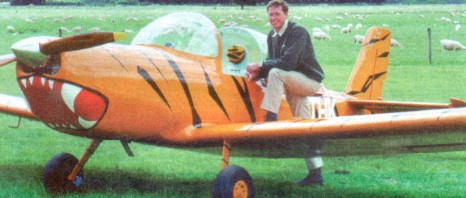
Of all-wood construction and covered with ceconite, the Tiger Hawk is finished with an Imron 700 paint system. All the design, fabricate and construction was carried out by Tim Bygate. This is no mean feat when you have to design each component before constructing it. The airframe contains a number of different timbers. Spruce was used for the spars, wing ribs, etc along with some Douglas Fir. The plywood covering found on the wings, turtle deck and seat was Birch and Hoop Pine. Tim found one of the trickier pieces to build was the Perspex canopy.
The Tiger Hawk was powered by an EA81 Subaru with a 2: 1 belt drive reduction system made by Cannings Engineering in Christchurch, New Zealand. The engine was stripped by Tim and measured for wear and tear and when reassembled it produced approx. 80 hp at 5400 rpm.
All construction was carried out in a small shed at the Hanmer Springs Forestry Camp in New Zealand by Tim Bygate, the designer. This shed kept expanding as the aircraft grew until finally on the completion the whole front of the shed had to be removed to enable the plane to be removed for its first flight on September 7, 2001.
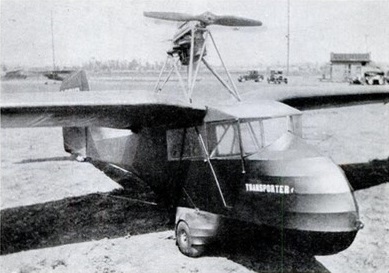
In 1935 Jay Buxton of Hawthorne, California, completed his Transporter powered glider. The engine is a 2 stroke inline, inverted type of unique design. It is a three cylinder, three port engine that weighs 115 lb and develops 35 hp at 2100 rpm.
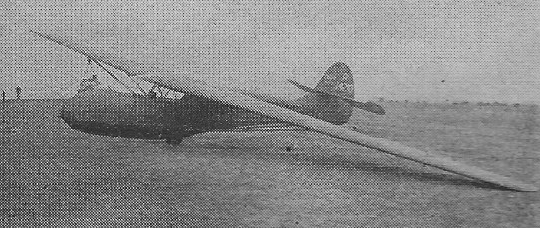
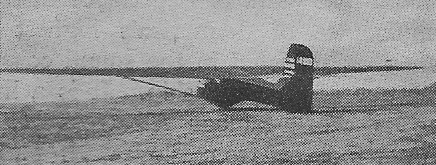
The motor cabane is completely removed and replaced by a plain cabane when used for gliding.